
Unknown's avatar

About Arcana

My name is Ben Hogwood, editor of the Arcana music site (arcana.fm)

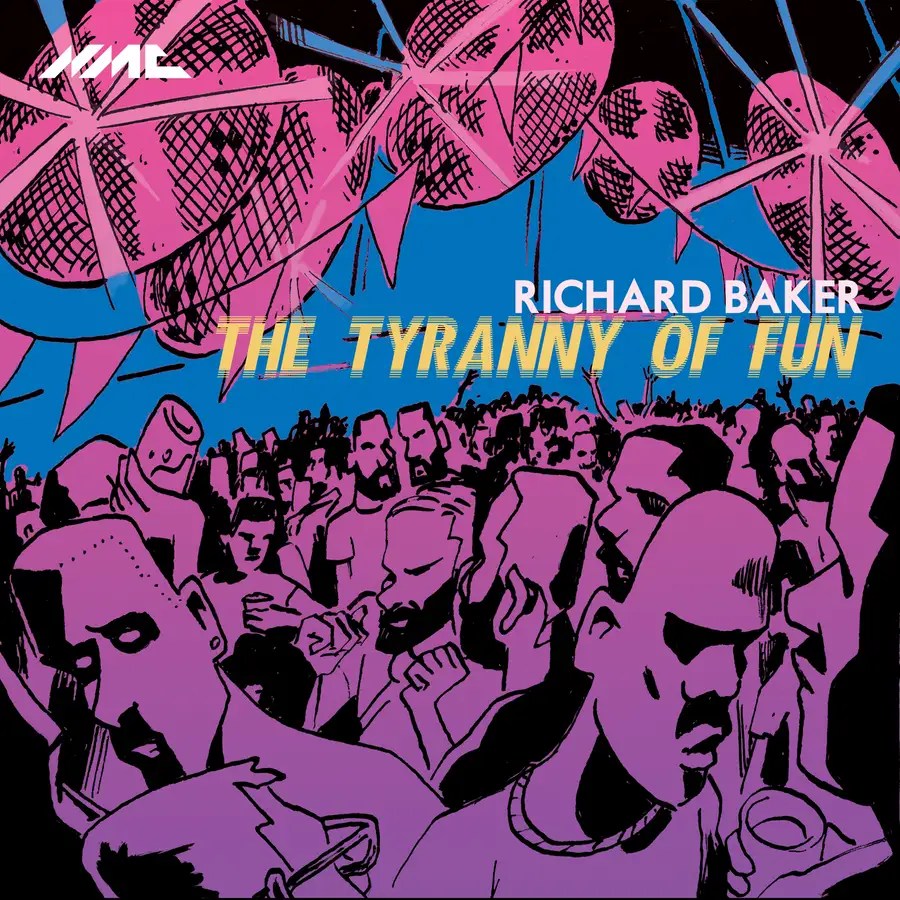
On Record – Richard Baker: The Tyranny of Fun (NMC Recordings)

Richard Baker
Crank (1994)a
Motet II (2020)b
The Tyranny of Fun (2012)c
Angelus (2004)d
Learning to Fly (1999)e
To Keep a True Lent (2001)f
Hommagesquisse (2008)g
Hwyl fawr ffriniau (2016, rev. 2020)h

hMelinda Maxwell (oboe); eOliver Janes (clarinet); bNye Parry (live electronics); aRichard Baker (diatonic music box); dThree Strange Angels (Richard Benjafield and Chris Brannick, percussion); fChoir of King’s College, Cambridge / Stephen Cleobury; bCHROMA Ensemble / Richard Baker; ceghBirmingham Contemporary Music Group / Finnigan Downie Dear

NMC D275 [60’37’’]
Producers/Engineers David Lefeber, fBen Collingwood
Recorded d19 April 2004 at St Giles’s Church, London; f29 February 2004 at Chapel of King’s College, Cambridge; b 4 August 2022 at Menuhin Hall, Cobham; cegh5 & 6 November 2022 at the CBSO Centre, Birmingham; a10 December 2023 at Parry-Williams Building, University of Aberystwyth

Reviewed by Richard Whitehouse

What’s the story?

NMC adds to its invaluable Debut Discs series with this timely release devoted to the music of Richard Baker, expertly realized by ensembles and musicians with which has been associated – not least the Birmingham Contemporary Music Group – whether as composer or conductor.

What’s the music like?

Prominent on the new music scene for over a quarter-century, Baker (b.1972) is equally well regarded as a conductor – notably for the German premiere of Gerald Barry’s The Triumph of Beauty and Deceit or the world premiere of Philip Venable’s 4.48 Psychosis – but he has built a select catalogue (published by Composers Edition), the variety of which is duly in evidence. BCMG has been central to his creative and executive work, so it is good to see this ensemble featured here – not least in two pieces commissioned as part of its Sound Investment scheme.

Baker was among numerous UK figures who undertook their postgraduate studies with Louis Andriessen, Crank being a whimsically oblique tribute in its unfolding of multiple pulses over a consistent tempo. The Dutch composer is also an influence behind Learning to Fly as takes its cue from those novels by Paul Auster for this compact concerto; the tonal range of basset clarinet tellingly to the fore in the eventful interplay of ‘Boisterous’, the subdued acceptance of ‘Somnolent’ and renewed animation of ‘Suddenly awake’ with its epiphanic closing phase.

Choral music features sparingly in Baker’s output, but his motet To Keep a True Lent captures Robert Herrick’s message unerringly. Hardly less affecting is his eliding between anxiety and repose in the dextrous percussion duo Angelus, while the punningly entitled Hommagesquisse serves as a laconic tribute to Pierre Boulez in alluding to his own music and that of others he advocated as conductor. Most substantial work here, The Tyranny of Fun draws on the notion of entertainment as distraction – hence escape – from the ambiguity of existence, along with a homage to Ravel (and Edgar Allen Poe) via Balanchine across two sections whose respective emergence and subsidence, then gradually accumulating energy outline a trajectory in which any tendency towards self-gratification is curtailed by vicissitudes of an encroaching reality.

The other pieces reflect aspects of Wales where Baker now lives. What translates as Goodbye Friends draws Edwin Christy’s song into a resourceful tribute, while Motet II makes reference to Welsh culture ‘then and now’ across six aphoristic movements understated yet provocative.

Does it all work?

Yes, inasmuch as this collection confirms the distinctiveness of Baker’s musical idiom across three decades of his composing. The recordings prove as assured as might be expected given these are artists with whom he has often collaborated, Oliver Janes taking time out as principal clarinettist of City of Birmingham Symphony Orchestra to demonstrate his prowess with the basset instrument, and Melinda Maxwell underlining why she has long been among the UK’s leading oboists. Gratifying too that a reading by the late Stephen Cleobury could be included.

Is it recommended?

Indeed, and those acquiring this release should be encouraged to investigate other of Baker’s works available from NMC – notably his breakthrough piece Los Rabanos (NMCD076), or his four diverse contributions to that label’s extensive download project Digital Discoveries.

Listen & Buy

To explore purchase options, visit the NMC Recordings website – and click on Richard Baker for his own website. Meanwhile for more on the performers, click on the names – Melinda Maxwell, Oliver James, Richard Benjafield, Chris Brannick, Nye Parry, King’s College Choir, Stephen Cleobury, Finnigan Downie Dear, CHROMA and Birmingham Contemporary Music Group

Published post no.2,130 – Wednesday 27 March 2024

Let’s Dance – Frank & Tony: Ethos (Scissor and Thread)

by Ben Hogwood

What’s the story?

Ten years on from their last appearance on a long playing format together, DJs Francis Harris and Anthony Collins renew their partnership with this collection of deep house cuts.

The idea was that Frank & Tony would connect for one night only on an imaginary dancefloor, vowing, in the words of the label, “to make work together in the future; however, having exchanged no information, and with classic club kid garb obscuring any common identifying characteristics, they turn to the internet in hopes of reconnecting for a collaboration.”

Since their first album, You Go Girl, the duo have taken part in all manner of collaborations, many of them under the Scissor and Thread umbrella, though here they use their own contact book to bring in a number of fellow artists. These include Eliana Glass, DaRand Land, Lawrence and DJ Aakmael.

What’s the music like?

Classy. Ethos fits into the duo’s observation that deep house music has evolved a great  deal since 2014, but in many ways it has been a point of stability. There has always been a need for new music in the genre, but often artists have been able to keep the stylistic features while producing quality new work.

Such is the case here. A warm wave breaks over Olympia, whose solid beat supports a beguiling vocal from Eliana Gloss. This is a heat-soaked track, crackling with atmosphere – a trick repeated later on with Cecile, with just a bit more breeze from the hi-hat.

DaRand Land joins for Ethos, an airy number with an active bass, while DJ Aakmael’s sultry collaboration Drift operates on the slower side, its minimal material spreading easily across the sonic sky. Too Poor For Movies, Too Tired For Love is a thoughtful number with Lawrence, its introspective mood countered by active keyboards.

The duo use fuller beats for their own tracks, upping the pace for By The End They Will, which features one of those keyboard pad sounds you could dive into. From Life Ahead is more languid, while Continuity breaks the beat and adds an effective spoken word sample.

Does it all work?

It does. This is the sort of music that seems to come effortlessly to Frank & Tony, but which is surprisingly hard to reproduce!

Is it recommended?

It is. An album of thoughtful deep house that comfortably does its job in also telling the feet to get that bit closer to the dancefloor.

For fans of… Miguel Migs, Kevin Yost,

Listen & Buy

Published post no.2,129 – Tuesday 26 March 2024

On Record – Kate Moore: Velvet (Heritage Records)

Ole Böhn (violin) (Heather, Dies Irae, Way of the Dead); Minah Choe (cello) (Velvet), Daniel Herscovitch (piano) (all) with Benjamin Kopp (piano) (The Body is an Ear)

Kate Moore
Zomer (2006)
Velvet (2010)
The Body is an Ear (2011)
Heather (2013)
Dies Irae (2015)
Way of the Dead (2017)
Lucidity: Eyes of Hands (2018)

Heritage HTGCD137 [79’38’’]
Producers Kate Moore, Daniel Herscovitch Engineers David Kim-Boyle, David Kinney Recorded 3 March, 8 August and 9 October 2023 at Verbrugghen Hall, Conservatorium of Music, Sydney

Reviewed by Richard Whitehouse

What’s the story?

Heritage rings the changes on its schedule of welcome reissues with this release of music by Kate Moore (b1979), Australian composer born in the UK who currently resides in the Netherlands, all played by a notable roster of musicians based at Sydney Conservatorium.

What’s the music like?

As the booklet notes make plain, any tendency to Minimalism in Moore’s music is rendered from a distinctly maximalist perspective. Hence an inexorable build-up of tension in the two-piano version of The Body is an Ear (initially for organ and recast for two such instruments), with its inspiration in Sufist legend, or growing plangency of Dies Irae where violin intones elements of that plainchant against some ominously undulating harmonies on piano in what the composer has aptly described as a ‘‘spiritual meditation on forgiveness and redemption’’.

Arguably even more revealing of Moore’s aesthetic is the title-track. Velvet draws cello and piano into a sustained and increasingly intense dialogue whose ostensible depiction of cloth in Renaissance painting yields great textural and colouristic diversity, while building toward an impassioned culmination from which the coda is more affecting for its brevity and pathos. Hardly less absorbing, Way of the Dead takes a not dissimilar formal trajectory – this ‘danse macabre’, as inspired by a Mexican festival, fusing melodic eloquence from the violin with an implacable rhythmic accompaniment on piano such as comes to the fore in those seismic final bars. At the opposite end of the scale in all senses, Zomer takes extracts from a sermon by John Donne for this piano rumination with the simple and profound artlessly combined.

The duo for violin and piano Heather takes its cue from the composer’s Hebridean hike – the incidence of vegetation growing in patterns according to outlines of now-vanished buildings effecting a piece where instrumental coordination becomes ever more exacting, as the music’s emotional velocity gradually while also remorselessly accelerates towards another of Moore’s reticent and poignant apotheoses. Lucidity: Eyes of Hands draws on the legend of St Lucie, as related by Dante, for a solo piano work whose polyrhythmic intricacy is in constant evolution as the music unfolds – though, on this occasion, there is no crystallizing of tension at the end; rather, the accrued impetus spills over into a forceful and even unnerving peroration to leave no doubt as to Moore’s identity with the narrative that made possible this piece’s conception.

Does it all work?

Yes, given that Moore’s is an arresting and appealing idiom, one whose outward consistency is countered by its variety of technical procedures along with its underlying expressive range. It certainly benefits from the advocacy of these musicians, their dedication and commitment coming across at every turn, while the clarity of recording emphasizes its visceral immediacy. Informative notes from the composer and Daniel Herscovitch. Those listening via download have an additional item – a Prelude for piano, whose limpid poise makes for a welcome tonic.

Is it recommended?

Indeed, and hopefully those who have acquired this Heritage project will investigate further releases of Moore’s music – the volume of piano pieces Dances and Canons (ECM) and the collection of vocal items Stories for Ocean Shells (Canteloupe) proving no less worthwhile.

Listen & Buy

You can hear excerpts and look at purchase options on the Presto website. For more information on Kate Moore head to her website – and for more on the artists click on the names Daniel Herscovitch, Ole Böhn, Minah Choe and Benjamin Kopp.

Published post no.2,128 – Monday 25 March 2024

In appreciation – Maurizio Pollini

by Ben Hogwood. Picture (c) Matthias Bothor / DG

Yesterday we heard the sad news of the death of the great Italian pianist Maurizio Pollini, at the age of 82.

You can read a number of tributes to Pollini, by Barry Millington on the Guardian website and by HarrisonParrott, his agents.

Throughout his career Pollini recorded for Deutsche Grammophon, leaving a succession of remarkable recordings ranging from a famous early collection of the Chopin Etudes through to pioneering modern collections, with a landmark LP of works by Schoenberg and a 20th century collection of Stravinsky, Webern, Boulez and Prokofiev. The playlist below is a personal selection of favourites and a memory from seeing Pollini play Schumann‘s Fantasie in C major at the Royal Festival Hall.

Published post no.2,127 – Saturday 24 March 2024

On Record – Roderick Williams, Rupert Marshall-Luck, BBC Concert Orchestra / John Andrews – La Belle Dame (EM Records)

Roderick Williams (baritone) (Holst, O’Neil, Quilter & Scott), Rupert Marshall-Luck (violin, Brian), BBC Concert Orchestra / John Andrews

Brian orch. Marshall-Luck Legend B144 (c1919)
Delius Petite Suite d’Orchestre no.1 RTVI/6 (1889-90)
Holst Ornulf’s Drapa H34 (1898, rev. 1900)
Mackenzie Colomba Op.28 – Prelude (1883)
O’Neill La Belle Dame sans Merci Op.31 (1908)
Quilter orch. anonymous The Faithless Shepherdess Op.12/4 (1908)
Scott The Ballad of Fair Helen of Kirkconnel Op.8 (1900)

EM Records EMRCD085 [61’21’’] English texts included
Producer Neil Varley Engineers Andrew Rushton, Robbie Hayward
Recorded 5-7 January 2023 at Battersea Arts Centre, London

Reviewed by Richard Whitehouse

What’s the story?

EM Records continues its enterprising schedule with this collection of mainly vocal settings from the early twentieth century – heard alongside early orchestral pieces by Mackenzie and Delius, plus a recent orchestration of what is Havergal Brian’s only surviving chamber work.

What’s the music like?

This album’s title is also that of the 1819 poem by John Keats, its tale of ecstasy recollected in despair tangibly conveyed by Norman O’Neill in a setting which surely ranks among his finest concert works before music for theatre productions became his focus. Only marginally less compelling, Cyril Scott’s take on a typically over-elaborate ballad by Walter Scott has a keen sense of atmosphere – not least as rendered by Roderick Williams with an appropriate Lowland burr. Less involving emotionally, Holst’s setting of verse from an early Ibsen play is rather forced in its rhetoric – though the passages of emotional impulsiveness, allied to an acute feeling for orchestral textures, does presage those masterpieces of his maturity. Roger Quilter’s setting of a favourite Elizabethan lyric launches the collection with brusque charm.

Of the orchestral pieces, Delius’s early Première Petite Suite is here heard in full for the first time. Influences are easy to discern – Bizet in its whimsical Marche, Grieg in its winsome Berceuse, Massenet in its vivacious Scherzo then Fauré in its plaintive Duo – but never to the detriment of this music’s appeal, while the final variations on a sternly unison theme with ecclesiastical overtones will keep even seasoned Delians guessing as to its provenance. The likelihood of Alexander Mackenzie’s lyrical drama Colomba being revived is slim, but the Prelude to its first act has an evocative ardency which concludes this album in fine style.

John Andrews has the measure of these contrasting idioms and gets committed playing from the BBC Concert Orchestra. Roderick Williams is on fine form, as is Rupert Marshall-Luck in the Legend by Havergal Brian he himself has orchestrated. Ranging widely in expressive profile, while building considerable fervour during its relatively brief span prior to a calmly eloquent close, it is a stylish adaptation of the violin-and-piano original which has enjoyed increasing exposure this past decade. Marshall-Luck speculates whether Brian intended his own orchestral realization yet, given the composer had evidently written an orchestral piece with this title around 1915, it seems not impossible that the duo version is itself a reduction.

Does it all work?

Yes, in that the whole proves greater than the sum of its parts. Certainly, the works by Scott and O’Neill find these contemporaneous while otherwise very different figures at something near their best, while the Delius makes for an attractive sequence which deserves more than occasional revival. As, too, does the Brian given that comparable shorter concertante pieces by figures such as Saint-Saëns are being taken up by a younger generation of violinists. The spacious sound and extensive annotations are both up to EMR’s customary high standards.

Is it recommended?

Indeed. Hearing the Holst prompts the thought that, with the 150th and 90th anniversaries of his respective birth and death falling this year, now would be the ideal time for revival of his orchestral suite Phantastes – which has seemingly remained unheard since its 1912 premiere.

Listen & Buy

La Belle Dame is due for release on 19 April, but you can hear excerpts and look at purchase options on the EM Records website. For more information on the artists click on the names of conductor John Andrews, baritone Roderick Williams, violinist Rupert Marshall-Luck and the BBC Concert Orchestra

Published post no.2,126 – Saturday 23 March 2024