Unknown's avatar

About Arcana

My name is Ben Hogwood, editor of the Arcana music site (arcana.fm)

On record – Param Vir: Wheeling Past the Stars (NMC Recordings)

param-vir

cPatricia Auchterlonie (soprano); cUlrich Heinen (cello); aSoumik Datta (sarod), aKlangforum Wien / Enno Poppe; bLondon Chamber Orchestra / Odaline de la Martínez dSchönberg Ensemble / Micha Hamel

Param Vir

Raga Fields (2014)a
Before Krishna (1987)b
Wheeling Past the Stars (2007)c
Hayagriva (2005)d

NMC Recordings NMC D265 [69’07”] 

Producers aFlorian Rosensteiner, bStephen Plaistow, cDavid Lefeber, dAnneke van Dulken, dWim Laman
Engineers aFritz Trondel, dDick Lucas

Recorded b14 December 1988 at BBC Studios, Maida Vale, London; d13 December 2005 at Muziekgebouw, Amsterdam; a23 May at Konzerthaus, Vienna; c10 October 2020 at Henry Wood Hall, London

Written by Richard Whitehouse

What’s the story?

Not a little surprisingly, this release from NMC is the first devoted to Param Vir (b1952), his music a welcome though undervalued presence in the UK over the almost four decades since relocating here from his native India and making for a ‘portrait’ whose appearance is timely.

What’s the music like?

Right from his earliest pieces written in the UK, Vir possessed a distinctive and engaging idiom – as can be heard in Before Krishna, subtitled an ‘Overture for Strings’, in which the narrative leading up to the deity’s birth is evoked through an intensive development of the ‘Krishna row’; heard in the context of string writing as is audibly influenced by (if never beholden to) the sonorist techniques from previous decades. Especially striking are those deftly enveloping chordal harmonics into which the music diffuses during the final bars.

Hayagriva is demonstrably more personal in approach – not least in its evoking the horse-headed being and mythological archetype behind a work whose headlong rhythmic energy gradually moves, via an intricately detailed transition, to a closing section whose subdued manner does not preclude music of fastidious textural variety and expressive nuance from emerging. The colour sequence ‘red/crimson-green/gold-blue’ evolves in parallel, but the aural trajectory pursued by this ‘mixed ensemble of 15 players’ is appreciably more subtle.

The song-cycle Wheeling Past the Stars draws on four poems by Rabindranath Tagore (sung in widely praised translations by William Radice). ‘Unending Love’ opens the sequence with its ecstatic vocal melisma and cello glissandi, while ‘Palm-tree’ portrays night-ride and storm with no mean resourcefulness. The unaffected charm and vivacity of ‘Grandfather’s Holiday’ then provides an admirable foil to ‘New Birth’, its frequently impassioned contemplation of those ‘who come later’ making for an earnest yet always eloquent conclusion to this cycle.

Raga Fields is outwardly a concerto for sarod but one where the orchestral contribution can be perceived as growing out of the soloist – whether in the gradual textural proliferation of ‘Void’; the comparable melodic interplay, notably through a variety of insinuating solos for woodwind, of ‘Tranquil’; then the stealthy rhythmic accumulation of ‘Vibrant’, in which the constant shifting between notated and improvisatory passages is heard at its most intensive. As the coming together of differing concepts, this is a productive and engrossing synthesis.

Does it all work?

Yes, in that Vir’s music exhibits its Indian antecedents distinctly yet always subtly. Allied to unforced harmonic clarity and a keen feeling for textural finesse is a sure sense of where each piece is headed formally, such that the considerable emotional intensity never risks becoming turgid or self-indulgent. It helps that these performances are attuned to the work at hand – not least Patricia Auchterlonie with Ulrich Heinen in the song-cycle, or the three ensembles that are heard in the remaining items. Whatever else, Vir has been well served by his performers.

Is it recommended?

Indeed. The sound has, in some cases, been remastered to mitigate the considerable time-span between performances, while Paul Conway pens his customary reliable notes. Hopefully, a follow-up release, maybe of Vir’s wide-ranging orchestral output, will not be long in coming.

Listen & Buy


You can get more information on the disc at the NMC website, where you can also purchase the album. For more on Param Vir, you can visit the composer’s website

Switched On: Masayoshi Fujita: Bird Ambience (Erased Tapes)

masayoshi-fujita

reviewed by Ben Hogwood

What’s the story?

Until now, Japanese multi-instrumentalist Masayoshi Fujita could declare the vibraphone to be his ‘principal’ instrument. It would be top of a long list including drums, percussion, synths, effects and tape recorder. Fujita completed a triptych of vibraphone-based works for the Erased Tapes label in 2018, while continuing to record under his other alias El Fog, where he makes dub music, and in his improvisations with other artists such as Jan Jelinek.

Bird Ambience takes a decisive step to unify all those elements of his musical personality, but at the same time changes his principal instrument from the metallic vibraphone to the wooden percussion of the marimba.

What’s the music like?

Enchanting. Fujita’s ear for instrumental colour is once again immediately apparent when the music for this album begins, and he shows just how expressive the marimba can be, especially when played as softly as it is in Cumulonimbus Dream. He also shows the wide variety of sounds it is possible to coax from the instrument, using different levels of attack and sustain, both in real time and in production, to go with other pitched percussion, ambient melodic lines and carefully managed levels of distortion.

Often the music has an improvised quality, but the styles vary quite markedly. Thunder starts with crisp down beats applied to full chords, the track gradually expanding outwards to fill the headphone space. Stellar adds extra white noise to its beats, the raucous cymbals contrasting with the padded percussion elsewhere. Noise Marimba Tape goes a similar route, its ticking motif gradually taking on new lines and a firm beat, with the occasional distorted aside. Anakreon offers a complement, moving to gentle droplets of melody from the main instrument alone, while Nord Ambient and Pons remove the attack almost entirely for pure, glacial ambience.

Fujita’s judgment with the textures of his other instruments is unerring, and the music is always colourful but never crowded, and not afraid to turn towards discord and distortion as Gaia does. The lovely Morocco, meanwhile, contrasts the watery marimbas with a deep hum from a brass section, building small cells through a more classical method. Finally Fabric sets a lasting spell, sustaining bright textures in an exquisite orbit while time is marked by simple blocks.

Does it all work?

Yes. Bird Ambience is an album that demands your time as a listener for its spell to be wholly cast, since there is a lot going on here that you might miss if you choose the approach of a background listener. Only by listening closely will you appreciate the melodic cells Fujita works with, ranging from clipped marimba phrases to much longer sustained electronics. Each complements the other.

Is it recommended?

Highly. Masayoshi Fujita must have been a little anxious about moving over from the vibraphone, after such a thorough study of it over three albums, but his achievement here is rather special and often deeply moving. Bird Ambience can be relied upon as a cushion from a heavy day, an aid to thoughtful contemplation, or something to bask in as the different sources of sound rain gently on the listener’s parade.

Stream

Buy

Listening to Beethoven #167 – Piano Sonata no.12 in A flat major Op.26

Abend (Sonnenuntergang hinter der Dresdener Hofkirche) (Evening (Sunset behind Dresden’s Hofkirche) by Caspar David Friedrich (1824)

Piano Sonata no.12 in A flat major Op.26 for piano (1801, Beethoven aged 30)

1. Andante con variazioni
2. Scherzo, allegro molto
3. Maestoso andante, marcia funebre sulla morte
4. Rondo

Dedication Prince Karl von Lichnowsky
Duration 27′

Listen

written by Ben Hogwood

Background and Critical Reception

Beethoven was enjoying one of the most productive periods of his life as a composer, yet conversely his health was worsening. He had chronic bouts of diarrhoea and a buzzing in his ears that was gaining in intensity as the years went on – this was the onset of his deafness which sadly was never to leave him.

His response, as Angela Hewitt says in her booklet notes for this piece on Hyperion, was to work hard – and the resultant piano sonatas leave biographer Jan Swafford in no doubt. In The Grand Sonata in A-flat major Op.26, Beethoven fully possessed the voice history would know him by, and at age 30 he was writing music that would place him once and for all in the history of his art. Everything about this sonata seems to be more than anything in the works before: more personal; more innovative in the approach to form (there are no movements in sonata form); more varied in the expressive scope, with fresh kinds of unity. Not least, starting from the gentle beginning, the A-flat major finds heights of individuality and sheer beauty of expression beyond anything he had reached before.’

Hewitt describes Op.26 as ‘a collection of four character pieces put together more under the lines of a divertimento (a title under which many of Haydn’s early sonatas were published)’. Its innovations begin with a theme and variations movement, which Hewitt sees as ‘more than just a show of compositional and technical virtuosity. Without straying far from the theme, Beethoven gives us a satisfying ‘introduction’ to the other movements.’

A ‘lively scherzo’ is next, then a funeral march, Hewitt observing that ‘Chopin loved this Beethoven sonata more than any other and played it frequently. This movement probably inspired him to write his own funeral march, which became the central focus of his Piano Sonata Op.35.’ The march was played at Beethoven’s own funeral in an arrangement.

The last movement is in a rondo form. ‘Instead of going for a brilliant finish’, writes Hewitt, ‘the work simply dissolves into thin air – a remarkable end to a remarkable piece.’

Thoughts

1801 appears to have seen a decisive shift for Beethoven. In pieces like the Serenade in D major he was clearly taking inspiration from the past, enjoying the chance to write in homage to Mozart and to some extent to Haydn. Yet as we move forward one opus number, here is a piece looking only in one direction – forwards.

The twelfth published piano sonata begins a run in this form of four consecutive works, all of them exploring new ways of presenting Beethoven’s ideas. The shock of the new is evident right from the start of this piano sonata,which begins with a theme and variations movement. Not only that, the theme carries a weighty emotional presence, and the subsequent departures from it are tightly but beautifully worked.

A quicker movement follows, with Beethoven in largely ebullient mood. The main melody is catchy, appearing in both higher and lower parts, and is only briefly displaced by a short trio section.

The funeral march, placed third, explores similar emotional depths to the slow movement of the Pathétique sonata, in the same key, but if anything goes for a more sustained darkness and greater tension than that movement. Here is an intensely dramatic passage of play, yet in the middle section Beethoven gives us a darkness to light moment, a glimpse of heaven from the turmoil. The clouds return, but the hope of transformation remains.

After these highs and lows, as Angela Hewitt notes, it is difficult to know what to expect next – so the fourth and final movement feels apt in its ‘straight down the middle’ approach. It is in fact a beautifully worked study of counterpoint that builds up a good deal of momentum

This is by some distance the most emotionally affecting piano piece we have yet heard from Beethoven, a noticeable change in tack from his previous works. The shift is decisive and will, as Jan Swafford says, affect the rest of his output. A willingness to embrace the new and to wear his heart on his sleeve pays many dividends here.

Recordings used and Spotify links

Emil Gilels (Deutsche Grammophon)
Alfred Brendel (Philips)
András Schiff (ECM)
Angela Hewitt (Hyperion)
Paul Badura-Skoda (Arcana)
Stephen Kovacevich (EMI)
Igor Levit (Sony Classical)
Claudio Arrau (Philips)
Rudolf Serkin (Sony)

Angela Hewitt gives the theme plenty of space to start with, and her reading of the sonata is beautifully weighted, taking its lead from the freedom in which Beethoven is operating. Schiff is superb, going at a daringly slow tempo in the first movement before giving it great guns in the faster music. Of the many other fine versions Rudolf Serkin left a lasting impression with his dramatic account.

You can hear clips of Hewitt’s recording at the Hyperion website

You can chart the Arcana Beethoven playlist as it grows, with one recommended version of each piece we listen to. Catch up here!

Also written in 1801 Field Piano Sonata in E flat major Op.1/1

Next up Piano Sonata no.13 in E flat major Op.27/1 ‘Quasi una fantasia’

Switched On: Alessandro Cortini: Scuro Chiaro (Mute)

alessandro-cortini

reviewed by Ben Hogwood

What’s the story?

A new album from Nine Inch Nails’ multi-instrumentalist Alessandro Cortini, Scuro Chiaro is a play on the word ‘chiaroscuro’, which means ‘the use of light and shadow to give strong contrast’.

As he did on previous solo opus Volume Massimo, Cortini has revisited old personal recordings for the building blocks for a new piece of work. Using these sounds and elements in a new context has enabled him to compose eight dramatic pieces using the contrast of the title to powerful effect.

What’s the music like?

Cortini’s music is compelling from the off, operating in long phrases that seem quite relaxed to start with, but actually build up a good deal of tension. This is heightened by the use of contrasting tones – some harsh distortion is involved, but that is complemented and often cushioned by soft synth pads. The long, sustained notes of Ecco set the scene over the steady heartbeat of a bass drum, after which Chiaroscuro itself stretches over a wide canvas, the music slowly shifting in a gorgeous chorale.

The pace of the album is refreshing, Cortini unwilling to put too much on the palette when the colours in place are already striking. Sempre is a great example of this, creating great tension with the slightest of pitch shifts that puts it in and out of harmony. Verde also has minimal roots, growing from primitive beginnings to a powerful whole, all the while using the same loop.

A few earlier influences creep into Cortini’s work, notably early Jean Michel Jarre in Lo Specchio, while the work of German pioneers of the 1970s are also visible at times. Yet this is music with a deeply personal resonance too.

Does it all work?

Yes. The colours Cortini uses are striking, and the structuring of his tracks is beautifully achieved. Not a note is wasted.

Is it recommended?

It is – an album of electronica with real conviction and depth. Scuro Chiaro is ambient music, but not without scenes of tension and drama.

Stream

Buy

Listening to Beethoven #166 – Serenade in D major Op.25

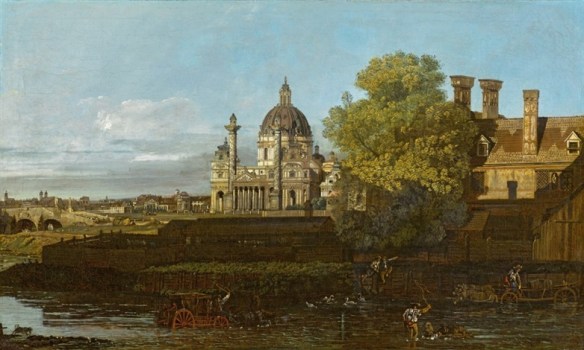
A View of the Karlskirche, Vienna by Bernardo Bellotto

Serenade in D major Op.25 for flute, violin and viola (1801, Beethoven aged 30)

Dedication Countess Maria Wilhelmine von Thun
Duration 22′

1. Entrata, Allegro
2. Tempo ordinario d’un Menuetto
3. Allegro molto
4. Andante con Variazioni
5. Allegro scherzando e vivace
6. Adagio – Allegro vivace e disinvolto

Listen

Background and Critical Reception

This attractive trio was initially thought to have been written around the same time as Beethoven’s Trio for clarinet, cello and piano – but as Richard Wigmore observes, writing in a booklet note for Hyperion, its actual date is three years later.

The flute was a very bankable instrument thanks to Frederick The Great, and Wigmore describes how ‘the Serenade, like the Septet, is a delightful late offshoot of the eighteenth-century divertimento tradition’.

There are six movements in a piece which appears not to have been written with any particular person in mind, more for the Viennese domestic market.

Thoughts

Beethoven looks back to Mozart and Haydn with this piece, using the form of a Serenade to its full potential. Like Mozart he brings the most out of seemingly small forces. On the face of it the combination of flute, violin and viola is relatively slight, but not in Beethoven’s hands. Each of the instruments gets a thorough workout in music that is both vivacious and touching.

The air of Spring, so prevalent in the sonata for piano and violin of the same name, is here in abundance too. The bright sound of the flute is one of the reasons for this, but so are the busy parts Beethoven assigns to violin and viola. There are few if any breaks for the instruments, and because of the almost complete lack of a bass instrument the piece has the lightest of textures.

The first movement is fun, the flute imitating a piper with the catchy main theme, but in the second movement Beethoven brings through a number of dance rhythms, with a minuet and two contrasting trio sections. The third movement is a rustic dance, with busy strings and lively flute.

The centrepiece, however, is the theme and variations movement, the strings introducing the theme with double stopping that makes them sound like a full quartet. As the music progresses each of the three protagonists gets their turn in the spotlight, which the audience would have enjoyed.

There is more, too – a scherzo where the instrumentalists are all at play, and a final Rondo where Beethoven heightens the folksy mood with the use of open strings on the violin and viola. The abundance of tunes and good humour in this piece make it a treat for audiences and listeners alike.

Recordings used and Spotify links

Gaudier Ensemble (Jaime Martin (flute), Marieke Blankestijn (violin), Iris Juda (viola) (Hyperion)
Members of the Berliner Philharmoniker (Karlheinz Zoeller (flute), Thomas Brandis (violin), Siegbert Uebershaer (viola) (Deutsche Grammophon)
James Galway (flute), Joseph Swensen (violin), Paul Neubauer (viola) (RCA)
Emmanuel Pahud (flute), Daishin Kashimoto (violin), Amihai Grosz (viola) (Warner Classics)
Melos Ensemble of London (Richard Adeney (flute), Emmanuel Hurwitz (violin), Cecil Aronowitz (viola) (Eloquence)

There are some fine versions of this piece available, the musicians clearly enjoying Beethoven’s high spirits throughout. The two I enjoyed most are from members of the Gaudier Ensemble on Hyperion, beautifully recorded, and the bright tones of three members of the Berliner Philharmoniker on Deutsche Grammophon, a recording made in 1969 that stands up very well.

You can listen to these versions on the playlist below:

You can chart the Arcana Beethoven playlist as it grows, with one recommended version of each piece we listen to. Catch up here!

Also written in 1801 Wranitzky 3 String Quintets Op.8

Next up Piano Sonata no.12 in A flat major Op.26