Unknown's avatar

About Arcana

My name is Ben Hogwood, editor of the Arcana music site (arcana.fm)

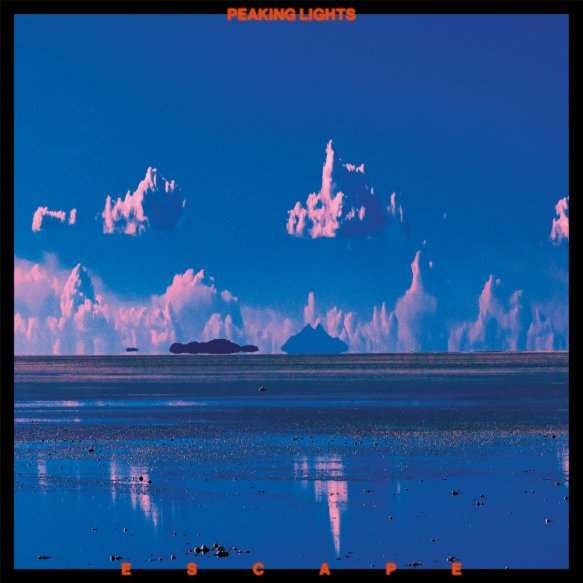
Switched on – Peaking Lights: E S C A P E (Dekmantel)

What’s the story?

Peaking Lights are easy to take for granted – but when you delve into their recent output you realise how remarkably consistent it has been. Since moving further into the mainstream with the rather wonderful 936 album of 2011, the husband and wife duo of Aaron Coyes and Indra Dunis gained momentum with Lucifer, Cosmic Logic and The Fifth State of Consciousness, all exploiting their talents for grooves infused with dub and psychedelia.

The title of E S C A P E is a pertinent one for their sixth album proper, since they have moved label (to Amsterdam’s Dekmantel imprint) and celebrate a return to the long-playing format for the first time in three years.

What’s the music like?

Put it this way, fans will be happy. Coyes and Dunis have been remarkably consistent in the quality of their album releases and E S C A P E is no different.

There is more upfront activity though, suggesting they have been energised by their new surroundings. Dharma has beguiling vocals but the beat is relatively fast and the psychedelic leanings are heavy – in a good way. Likewise for Soft Escape (Moonman Mix), with some heavy distortion, and Innerterrestrial with its fat bass line, while Traffic adds a punchy guitar. Oddly, the enchanting vocal Dunis brings to The Dammed has quite a similar melodic profile to R.E.M.’s Losing My Religion, with appealing block synths that blossom into a glorious wall of sound.

It is one of many moments for the listener to lose themselves in, as are Peace and Dreams – the ideal counterparts to the dark world climate in the last few weeks, with soothing textures. Meanwhile The Caves has more than a touch of Stranger Things with its bubbling synth lines. Perhaps the most reassuring sentiment of all is saved for last, the lush Change Always Comes devoid of beats and left for Dunis to star, part of a multilayered dreamscape.

Does it all work?

Yes. There is no need to change their approach, yet the music still sounds fresh, and there is a generously filled album here. Peaking Lights never re-tread the same ground on their music, yet they hit a familiar and very welcome combination of relaxation and stimulation unerringly.

Is it recommended?

Yes. A new Peaking Lights album is just what we need in these troubled times, drawing a veil over the world outside and allowing us to dabble with some positively blissful vibes for once.

Listen

Buy

Listening to Beethoven #9 – Rondo in C major


Beethoven statuette – plaster cast by Gebrüder Micheli based on an original by Gustav Adolf Landgrebe (Beethoven-Haus, Bonn)

Rondo in C major WoO 48 for piano (1783, Beethoven aged 12)

Dedication not known
Duration 2’40

Listen

Background and Critical Reception

March 1783 saw a tragic time for the Beethoven family, as a younger brother to Ludwig, Franz Georg van Beethoven, died at the age of two. This precipitated a family visit from Rotterdam of the dead child’s sister, Maria Magdalena, who arranged for a return visit from Beethoven and the opportunity to perform new works.

With the three Electoral sonatas on the table Beethoven was really hitting his stride with writing for the piano, and with a first concerto just around the corner he produced another short Rondo for solo piano. Its exact composition date is not known, only that Beethoven was ‘around 12’.

Daniel Heartz describes the Rondo as having a ‘catchy and quite folk-like theme’. He says that ‘the model is clearly the second and last movement of Mozart’s Violin and Piano Sonata in G major K301’. Explaining in detail, he declares ‘The correspondence is evident not only in the theme but also in the way it is treated to rapid alternation of major and minor forms. Beyond looking up to Mozart as a legendary performer, Beethoven obviously took him as a model for composition. You can compare for yourself here:

Thoughts

Daniel Heartz’s observation is a fascinating one, and on listening it rings true. The purity of Beethoven’s theme is closely aligned to Mozart’s, though there is a slight glint in the eye at times, especially with one or two of its harmonic shifts. The use of C major is also in line with one of Mozart’s most popular piano sonatas.

Again, this is very surefooted music for a 12-year-old boy to be writing!

Recordings used

Mikhail Pletnev (DG); Jenő Jandó (Naxos), Ronald Brautigam (BIS)

Jenő Jandó takes the ‘Allegretto’ tempo marking more to heart with a slower reading which initially sounds quite pedestrian but makes sense when it has settled down. Ronald Brautigam goes for a very similar approach, adding a little more mystery to the middle section. Mikhail Pletnev is quite light hearted, and affectionate at the end – but his tempo choice is much faster than Beethoven indicates.

Spotify links

Mikhail Pletnev

Jenő Jandó

Ronald Brautigam

You can chart the Arcana Beethoven playlist as it grows, with one recommended version of each piece we listen to. Catch up here!

Also written in 1783 Paisiello La passione di Gesù Cristo

Next up Piano Concerto in E flat major WoO 4

Listening to Beethoven #8 – An einen Säugling


A Peanuts strip drawn by Charles M. Schulz (c)PNTS

An einen Säugling WoO 108 (“Noch weisst du nicht, wes Kind du bist”) for voice and piano (1783, Beethoven aged 12)

Dedication not known
Text Johann von Dohring
Duration 3’20”

Listen

Background and Critical Reception

There are very few words written on Beethoven’s second song, a duet for two upper range female voices. It comprises four verses by Johann von Doring, with a piano introduction and postlude.

For Lewis Lockwood, the three-minute song ‘shows a slight touch of originality in its brief major-minor mixture, but reflects the pretty, homely sentimentality of the contemporary German ‘lied’ (song).’

Thoughts

An airy piano introduction leads to some rather beautiful harmonies in this song. Both singers are close together in pitch, occasionally uniting in unison but rarely further than a third apart.

The harmonic language is very straightforward – this is a song ‘to an infant’ so that is not a surprise! – but the elaboration of the piano part in between verses is attractive.

Recordings used

There are only two versions immediately available on Spotify. The Heinrich Schütz Kreis, Berlin deliver a chaste reading of the song with pianist Leonard Hokanson, but get to the right level of innocence with pure harmonies.

That said, the version on the DG complete edition, from single voices Karen Wierzba and Natalie Pérez, is really nicely done. The pair have more vibrato, but their unison and harmony singing is ideal, the roomy recording works nicely and pianist Jean-Pierre Armengaud adds some sensitive touches.

Spotify links

Heinrich Schütz Kreis & Leonard Hokanson:

Karen Wierzba, Natalie Pérez and Jean-Pierre Armengaud:

Also written in 1783 Dittersdorf Six Symphonies after Ovid’s Metamorphoses

Next up Rondo in C major

Listening to Beethoven #7 – Piano Sonata in D major (‘Electoral’ no.3)


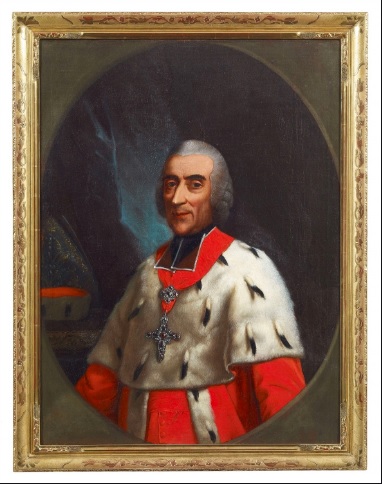
Portrait of Maximilian Friedrich von Königsegg-Rothenfels, Archbishop-Elector of Cologne. Portrait by Georg Oswald May

Piano Sonata in D major WoO 47/3 ‘Electoral’ for piano (1783, Beethoven aged 12)

Dedication Maximilian Friedrich, Elector of Cologne
Duration 14’00

Listen

Background and Critical Reception

The third of the Electoral sonatas is, for Jan Swafford, the strongest of the set. For him, it ‘suggests Haydn at his most vivacious. Its jolly outer movements frame the most striking formal idea of the sonatas, a minuet followed by six variations…’ and it finds Beethoven in D major, ‘bright and ebullient’.

Pondering the forms further, he says, ‘It is hard to tell whether his departures from standard forms are imaginative or naive. Only in the D major does he begin to grapple with the sophisticated discipline of sustaining an idea’.

At this point it is worth restating that this is music written by a 12-year old, one of his first public statements – and certainly one of the first opportunities for teacher Christian Kneefe to show off the work of his pupil.

Thoughts

As Swafford says, the brightness of this music is striking, right from the airy, genial first theme. This is music you would listen to in order to feel right with the world, to take the weight off a difficult day. With rippling textures in the left hand, Beethoven writes a fluid first movement.

The Menuett and variations is the star though, an attractive triple-time dance supported by the left hand which is clearly the ‘feet’ of the operation. The variations include a glittering right hand (4) then some gentle syncopation (5) before an attractive couplet in thirds (6).

The third movement is similarly bright, more closely related to the fourth variation of the Menuett in its rapid movement for the right hand – which helps keep the music on its natural high level. Beethoven will give us more of these natural highs in D major – this is simply the first!

Recordings used

Jörg Demus, as used on the DG complete edition, is given a very roomy backdrop in Vienna to work with. As a result his recording, made in 1969, does show its age in spite of some lovely playing. In part because of that the preference is for Jenő Jandó on Naxos, who also gives the music a nice amount of room. Beethoven’s work is closely aligned to Haydn in his hands. Ronald Brautigam, meanwhile, adds all repeats in an account that lasts 17 minutes, bringing forward Beethoven’s potential for the longer form. His virtuosity and musicality really bring these pieces to life.

Spotify links

The playlist below is for all three Electoral Sonatas, and includes the recordings discussed above:

You can chart the Arcana Beethoven playlist as it grows, with one recommended version of each piece we listen to. Catch up here!

Also written in 1783 Michael Haydn Symphony in E-flat major .

Next up An einen Säugling

Listening to Beethoven #6 – Piano Sonata in F minor (‘Electoral’ no.2)


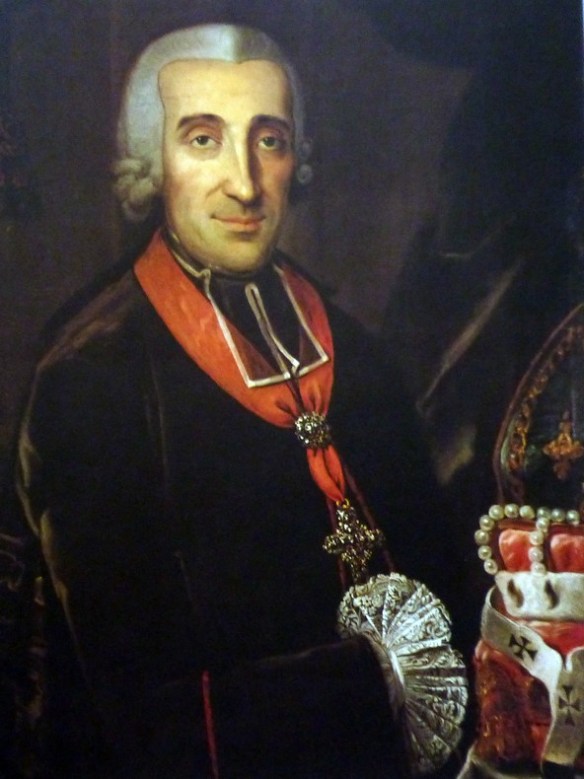
Portrait of Maximilian Friedrich von Königsegg-Rothenfels, Archbishop-Elector of Cologne. Artist unknown

Piano Sonata in F minor WoO 47/2 ‘Electoral’ for piano (1783, Beethoven aged 12)

Dedication Maximilian Friedrich, Elector of Cologne
Duration 11’20

Listen

Background and Critical Reception

The three Electoral sonatas divide opinion among Beethoven scholars. While you can read largely complimentary thoughts in the background to no.1 – as appraised yesterday – Lewis Lockwood‘s biography decides that the three works are ‘short, undeveloped and crowded with stereotyped figures. He does however go on to concede that ‘still, these three little works show that the barely adolescent Beethoven could spin coherent phrases and short paragraphs as capably as many an adult professional.’

Charles Rosen‘s observation that Beethoven’s three Electoral Sonatas ‘start clearly from Haydn’s work of the late 1760s’ appears to have greatest traction with the second work in F minor. This key was important to Beethoven’s contemporary, and accounts for two of his most profound works – the Symphony no.49 (‘La Passione’) and the Variations in F minor for piano.

Beethoven too made use of F minor for important works, and it was a relatively brave choice to use it early on in his career as here. For Barry Cooper, writing in the complete edition as released on Deutsche Grammophon, this second sonata is ‘the most strongly emotional in the set, with powerful gestures that anticipate some of Beethoven’s later minor-key sonatas such as the Pathétique and the Moonlight.’

Thoughts

The first movement starts deep in thought, but Beethoven snaps out of that mood with a flash the music suddenly tearing forward. However it doesn’t completely throw off the mood of the sombre opening, which leaves its striking mark and brings to mind the writing of C.P.E. Bach in the process – not to mention the aforementioned La passione symphony from Haydn.

In spite of this the slow movement is the emotional heart of this sonata – and it is probably the most meaningful music we have heard so far. Time really does slow as Beethoven’s thoughts unfurl, a method with which we will become increasingly familiar as time moves on. Here it feels like we have a private audience with him as the music becomes more freeform.

The third movement, marked Presto, throws off the shackles, with a heavily ornamented melody which must be tricky to play. It means the music retains some tension despite its much quicker delivery.

Recordings used

There is a terrific account of this piece from Emil Gilels, whose playing gets to the heart of the emotion in the second movement but also catches the devil-may-care freedom of the third. Jenő Jandó also gives a fine performance, if slightly trailing in the wake of the Russian.

Spotify links

The playlist below is for all three Electoral Sonatas, and includes the two recordings discussed above – Emil Gilels and Jenő Jandó:

You can chart the Arcana Beethoven playlist as it grows, with one recommended version of each piece we listen to. Catch up here!

Also written in 1783 Mozart Mass in C minor, K427 (the Great Mass) .

Next up Piano Sonata in D major, ‘Electoral’