Unknown's avatar

About Arcana

My name is Ben Hogwood, editor of the Arcana music site (arcana.fm)

On screen: Goldschmidt: Beatrice Cenci

Goldschmidt Beatrice Cenci (1949/50)

Prague Philharmonic Chorus; Wiener Symphoniker / Johannes Debus

C Major Blu-ray 751504 [107’] 1080i / 16:9. PCM Stereo / DTS-HD MA 5.1.

Sung in German with English, Japanese and Korean subtitles. Regions A, B and C Video Director: Felix Breisach.

Recorded live at Bregenz Festival on 18th July 2018

Reviewed by Richard Whitehouse

What’s the story?

The first DVD release for the opera Beatrice Cenci by Berthold Goldschmidt (1903-96), in a production at the Bregenz Festival in 2018 – continuing the lineage of stage-works by once forgotten and suppressed composers to have been presented at this event over recent years.

What’s the opera like?

Finished midway through the last century, Beatrice Cenci might have been expected to revive its composer’s career two decades after reaching its peak with the premiere of his first opera Der gewaltige Hanrei and 17 years after he fled Germany. A Covent Garden staging failed to materialize and it stayed unheard until a concert performance in 1988, with a full production six years later. Drawing on the 1819 verse-drama by Shelley, librettist Martin Esslin created a succinct and cohesive text where tension rarely lets up over the opera’s 105-minute duration.

Musically things are a little more ambiguous. Goldshmidt’s intention was to revive the art of bel canto and Beatrice Cenci indeed focuses attention on vocal writing to a degree unusual in post-Wagnerian opera. That said, melodies per se are in relatively short supply across a work that, for all it drama and immediacy, is arresting rather than memorable in content. Musically the idiom is still rooted in the ‘neue sachlichkeit’ found in the stage-works of Hindemith and Weill 25 years earlier, such that genuine emotion feels reined-in even at dramatic highpoints.

Johannes Erath‘s staging further exacerbates this impression, its lurid tone and over-wrought action suggestive of a gothic overkill that Goldschmidt was surely anxious to avoid. Katrin Connan‘s sub-expressionist sets, Katharina Tasch‘s faux-Renaissance costumes (redolent of Peter Greenaway during his 1980s heyday) and Bernd Purkrabek‘s lighting with its extremes of darkness and light further ensure the outcome has an exaggerated, even two-dimensional quality which leaves little room for subtlety or finesse in delineating character and incident.

Does it all work?

Only in part, but this is hardly the fault of the singers – among whom, Gal James comes into her own as the cruelly mistreated Beatrice with her soliloquy in the final act, with Dshamilja Kaiser eloquent as her step-mother Lucrezia and Christina Bock no less sympathetic as her weak half-brother Bernardo. Christoph Pohl is almost too suave to convey the sheer evil of her father Francesco, while Per Bach Nissen treads a fine line between humour and caricature as the cardinal Camillo, and Michael Laurenz brings purpose to the vacillating prelate Orsino.

The Prague Philharmonic Chorus is heard to impressive effect in those banquet and execution scenes that bring the outer acts to their climax, with Johannes Debus securing a trenchant and committed response from the Vienna Symphony players.

Understandable that the production should have been given in the composer’s own translation of the original libretto, yet this in itself tends to underline the sardonic and darkly comic aspects which, whether in accord with Esslin’s absurdist convictions, inevitably militate against Goldschmidt’s expressive priorities.

Is it recommended?

Yes, in that Beatrice Cenci is a significant and (given its historical context) valiant attempt to renew certain dramatic qualities at a premium in opera of that era. This Bregenz production makes for compulsive viewing, if rather less in the way of affective or empathetic listening.

Further information can be found at the <a href=”http:/www.cmajor-entertainment.com”>C major</a> website

Live review – CBSO / Riccardo Minasi: Haydn & Mozart

Oliver Janes (clarinet), Nikolaj Henriques (bassoon), City of Birmingham Symphony Orchestra / Riccardo Minasi (above)

Symphony Hall, Birmingham
Wednesday 27 November 2019

Haydn Symphony no.88 in G major (1787)
Richard Strauss Duet-Concertino (1946)
Beethoven Coriolan Overture (1806)
Mozart Symphony no.39 in E flat major K543 (1788)

Written by Ben Hogwood

What a refreshing concert for a dank November evening. This was a slightly stripped back version of the City of Birmingham Symphony Orchestra, with their guest conductor Riccardo Minasi overseeing energetic accounts of Haydn and Mozart, a high octane Beethoven overture and a youthful take on the music of an elderly Richard Strauss.

The Haydn first, in the form of a strongly characterised account of his Symphony no.88, premiered in Paris in 1787. We still take Haydn’s astonishing output of 104 published symphonies for granted, for while they make effective concert openers they are full of invention, wit, and – especially in this case – drama.

After a poised first movement, Minasi lovingly shaping the phrases with tasteful rubato, the second movement Largo was laid bare as a strongly emotive utterance with dark twists and turns, interventions from brass and timpani sounding powerful warning notes. By contrast the Minuet was a light hearted dance, its trio section employing bagpipe-like drone effects that anticipate the Brahms Serenades. Minasi and the players clearly love this music, and their effervescence carried over into the finale, the conductor dancing on the podium as upper and lower strings egged each other on.

Richard Strauss was looking intently at the Classical period when he wrote his penultimate orchestral work at the age of 83. The Duett-Concertino is an unusual piece, bringing forward clarinet and bassoon soloists to shine in front of a decorative chamber orchestra. This is recognisably late music in its assured and economical treatment of form, and in some unexpectedly spicy harmonic twists, but the soloists captured its ‘Indian summer’ profile.

Oliver Janes and Nikolaj Henriques were superb, plucked from the orchestra and fully enjoying their moment in the spotlight in front of their colleagues, who responded with rustic string accompaniment and beautifully rendered harp (Katherine Thomas). Janes’ clarinet tone was delightful, with Henriques’ bassoon cajoling and prompting in response. Both came into their own with some dazzling acrobatics in the finale. The light hearted approach spilled over into a brilliantly designed encore, a selection of Mozart themes arranged for the two solo instruments to often comic effect.

The second half began with high theatre, an account of Beethoven‘s Coriolan overture that crackled with atmosphere and descriptive content. The opening chords bore the effect of powerful slamming doors, such was the crisp ensemble, and as the overture gradually opened up so did a vivid response to Heinrich von Collin’s tale. As the story unfolded there was no doubt on its tragic ending, and here Minasi’s management of the quiet string dynamics looked forward to equivalent drama in the first movement of Mahler’s Resurrection symphony.

Even in the context of this concert the best was saved for last in an account of Mozart‘s Symphony no.39 that positively fizzed with good spirits. When he composed the piece in 1788 Mozart was writing without commission, a relative rarity for him, and this was the first of three symphonic works that were to redefine the form, effectively preparing the way for Beethoven and Schubert.

The atmosphere crackled in a fulsome introduction to the first movement, which took on a waltz-like form, Minasi’s prowess as an opera conductor clear for all to see through his dramatic instincts and more tasteful rubato. The slow movement was perfectly judged, initially and deceptively straightforward but with stern interventions from the woodwind. These highlighted the lyricism of the main subject, once again beautifully phrased. A warmly coloured Minuet followed before the finale sprang out of the traps, violins easily handling the considerable demands placed on them in rushing scales and rapid string crossing. Minasi was if anything even more energetic than he had been at the start of the concert, prompting the wonderful syncopations and interplay of Mozart’s inspiration which were brought right to the front.

So good was this concert it was a shame when we entered the closing bars of the symphony, but we did so with great positivity, Mozart – and Minasi – inspiring us through their wonderful craft.

Further listening

You can listen to the music from this concert on the Spotify playlist below, made up of some leading recordings of the works played.

Switched On – Pop Ambient 2020 (Kompakt)

What’s the story?

Wolfgang Voigt has every right to be proud as one of the flagship series of the Kompakt label, Pop Ambient, reaches its 20th edition. Cologne’s finest label refuses to rest on its laurels, mind, delivering a set of old and new music, best enjoyed horizontally.

What’s the music like?

Blissful. Kompakt have not been doing this sort of compilation for 20 years without reward – they know the quick routes to peace of body and mind, as made possible in music.

There is a pleasing mix of familiar and relatively new names here. In the former camp sit Thomas Fehlmann and the bubbling textures of Liebesperlen, Raumschmiere‘s brooding Notre-Dame and two Andrew Thomas contributions, Song 9 and Sleep Fall.

Into the latter group come the easy paced guitar instrumental from Urquell, who also contributes Alles Bleibt Anders. On a similar plain is Gen Pop‘s Iron Woman and early Kompakt contributor Klimek‘s All The Little Horses, though the same producer’s Requiem For A Butterfly offers darker, widescreen strings. For even deeper ambience Yui Onodera offers the incredibly calming Cromo 4, while Joachim Spieth is even more immersive on Meteor.

The ambience deepens still further through the thick, soothing blanket of Markus Guentner‘s Clade.

Does it all work?

Yes. The ebb and flow of the tracks is ideally judged, and the high ratio of exclusives and new tracks make the 20th edition of this series as collectable as ever.

Is it recommended?

Without hesitation. Pop Ambient has a reassuringly regular place in the calendar of down tempo music, and this is it’s best collection for some time. On a personal level, with the world experiencing such stress and change at present, this is just the sort of music required to counteract it!

Stream and Buy (from November 29)

Switched On – Max Cooper: Yearning For The Infinite (Mesh)

reviewed by Ben Hogwood

What’s the story?

For anyone who attended his sellout Barbican show, the release of Max Cooper‘s second album will be big news indeed. As Arcana reported, this was a rare occasion where a gig lived up to its ambitious title, and since this is the music behind that gig attendees will need little encouragement.

For those new to the story, Max Cooper is a progressive artist and bioscientist looking to explore music through algorithms and pre set patterns in a way that doesn’t dilute its emotional impact. In other words, music that makes you think and feel while pushing the boundaries of composition. “We are rats in the wheel”, he says, “imprisoned by our nature to endlessly pursue. But the view of the essence of this process as a whole, is a beautiful thing.”

What’s the music like?

Cooper’s music is flexible in a way that rewards lovers of ambient music as much as those who love wide, sweeping vistas rich in percussion.

Yearning For The Infinite is a through composed work able to be enjoyed as an hour long stretch or in its constituent parts. Let There Be establishes the wide scope of the ambient sound, seguing into the pulses of Repetition where the extent of the emotion becomes clear. Parting Ways presses forward with a deliberate beat but Perpetual Motion hits a more natural, syncopated groove. After a brief repose Aleph2‘s thick textures are capped by rolling percussion, then Scalar fires rallies of drum and bass around processed vocals from Alison Moyet. Busy beats ricochet through Penrose Tiling while Morphosis has dazzling beauty.

Does it all work?

Yes. On occasion you may find some of the beats too busy for your mood, but that should not be a problem. As Cooper progresses through his voyage the listener is drawn right in to the action, and will find it easy to stay to the end.

Is it recommended?

Yes, without reservation to Cooper devotees, but also to lovers of Jon Hopkins, Nils Frahm or Floating Points. The music here forges a deeply individual path that makes it one of the electronica albums of the year.

Stream

Buy

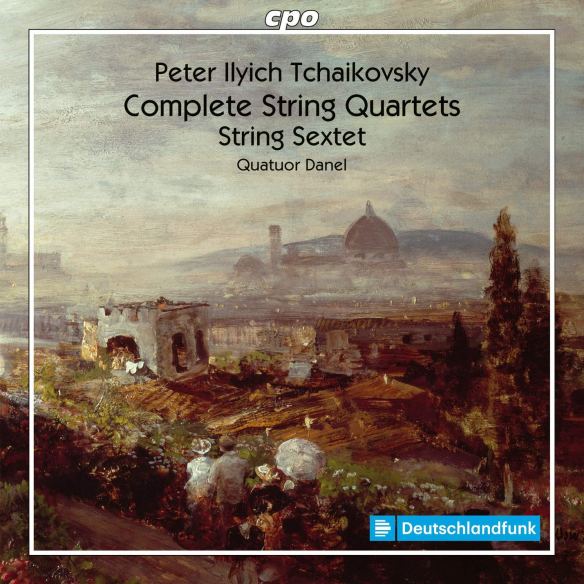
On record – Quatuor Danel: Tchaikovsky – Complete String Quartets & Souvenir de Florence (CPO)

Quatuor Danel [Marc Danel & Gilles Millet (violins), Vlad Bogdanas (viola), Yovan Markovitch (cello)], Vladimír Bukač (viola)*, Petr Prause (cello)*

Tchaikovsky
String Quartet no.1 in D major Op.11 (1871)
String Quartet no.2 in F major Op.22 (1873-4)
String Quartet movement in B flat major (1865)
String Quartet no.3 in E flat minor Op.30 (1876)
String Sextet in D minor Op.70, ‘Souvenir de Florence’ (1890)*

Written by Ben Hogwood

What’s the story?

This is a very welcome release from the Quatuor Danel. Having already given us complete cycles of Weinberg and Shostakovich – a total of 32 string quartets – they extend their reach back to Tchaikovsky and the first major quartet cycle in Russian music. There are two discs which include the three published quartets, the quartet movement and Souvenir de Florence, the composer’s String Sextet.

What’s the music like?

Following these pieces is a very interesting way of charting Tchaikovksy’s development as a composer.

The String Quartet no.1 in D major gives evidence of his major early influences, with Mozart and Mendelssohn in evidence. It also contains as its second movement the Andante cantabile, removed and arranged for string orchestra and very popular as a standalone piece for reflection.

The String Quartet no.2 in F major is weightier, with a more overtly Romantic musical language as Tchaikovsky shows more obvious emotion in his writing. The String Quartet no.3 is unusually cast in E flat minor, not a key string players regard with great affection, but one which offers very effective, dark colouring in an elegiac work.

The cycle is nicely positioned at regular intervals in the composer’s career, predated by a Quartet Movement in B flat major from the mid-1860s and capped by the String Sextet, Souvenir de Florence, from 1890, written while the composer was working in the Italian city.

Does it all work?

Yes. These are excellent performances from a quartet clearly attuned to Russian chamber music. They enjoy the graceful music with which the String Quartet no.1 starts, gliding forward with poise and elegance. As the development of the ideas gathers pace and intensity, so the quartet become more animated, convincingly driving through to the final bars. The Andante Cantabile is fresh and free of indulgence, its central dance offsetting the thoughtful main material. The Scherzo has plenty of cut and thrust, plus an enjoyable, bubbly trio, while the finale is in a similar vein but sunnier, enjoying the major key and some glorious melodies from Marc Danel’s violin.

Once fully in to gear, the String Quartet no.2 has an exuberant first movement. It is a high voltage performance, occasionally brimming over with its high spirits, but with a nicely judged and serene close. The quartet enjoy the rustic sounds of this work, particularly evident when Tchaikovsky uses open fifths in the lower parts, and they get admirable clarity from the big textures in the middle of the Andante.

The String Quartet no.3 receives a telling performance, getting right to the heart of Tchaikovsky’s thoughts. Sombre and thoughtful in its introduction, the first movement soon has admirable depth, the transition to the faster music ideally judged. The quartet relish Tchaikovsky’s fulsome writing but also the deeply soulful character of the movement’s second theme. The Scherzo is light on its feet, enjoying the exchanges from the top of the first violin to the bottom of the cello and back again, while the muted start to the third movement is particularly intense, deeply telling in its sorrowful and respectful closing pages. The finale largely shakes off these shackles but for a brief reference to the mood of the third.

As a useful postscript the Quartet Movement has a quiet and mysterious beginning, and it is not initially obvious where the work is going but then it blooms into a full structured movement, using the influence of Schubert and Mendelssohn to strong effect.

Finally a spirited account of the Souvenir de Florence, busy and upfront from the start, with plenty of energy from the six players – but with time too to enjoy both the softer second theme of the first movement and the lovely slow movement, where the cello line blooms beautifully. The shimmering central section here has plenty of drama, then the sound becomes earthy as the cello line returns. Textures are occasionally stretched in the third movement but the finale has a dramatic sense of urgency as well as a lovingly dispatched, broadly phrased second theme bringing brief parallels to the composer’s fantasy overture Romeo and Juliet. After this the sextet secure a thoroughly emphatic and affirming finish.

The big challenge with these works is getting the melodies to sing through the full textures with which Tchaikovsky writes, but the Quatuor Danel achieve the right balance throughout these excellent versions.

The elegance of the first quartet is immediately appealing, as is the red blooded cut and thrust of the second and the deeply emotive third, the best performance here. Having the Quartet Movement and an excellent account of Souvenir de Florence is the icing on the cake.

Is it recommended?

Yes. There is formidable competition in these pieces from the Borodin String Quartet, in company with Genrikh Talalyan and Mstislav Rostropovich for the Souvenir de Florence, and also from the Gabrieli and Chilingirian Quartets.

Yet despite these the Quatuor Danel offer an excellent modern alternative, with excellent performances and recording all round. It’s time for Tchaikovsky’s string quartets to come in from the cold.

Listen

Buy

You can listen to clips from the Quatuor Danel’s Tchaikovsky cycle and purchase a copy at the Presto website here