Prom 61 – Renée Fleming (soprano), Royal Stockholm PhilharmonicOrchestra / Sakari Oramo
Andrea Tarrodi Liguria (2012) (UK premiere)
Barber Knoxville: Summer of 1915, Op 24 (194)
Richard Strauss Daphne – Transformation Scene, ‘Ich komme – ich komme’ (1937)
Nielsen Symphony no.2, ‘The Four Temperaments’ (1901-2)
Royal Albert Hall, Wednesday 30 August 2017
You can listen to this Prom here for 28 days from the date of the performance
In her previous visits to the Proms Renée Fleming has proved a big draw, and although the arena may not have been full for her latest visit, with regular collaborators Sakari Oramo and the Royal Stockholm Philharmonic Orchestra, it comprised a satisfying and ideally executed program.
Fleming’s contributions grouped into a loose theme of distant light and transformation. Barber’s Knoxville: Summer of 1915 is a love letter to the American home, and its dappled evening sunlight flickered beautifully under the hands of Oramo, the composer’s warm harmonies setting the scene for Fleming’s characteristically full bodied interpretation. She inhabited the storyteller’s guise with effortless and instinctive calm, though the animated middle section was also very well judged. With just the right amount of sentimentality, this was an ideal performance, and an aptly chosen encore of the song Sure on this shining night blazed a similar trail.
Fleming’s projection was ideal, particularly in the Transformation Scene from Richard Strauss’s second opera Daphne, where she moved from the front to a well-chosen offstage position for the culmination of the transformation itself, which sees Daphne take on the form of a laurel tree. The extended postlude from the orchestra reached upwards to a serene level of euphoria, and Fleming’s wordless vocalise at the end put the seal on a beautifully judged performance. Again we had an encore, and this was a special account of Strauss’s own orchestration of his best-loved song Morgen, with rapt solo from orchestra leader Andrej Power.
If anything the other two pieces were even more successful. The music of Andrea Tarrodi was new to the Proms, but on the basis of the orchestral piece Liguria this was extremely unlikely to be her only appearance. A colourful account of a visit to the Italian coast, Liguria is a kind of symphonic lettercard, its six scenes recounted in brightly lit orchestrations. The recurring, creeping brass harmonies from the first scene stood out, and reappeared towards the end, but also notable was the assurance with which the Swedish composer works with the orchestra, making original sounds and not resorting to contemporary music clichés. A composer whose acquaintance you are strongly advised to make.
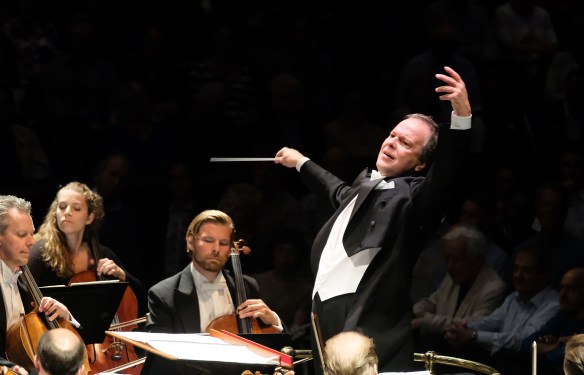
Finally we heard Carl Nielsen’s Second Symphony, ‘The Four Temperaments’, receiving its second Proms performance in three years after the festival’s complete neglect of it in the 20th century. It is a powerful piece, and this account made a strong impression. Although the feverish first movement (Choleric) was convincing and brilliantly played the emotional centre lay in the Melancholic third movement, where Oramo wrought music of impressive angst and depth. Nielsen’s struggles were resolved by the Sanguine finale, where the composer lets rip perhaps a little too easily, but again the structure and the melodic groups made perfect sense. Oramo has built a strong affinity with the Danish composer’s music over the years, and there was something very satisfying in these days of disunity at seeing a Finn conduct a Swedish orchestra in Danish music.
Ben Hogwood
Stay tuned for the next in Arcana’s Ask The Audience series, where Leanne Mison will give her verdict on the Royal Stockholm Philharmonic Prom. Coming shortly!
For the latest in Arcana’s Ask The Audience series Tom Morley gives his thoughts on the Britten Sinfonia’s rare performance of the Philip Glass / Ravi Shankar collaboration Passages, with the composer’s daughter Anoushka Shankar playing the sitar.
ARCANA: Tom, how would you describe your musical upbringing?
There were two main influences in my musical upbringing. The first came from the local church choir which I sang with three times a week. Most of what we sang was very traditional although there was a piece by Messiaen which got wheeled out every now and then which was pretty out there.
Secondly, my parents were musical so I remember them playing and singing around the house. I’ve also got memories of sitting down with my Dad to listen to a recording, his taste is pretty eclectic so I remember listening to Phantom of the Opera, Donald Where’s Your Troosers, Return to Innocence by Enigma and Night Boat To Cairo by Madness!
What experiences have you had up until now with classical music, and have they been good or bad, or both? (Examples are great if you’re able!)
Aside from the choir, I played trumpet in an orchestra for a short while but decided it wasn’t really my thing. At university I had a few lectures on classical music but once again, struggled to find anything that really spoke to me apart from the odd piece here and there. I wouldn’t say my experiences with classical music have been either good or bad, probably somewhere in the middle. What if any have been your previous experiences of the Proms?
I’ve never been to a Prom. I sometimes look through the schedule and think about going but have got round to going to see one.
Could you name three musical acts you love, and why you love them?
Radiohead – They always seem to keep their music interesting and challenging and I like the cinematic quality to some of what they write as well as the artwork and concepts that go along with the music.
Snarky Puppy – These guys are brilliant musicians, they’re really supportive of music education and they look like they’re having a great time on stage. Definitely more of a live band than a studio band.
The Beatles – An obvious choice, but they did so much to push the boundaries of popular music and created so many memorable tracks in a such a short while as well as having a massive influence on music and culture.
What did you think of the concert?
I loved it. I can honestly say I’ve never heard anything like that before. I think I was particularly fortunate to be at this one which was a real meeting of styles and ideas and the first live performance of the piece with great musicianship all round.
What did you think of the environment in the Arena?
Not what I was expecting at all. When we walked up the steps the atmosphere changed completely. Some people were standing, some were sitting or lying down and there was a buzz of excitement but when the music started everyone was listening intently. I think this was helped by the fact that this was a late night performance and in some ways, it felt more like a gig than a concert and even though we were close to the back, we still had a good view of the stage.
Is there anything you would change about the Proms?
More of the same please. If they’re all as varied and unique as this one then there’s nothing I’d change, stick to the same formula. If I had to change one thing, it’d be an outsiders perception of the proms. I thought that it was a strictly ‘classical’ music event but there seems to be a real range of different styles and types of music being performed. It’d be great if more people realised how accessible the proms are, even if you don’t typically listen to classical music.
Roger Vignoles is one of Britain’s best-established accompanists. Respected for his technical ability, experience, breadth of repertoire and the work he does nurturing singers old and new, he is regularly seen at the illustrious venues worldwide.
More recently at the Wigmore Hall he has plotted a course through the daunting output of songs by Richard Strauss, a lesser known corner of the composer’s output. This has been complemented on disc courtesy of Hyperion, their series recently completed by an eighth and final disc with tenor Nicky Spence and soprano Rebecca Evans.
In a fascinating interview he talks with Arcana about his own introduction to classical music, the technical and psychological challenges in performing Strauss, his highlights from the series and the principles of accompanying a singer.
Can you remember your first encounters with classical music?
I have an early memory of a concert at Cheltenham Town Hall when Tchaikovsky’s Pathétique Symphony was performed – it was one of my father’s favourite pieces, hence one of his first LPs, together with Beethoven‘s Fifth Symphony and Franck’s Symphonic Variations. But he also loved Gilbert & Sullivan, so my brothers and I who were all choristers were basically brought up on a diet of English Cathedral Music and HMS Pinafore.
I also remember Peter and the Wolf loomed quite large (my favourite bit was the appearance of the wolf out of the forest), as well as the audience songs from Let’s Make an Opera. And I treasured a 78 single of Sousa’s Stars & Stripes played by the Coldstream Guards Band: nowadays my favourite version is Vladimir Horovitz’s – he gives it such an aristocratic swagger, like a Grande Polonaise in 4/4 time.
What was it about Gerald Moore that made you want to follow in his footsteps?
It was when my elder brother Charles (on whom I really learnt the basics of accompanying when we were both in our teens) gave me the first LP of Winterreise, sung by Dietrich Fischer-Dieskau with Gerald Moore. I was fascinated by the piano parts, but especially by Gerald’s beautifully judged piano sound and his wonderful sense of rhythm and pace, and I just thought: “I’d love to be able to do that.”
When did you first discover the songs of Richard Strauss?
It was probably when I went to the RCM in 1966. Hubert Dawkes, to whom I’d been assigned for accompaniment, plunged me in at the deep end with the Four Last Songs. But I also thrilled to songs like Allerseelen, Die Nacht, Ständchen, etc.
Listen to Rebecca Evans singing September, the second of Strauss’s Four Last Songs, with Roger Vignoles. This is part of the eighth and final volume of Strauss songs released by Hyperion and available here
Are the piano parts particularly challenging? When I have seen you play at the Wigmore Hall before they often feel orchestral in concept, as though you are having to voice a whole ensemble.
Strauss’s early songs sound much like Schumann: pianistic in quality and perfect for a domestic soirée. But with Zueignung, the first of his Opus 10 group (his first published songs), there is an unmistakable sea change. It’s as though the Vienna Philharmonic has entered the drawing room, and from then on Strauss never looked back. Challenging? Indeed, but Strauss also has a wonderful feel for the piano, and with very few exceptions his accompaniments are very grateful to play. Of course there can be a lot of notes to deal with and every now and then he does go completely over the top: Lied an meinem Sohn for instance, which sounds like a cross between Die Walküre and a Tchaikovsky piano concerto and was declared unplayable by Alfred Brendel, no less. It’s wonderfully sung by Christopher Maltman on Volume 4 (listen below):
As it happens thinking orchestrally has always come naturally to me, ever since my time studying with Paul Hamburger, for whom it was axiomatic that all song composers from Schubert onwards have a miniature orchestra in their heads. A couple of years playing Wagner and Strauss at Covent Garden helped cement this approach: many pianists make the mistake with Strauss of learning all the little notes first, but a stint in the opera house teaches you to see the wood for the trees, and as Paul Hamburger would often say, “If you get the gesture right, the little notes will fall into place”.
I should like to add that I owe an enormous amount to Paul, who taught me not only more about piano technique than any “real” pianist I ever worked with, but also about vocal coaching, style, language and poetry (even down to explaining Thomas Hardy to me in his thick Viennes accent). Quite coincidentally the first song I ever took to him was by Strauss – Schlagende Herzen.
The Strauss series on Hyperion has had a really nice blend of singers new and slightly older, English and European. Was that a deliberate aim?
It wasn’t a deliberate aim, so much as the result of the series having taken twelve years to record, and at each stage looking for artists with the appropriate vocal and musical character for the volume in hand. It also very much reflects the singers whom I already was enjoying working with at any given time.
Do you think that in the Strauss songs we get a different view of him as a composer?
Strauss was naturally a composer of the large gesture, the panoramic sweep, with a distinct tendency to overblown romanticism of the kind that can turn some listeners off. And of course the opera composer often shines through – there can be no doubt that the 25 years of song-writing that preceded his first operas were the laboratory in which he developed his gift for vocal characterisation.
But in the song format he is obliged to distil his musical ideas to their simplest essence. Just occasionally he doesn’t succeed, but on the many occasions when he does the result can be pure magic. If I had to give just one example it might be Nachtgang, a tiny love-song of breathtaking tenderness – and unfathomable poignancy (listen below):
‘Accompanist’ feels like a slightly derogatory term for a role that requires such control and artistry. Is it your view that both performers have equal billing in a vocal recital?
It’s not often realised that the Lied or Mélodie is as much a piano art as a vocal one – it’s no accident that Schubert’s Lieder evolved with the early years of the piano – so of course singer and pianist should have equal billing. It is indeed a truly symbiotic partnership. But as for the A-word, I am proud to follow Gerald Moore as an “Unashamed Accompanist”. To me it’s the only term that naturally describes what I and my colleagues do. Nevertheless I can understand those who baulk at its negative associations and prefer the American coinage “collaborative pianist”. Just for the record the billing should of course always read “So-and-So, piano”, never “So-and-so, accompanist”.
What is the most common piece of advice you give to your students on accompanying a singer?
This from Geoffrey Parsons, another mentor: “Always have your own idea of how the song goes, rather than just be a blank canvas for the singer to draw on”.
But two other rules of thumb are useful: “It’s the singer’s job to slow down, the pianist’s to speed up again” and “Balance is as much a function of texture (ie transparency and clarity) as of decibels (as in am I too loud?)”
Is it important to have a personal affinity with the singer you are performing with, as well as a musical one?
It helps of course, especially if you are going on tour together. But I have had many experiences of wonderful music-making on minimal rehearsal, when there was no time at all to find out whether you got on personally offstage.
Are there any composers you have not yet recorded that you are keen to explore?
I love playing Rachmaninov songs (probably for the same reason that I love playing Strauss). And one day I might get round to Schoenberg’s Buch der hängenden Gärten.
If you could recommend a Strauss song to Arcana readers listening for the first time, which one would it be?
So many to choose from… But for a real out-of-body experience, try Am Ufer, sung exquisitely by Christopher Maltman on Volume 4 (listen below):
Or for a remarkable stream of consciousness, Anne Schwanewilms singing O wärst du mein! on Volume 2 (listen below):
You are a painter as well, looking at Twitter…does music inspire your paintings at any point?
Not precisely: but a friend once told me they thought I painted with the same part of the brain that I play with. Which is probably true. It is a fact that I have a very visual conception of the music that I play, especially in song where so much of the verbal imagery is itself visual. So in either medium I am playing with light and shade, with colour and texture, and with contrast – perhaps the most important tool in both.
You can read more about Roger Vignoles on his artist page, or click here for his Hyperion discography. With grateful thanks to Hyperion for the provision of highlights from their Strauss series, which are of course (c) Hyperion Records Ltd.
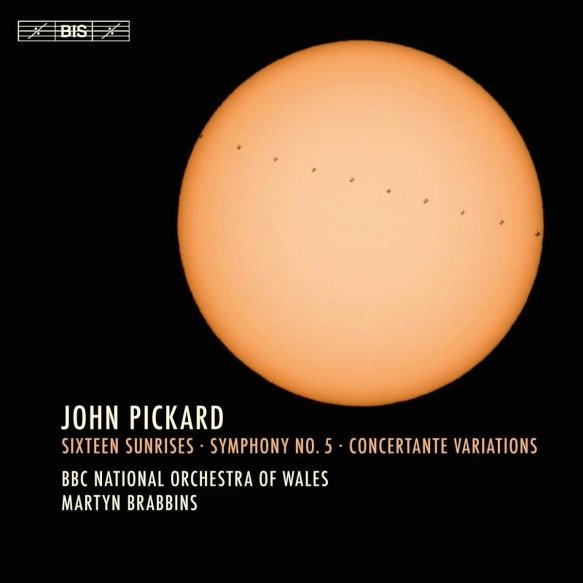
The fourth release in BIS’s survey of orchestral works by John Pickard (b1963), featuring his latest symphony and two shorter pieces which between them underline the expressive scope of his musical thinking; rounded off by his sparkling transcription of a Baroque perennial.
What’s the music like?
Pickard has long been established as a symphonist of stature, with the Fifth as resourceful as its predecessors – a 32-minute continuity which unfolds an uncompromising argument with real subtlety. A key factor is the writing for three sets of timpani, distributed spatially to the rear of the orchestra, that pursue antiphonal exchanges of motifs and chords but also evolve melodic lines to a degree seldom attempted. This is most evident towards the centre, where timpani lines are heard over dense string harmonies in music as audacious as it is mesmeric.
The piece arrives here via a series of interrelated faster and slower tempi, the latter gradually predominating without any tailing-off of momentum so that the greater prominence of faster tempos in the latter stages feels as if a process coming full-circle. Aligned with this is a four-movement outline – the initial Tempestoso segueing into a Prestissimo then a Maestoso, before the final section culminates in a return to the defiant opening gesture. This is followed by a coda that brings suspenseful calm while also intimating activity still to be encountered.
As to the remaining works, Sixteen Sunrises was written for the Nagoya Philharmonic and takes as its inspiration those sunrises observable over 24 hours from the International Space Station. Pickard conveys this through an intensifying sequence of climaxes whose subsiding into stasis feels more pronounced each time; a process enhanced by some of the composer’s headiest and most atmospheric orchestration. Not that this is in any sense a literal depiction, as his admonishment to listeners who might attempt to count the 16 sunrises makes plain!
By contrast, Concertante Variations was written for the Presteigne Festival (and premiered there by Orchestra Nova) and represents Pickard at his most urbane. Scored for wind quintet, strings and timpani, this unfolds as an introduction, five variations and fugal coda. The theme introduces each wind instrument in turn, then the variations (alternately fast and slow) feature them as ‘first among equals’, before the coda sees the strings assume centre-stage as the piece races towards its affirmative ending – albeit given a droll twist by the laconic closing gesture.
Commissioned by the BBC as the ‘fanfare’ to a festival celebrating four centuries of Italian music, Pickard’s transcription of Monteverdi’s Toccata (the extended version as heard at the start of the 1610 Vespers) includes tuned percussion in what is a scintillating curtain-raiser.
Does it all work?
Indeed, not least when the Fifth Symphony is given so powerful a recording (made right after the premiere) by the BBC National Orchestra of Wales (spearheaded by truly heroic timpani playing from Steve Barnard, Christina Slominska and Phil Hughes) under Martyn Brabbins, who has championed Pickard over two decades. Other pieces are no less committed in what is a finely balanced programme.
Is it recommended?
Very much so. The sound is arguably the best yet in this series (SACD benefits the depth and translucency of this music’s textures), while Pickard’s annotations inform and amuse by turns.
Richard Whitehouse
You can find more information on this release on the BIS website
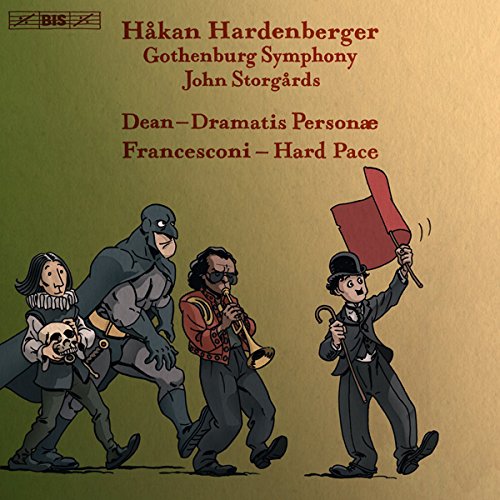
Dean Dramatis Personae (2013), Francesconi Hard Pace (2007)
Håkan Hardenberger (trumpet), Gothenburg Symphony Orchestra / John Storgårds
BIS (BIS 2067SACD)
What’s it all about?
Håkan Hardenberger returns with a further two concertos to add to the sizable number he has commissioned over these past three decades, as written by two leading composers from the middle generation whose musical aesthetics complement each other in almost every respect.
What’s the music like?
Well established as a violist before turning successfully to composition, Brett Dean (b1961) has several concertos among his output. As its title attests, Dramatis Personae evinces overtly dramatic connotations – not least those of Hamlet, an opera on which Shakespeare play Dean began writing immediately after the present work. Not that this concerto is about existential angst; rather it favours a distinctly sardonic take on the heroic concept – its initial movement, Fall of a Superhero, building from an anticipatory crescendo to an animated if increasingly fatigued interplay as subsides into enervated calm. Soliloquy proceeds as reflective dialogue whose elegiac quality takes on a renewed impetus in The Accidental Revolutionary, whose Chaplinesque humour reaches its apogee in the knockabout recessional which acts as coda.
A composer whose formative years were focussed on electronics, jazz and production, Luca Francesconi (b1956) has amassed a comparably diverse output where instrumental virtuosity is everywhere apparent. Not least in Hard Pace, a trumpet concerto that takes its cue from one of the instrument’s great practitioners. Although he never wrote or commissioned a concerto, Miles Davis delved extensively into those possibilities of varied accompaniment and sound diffusion everywhere audible in the Francesconi. This falls into two parts, the first building from eventful stasis to hectic activity before it suddenly ceases. The second part consists of three increasingly shorter sections – a taciturn Adagio whose emotional intensity spills over into the semi-cadenza of Miles, before the brief Finale brings matters to a decisive close.
Does it all work?
Yes. Neither of these concertos takes the all-round possibilities of the trumpet forward to the same degree as Peter Eötvös’s Jet Stream or Olga Neuwirth’s …miramondo multiplo… (both of which have been recorded by Hardenberger), but there can be no doubt as to their success in terms of demonstrating the instrument’s essential demeanour. That this is Hardenberger’s fourth disc of works for trumpet and orchestra on this label, moreover, wholly confirms his dedication to expanding what was once a genre proscribed both temporally and expressively.
The time has long gone when trumpeters searching for concertos outside of the Baroque or Classical eras had little more than that by Alexander Arutunian to draw on, for which sea-change Hardenberger can take no mean credit. His stentorian playing in both these pieces is further enhanced by an excellent contribution from the Gothenburg Symphony Orchestra, conducted by John Storgårds with sure understanding of that expressive ebb-and-flow between soloist and orchestra. Both the SACD sound and booklet notes are well up to BIS’s customary standards.
Is it recommended?
Indeed. A welcome and impressive addition to a discography which, formerly on Philips and latterly on BIS, has no equals when it comes to defining a repertoire for the trumpet such as younger practitioners can take forward in the knowledge its potential is far from exhausted.



 Fleming’s contributions grouped into a loose theme of distant light and transformation. Barber’s Knoxville: Summer of 1915 is a love letter to the American home, and its dappled evening sunlight flickered beautifully under the hands of Oramo, the composer’s warm harmonies setting the scene for Fleming’s characteristically full bodied interpretation. She inhabited the storyteller’s guise with effortless and instinctive calm, though the animated middle section was also very well judged. With just the right amount of sentimentality, this was an ideal performance, and an aptly chosen encore of the song Sure on this shining night blazed a similar trail.
 Finally we heard Carl Nielsen’s Second Symphony, ‘The Four Temperaments’, receiving its second Proms performance in three years after the festival’s complete neglect of it in the 20th century. It is a powerful piece, and this account made a strong impression. Although the feverish first movement (Choleric) was convincing and brilliantly played the emotional centre lay in the Melancholic third movement, where Oramo wrought music of impressive angst and depth. Nielsen’s struggles were resolved by the Sanguine finale, where the composer lets rip perhaps a little too easily, but again the structure and the melodic groups made perfect sense. Oramo has built a strong affinity with the Danish composer’s music over the years, and there was something very satisfying in these days of disunity at seeing a Finn conduct a Swedish orchestra in Danish music.
 Roger Vignoles is one of Britain’s best-established accompanists. Respected for his technical ability, experience, breadth of repertoire and the work he does nurturing singers old and new, he is regularly seen at the illustrious venues worldwide.
 Are the piano parts particularly challenging? When I have seen you play at the Wigmore Hall before they often feel orchestral in concept, as though you are having to voice a whole ensemble.