After an extended time out, Ryan Lee West – the man behind Rival Consoles – returns with his ninth album.
Having fallen out of favour with the creative process, West retreated and started composition by way of an audio scrapbook, where past clippings and musical sketches were transformed into fully fledged tracks.
What’s the music like?
There is a fresh, revitalized feel to Rival Consoles on this album. In fact West seems to be falling over an abundance of ideas, but has found the best way to get them all together and make an album that is consistently rewarding, colourful and durable.
There are many highlights, such as Coda and Drum Song, where percussive work and melodic craft work well hand in hand. Yet at times the music is at its most effective without a drum track, as on the start of Nocturne, or the reverie Tape Loop. 2 Forms brings both together intriguingly, starting in an ambient mood but with a sudden burst of acidic, quasi-industrial noise.
Gaivotas, meanwhile, is a great illustration of the colour West brings through from the studio, a rich and dazzling array of textures.
Does it all work?
It does – and the album only gets better and more rewarding with repeated listening.
Is it recommended?
Yes. If you’re a Rival Consoles fan then you will need no persuasion, but if you are new to his music then Landscape From Memory is a great place to start.
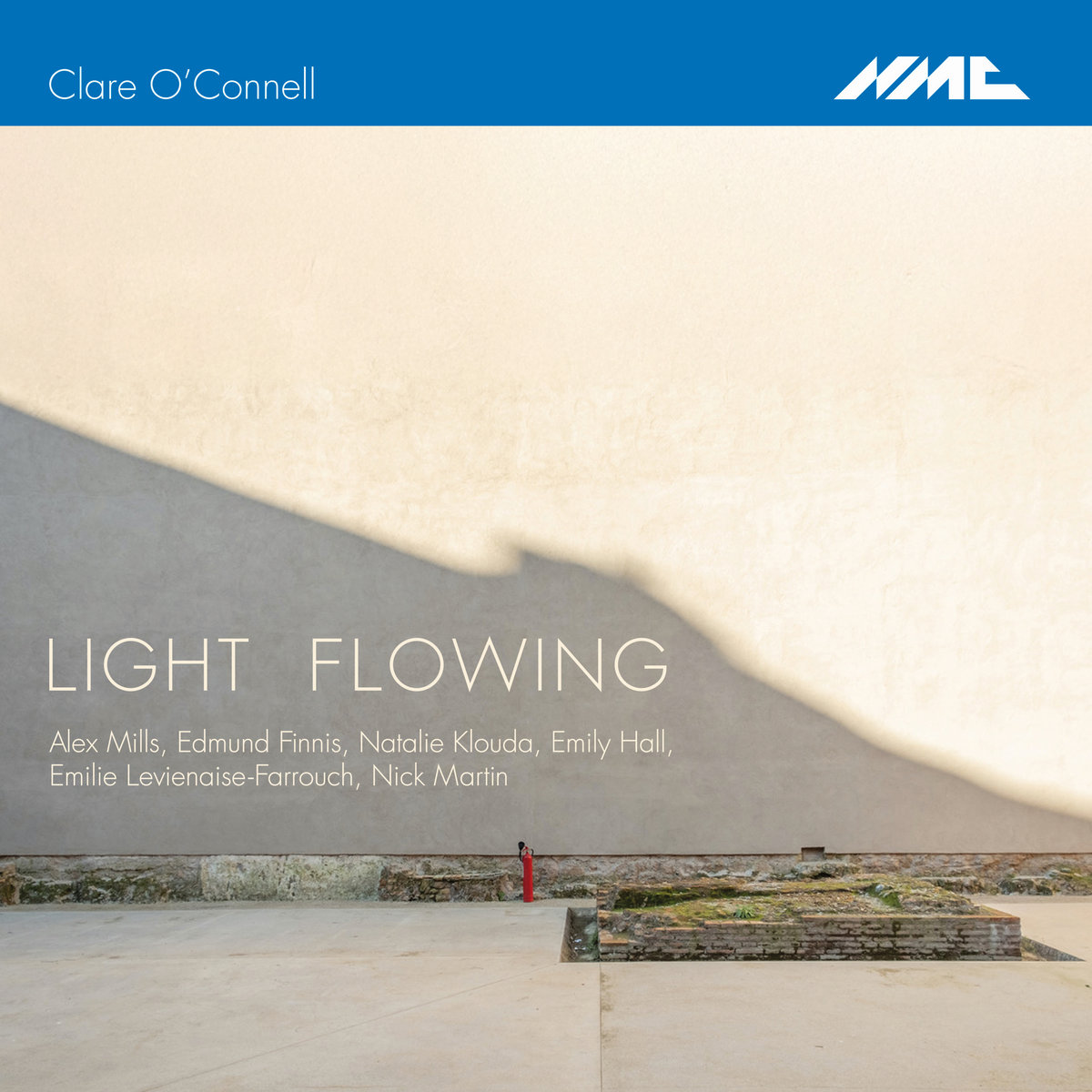
Cellist Clare O’Connell releases the Light Flowing album, which, in the words of the press release, is “inspired and tied together conceptually by ideas of light, depth, simplicity, the search for a perfect line, and capturing an otherworldly beauty that these carefully chosen composers represent within their different sound worlds.”
She looked for an ‘introverted introspective simplicity’, which is found through new compositions from five composers.
What’s the music like?
The music here is rather bewitching, in the best examples drawing the listener into a spell, with O’Connell playing beautifully.
Edmund Finnis contributes two examples, beginning with the Three Solos, expressive miniatures that O’Connell inhabits easily, especially the playful second solo with its pizzicato. Finnis allows for expansive thought in the outer two movements.
Meanwhile Emilie Levienaise-Farrouch contributes the imaginative four-part suite Opened, its movements based on the pitch of each of the cello’s four strings. Although it starts from the lowest ‘C’ string and works up, the pitches are closely linked and longer, sustained drones are used. The colours are subtly shaded, the musical motifs rich in thought and execution.
Natalie Klouda’s Uhteare is an excellent piece, packing a strong emotional punch but also falling naturally under the scope of the instrument, with a terrific end – O’Connell’s tone in the high register as sure and pure as it could be.
Emily Hall’s You Sail To The Sky is a meditative space, while Nick Martin’s two Vocalises find a hypnotic and compelling train of thought. The first floats down with delicate harmonics like a feather falling slowly through the sky, while the second floats most attractively, O’Connell’s cello ideal for its songlike profile. Prayerful, and lost in thought towards the end in contemplation, it disappears beyond the horizon.
Zenith introduces a timely change of sonorities, introducing the harp of Eleanor Turner, which has a more Japanese feel. An engaging discourse between the two instruments, it grabs the listener especially towards the end where O’Connell’s cello climbs higher. Then the sound descends to the depths as Marianne Schofield’s grainy double bass winds through a shadowy encounter as the first of three Figures Of Eight, Finnis writing a slight but compelling second movement drawing in the listener’s ear. The two instruments circle each other with pizzicato figures that get more insistent but stay largely quiet in the second movement, while the third has a richer, mellow sound
Does it all work?
It does, a thoughtfully planned recital executed with no little technical expertise.
Is it recommended?
Yes. The literature for solo cello is a rich body of work, right back to Bach in the 18th century, but this wide range of works illustrates how, with imagination, it is still possible for composers to explore new paths. Clare O’Connell proves a compelling communicator in bringing the pieces to life.
This is an intriguing collaboration between the multi-skilled producer and instrumentalist Matthew Herbert, and drummer / vocalist Momoko Gill. Clay is the result of a musical relationship begun in 2024 with the song Fallen.
Typically for Herbert releases there are some intriguing sound sources involved, with live improvisation and sampling paired with the use of instruments ranging from kotos to basketballs. In the words of the Bandcamp commentary, “Clay treads nimbly between the dancefloor and the more introspective moods of the early hours”.
What’s the music like?
Intriguing at the very least, and often touching on the sweet spot between the end of the night and the start of the morning, capturing a rarefied set of sounds.
Gill’s pure voice conjures memories of Sade on occasion, and with sensitive and creative drumming proves the ideal foil to Herbert’s creative production. As the album progresses the songs only get better and more substantial.
Mowing is reminiscent of early Herbert, with its ‘kitchen sink’ percussion paired with a sonorous vocal, and so is Fallen Again, a particularly beautiful number. Drums and vocals – upper and lower registers – trade off to good effect on More And More, while the vocals dovetail nicely with minimal accompaniment on the short Heart.
Animals pairs flickering riffs from percussion and keyboard with the voice, but the longer songs are even more effective, developing in hypnotic fashion. Fallen Again is definitely one of those, while Circle Shore, by contrast, proves to be a thoughtful coda led by Gill’s drums.
Does it all work?
It does, though where you listen is key, as sometimes the level dips on headphones and the intricate production cannot be fully appreciated. When at their peak, though, Gill and Herbert are frequently compelling.
Is it recommended?
Yes. With such creative minds in play the results could never be less than interesting, and with Clay Matthew Herbert and Momoko Gill have created a bewitching and seductive album.
For fans of… Jamie Lidell, M J Cole, Roisin Murphy, Dani Siciliano
Artist albums from established DJs in house and techno are relatively rare these days, which is one of a few explanations for Adam Beyer’s first album in over 20 years.
Swedish DJ Beyer runs the Drumcode label, but the title Explorer Vol.1 reflects a desire to explore different approaches and styles within and beyond techno.
What’s the music like?
Right from the start it is clear that a lot of thought as gone into this, and even though Explorer is an artist album it also works as an unmixed DJ set.
Beyer works the ebb and flow of the beats and breakdowns perfectly, keeping the listener’s attention with a wide range of material but getting the feet engaged at every opportunity too.
After the introduction, Taking Back Control has a good vocal, while Alto, with Layton Giordani, uses the familiar “What were the clouds like when you were young?” sample before a sturdy beat kicks in, courtesy of his collaborator.
Elsewhere, Explorer has real attitude, while Desolate Lands, a collaboration with Chris Avantgarde, stands out with its brilliant, roughed-up bass. Tanit adds a strong breaks undercarriage, Beyer getting a fine blend between styles with one eye straying towards the Mediterranean. Meanwhile The Distance Between Us has proper bite to it, a clash of styles that is definitely the sum of its parts. Finally The Long Way Home, like Tanit a track rescued from Beyer’s pre-COVID writing, is a cracker with which to end.
Does it all work?
It does – no skipping here! The beats are brilliant, too.
Is it recommended?
Very much so. An exciting new chapter of Adam Beyer’s career, Explorer has plenty of thrills and spills from beginning to end, stimulating the mind while it does maximum damage on the dancefloor. Very encouraging to see that it’s the first volume, too, as it demands a sequel!
Listen / Buy
You can listen to clips and explore purchase options at the Beatport website – and read more about Adam Beyer and previous releases on his own Drumcode label site
On this day in 1901, the composer Gerald Finzi was born in Oxford.
Finzi’s most popular pieces tend to be in slightly shorter forms, and his unique way of writing for strings has endeared him to many lovers of British music. Here is a great example, a piece more than suitable for a summer’s evening – the Romance for String Orchestra: