Arcana at the Proms – Prom 19: Jess Dandy, Senja Rummukainen, BBC SO & Sakari Oramo – Holst ‘Cloud Messenger’, Harvey & Elgar

Harvey Tranquil Abiding (1998) [Proms Premiere]
Elgar Cello Concerto in E minor, Op. 85 (1918-19)
Holst The Cloud Messenger, H111 (1909-10, rev. 1912) [Proms Premiere]

Jess Dandy (contralto), Senja Rummukainen (cello), BBC Symphony Chorus, BBC Symphony Orchestra / Sakari Oramo

Royal Albert Hall, London
Saturday 3 August 2024

reviewed by Richard Whitehouse Photos (c) Chris Christoudoulou

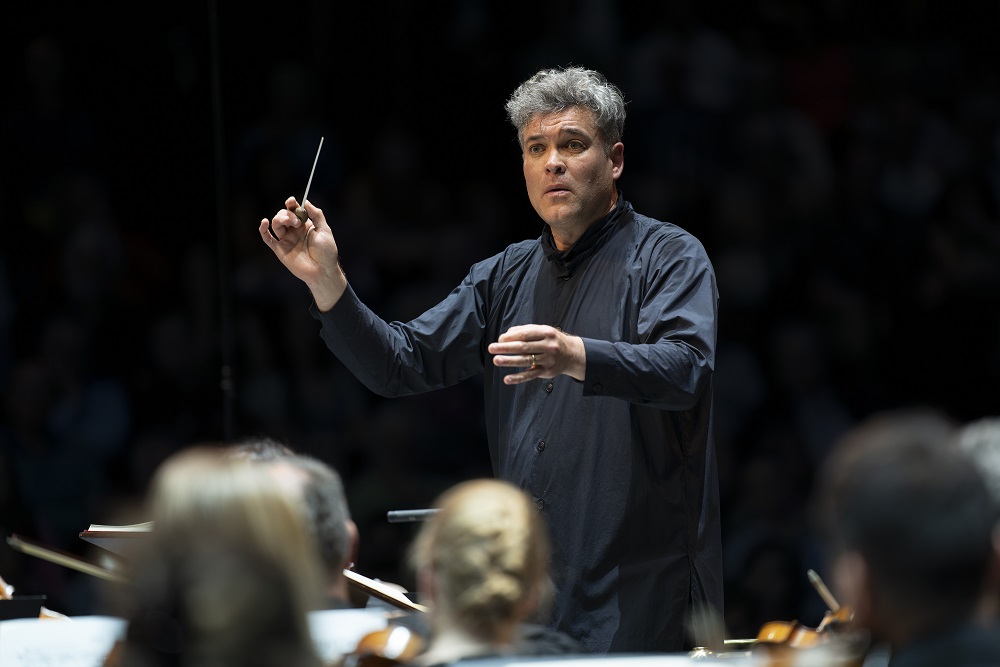
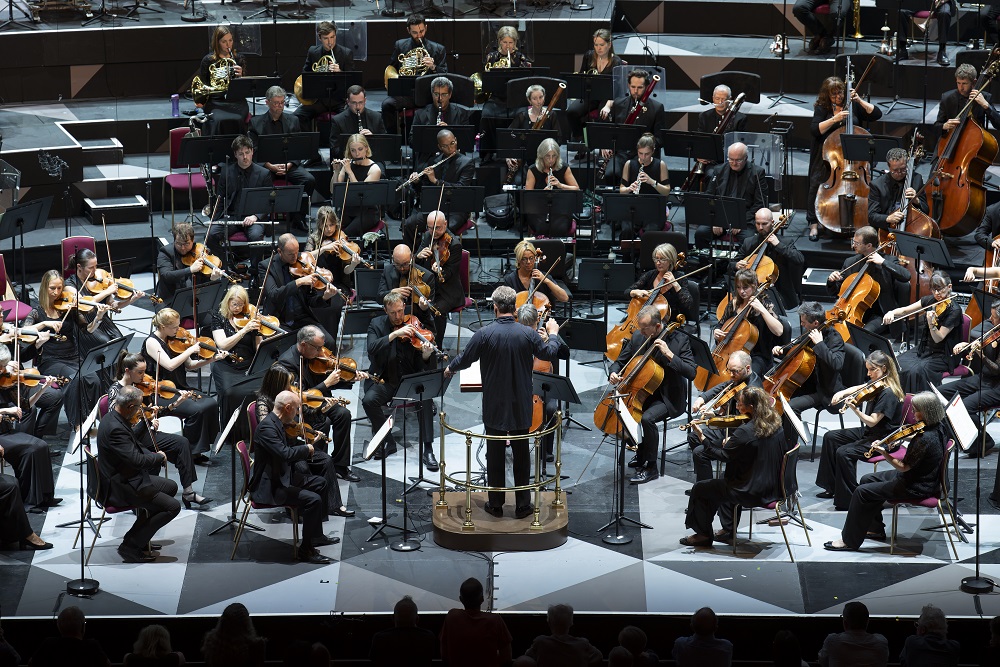
Now approaching his 12th season as chief conductor of the BBC Symphony Orchestra, Sakari Oramo tonight gave his first Prom of the season with this typically well-balanced programme of British music framing unfamiliar pieces past or (relative) present with a classic of its genre.

First came a welcome revival for Tranquil Abiding – doubtless one of Jonathan Harvey’s most immediately appealing works and one where the rhythm of ‘breathing’ central to so much of his later output is afforded lucid expression. The degree to which its melodic content emerges out of then returns into the surrounding texture was duly conveyed by Oramo, who ensured a real sense of expectation as this music took on an almost tangible impetus towards its climax. A pity that some restless and inattentive listeners robbed the final stage of its ‘ultimate calm’.

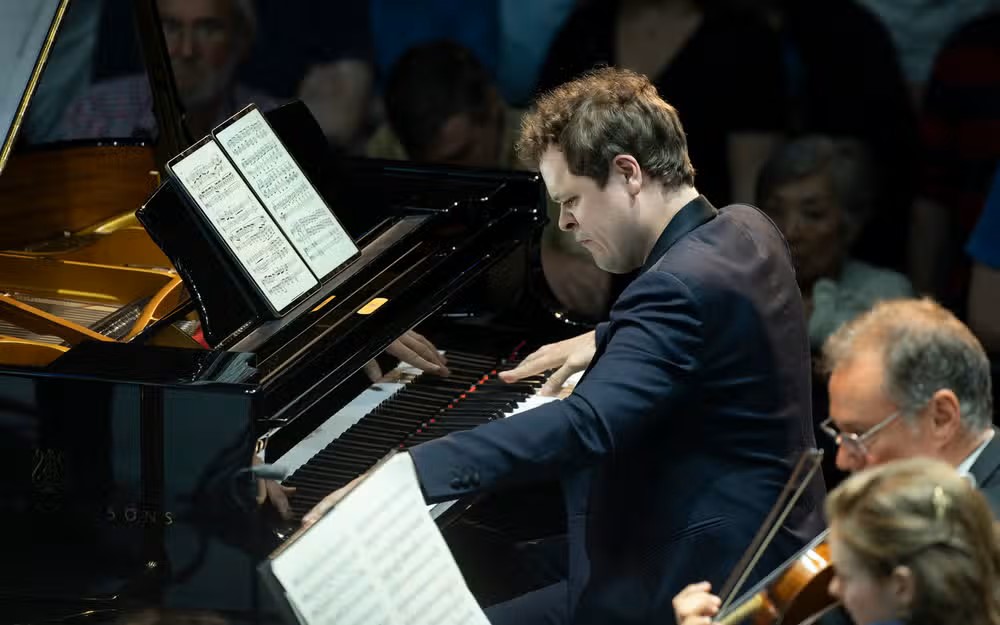
Long before it had the eminence it now enjoys, Elgar’s Cello Concerto was a regular Proms item through advocacy from Beatrice Harrison, Anthony Pini and, latterly, Jacqueline du Pré. Senja Rummukainen (above) thus joined a distinguished roster of soloists and, in the first movement at least, seemed a little inhibited in this context. Her arresting lead-in to the scherzo brought playing of greater involvement, both here and in an Adagio whose autumnal eloquence never risked sentimentality. The relatively lengthy finale was securely rendered, its themes incisive then genial, and if the development culminated a little portentously, the reprise was tellingly subdued before a moving apotheosis and curtly inevitable coda. Rummukainen can be heard again in London in the Dvořák concerto, with the BBC Concert Orchestra, this October 4th.

In the 150th anniversary of his birth, and the 90th anniversary of his death, a major revival by Gustav Holst was almost mandatory. Setting his translation from the Sanskrit of a poem by Kālidāsa, The Cloud Messenger never quite recovered from its evidently disastrous premiere such that revivals have been occasional. At almost 45 minutes, it is a demonstrable statement of intent whose expansive choral gestures are assured but almost anachronistic given Holst’s chamber opera Sāvitri redefined his conceptual approach and musical idiom barely a year before. Yet the present work amply foreshadows much of what was achieved over the next two decades, notably a freely evolving melisma mostly unimpeded by rhythmic precedent and a harmonic subtlety such as only needed greater refinement in its handling to realize its fullest potential.

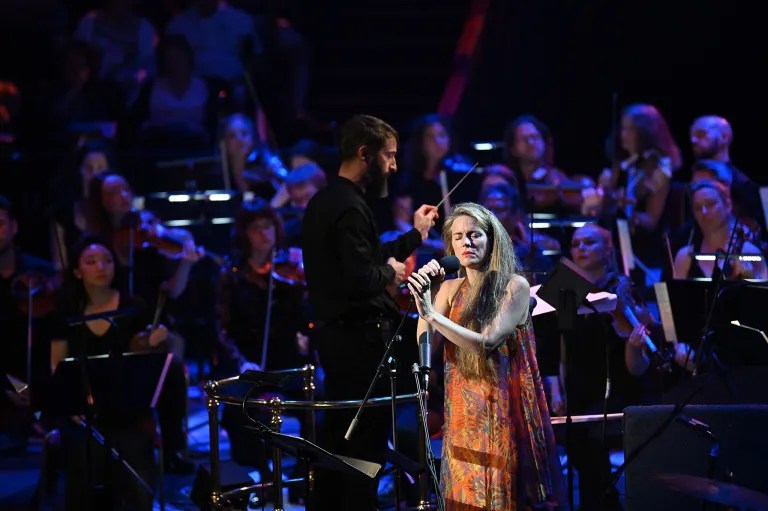
That much of this latter aspect was already in place is clear from those intimate passages for semi-chorus to the fore during its later stages, while the third of its five continuous section brought a confiding soliloquy that Jess Dandy (above) – contralto in the truest sense – realized with distinction. A pity she was not heard again, but the BBC Symphony Chorus was not found wanting beforehand or in that ethereal leave-taking with which the work evanesces, ‘Venus’-like, to its close. Whatever the stylistic inconsistencies, the best of it is Holstian to its core.

Now it is available in an expert reduction for chamber orchestra by Joseph Fort, The Cloud Messenger should attract more frequent hearings, but the Royal Albert Hall proved a fitting venue for this expansive original while Oramo’s perceptive performance did not disappoint.

For more on this year’s festival, visit the BBC Proms website – and for more on the artists involved, click on the names to read more about Jess Dandy, Senja Rummukainen, the BBC Symphony Chorus, BBC Symphony Orchestra and chief conductor Sakari Oramo

Published post no.2,261 – Monday 5 August 2024

Arcana at the Proms – Prom 10: Laura van der Heijden, BBC Scottish Symphony Orchestra & Ryan Wigglesworth – Britten, Frances-Hoad & Elgar

Britten Gloriana – Symphonic Suite Op.53a (1953)
Frances-Hoad Cello Concerto ‘Earth, Sea, Air’ (2022) [Proms Premiere]
Elgar Symphony no.2 in E flat major Op.63 (1909-11)

Laura van der Heijden (cello), BBC Scottish Symphony Orchestra / Ryan Wigglesworth

Royal Albert Hall, London
Friday 26 July 2024

reviewed by Richard Whitehouse

He might not be the only composer-conductor of his generation, but Ryan Wigglesworth has rapidly established himself among the best – as this concert with the BBC Scottish Symphony Orchestra, whose chief conductor he has been over these past two seasons, amply confirmed.

Other than Peter Grimes, the coolly received Gloriana was his only opera from which Britten extracted a concert suite. The vaunting syncopation of Tournament then wrenching fatalism of Gloriana moritura make for a telling framework, with this account at its most perceptive in the wistful poise of the Lute Song – the oboe being an eloquent replacement for the tenor thanks to Stella McCracken – then the evocative sequence of Courtly Dances where Britten effortlessly bridges the historical and the aesthetic divide between the eras of two Elizabeths.

Next a first Proms hearing (just over a year after its Glasgow premiere) for the Cello Concerto by Cheryl Frances-Hoad. Drawing inspiration from recent research into diverse aspects of the natural world, the three continuous movements provide an arresting vantage on an outwardly traditional form. Hence the trajectory of swifts in flight, carbon-absorbing algae over oceanic expanses and gravitational force of volcanic activity each influencing the musical content of a rhythmically impulsive Allegro, harmonically diaphanous Larghetto and melodically soaring Presto giocoso; the whole afforded unity through its composer’s motivic resourcefulness and the engaging commitment of Laura van der Heijden (above) in her realizing of its solo part. She then responded to deserved applause with a limpid reading of Pablo Casals’ The Song of the Birds.

Elgar is a composer evidently close to Wigglesworth’s heart and this evening’s account of his Second Symphony did not disappoint. Launched a little too circumspectly, the initial Allegro duly found a persuasive balance between bounding energy and that musing uncertainty to the fore in the otherworldly processional near its centre. Its overall extroversion was countered by the Larghetto – circumstantial association with the death of Edward VII having tempted many into a funereal pacing but not Wigglesworth, whose handling of its cumulative halves brought sustained emotional intensity framed by the stark lamentation with which it begins and ends.

One of Elgar’s most formally subtle and expressively audacious movements, the scherzo had the requisite impetuousness and nonchalance, thrown into relief by the mechanistic violence towards its core and unnerving energy at its close. Moderate in tempo and not overly majestic in outlook the finale might have been thought anti-climactic, but Wigglesworth’s keen sense of its long-term unfolding emerged in the searching ambivalence of its development and the understated grandeur of a peroration which did not require reinforcing with an organ pedal. Those closing pages could have yielded even greater pathos, but their suffused fatalism was wholly in accord with the conductor’s conception of this movement, as of the work overall.

Just over a year before, Wigglesworth presided over an inspirational account in Birmingham of The Dream of Gerontius. Tonight’s performance of the Second Symphony might not have been quite its equal, but it more than confirmed him as an Elgar interpreter of genuine stature.

For more on this year’s festival, visit the BBC Proms website – and for more on the artists involved, click on the names to read more about Laura van der Heijden, the BBC Scottish Symphony Orchestra and conductor Ryan Wigglesworth, and composer Cheryl Frances-Hoad

Published post no.2,253 – Sunday 28 July 2024

Arcana at the Proms – Prom 8: Nick Drake – An Orchestral Celebration

Olivia Chaney, Marika Hackman, BC Camplight, Scott Matthews, The Unthanks, BBC Symphony Orchestra / Jules Buckley

Royal Albert Hall, London
Wednesday 24 July 2024

reviewed by John Earls Pictures below (c) John Earls and (bottom) Chris Christodoulou

This November sees the 50th anniversary of the tragic death of the English singer-songwriter Nick Drake at the age of 26, having released just three albums of beautiful, bittersweet songs. Little known at the time, his reputation and influence has grown significantly.

This 2024 BBC Prom – an ‘orchestral celebration’ of his music – was destined to be something quite special and credit should go to British journalist and broadcaster John Wilson for proposing it.

Jules Buckley, here conducting the BBC Symphony Orchestra, has been involved in a number of BBC Proms over the years giving orchestral twists to contemporary music. Many of Drake’s songs were released at the time with string arrangements by Robert Kirby (it was good to hear Buckley pay tribute to Kirby who he referred to as “Nick Drake’s foil”) and these were developed, as well as some new ones added, by a number of other arrangers for this concert.

Following a gripping opening of the instrumental Introduction from Drake’s Bryter Layter album, BC Camplight gave excellent performances of Fly and Pink Moon which was deftly accompanied by strings and horns. Alas, his closing of the concert with Drake’s classic Saturday Sun didn’t quite cut it, being a bit too schmaltzy for this reviewer. However, the final all orchestral piece, an arrangement by Sam Gale of Horn, a sparse solo guitar piece from Pink Moon, was luminous and intense, culminating in a poignant solo trumpet.

Marika Hackman gave enchanting versions of Fruit Tree and River Man and her take on Time Has Told Me was a wonderfully smoky blues accompanied by drums, organ and guitar (Neill MacColl did some sterling work throughout the evening).

Scott Matthews opened his account with a wonderful Way to Blue with dramatic strings and timpani which, from where I was sitting, at times slightly overpowered his delicate voice, something rectified in the second half for his lovely performances of Northern Sky and From the Morning.

Olivia Chaney (above) gave a strong vocal performance of Hazey Jane I and a terrific version of At the Chime of a City Clock where the strings and horns were again particularly effective. Her solo piano rendition of Time of No Reply was outstanding.

Two of the most moving moments did not feature Nick Drake songs at all but those of his mother Molly. The Unthanks performed touching versions of What Can a Song Do to You? and Set Me Free and were joined by Drake’s sister Gabrielle reciting some of Molly’s poems in both cases. It was extremely affecting.

One can only imagine what Gabrielle Drake must have thought hearing the songs of her brother (and mother) performed in this way after so many years to a packed Royal Albert Hall that listened respectfully and lovingly. It was fitting testimony to the enduring quality of the music of an extraordinary songwriter.

This concert (including interval discussion with John Wilson, Radio 3 presenter Elizabeth Alker and Gabrielle Drake) is available on BBC Sounds until early October. For more on the 2024 BBC Proms, visit the festival’s website at the BBC, and click on the link to read John Earls’ review of Richard Morton Jack’s biography on Nick Drake: The Life. 

John Earls is Director of Research at Unite the Union and tweets / updates his ‘X’ account at @john_earls

Published post no.2,250 – Thursday 25 July 2024

Arcana at the Proms – Prom 5: BBC National Orchestra of Wales & Ryan Bancroft – Schoenberg & Zemlinsky

Schoenberg Pelleas und Melisande Op.5 (1902-03)
Zemlinsky Die Seejungfrau (1902-03)

BBC National Orchestra of Wales / Ryan Bancroft

Royal Albert Hall, London
Monday 22 July 2024

reviewed by Richard Whitehouse

While the Proms has periodically resorted to re-creating concerts from its earlier years, there have been relatively few attempts to recreate groundbreaking events elsewhere – so making this replication of a programme played in Vienna on 25th January 1905 the more significant. Neither work enjoyed regular revival until the 1980s – the Schoenberg through logistics and the Zemlinsky through inaccessibility – but their expansive all-round scope, and their lavish forces, ensured that both were heard to advantage in the opulent Royal Albert Hall ambience.

It is not clear whether this running-order was that of the Vienna concert, where Schoenberg’s symphonic poem Pelleas und Melisande was lauded as the more original statement. Which is true as regards its late-Romantic idiom on the cusp of nascent Modernism, but the composer made things more difficult than they might be through his approach to form, whose outcome Busoni likened to ‘‘a number of sharp implements jostling in a sack’’. Maurice Maeterlinck’s drama may be covered in its essentials, but the challenge of channelling this into a systematic evolution make for an undeniably episodic trajectory. Ryan Bancroft succeeded admirably in holding together the sprawling whole, not least with his relatively swift (40-minute) traversal that kept the narrative aspect always in focus, while emphasizing the numerous harmonic and textural innovations. Nor was the BBC National Orchestra of Wales lacking in power, finesse or, indeed, that clarity needed to convey the density of Schoenberg’s motivic thinking, but the feeling of this work being ultimately being no more than the sum of its parts was inescapable.

Not something as could be levelled at Die Seejungfrau, Zemlinsky’s symphonic fantasy after Hans Christian Andersen that was well received if soon condemned as unduly derivative and disappeared after the score was withdrawn in 1907 – only to resurface 77 years later. It might lack the force and personality of Schoenberg, but Zemlinsky’s handling of an orchestra only slightly less extensive is comparatively effortless; the formal division into three movements of almost equal duration providing an overview of, without being beholden to the narrative, while enabling its composer’s hardly less resourceful handling of motifs to evolve with due artlessness. True, Zemlinsky’s melodic language leans more audibly on others (chief among them Tchaikovsky and Mahler), but its unforced spontaneity feels in striking contrast to the portentous, even over-wrought aspect of Schoenberg’s writing. BBCNOW responded with unfailing sensitivity, and Bancroft ensured a seamless unfolding over each movement as of the work overall. For all its stylistic derivation, Zemlinsky’s is intrinsically the better piece.

Such an outcome may not have been evident had the pieces been otherwise juxtaposed, such as only made the decision to present them thus the more worthwhile. Clearly attuned to their notably differing idioms, Bancroft brought out the best in both works (interestingly he opted to omit the ‘Sea Witch’ episode from the second movement, excised before the premiere but restored in the critical edition of 2013) – their respective qualities able to be assessed in more objective terms, now that consideration of ‘historical necessity’ has itself receded into history.

For more on this year’s festival, visit the BBC Proms website – and for more on the artists involved, click on the names to read more about the BBC National Orchestra of Wales and conductor Ryan Bancroft. Dedicated pages for the composers can be accessed by clicking on Schoenberg and Zemlinsky

Published post no.2,249 – Wednesday 24 July 2024

In concert – Mary Bevan, CBSO / Edward Gardner: Schubert – Symphony no.9 & Songs

Mary Bevan (soprano), City of Birmingham Symphony Orchestra / Edward Gardner

Schubert
Rosamunde D797 – No. 3b, Romanze (1823)
Der Erlkönig D328 (1815, orch. Berlioz 1860)
Die Forelle D550 (1816, orch. Britten 1942)
Im Abendrot D799 (1825, orch. Reger 1914)
Geheimes D719 (1821, orch. Brahms, 1862)
Symphony no.9 in C major D944 ‘Great’ (1825-6, rev. 1828)

Symphony Hall, Birmingham
Wednesday 17 May 2024

Reviewed by Richard Whitehouse Pictures by Benjamin Ealovega (Ed Gardner), Victoria Cadisch (Mary Bevan)

July concerts no longer a consistent fixture in the City of Birmingham Symphony Orchestra’s schedule, it made sense to end the current season with the intended programme for the fourth and final volume of this orchestra’s Schubert cycle with former chief guest conductor Edward Gardner.

If not his final such project, the ‘Great’ was the final symphony that Schubert finished and the culminating orchestral work of his last decade. Now, as almost two centuries ago, it is not an easy work to being off – but this account hit the ground running with a flowing yet purposeful introduction that elided seamlessly with the initial Allegro. Gardner kept momentum on a sure yet flexible rein over those impetuous and capricious themes of its exposition; underlining the subtly eddying tension of its development and a propulsive coda whose link-up with the tempo of that introduction was marred only by the too emphatic final gesture. Respectively plaintive or consoling, the Andante’s alternate episodes were brought into eloquent accord – the fanfare -riven anguish at its climax then the stark fatalism towards its close being especial highlights.

The essential link between the scherzos of Beethoven and Bruckner, the third movement had the right buoyancy but also a suavity in keeping with the Viennese character of its dance-like themes, and complemented by those of its trio whose lilting elegance were tinged by wistful regret. Launched with a commanding call-to-attention, the Finale did not lack for vigour but, unlike so many performances, Gardner was mindful not to rush either here or in the capering second theme whose relentless string accompaniment was vividly rendered. The development more than fulfilled its purpose as an extended transition into the reprise, then the coda opened with a frisson of anticipation such as underpinned the closing pages as they powered towards the decisive but never headlong close to what was a convincing and engrossing performance.

Regarding repeats, Gardner observed that of the first movement’s exposition but not those in the second half during either scherzo or trio, and that of the finale’s exposition. This at least made matters easier for the players, and left options open for their inclusion in the recording.

That forthcoming release on Chandos will hopefully find room for the five songs that formed the first half of this concert, with each of them arranged by a different composer. The pensive Romanze from Schubert’s incidental music to Rosamunde was heard in the composer’s own orchestration, with the compact psychodrama of Der Erlkōnig in a resourceful and nowadays overlooked orchestration by Berlioz. The looping but not always ingratiating playfulness of Die Forelle was expertly attended to by Britten, while the pensive soulfulness of Im Abendrot summoned an appropriate response from Reger; the sombre resignation of Geheimnis making for a welcome encore in its orchestration by Brahms. Throughout the selection, Mary Bevan’s veracity of emotional response and her clarity of enunciation were qualities worth savouring.

This programme may have concluded the Schubert cycle by Gardner and the CBSO, though hopefully it will not see of this partnership in recorded terms – the symphonies of Schumann, and maybe Brahms, being well worth considering as additions to the orchestra’s discography.

For details on the 2024-25 season A Season of Joy, head to the City of Birmingham Symphony Orchestra website. Click on the names to read more about soprano Mary Bevan and conductor Edward Gardner

Published post no.2,243 – Thursday 18 July 2024