In concert – Sacconi Quartet & Festival Voices: Earth Unwrapped – Terry Riley’s Sun Rings

Sacconi Quartet [Ben Hancox, Hannah Dawson (violins), Robin Ashwell (viola), Cara Berridge (cello]; Festival Voices [Lucy Cronin, Ana Beard Fernández, Lucy Goddard, Sam Jenkins, Michael Craddock, Oskar McCarthy] / Greg Batsleer; Brett Cox (electronics)

Riley Sun Rings (2002)

Hall One, Kings Place, London
Thursday 16 January 2025

by Ben Hogwood Pictures courtesy of Monika S Jakubowska / Kings Place

A sobering thought: in the course of this concert, the NASA spacecraft Voyager 1 travelled another 60,000 miles away from the Solar System.

Quite how far it will travel in the course of the Kings Place festival Earth Unwrapped remains to be seen, but by that time audiences will have enjoyed a wide array of musical and visual treats, all designed to heighten awareness of the plight in which we find ourselves here on planet Earth.

Such thoughts were close to the surface throughout Sun Rings, an ambitious start to the festival. The substantial work was completed by Terry Riley in 2002, the result of an approach made by NASA to the Kronos Quartet. They wanted to create a work based on recordings of ‘space sounds’ (plasma waves) from Voyager 1 made by Professor Donald Gurnett. Riley had these transferred to audible audio frequencies in order to mark 25 years since the spacecraft was launched, at the same time contemplating the place of humanity in the universe. Since Sun Rings was completed, Voyager I has passed from the Solar System to interstellar space.

The Kronos Quartet released their recording of Sun Rings in 2019 (reviewed by Arcana here), and until now were the only ensemble to have played the piece in public. This UK premiere from the Sacconi Quartet and Festival Voices changed that, an illustration of the ever-growing reach of ‘minimalist’ music. The twelve assembled on stage performed heroically, the unbroken span of ten movements lasting 90 minutes yet delivered with flair, poise and no little emotion.

The music was prefaced by words from Riley himself, a stamp of authenticity and gratitude from the 90-year-old composer. It was the first of many audio clips carefully managed by Brett Cox, whose contributions were crucial to the success of the performance. Chief among these were the audio translations of the Voyager craft itself, converted by Riley from spectrographs. They provided an industrial edge to the sound – reminiscent of Voyager contemporaries Cabaret Voltaire – and were alternately eerie and consoling in their different sound worlds. As the audience sat in the dark the notion of being on our own journey was inescapable, a reminder that our own planet moves even quicker than Voyager 1 itself.

The quartet made a strong start, bolstered by colourful percussion. The Overture, Hero Danger and Beebopterismo sections had rhythmic vitality, complemented by the electronics and samples. Towards the halfway mark however the momentum and intensity flagged, the notion of deep space now all around us but feeling more oppressive. Time stood relatively still in the eerie Earth / Jupiter Kiss section, though Riley’s musical intensity flagged before being re-energised by the Festival Voices. The excellent singers brought expression and impetus to Earth Whistlers and Prayer Central, but on occasion it was difficult to hear some of the words, the singers’ pitch aligned with the frequency of the audio recordings.

The most powerful music, ironically, was the slowest and the most restrained. The coda, One Earth, One People, One Love, became a deeply felt meditation, the singers whispering under their breath as they moved slowly to the exit in an inspired piece of choreography. The pensive strings remained, adding their commentary to recorded spoken word, whose statements could not have been more apt.

As I write this, the news of alarming carbon dioxide levels in the Earth’s atmosphere serves as a reminder of our changing world, hurtling towards the environmental precipice. This stark reality check confirms Earth Unwrapped to be arguably the most important arts festival in London this year – and this was an auspicious start.

For more information on the Earth Unwrapped festival, head to the Kings Place website. Click on the artist names for Sacconi Quartet and Festival Voices, and composer Terry Riley. You can visit NASA to find out where Voyager 1 and Voyager 2 are now

Published post no.2,415 – Saturday 17 January 2025

In concert – Quatuor Danel: Shostakovich & Weinberg #8 @ Wigmore Hall

Quatuor Danel [Marc Danel & Gilles Millet (violins), Vlad Bogdanas (viola), Yovan Markovitch (cello)]

Shostakovich String Quartet no.11 in F minor Op.122 (1966)
Shostakovich String Quartet no.12 in D flat major Op.133 (1968)
Weinberg String Quartet No. 12 Op.103 (1969-70)

Wigmore Hall, London
Wednesday 15 January 2025

by Richard Whitehouse Photo (c) Marco Borggreve

This latest instalment in Quatuor Danel’s traversal of the string quartets by Shostakovich and Weinberg comprised the Twelfth Quartets from both composers – masterpieces both, and was prefaced by the teasing brevity and obliqueness of the former’s preceding such composition.

His 60th year marked the onset of Shostakovich’s ‘late period’ – its overt introspection being appropriate for a piece dedicated to the memory of Vasily Shirinsky, former second violinist of the Beethoven Quartet who premiered all but the first and last of the composer’s cycle. In fact, the Eleventh Quartet is appreciably more varied than this memorial aspect may suggest – the Introduction initiating a subdued discourse given an ironic twist in the Scherzo then erupting combatively in the Recitative, prior to the anxiety of the Etude and ruthlessness of the Humoresque. This performance came into its own with the Elegy, a remembrance of enfolding pathos – after which, the Finale assumed that retrospective function found in many of Shostakovich’s later works with due emphasis on its stealthy and quixotic humour.

Just two years on brought Shostakovich’s Twelfth Quartet – if not his greatest then surely in the top two, while arguably uncharacteristic in its self-conscious yet masterly formal design. Although not introductory as such, the Danel was mindful to keep its opening movement on a tight rein such that its interplay of mood and tempo inferred without defining those seismic confrontations to come. This longest and most diverse of its composer’s quartet movements did not disappoint – the Danel having fullest measure of an 18-minute span whose eventual subsiding presages a pizzicato-driven assault the more visceral for being so methodical in its unfolding. Nor was the allusion to initial material at all misconstrued as this work enters its climactic phase, a transformation whose unbridled affirmation was powerfully in evidence.

It might have emerged barely 18 months on, but Weinberg’s Twelfth Quartet feels comparable only in its scope and ambition. A likely response to the creative radicalism this composer had encountered on returning to his native Poland after over a quarter-century, its four movements essentially reinvent the Classical archetype so that the opening Largo outlines a succession of amorphous or disruptive elements with little audible regard for just how they might interact – something that will only come into focus as the work unfolds while opening-out expressively.

This evolution takes in a stealthy if always speculative Allegretto, and a Presto whose violence has become assaultive by its close. It remains for the final Moderato to effect closure through a synthesis almost improvisatory for all its formal rigour. Allied to this comes a dominance of playing techniques that does not intensify the music as drain it of all emotion and so reduce it to merest gestures by the end. A remarkable piece, even so, and a testament to its composer’s tenacity in the face of an unsympathetic, often antagonistic cultural climate at home or abroad.

Tonight’s impressive reading almost had to be abandoned as Gilles Millet’s bridge collapsed just before the end of the third movement, but his last-minute location of a replacement saw it resume to the close – an unexpected hiatus seemingly in accord with this extraordinary work.

You can hear the music from the concert below, in recordings made by Quatuor Danel -including their most recent cycle of the Shostakovich quartets on Accentus:

For more information on the next concert in the series, visit the Wigmore Hall website. You can click on the names for more on composer Mieczysław Weinberg and Quatuor Danel themselves.

Published post no.2,414 – Friday 17 January 2025

In concert – David Cohen, London Symphony Orchestra / Sir Antonio Pappano: Vaughan Williams 9th Symphony, Elgar & Bax

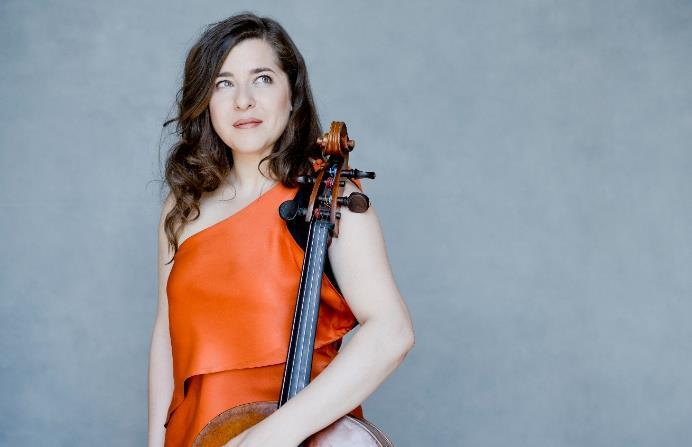
David Cohen (cello), London Symphony Orchestra / Sir Antonio Pappano

Vaughan Willams Symphony no.9 in E minor (1956-57)
Elgar Cello Concerto in E minor Op.85 (1919)
Bax Tintagel (1917-19)

Barbican Hall, London
Sunday 15th December 2024

Reviewed by Richard Whitehouse Picture (c) Mark Allan

Sir Antonio Pappano‘s conducting of Vaughan Williams’s Sixth Symphony in March 2020 will be recalled as almost the final live event before the descent of lockdown. Forward to the present found him tackling the composer’s Ninth Symphony under outwardly different circumstances.

Such context is significant given this work picks up where its predecessor left off, the Sixth’s fade into nothingness making possible that ominous and otherworldly beginning of the Ninth. Few conductors opt for its rapid metronome markings, but Pappano’s was an unusually broad conception of a first movement whose Moderato maestoso marking was evident throughout. Any lack of cumulative fervency was more than countered by a luminosity which permeates the music’s textures, and nowhere more so than with that lambent aura conveyed by its coda.

More an intermezzo than slow movement, the ensuing Andante sostenuto may have taken its cue from Hardy’s Tess of the D’Urbervilles but its interplay of bleakness, violence and ardour satisfies on its own terms and Pappano’s take was audibly cohesive. Nor did he misjudge the Allegro pesante of a scherzo which veers between the martial, sardonic and the ethereal with as much formal freedom as VW allows his ‘reeds’ in pointing up its expressive recalcitrance. Despite being marked Andante tranquillo, the finale is no peaceful comedown and Pappano was mindful to balance the expansively unfurling arcs of its opening half with the mounting intensity of what follows. Moreover, those three seismic ‘gestures of farewell’ summoned an emotional frisson that felt comparable to anything Vaughan Williams had previously written.

If it no longer elicits the lukewarm response as at its premiere, the Ninth Symphony remains elusive and often disquieting. Securing an impressive response from the London Symphony Orchestra, flugel horn and saxes evocatively in evidence, Pappano certainly had its measure.

A pity it was thought necessary to place this work in the first half, as following it with Elgar’s Cello Concerto felt a little anti-climactic. Not that David Cohen, securely established as LSO section-leader, was other than committed – his reading, gaining conviction as it unfolded, at its best in an Adagio of suffused eloquence then a finale that built purposefully to a soulful if not unduly emotive culmination and brusque payoff. Neither the unfocussed first movement nor a brittle scherzo hit the mark but, overall, this account was more then the sum of its parts.

Following Vaughan Williams’s and Elgar’s last major works with a middle-period one by Bax might be thought sleight-of-hand as regards programming, but the latter’s March for the 1953 Coronation would hardly have seemed apposite and Tintagel provided an undeniably rousing send-off. For all its indebtedness to Debussy, its surging Romanticism is its own justification and Pappano ensured that every aspect of this alluring (and on occasion lurid) seascape could be savoured to the fullest – not least its apotheosis then a conclusion of resplendent opulence.

Hopefully Pappano will schedule further British music in addition to continuing his Vaughan Williams cycle. Whatever else, Bax seems tailor-made for the LSO’s virtuosity such that his Second or Sixth symphonies, or another of his tone poems, would assuredly leave their mark.

For more on the 2024/25 season, visit the London Symphony Orchestra website – and for more on the artists click on the names David Cohen and Sir Antonio Pappano. Resources dedicated to the composers can be found by accessing the Vaughan Williams Society, The Elgar Society and the recently formed Sir Arnold Bax Society

Published post no.2,397 – Thursday 19 December 2024

In concert – Pocket Ellington @ The Vortex

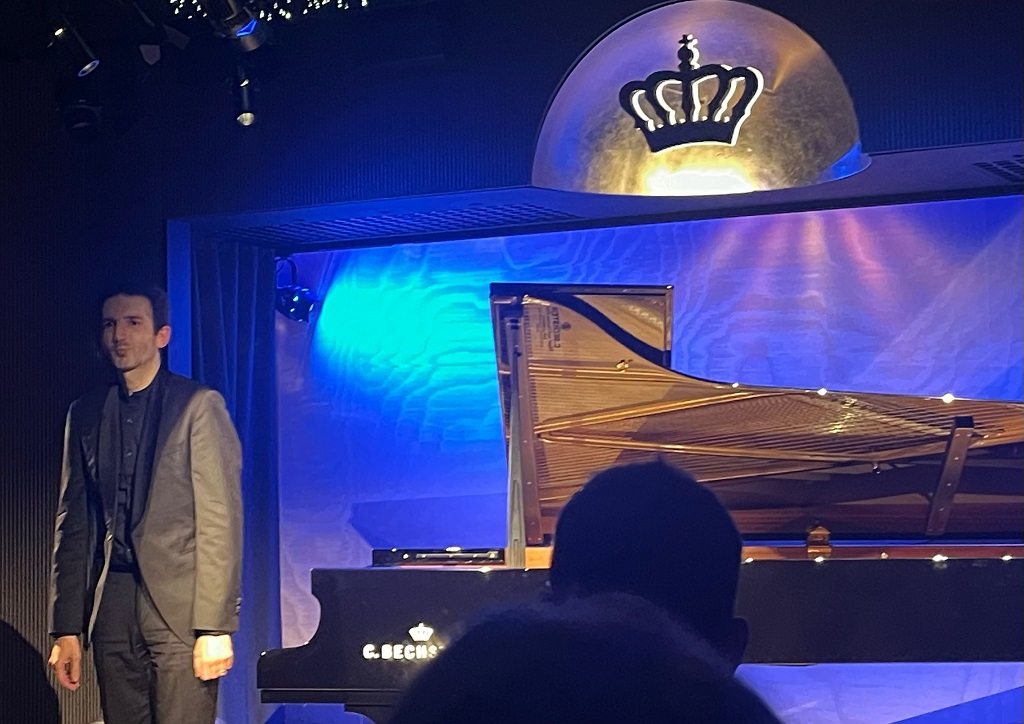
Alex Webb (piano, musical director), Tony Kofi (tenor saxophone), Alan Barnes (saxophones/clarinet), David Lalljee (trombone), Andy Davies (trumpet), Dave Green (double bass) and Winston Clifford (drums)

The Vortex, London, 14 December 2024

by John Earls. Photo credit (c) John Earls

One might think at first that the idea of a ‘Pocket Ellington’ – big band jazz played by a smaller ensemble – is something of a contradiction if not illogical. But then there’s the tunes and then there’s this particular group of musicians (under the musical direction of Alex Webb) and their love of the music.

Duke Ellington’s stature and influence as a pianist, composer and band leader is pretty much unsurpassed. Miles Davis is supposed to have said “At least one day out of the year all musicians should just put their instruments down, and give thanks to Duke Ellington”. So it was fascinating to see and hear this seven piece band interpret some of the best big band charts there are.

Three of the Ellington compositions played – Main Stem, What Am I Here For and Happy Go Lucky Local – feature on his Piano in the Background album which contains the following lines in Irving Townsend’s sleeve notes: “The piano used for this album has three more keys than regular pianos, allowing Duke to play ninety-one keys instead of eighty-eight. He wants you to know that he played them all madly”. I assume Alex Webb’s piano had the standard number of keys but I was reminded of this quote with some of his playing and the enthusiasm and respect for the music that was on display from the rest of the band.

Mood Indigo featured some raspy trumpet from Andy Davies and smoky tenor saxophone from Tony Kofi as well as Alan Barnes“more reeds than you can shake a stick at” according to Webb – playing saxophone and clarinet.

As well as compositions by Ellington there was also a nod to other artists influenced by him. Thelonious Monk’s Ruby, My Dear and Monk’s Dream were combined in a fantastic Ruby, My Dream medley and Charles MingusBoogie Stop Shuffle featured some terrific mute trombone by David Lalljee who also went full throttle on Gil EvansLas Vegas Tango. The rhythm section of Dave Green (double bass) and Winston Clifford (drums) were solid throughout.

It wasn’t just full-on swing either. Come Sunday (from Ellington’s Black, Brown and Beige suite) was smooth and gorgeous with the horns in lovely collective harmony and the ballad Day Dream enchanting.

Day Dream is a Billy Strayhorn composition and not surprisingly, given that Strayhorn was Ellington’s great songwriting collaborator and friend, there were a number of other Strayhorn tunes in the set. These included a moving Blood Count which was the last finished piece that Strayhorn wrote. It features on the terrific album of Strayhorn tunes by Ellington and his Orchestra …And His Mother Called Him Bill recorded in 1967 after Strayhorn’s death. On the album the saxophone is played by Johnny Hodges for whom Strayhorn often wrote – “We have our own Johnny Hodges” said Webb acknowledging Alan Barnes’ affecting rendition. (Apparently, Ellington never played the tune again after the recording session.)

The set finished with – what else? – the Ellington Orchestra’s signature tune Take the “A” Train (another Strayhorn composition). It was a great version of a great tune that has a great story (the title refers to the opening words with which Ellington gave Strayhorn directions to get his house by subway but there’s more to it than that). It was a fitting end to a wonderful night’s live music paying tribute to one of the greats.

John Earls is Director of Research at Unite the Union. He posts on Bluesky and tweets / updates his ‘X’ content at @john_earls

Published post no.2,395 – Monday 16 December 2024

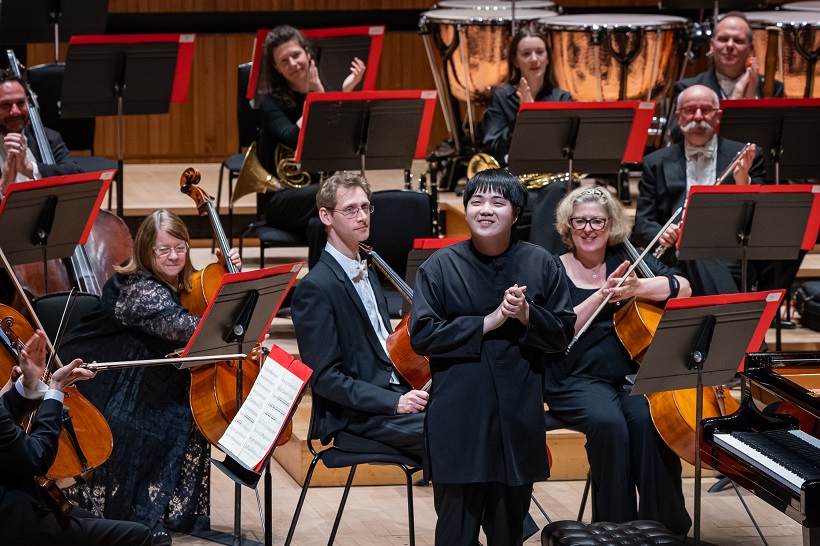
In concert – Martin Helmchen, CBSO / Kazuki Yamada: Mozart Piano Concerto no.26 & Bruckner Symphony no.9

Martin Helmchen (piano, below), City of Birmingham Symphony Orchestra / Kazuki Yamada (above)

Mozart Piano Concerto no.26 in D major K537 (1788)
Bruckner Symphony no.9 in D minor WAB109 (1887-96, ed. Nowak)

Symphony Hall, Birmingham
Thursday 12 December 2024

Reviewed by Richard Whitehouse Pictures (c) Beki Smith (Kazuki Yamada), Giorgia Bertazzi (Martin Helmchen)

This last concert before its Christmas and New Year festivities found the City of Birmingham Symphony Orchestra back with music director Kazuki Yamada for a coupling of Mozart and Bruckner that worked well as a programme over and above its D major-D minor framework.

Lauded for decades after his death, Mozart’s Piano Concerto no.26 was then dismissed as one of his few mature failures through a steely brilliance concealing little, if any, more personal expression. While it may lack the pathos or ambivalence that inform its dozen predecessors, its extrovert nature is complemented by a poise to which Martin Helmchen was well attuned. The martial undertow of its opening Allegro was offset by its winsome second theme and by the harmonic freedom of one of Mozart’s most capricious developments, then the Larghetto had a lilting charm cannily offset by the suavity of the closing Allegretto. That the autograph omits much of its piano’s left-hand part has led others to extemporize their own completion, but Helmchen restricted himself to cadenzas that were inventive and never less than apposite.

Yamada and the CBSO were unwavering in support, making for a performance that certainly presented this work to best advantage and reaffirmed Helmchen’s credentials as a Mozartian. Hopefully this soloist’s and conductor’s first Birmingham collaboration will not be their last.

Birmingham audiences had not so far encountered Yamada in Bruckner but, on the basis of his Ninth Symphony, here is a composer for whom he has real affinity. Not that this performance had it all its own way – the first movement, if not lacking either solemnity or mystery, did not quite cohere across its monumental span. Each thematic element was potently characterized, but their underlying follow-through felt less than inevitable such that the development lacked something of the centripetal force needed for a properly seismic impact, though the coda built with due remorselessness to a baleful close. If the Scherzo’s buoyant outer sections eschewed the ultimate violence, Yamada judged almost ideally the contrasting tempo for its trio – which latter emphasized a spectral or even sardonic humour which is surely unique in this composer.

In the absence of a finale (though such a movement was well on its way towards completion, as numerous realizations attest), the Adagio represents this work’s nominal culmination. Here orchestra and conductor gave of their interpretative best. Once again, the issue is how to fuse its almost disparate components into a sustained while cumulative totality and Yamada faced this challenge head on – the music exuding gravitas but with enough flexibility of motion to encompass its textural and emotional extremes right through to an apotheosis numbing in its unrelieved dissonance. Not that it pre-empted the coda’s benedictive quality from endowing closure on this movement as on the work as a ‘whole’, woodwind and strings gradually being drawn into the timbre of horns and Wagner tubas as these resounded eloquently into silence.

It hardly needs to be added that the CBSO’s playing abetted this impression, while Yamada’s placing of the double-bases in a row at the rear of the platform audibly galvanized the music-making and so set the seal on a performance which will doubtless linger long in the memory.

For details on the 2024-25 season A Season of Joy, head to the City of Birmingham Symphony Orchestra website. Click on the names to read more about pianist Martin Helmchen – and the orchestra’s principal conductor Kazuki Yamada

Published post no.2,394 – Sunday 15 December 2024