In concert – Elisabeth Brauß @ Wigmore Hall – Domenico Scarlatti, Mozart, Ravel & Prokofiev

Elisabeth Brauß (piano)

Domenico Scarlatti Sonata in C minor Kk56; Sonata in C Kk159 ‘La caccia’; Sonata in B minor Kk27; Sonata in B minor Kk87; Sonata in G Kk427 (exact dates unknown)
Mozart Piano Sonata in A minor K310 (1778)
Ravel Sonatine (1903-05)
Prokofiev Piano Sonata no.3 in A minor Op.28 (1917)

Wigmore Hall, London, 24 January 2022

reviewed by Ben Hogwood from the online broadcast

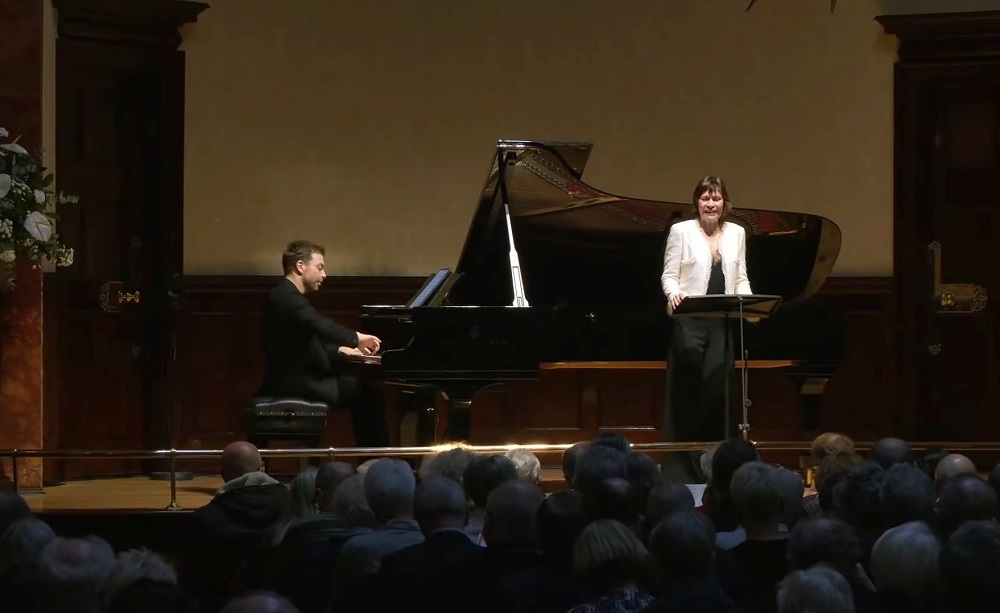
Seven sonatas and a sonatine in the space of an hour represents good value for a lunchtime concert – and even more so when the works in question span nearly two centuries. This was down to the clever programming of German pianist Elisabeth Brauß, a member of the BBC New Generations Scheme. She presented a potted history of the development of the sonata, moving as it did to the very centre of the concert platform by the twentieth century.

Brauß began her imaginatively thought-out hour with five sonatas by Domenico Scarlatti, just under 1% of the composer’s remarkable output in the form. Within his 550 or so published works there is an inexhaustible variety, and Brauß gave us some fine examples. Her crisp delivery of the C minor work was complemented by the playful ‘Caccia’ sonata, Scarlatti’s writing of parallel thirds tastefully ornamented in the right hand. Slipping into B minor, there was a more obvious Bach influence in an elegant performance of the Kk27 sonata, before a more reflective example in the same key, given plenty of room with ideally weighted inside parts. This thoughtful and emotive account was swept to one side by the showy G major sonata, chasing the clouds away.

Mozart‘s A minor sonata followed, a profound work written in the wake of the sudden illness and death of the composer’s mother Anna Maria in Paris, 1778. The principal phrase of the first movement is conspicuous for a ‘wrong’ note, an E flat played at the same time as an A minor chord, which can throw the listener. Brauß did well to give it the surprise factor, resulting in quite an unnerving and uncertain mood.

The second movement was initially calm, bringing out the singing style of Mozart’s marking of Andante cantabile con espressione rather beautifully. There was a refreshing lack of weight to this performance, the melodies floating on air, in contrast to a heavy-set middle section. The Presto finale, initially serious, brightened as the tonality moved into the major key, Brauß sensing hope in Mozart’s writing.

There was clarity in her Ravel, too, which found the right combination of technical flair and intimacy. Brauß portrayed the questioning nature of the first movement, just before its main theme returns and resolves. A limpid second movement was followed by a finale notable for its virtuosity – following the Animé marking – but which kept its conversational qualities.

Prokofiev’s Piano Sonata no.3 is a compressed firecracker, a work with plenty to say in its eight minutes. This performance was very impressive if holding back a little in the more raucous moments. Brauß was a more than capable guide to this impetuous piece, however, finding the heart of the adventurous coda, which sounds a lot newer than its 1917 composition date would suggest.

She clearly loves Prokofiev, as the Prelude in C major Op.12/7 made an ideal encore, bringing out the composer’s balletic side. There was less percussiveness in this lyrical account, notable for some lovely melodic phrasing.

Watch and listen

You can listen to the repertoire from this concert in choice recordings on the Spotify playlist below (Elisabeth has not yet recorded any of the pieces):

Online concert – English String Orchestra / Kenneth Woods: Tchaikovsky: String Quartet no.3

eso-tchaikovsky

English String Orchestra / Kenneth Woods

Tchaikovsky arr. Woods String Quartet No. 3 in E flat minor, Op. 30 (1876)

Wyastone Concert Hall, Monmouth
12-13 July 2021

Written by Richard Whitehouse

The English String Orchestra launched its schedule for 2022 with another premiere – that of Tchaikovsky’s Third Quartet in an arrangement by Kenneth Woods, continuing a line of such rethinking which has previously included Brahms’s Second Piano Quartet (Nimbus NI6364).

Completed early in 1876, this work came about through the premature demise of Ferdinand Laub who led those premieres of Tchaikovsky’s previous quartets and whom the composer held in highest regard. Its tonic-key is unexpected yet influential (notably on Shostakovich), not least in an opening movement where the Andante introduction leads to an Allegro whose fervent striving never quite breaks free of the fatalism from which it emerges and to which it returns. Woods might have made more of that Allegro’s undulating emotions, but his take on its introduction and coda duly enhanced their sombre intensity. Nor was there any lack of wit or urbanity in the next movement, poised unerringly between scherzo and intermezzo, which could become almost as popular as the waltz of the Serenade for Strings in this incarnation.

Interesting that Tchaikovsky belatedly reversed the order of the middle movements, given the Andante funebre is the undoubted highpoint of this work and its impact would be diminished if heard earlier in the overall design. Moreover, Woods’ arrangement was at its finest here in terms of the interplay between solo and ensemble strings – those soliloquys for violin, viola and cello given added pathos by the greater textural depth; not least as the movement reaches its anguished climax then subsides into the chant-inflected elegy of its closing stages. Maybe the finale would have conveyed even more a sense of release at a swifter tempo, but Woods was scrupulous as regards its ‘non troppo’ marking; nor was there any lack of resolve as this movement headed on its impetuous course towards a decisive and life-affirming conclusion.

A convincing new guise, then, for arguably the finest of Tchaikovsky’s chamber works (not least compared to the over-inflated arrangements of Souvenir de Florence), and a welcome reminder of the ESO’s collective prowess whether heard in original pieces or transcriptions.

You can view this concert from 21-25 January at the ESO website, and thereafter for ESO digital supporters here. Meanwhile for information on the ESO’s latest release of the music of Steven R. Gerber, click here

In concert – CBSO Centre Stage: Poulenc Chamber music

cbso-centre-stage

Poulenc Sonata for Clarinet and Bassoon, FP32 (1922); Trio for Oboe, Bassoon and Piano, FP43 (1924-6); Sextet for Wind Quintet and Piano, FP100 (1931-2, rev. 1939-40)

City of Birmingham Symphony Orchestra Members: Marie-Christine Zupancic (flute),Emmet Byrne (oboe), Oliver Janes (clarinet), Nikolaj Henriques (bassoon), Elspeth Dutch (horn), Robert Markham (piano)

CBSO Centre, Birmingham
Friday 21 January 2022 2pm

Written by Richard Whitehouse

It made sense to devote a programme in the Centre Stage series – put on by musicians of the City of Birmingham Symphony Orchestra – to the chamber music of Poulenc, which is hardly less representative than those vocal and choral pieces that likewise run throughout his output.

Increasing in size and substance, the three works this afternoon were also a viable overview of the composer’s evolution during the interwar period. The Sonata for Clarinet and Bassoon finds Poulenc teasing out the expressive potential of Stravinsky’s often inscrutable chamber music from the previous decade; its Allegro and Final movements pursuing an agile dialogue whose harmonic astringency is offset by the wistful insouciance of its central ‘Romance’, in which the interplay between Oliver Janes and Nikolaj Henriques was at its most persuasive.

Stravinsky evidently had a direct output into the composition of the Trio for Oboe, Bassoon and Piano which, cut from similar stylistic cloth to the earlier piece, reveals greater emotional range. Not least in the opening movement’s pointed contrast between its wistful introduction and headlong Presto, or the Andante’s haunted charm – here emphasized by plaintive oboe playing from Emmet Byrne – whose ‘vulnerability behind the façade’ is duly swept away by a finale in which the breezy humour of the ballet Les biches comes unmistakably to the fore.

The Sextet cost Poulenc fair effort before reaching definitive form at the start of the Second World War but is arguably his most representative work at that stage. Not least in the way its animated opening Allegro makes a virtue of any imbalance between piano and wind quintet – Robert Markham keeping matters securely grounded – or sheer timbral and textural variety of the Divertissement with piquant contributions from flautist Marie-Christine Zupancic and horn player Elspeth Dutch. Nor was there any lack of verve in a Finale whose recollection of the work’s opening, now suffused with greater pathos, must surely be a comment on the times.

Eloquently realized, it brought to an end an admirable showcase for both music and musicians. Next week sees a no less engaging programme of Kodály and Korngold by the CBSO strings.

Further information on future CBSO Stage concerts can be found here

In concert – Fatma Said, CBSO / Kazuki Yamada – Mozart, Mahler & Richard Strauss

fatma-said

Richard Strauss Don Juan, Op. 20 (1888)
Mozart
Vado, ma dove?, K583 (1789)
Mozart
La Clemenza di Tito, K621 (1791) – Non più di fiori
Mahler
Symphony No. 4 in G major (1899-1900)

Fatma Said (soprano), City of Birmingham Symphony Orchestra / Kazuki Yamada

Symphony Hall, Birmingham
Wednesday 19 January 2022

Written by Richard Whitehouse

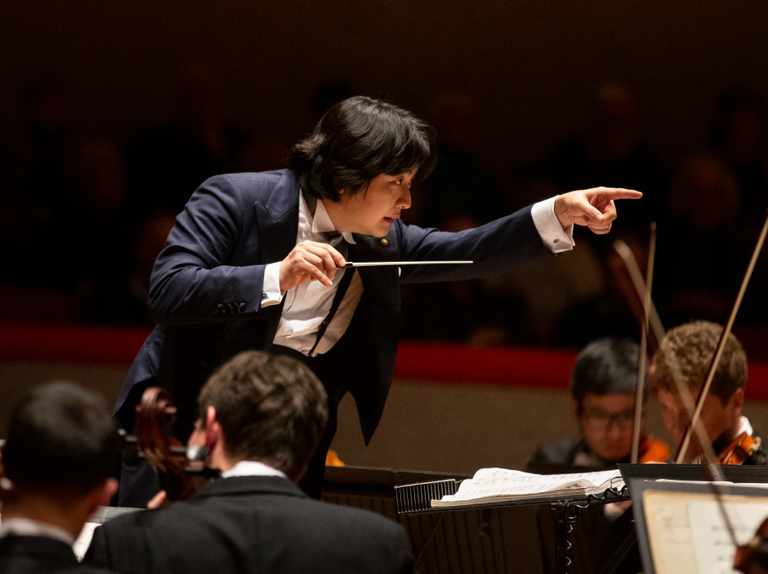
It may still be over a year before Kazuki Yamada becomes chief conductor and artistic advisor of the City of Birmingham Symphony Orchestra, but concerts such as tonight’s afford ample indication of just what can be expected from this already engaged and productive partnership.

If there any ongoing theme to this programme, it was one of transcendence – admittedly, one of negation in Richard Strauss’s Don Juan, though Yamada relished those encounters chivalrous and amorous during its course. The ‘carnival’ episode drew some especially incisive playing from woodwind and brass, and while the climactic restatement of the horns’ aspiring theme lacked nothing in grandiloquence, it did not detract from the starkness of a coda whose fatalism was to be encountered within this composer’s tone poems more regularly than might be supposed.

Strauss’s lifelong devotion to Mozart made two of the latter’s arias an appealing complement. Written as a replacement number for a long-forgotten opera by Vicente Martín y Soler, Vado, me dove? enjoys frequent revival as a standalone aria and, when elegantly rendered by Fatma Said, it was not hard to hear why. One of the (relatively few) highpoints from Mozart’s final opera La Clemenza di Tito, Vitellia’s aria makes greater expressive challenges to which Said rose accordingly – the trajectory of its ‘Ecco il punto’ recitative subsiding from anguish into that resignation from where the aria itself proceeds unerringly to the resolve at its close. All of which was eloquently conveyed, and while a further aria – the mellifluous Nehmt meinen Dank? – would have been welcome, there was more to come from this impressive singer.

Namely the finale of Mahler’s Fourth Symphony – hardly the rarity it was when Adrian Boult introduced it to Birmingham audiences 95 years ago, but easy to underestimate in the context of this composer’s overall output. As ‘unhurried’ as its heading indicates, the first movement exuded no little ambiguity – Yamada pointing up those myriad timbral and textural shadings that permeate the development and so make possible the heightened equanimity of the reprise. Sardonic but not unduly malevolent, the scherzo was tangibly evocative (Eugene Tzkindelean switching adeptly from his violin to its retuned doppelganger) – with breath-taking change of tonal perspective at the arcadian vision near its end. Visionary was no less apt to describe the slow movement, its variations alternating between fervour and anguish with seamless accord.

Felicitous playing from CBSO woodwind informed its progress on the way to its climax, with ‘heaven’s door’ briefly yet thunderously ajar prior to the transfigured calm of the closing bars. Stealing in just before, Fatma Said was an appealing guide to the setting of ‘Das himmlische Leben’ with its not always blissful recounting of the joys awaiting those who arrive there. Of particular note was the easefulness that spread across the final pages, when the singing ceases and the orchestra withdraws stealthily while raptly to leave just the harp’s pulsing resonance.

A lucid, often captivating performance of a work whose enticements Yamada realized in full measure. Anyone who can make it along to Symphony Hall for tomorrow afternoon’s repeat should certainly do so, while Kazuki Yamada will be back with the CBSO during this spring.

For more information on this concert visit the CBSO website. Meanwhile click on the links for information on the artists Fatma Said and Kazuki Yamada.

In concert – Sandrine Piau & David Kadouch @ Wigmore Hall – Journeys: Longing and Leaving

Sandrine Piau (soprano), David Kadouch (piano)

Schubert Mignon (Kennst du das Land) D321 (1815), Gesänge aus Wilhelm Meister D877: Heiss mich nicht reden; Nur wer die Sehnsucht kennt (1826)
Clara Schumann Er ist gekommen Op. 12 No. 1 (1841); Sie liebten sich beide Op. 13 No. 2 (1842); Lorelei (1843)
Robert Schumann Lieder und Gesänge aus Wilhelm Meister Op. 98a: Kennst du das Land (1849)
Duparc La vie antérieure (1884); L’invitation au voyage (1870)
Lili Boulanger Clairières dans le ciel (1913-14): Si tout ceci n’est qu’un pauvre rêve; Je garde une médaille d’elle; Vous m’avez regardé avec toute votre âme
Debussy Les soirs illuminés par l’ardeur du charbon (1917); 5 poèmes de Baudelaire (1890): Le jet d’eau; Recueillement; La mort des amants

Wigmore Hall, London, 17 January 2022

reviewed by Ben Hogwood from the online broadcast

It was heartening indeed to see the Wigmore Hall at capacity for the visit of soprano Sandrine Piau and pianist David Kadouch, bringing with them a new program with the theme of Journeys: Longing and Leaving.

They delivered the songs in two ‘halves’, one of German Lieder drawn  from the first half of the 19th century, the other of French song from the late 19th and early 20th centuries, giving us a smooth trajectory from Schubert to Debussy.

Refreshingly the journey took in substantial contributions from Clara Schumann and Lili Boulanger, three songs from each – as well as showing the increasing influence of Wagner on even the smallest forms of vocal music as the century turned.

Singing from a tablet, Sandrine Piau gave heartfelt performances and had the ideal foil in David Kadouch, whose brushstrokes on the piano were immediately telling. His chilly introduction to the third song in the Schubert group, Nur wer die Sehnsucht kennt, set the tone after a characterful first song and a sorrowful second, with a soaring vocal line from the soprano. Piau sang with arms outstretched, expressively capturing all the ornamentation and hitting the depths of the song’s turbulent middle section.

The Clara Schumann selection was fascinating, especially given the context of husband Robert’s well-known productivity in the years 1841-1843. The urgent Er ist gekommen was first, a heady song sitting high in the range, before a setting of Heine from just after Schumann’s celebrated year of song, a yearning and ultimately tragic number with a limpid commentary from the piano. The Loreley started in the same key, pushing restlessly forward. The only Schumann song in the program retained its intensity despite a noisy mobile phone introduction, a very different setting to the same text as tackled by Schubert at the start.

Turning to France, we heard two from the small output of Henri Duparc, whose entire output barely covers the length of a single concert. There is quality rather than quantity, however, and we heard the celebrated L’invitation au voyage, sumptuously performed with great poise. The two found the ideal pacing for La vie antérieure before it, solemn but quite open, and building to a powerful declamation.

Lili Boulanger wrote powerfully original music before her tragic death at the age of 24. Her orchestral tone poems have received greater exposure of late but the songs have remained relatively hidden. Piau and Kadouch put that to rights with three songs drawn from the wartime collection Clairières dans le ciel. They found an ominous tone in the lower vocal register from Piau, all the more so given the retrospective knowledge that Boulanger would only live for another three years from when the songs were written. The pained complexion at the end of Si tout ceci n’est qu’un pauvre rêve from Piau was profoundly affecting, then a slightly more optimistic Je garde une médaille d’elle led to the purity of Vous m’avez regardé avec toute votre âme.

Finally a selection from Debussy, prefaced by his final published piano piece Les soirs illumines par l’ardeur du charbon. This was a nice touch as an interlude, and was beautifully played. by Kadouch, We then heard three of the five Baudelaire poèmes, beginning with a babbling fountain shaded by Kadouch as Piau’s voice floated easily above. Recueillement (Meditation) found stillness initially but with the poet, distracted by darker thoughts, was mirrored by the music breaking from its reverie. Piau judged the awkward intervals perfectly, especially the final words with their harmonic transformation. The ultimate farewell was saved for last, La mort des amants quite a complex song. As with much early Debussy the harmonies travelled far but arrived at a strangely logical end point, both performers exhibiting exceptional control at journey’s end.

Piau spoke of the program giving ‘therapy after these two long years’, after which Beau Soir – one of Debussy’s celebrated songs – proved the ideal encore, though as the soprano warned, it was essentially saying, “Look at these beautiful things, because everybody goes in the same direction – death!”

Watch and listen