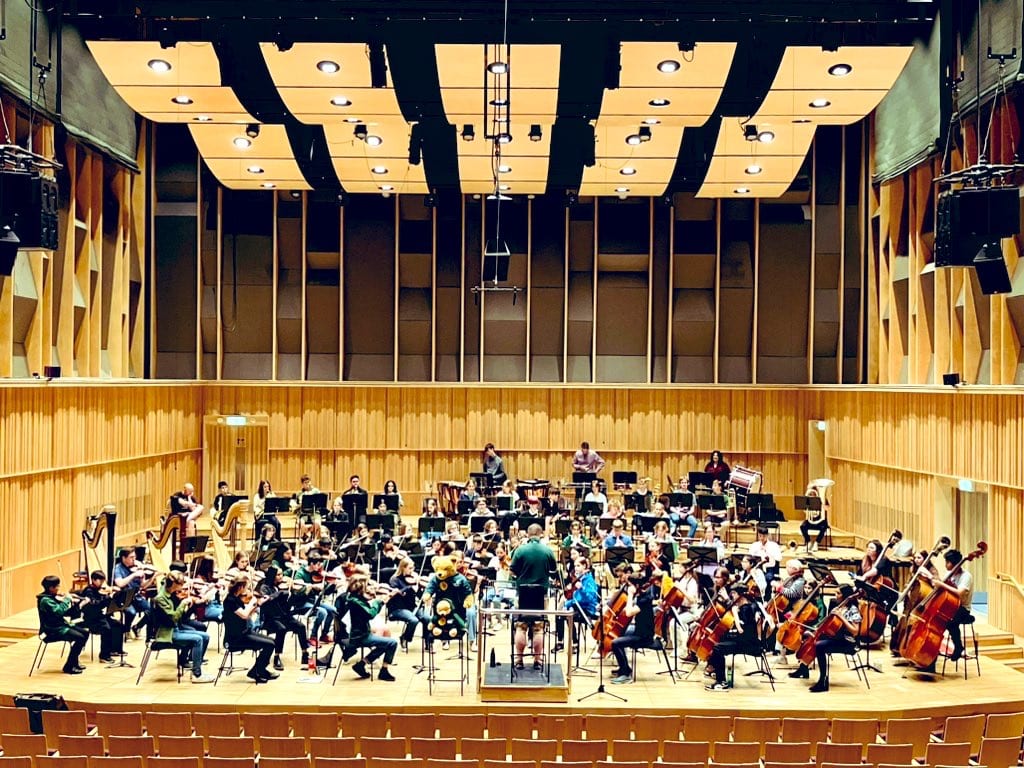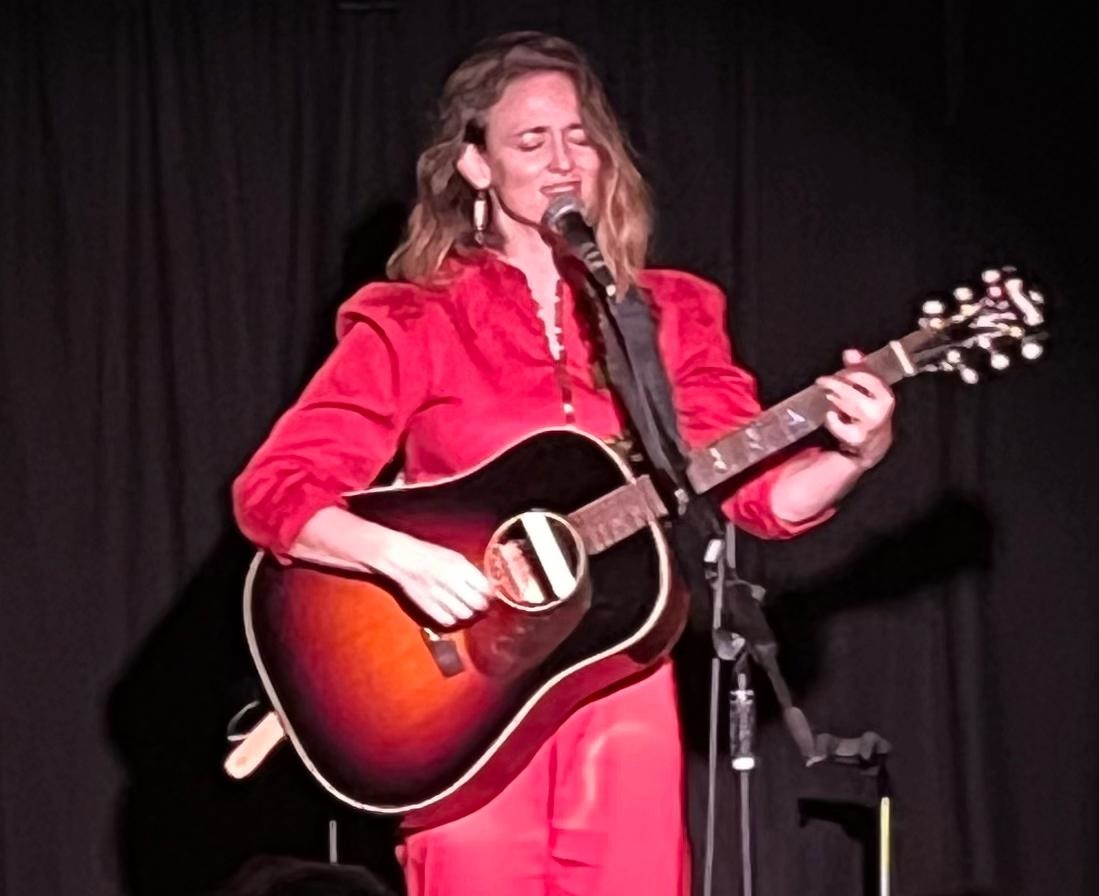
In concert – Fenella Humphreys, ESO Youth Symphony Orchestra / James Topp: Walton, Heathfield & Korngold

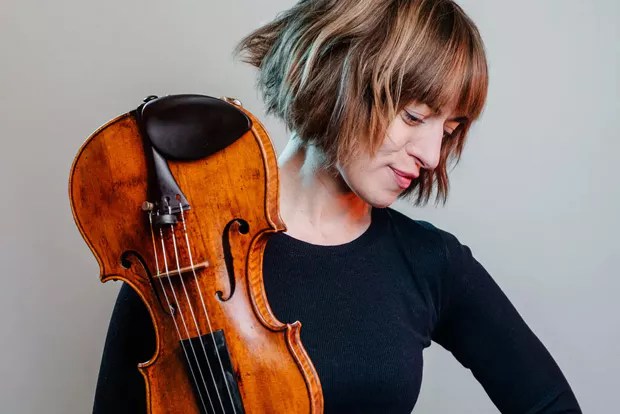
Fenella Humphreys (violin, below), ESO Youth Symphony Orchestra / James Topp

Walton Prelude and Fugue ‘The Spitfire’ (1942)
Korngold Violin Concerto in D, Op. 35 (1945)
Heathfield JAZZ HORSE (2024) [World Premiere]
Korngold arr. Russ The Sea Hawk – Suite (1940)
Walton arr. Matheson/ed. Lloyd-Jones Henry V – Suite (1944, arr. 1963)

The Bradshaw Hall, Royal Birmingham Conservatoire, Birmingham
Friday 23 August 2024

Reviewed by Richard Whitehouse

The English Symphony Orchestra’s annual Summer Course reached its climax this evening with a concert by its Youth Symphony Orchestra as ranged across film music from the mid-20th century, and in various guises from straightforward adaptation to wholesale reworking.

Whether or not those films for which he provided music have stood the test of time, Walton’s is a significant contribution to the cinema. As adapted from The First of the Few, his ‘Spitfire’ Prelude and Fugue remains one of his most characteristic such pieces and this performance did full justice to the prelude’s martial tread as to the fugue’s driving impetus, though James Topp was mindful to ensure the pastoral interlude (just before the return of the main theme) yielded an intimacy as underlined the essentially personal nature of this now underrated film.

Whereas Walton’s metier was in wartime or theatrical subjects, that of Korngold centred on Hollywood ‘blockbusters’ which required scores of suitably emotional opulence. Several of these found an equally appropriate home in the Violin Concerto completed at the end of the Second World War, whose formal cohesion prevents any risk of its expressive power losing focus. This was certainly the impression as conveyed by Fenella Humphreys – notably the ardency of her take on the opening Moderato, with a central Romance as ingenious in its trajectory as it was eloquent in content. Nor was there any lack of energy in a final Allegro with repartee between soloist and orchestra at its most engaging and not least in its closing stages, when a resplendent version of the main theme is outflanked by the uproarious coda.

After the interval, a sinisterly attired Finn Heathfield put members of the orchestra through their collective paces with JAZZ HORSE, described as ‘‘a collection of improvisations and performance exercise rooted by the rhythm section’s bass motif (thus F-Ab-Bb-Eb). It duly provided a telling foil to the suite (here arranged by Patrick Russ) from Korngold’s score to The Sea Hawk; a sequence capturing this film’s overall panache as surely as its resourceful writing for percussion and a reminder of a composer who should never be underestimated.

The programme concluded with more Walton and the suite from his score to Henry V – now remembered as a star-vehicle for Laurence Olivier, but which at the time played a necessary role in the British war-effort. Muir Matheson’s adaptation features most of the highlights and, as edited by the late David Lloyd-Jones, takes in more from the Overture in its evoking The Globe Playhouse via Elizabethan stylizations these players audibly relished. The sombreness of The Death of Falstaff and calm ecstasy of Touch Her Soft Lips and Part were rendered with no less insight, while the Charge and Battle placed between them brought a frisson of excitement set in relief by a poetic evocation of the Baïlerò at the close. Building intently to its joyous close, the Agincourt Song provided a rousing end to the suite and to this concert.

Another Summer Course Concert completed – its success not, as Topp indicated, to be taken for granted given the logistical and financial obstacles in bringing 91 musicians to this level of attainment. Hopefully such considerations will not become insurmountable in the future.

For details on the artists, click on the names to read more about Fenella Humphreys, James Topp, the ESO Youth Orchestra and the English Symphony Orchestra – and for more on composer Finn Heathfield

Published post no.2,282 – Monday 26 August 2024

In concert – Paul Lewis, CBSO / Kazuki Yamada: Ravel, Mozart, Holmès & Mussorgsky / Wood

Paul Lewis (piano, above), City of Birmingham Symphony Orchestra / Kazuki Yamada

Ravel Ma mère l’Oye – suite (1910-11)
Mozart Piano Concerto No. 27 in B flat, K595 (1790-91)
Holmès La Nuit et de l’Amour (1888)
Mussorgsky arr. Wood Pictures at an Exhibition (1874, orch. 1915)

Symphony Hall, Birmingham
Wednesday 21 August 2024

Reviewed by Richard Whitehouse

Although the CBSO has not put on its own Proms season for many years, a concert featuring the programme for its annual Proms appearance has been a regular fixture and this evening’s event proved to be much more than merely a ‘dry run’ for tomorrow’s Royal Albert Hall date.

Despite the timing, this was indeed the suite as orchestrated by Ravel from his Mother Goose piano duets before being expanded into a ballet. It took a while to get going – Pavane of the Sleeping Beauty feeling impassive and Little Tom Thumb enervated, yet Laideronette had the requisite playfulness. Conversations of Beauty and the Beast was ideally poised between whimsy and pathos, before The Enchanted Garden concluded this sequence with an inward rapture made more so thanks to its exquisite contribution from leader EugeneTzikindelean.

Paul Lewis must have played Mozart’s 27th Piano Concerto on innumerable occasions (and several times with the CBSO) but his perspective constantly varies. The opening movement had a spaciousness resulting in an unusually moderate Allegro, albeit never at the expense of a subtly incremental intensity unerringly sustained through to a cadenza of limpid eloquence. Even finer was the Larghetto – dependent, as with much of Mozart’s late music, on what the performer brings to it; here yielding a serenity informed by not a little fatalism. After which the finale provided an ideal complement in its buoyancy and unforced humour, leading into a cadenza (how fortunate Mozart’s own have survived) of pensive understatement, then a coda launched with a guileless interplay of soloist and string that set the seal on this performance.

Opening the second half was Augusta Holmès’s La Nuit et l’Amour – actually, an interlude from Ludus pro Patria, her ‘Ode-Symphonie’ which, even if it might not sustain the present piece’s enfolding passion, should certainly be worth at least a one-off hearing in its entirety.

In Henry Wood’s orchestration, Mussorgsky’s Pictures at an Exhibition proved a highlight of last season. Wood retains only the first appearance of the Promenade but is not unfaithful to the original’s essence. Hence the shock-horror of Gnomus, sombre aura of The Old Castle with its baleful euphonium, playful insistence of The Tuileries or fatalistic tread of Bydlo with its evocative percussion. The whimsical Ballet of the Unhatched Chicks contrasts with the grim realism of Samuel Goldberg and Schmuÿle or the frantic bustle of The Market at Limoges.

Respighi surely took note of this glowering Catacombs with its plangent recollection of the promenade refrain hardly less effective than in Ravel, and while Baba Yaga is unnecessarily curtailed here, its sudden dispersal more than prepares for the crescendo of offstage bells that launches The Great Gate[s] of Kiev. This set the tone for a realization which, if its opulence borders on overkill, could not prevent the CBSO from projecting Wood’s cinematic sonics to the maximum. Those present once again erupted during that echoing resonance at its close.

Quite a way, then, to end an impressive performance and memorable concert. Kazuki Yamada and the orchestra will be doing it all over again tomorrow evening at their Prom, at which this orchestration of the Mussorgsky will be heard in the environs as envisaged by its orchestrator.

The playlist below collects the music from this concert, including the only available recording of the arrangement of Pictures At An Exhibition by Sir Henry Wood:

For details on the 2024-25 season A Season of Joy, head to the City of Birmingham Symphony Orchestra website. Click on the names to read more about pianist Paul Lewis and chief conductor Kazuki Yamada

Published post no.2,279 – Friday 23 August 2024

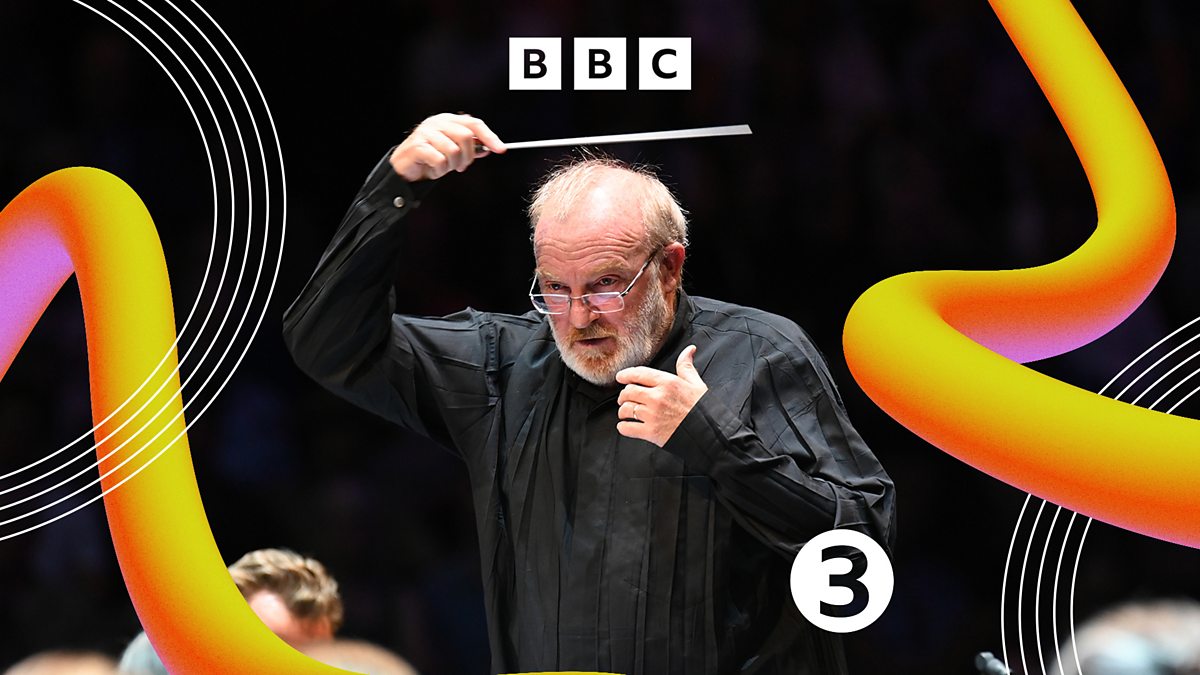
Arcana at the Proms – Prom 33: Christopher Maltman, BBC Symphony Orchestra / Martyn Brabbins – Elgar, Holst, Stanford & Vaughan Williams London Symphony

Elgar Overture ‘Cockaigne’ (In London Town) Op.40 (1901)
Holst Hammersmith (Prelude and Scherzo) Op.52 (1930)
Stanford Songs of Faith Op. 97 (1906): no.4 (To the Soul), no.5 (Tears), no.6 (Joy, ship-mate, joy); An Irish Idyll in Six Miniatures Op.72 (1901): no.2 (The Fairy Lough)
Vaughan Williams A London Symphony (Symphony no.2) (1912-13, rev. 1918-20)

Christopher Maltman (baritone), BBC Symphony Orchestra / Martyn Brabbins

Royal Albert Hall, London
Friday 9 August 2024, 6pm

reviewed by Richard Whitehouse

Concerts devoted to British music are by no means an unknown quantity at the Proms, but to have one as judiciously planned as that featuring Martyn Brabbins with the BBC Symphony Orchestra, on the conductor’s 65th birthday, was as unexpected as its realization ‘on the night’ proved consistently impressive.

Whether or not this account of Elgar’s Cockaigne ranked among the best of the previous 70 or so hearings at these concerts, it assuredly did the piece justice. Not its least attraction was Brabbins integrating this evocation of London on the cusp of Victorian and Edwardian eras with due perception of its ingenious sonata design, resulting in a reading as characterful as it was cohesive. Such as the emergence of the marching band at its centre and final peroration (Richard Pearce making his presence felt at the organ console) were the highpoints intended.

Whereas Elgar conveys London in its midst, Holst renders Hammersmith at a remove – his Prelude and Scherzo evoking those sights and sounds where the latter long made his home with a poise and precision no less involving for its objectivity. The orchestral version might be less often revived than its wind-band original but it yields little, if anything, in terms of expressive immediacy; not least with Brabbins mindful to underline how its two sections do not just succeed each other but are juxtaposed, even superimposed, prior to the rapt ending.

In the centenary of Stanford’s death, this selection of songs provided a welcome reminder of its composer’s prowess in the genre. The final three Songs of Faith denote an appreciation of Walt Whitman comparable to that of the next generation – whether in the eloquent musing of To the Soul, surging anguish of Tears or effervescence of Joy, shipmate, joy. Christopher Maltman then brought his burnished tone and clarity of diction to an affecting take on Moira O’Neill’s The Fairy Lough – proof Stanford could do ‘lightness of touch’ where necessary.

Whereas Stanford’s songs have barely featured here for almost a century, Vaughan Williams’s A London Symphony has accrued 36 performances, but what might be thought its ‘intermediate version’ had not been heard in nine decades. Actually, this is much closer formally to the final version of 1933 than the original – its main differences centring on those more extensive codas in the Lento and finale which, by aligning them more audibly with the introduction to the first movement, arguably ensures a more thematically close-knit trajectory across the work overall.

The performance was very much in accord with Brabbins’ recording (Hyperion). An unforced traversal of the opening Allegro, impetuous in its outer sections and affecting in that rapturous passage for solo strings at its centre, then a slow movement whose brooding introspection did not omit a sustained fervency at its climax. Nor did the Scherzo lack those ambivalent asides that find focus in its sombre close, while the nominally discursive finale built purposefully to a seismic culmination then an epilogue which drew solace from the aftermath of catastrophe.

‘‘The river passes – London passes – England passes’’. Whether the closing words from H.G. Wells’ Tono-Bungay determined or even influenced it, a sense of renewal was palpable as the music faded towards silence at the end of this persuasive performance and memorable concert.

For more on this year’s festival, visit the BBC Proms website – and to read more on the artists involved, click on the names: baritone Christopher Maltman, conductor Martyn Brabbins and the BBC Symphony Orchestra. Click on the name for more on The Stanford Society

Published post no.2,270 – Wednesday 14 August 2024

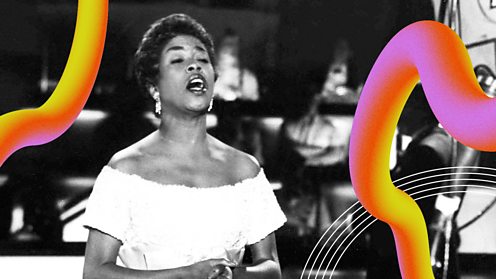
Arcana at the Proms – Prom 13: Sarah Vaughan – If You Could See Me Now

CHERISE, Lucy-Anne Daniels, Marisha Wallace, Lizz Wright, Clarke Peters, BBC Concert Orchestra / Guy Barker

Royal Albert Hall, London
Sunday 28 July 2024

reviewed by Richard Whitehouse Pictures (c) Andy Paradise

It has been customary in Proms seasons across the past decade to celebrate figures from those interconnected worlds of jazz, blues and soul. In this context, Sarah Vaughan (1924-90) was a natural choice as, though she rarely featured as a songwriter, her versatility across the musical spectrum meant she had few (if any) equals among her peers and even fewer successors. That tonight’s programme, and its four main singers, could do little more than touch on the relevant stylistic bases was itself tribute to one whose insisting ‘‘I am a singer’’ was not to be gainsaid.

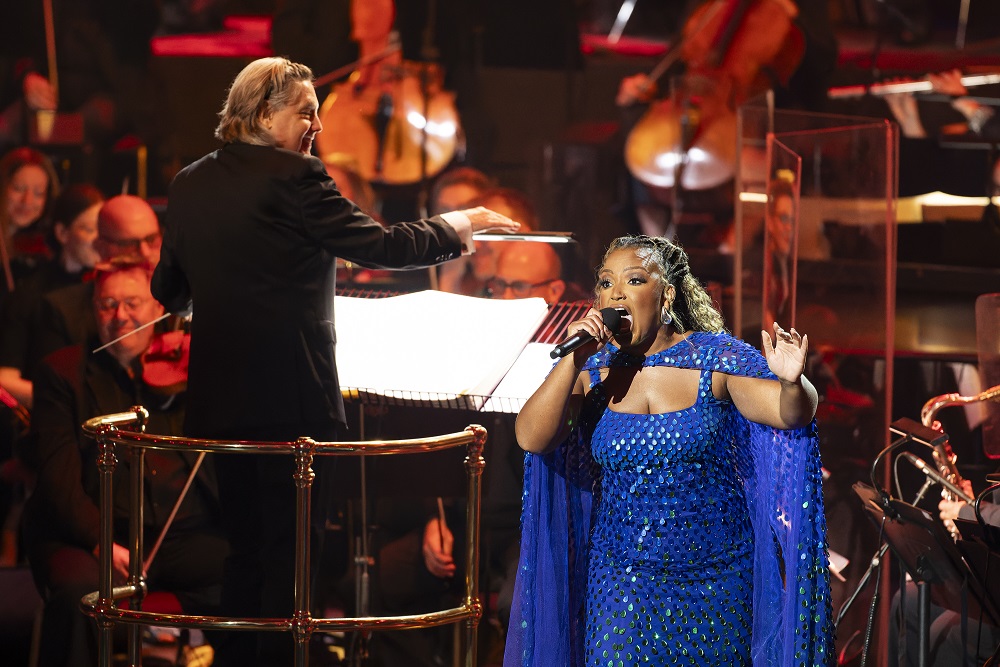
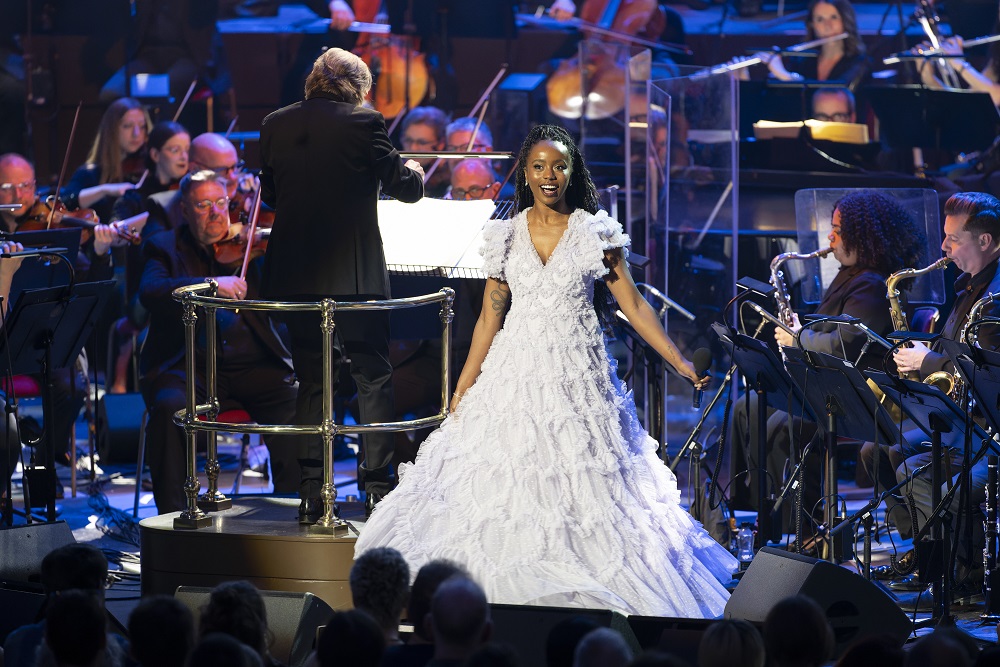
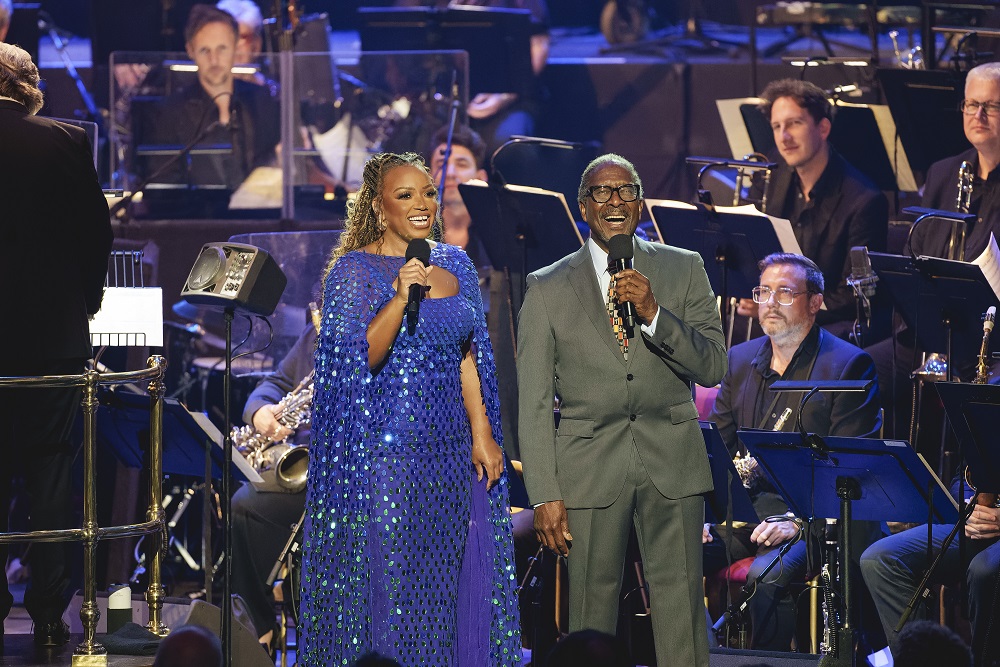
Marisha Wallace (above) pitched straight in with her no-holed-barred reading on I’m Gonna Live Till I Die, complemented by Lucy-Anne Daniels with an appropriately ‘sassy’ Nobody Else but Me then a soulful rendering of A Night in Tunisia (aka Interlude and surprisingly little heard as a vocal item). CHERISE (below) brought no mean pathos to I’ll Wait and Pray then no little wit to the catchy Mean to Me, while Clarke Peters made the most of his spotlight with a dextrous take on I Love the Rhythm in a Riff. Lizz Wright was eloquence itself in Tenderly, and despatched I Hadn’t Anyone Till You with a deft touch, then CHERISE gave a melting rendition of Misty (more affecting for the absence of affectation), but Daniels’s rather ‘by numbers’ scat rather undersold Sassy’s Blues – a pity given this was a rare Vaughan co-write. Wallace returned to round off the first half with a contrasting brace in which My Man, encompassing the wistful and dramatic in equal measure, proved a perfect foil to Great Day whose sheer vocal agility made for an undoubted showstopper with the BBC Concert Orchestra firing on all cylinders.

The orchestra came into its own at the start of the second half, its Bebop Instrumental Medley of standards by Thelonious Monk (‘Round Midnight, Little Rootie Tootie and Pannonica) and Dizzy Gillespie (A Night in Tunisia and Manteca) engaging reminder of the musical environs out of which Vaughan emerged. Daniels then sounded a plaintive tone in Body and Soul, with CHERISE’s insinuating take on Double Rainbow (whistling done to perfection) a reminder of Vaughan’s attraction to Brazilian music in later years. Wallace and Peters were a characterful double-act in Passing Strangers (without banishing memories of Kiki Dee and Scott Walker in their 1968 reading) while CHERISE was raunchiness incarnate in Don’t Be on the Outside, before Wright took the stage for a sequence comprising a moody Black Coffee, sultry Lullaby of Birdland then a confiding If You Could See Me Now which underlined just why this should have become a signature-tune for Vaughan.

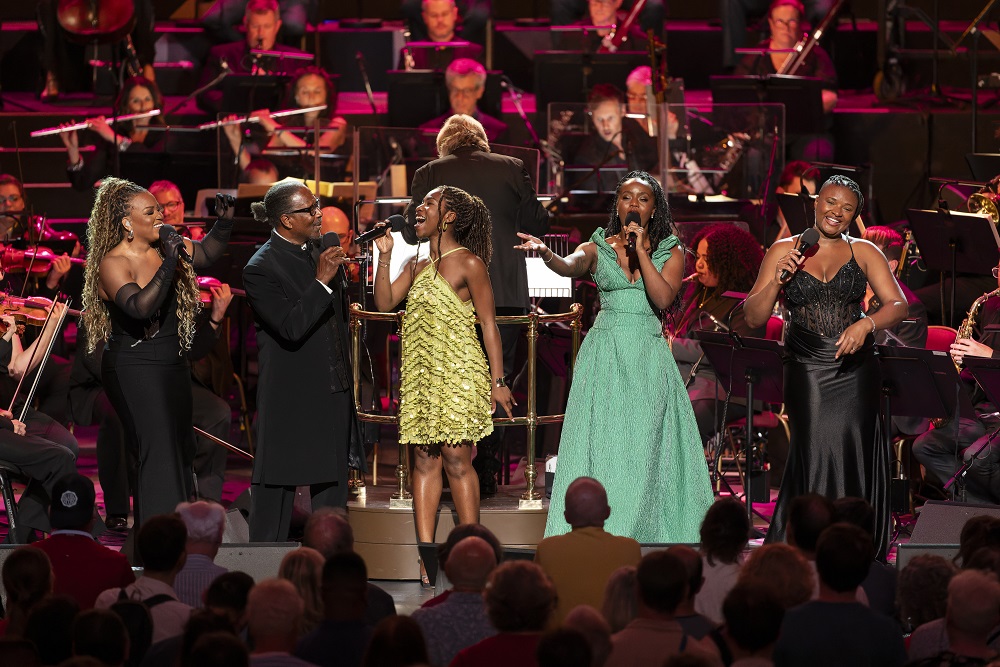
Daniels consequently upped the ante with a blithe I Cried for You, ideally complemented by Wallace with her genial take on Just a Little Lovin’. Although tonight was very much a showcase for vocal prowess, most of the items found space for at least one instrumental solo and rightly so, given the roster of ‘names’ in the BBCCO (a pity that woodwind and reeds were omitted from the personnel in the programme). As conductor (and arranger?), Guy Barker set his inimitable seal on proceedings which hopefully brought Sarah Vaughan a younger generation of admirers. All four vocalists (and Peters) returned for a send-off in the guise of an effervescent take on Perdido that assuredly brought the house down.

Prom 13: Sarah Vaughan – If You Could See Me Now. CHERISE Lucy-Anne Daniels Marisha Wallace Lizz Wright Clarke Peters presenter BBC Concert Orchestra Guy Barker conductor

The night’s program was as follows:

Curtis/Hoffman/Kent: I’m Gonna Till I Die
Kern: Nobody Else but Me
Gillespie: Interlude (A Night in Tunisia)
Treadwell/Valentine: I’ll Wait and Pray
Ahlert: Men to Me
Eckstine: I Love the Rhythm in a Riff
Gross: Tenderly
Noble: I hadn’t Anyone Till You
Garner: Misty
Vaughan/Jones: Sassy’s Blues
Yvain: My Man
Youmans: Great Day
Monk/Gillespie: Bebop Instrumental Medley
Green: Body and Soul
Jobim: Double Rainbow
Mitchell/Applebaum/Mann: Passing Strangers
Kelly/Watts/Wyche: Don’t Be on the Outside
Burke: Black Coffee
Shearing: Lullaby of Birdland
Dameron: If You See Me Now
Arnhelm/Lyman: I Cried for You
Mann/Weil: Just a Little Lovin’
Martínez: Perdido

You can watch this concert on the BBC iPlayer. For more on the 2024 BBC Proms, visit the festival’s website at the BBC. Click on the names for more information on Sarah Vaughan, and on the artists – CHERISE, Lucy-Anne Daniels, Marisha Wallace, Lizz Wright, Clarke Peters, the BBC Concert Orchestra and Guy Barker

Published post no.2,255 – Tuesday 30 July 2024

Arcana at the Proms – Prom 8: Nick Drake – An Orchestral Celebration

Olivia Chaney, Marika Hackman, BC Camplight, Scott Matthews, The Unthanks, BBC Symphony Orchestra / Jules Buckley

Royal Albert Hall, London
Wednesday 24 July 2024

reviewed by John Earls Pictures below (c) John Earls and (bottom) Chris Christodoulou

This November sees the 50th anniversary of the tragic death of the English singer-songwriter Nick Drake at the age of 26, having released just three albums of beautiful, bittersweet songs. Little known at the time, his reputation and influence has grown significantly.

This 2024 BBC Prom – an ‘orchestral celebration’ of his music – was destined to be something quite special and credit should go to British journalist and broadcaster John Wilson for proposing it.

Jules Buckley, here conducting the BBC Symphony Orchestra, has been involved in a number of BBC Proms over the years giving orchestral twists to contemporary music. Many of Drake’s songs were released at the time with string arrangements by Robert Kirby (it was good to hear Buckley pay tribute to Kirby who he referred to as “Nick Drake’s foil”) and these were developed, as well as some new ones added, by a number of other arrangers for this concert.

Following a gripping opening of the instrumental Introduction from Drake’s Bryter Layter album, BC Camplight gave excellent performances of Fly and Pink Moon which was deftly accompanied by strings and horns. Alas, his closing of the concert with Drake’s classic Saturday Sun didn’t quite cut it, being a bit too schmaltzy for this reviewer. However, the final all orchestral piece, an arrangement by Sam Gale of Horn, a sparse solo guitar piece from Pink Moon, was luminous and intense, culminating in a poignant solo trumpet.

Marika Hackman gave enchanting versions of Fruit Tree and River Man and her take on Time Has Told Me was a wonderfully smoky blues accompanied by drums, organ and guitar (Neill MacColl did some sterling work throughout the evening).

Scott Matthews opened his account with a wonderful Way to Blue with dramatic strings and timpani which, from where I was sitting, at times slightly overpowered his delicate voice, something rectified in the second half for his lovely performances of Northern Sky and From the Morning.

Olivia Chaney (above) gave a strong vocal performance of Hazey Jane I and a terrific version of At the Chime of a City Clock where the strings and horns were again particularly effective. Her solo piano rendition of Time of No Reply was outstanding.

Two of the most moving moments did not feature Nick Drake songs at all but those of his mother Molly. The Unthanks performed touching versions of What Can a Song Do to You? and Set Me Free and were joined by Drake’s sister Gabrielle reciting some of Molly’s poems in both cases. It was extremely affecting.

One can only imagine what Gabrielle Drake must have thought hearing the songs of her brother (and mother) performed in this way after so many years to a packed Royal Albert Hall that listened respectfully and lovingly. It was fitting testimony to the enduring quality of the music of an extraordinary songwriter.

This concert (including interval discussion with John Wilson, Radio 3 presenter Elizabeth Alker and Gabrielle Drake) is available on BBC Sounds until early October. For more on the 2024 BBC Proms, visit the festival’s website at the BBC, and click on the link to read John Earls’ review of Richard Morton Jack’s biography on Nick Drake: The Life. 

John Earls is Director of Research at Unite the Union and tweets / updates his ‘X’ account at @john_earls

Published post no.2,250 – Thursday 25 July 2024