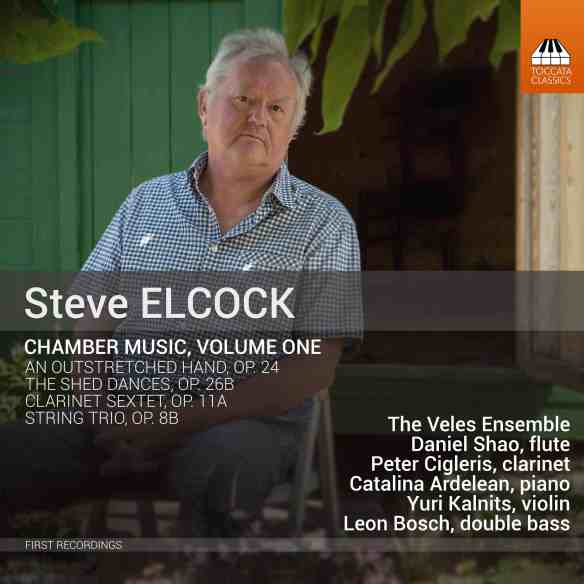
On record – Steve Elcock: Chamber Music Vol.1 (Toccata Classics)

The Veles Ensemble (Hartmut Richter (violin), Ralitsa Naydenova (viola), Evva Mizerska (cello), with Daniel Shao (flute), Peter Cigleris (clarinet), Yuri Kalnits (violin), Leon Bosch (double bass), Catalina Ardelean (piano)

Steve Elcock
Clarinet Sextet Op.11b (2001/14)
String Trio no.1 Op.8b (1998/2016)
The Shed Dances Op.26b (2016)
An Outstretched Hand Op.24 (2015)

Toccata Classics TOCC0506 [79’36”]

Producer & Engineer Michael Ponder

Recorded 21-22 May 2018, St Silas, Chalk Farm, London, 24 May 2018 (Sextet, Trio, The Shed Dances), Henry Wood Hall (An Outstretched Hand)

Written by Richard Whitehouse

What’s the story?

Following an impressive disc of his orchestral music (TOCC0400, reviewed on Arcana here), Steve Elcock (b1957) is given further coverage by Toccata Classics with this release of chamber music, reaffirming him as a force to be reckoned with among those symphonic composers from his generation.

What’s the music like?

Every bit as engrossing as the works on that earlier release – that is, uncompromising without being unyielding and serious without being (unduly) earnest. This is evident from the earliest piece here, Elcock’s First String Trio having been conceived for two violins and viola before reaching its present guise. A tensile single movement pivots constantly between the fractious and consoling, at times encroaching upon a more equable expression that nevertheless fails to sustain itself, and with a conclusion where even the most tenuous poise is summarily denied.

Starting out as a Concertino for clarinet and string orchestra, the Clarinet Sextet is on a larger scale – opening with an Allegro whose clear-cut sonata design opens-out intriguingly with a cadenza-like passage just before the reprise. Similarly, the Romanza is thrown off-balance by a faster central section which duly intensifies the climactic stages, and if the progress of the final Variations and Theme seems more arresting as regards form rather than content, the gentle evanescence after the theme has been elaborated feels as subtle as it is intriguing.

More immediately approachable, The Shed Dances began life as a sequence for violin and piano before being recast for clarinet and string trio. Written at the suggestion of a sufferer from the neurological condition known as ataxia, all six dances are thwarted or undermined by rhythmic imbalances that are only effortfully overcome – the most memorable being the inhibited gait of Petrified minuet, edgy impulsiveness of Boneyard antics and winsome swaying of Marion’s pavane which confirms Elcock as possessing no mean melodic gift.

Finally, to An Outstretched Hand whose inspiration in the stark contrasts of composing as an act of friendship across the centuries and the burgeoning refugee crisis across Europe became fused into this powerfully sustained single movement for flute, clarinet and piano quartet. Its sombre initial Largo is followed by two Allegros (themselves separated by a stark interlude) whose increasingly confrontational manner carries over to a final Largo which recalls earlier material in a mood that, fatalistic rather than merely defeatist, exudes the keenest poignancy.

Does it all work?

Yes, in almost all respects. It helps when these performances are so evidently attuned to this idiom, teasing subtleties out of the charged formal processes and grating expressive contrasts that are recognizable Elcock traits. The overall programme is carried by the Veles Ensemble, whose tonal finesse and tangible commitment to this music is evident throughout – which is hardly to decry the contributions of those other musicians featured here. Hopefully it should prove possible for these pieces to be heard in public performance on some future occasion.

Is it recommended?

Certainly – not least when the sound is unexceptionally fine, and the composer’s annotations are unfailingly to the point. Elcock’s growing admirers will be pleased to hear that a further disc of orchestral music (including the Fifth Symphony) is scheduled for imminent release.

Listen and Buy

You can listen to clips and purchase this disc from the Toccata Classics website

On record – Roger Smalley: Piano, Vocal and Chamber Music (Toccata Classics)

Taryn Fiebig (soprano), Darryl Poulsen (horn), James Cuddeford (violin), Daniel Herscovitch (piano), Scott Davie (piano), Roger Smalley (tam-tams)

Roger Smalley
Albumblatt (1990) Nine Lives (2008)
Capriccio no.1 (1966)
Barcarolle (1986)
Morceau de Concours (2008)
Piano Pieces I-V (1962-5)
Three Studies in Black and White (2002-4)
Lament for the Victims of Natural Disasters (2005)

Toccata Classics TOCC0501 [72’21”]

Producer & Engineer David Kim-Boyle

Recorded 2005, University of Western Australia, Perth (Three Studies in Black and White), 13 February, 28-29 March 2019, University of Sydney Conservatorium of Music

Written by Richard Whitehouse

What’s the story?

Toccata Classics releases this welcome overview of music by Roger Smalley (1943-2015), whose extensive output followed an eventful and unpredictable trajectory from unabashed modernism to post-classicism demonstrably informed and enhanced by a performer’s insight.

What’s the music like?

As varied as this selection might suggest. Earliest here is Piano Pieces I-V, tersely distinctive miniatures whose conspectus of radical tendencies from Schoenberg to Stockhausen is allied to a pianism at once resourceful and pragmatic. An aesthetic heightened in Capriccio no.1, whose often confrontational interplay between violin and piano owes much to Schoenberg’s late Phantasy while not precluding a more personal approach such as Smalley’s subsequent involvement with Stockhausen transmuted into a more progressive but less emotive manner.

By the time of Barcarolle, Smalley had moved away from modernist traits towards an idiom permeated by while never beholden to the Romantic era. Chopin’s famous example may not be evident here, but the ominous undulation of Fauré’s earlier such pieces is unmistakable; as is Liszt in the scintillating dexterity of Morceau de Concours, a test-piece to reckon with not just in terms of its technique. Most impressive, however, is Three Studies in Black and White, a trilogy likely inspired by Alkan’s Op. 76 Études – with the opening Gamelan a visceral yet ultimately eloquent exploration for left hand; by contrast, Moto perpetuo is an edgy and often volatile workout for right hand, then Dialogue reunites both hands in music at once resolute and consoling. Few, if any, piano pieces of such substance have been composed this century.

Which is not to underestimate the effectiveness of Nine Lives. Subtitled A Song-Cycle about Cats, these settings of feline evocation range as widely as that of the authors featured. Of the three extended items – that by Oscar Wilde is stealthy and secretive, that by Christina Rosetti a memorial of deadpan insouciance, while that by Oliver Herford is a luminous and affecting envoi. Framing the programme are a brief Albumblatt later subsumed into the Piano Trio, and Lament for the Victims of Natural Disasters where horn eulogizes against resonant tam-tams.

Does it all work?

Yes. Smalley’s academic career at University of Western Australia at Perth connected him to many significant musicians, several of whom are present here. Taryn Fiebig brings a wealth of nuance to the songs and is ably accompanied by Scott Davis, while James Cuddeford and Darryl Poulsen make salient contributions. Greatest credit, though, to Daniel Herscovitch for piano playing as not only makes light of the considerable technical demands but conveys the unity within diversity of Smalley’s musical language throughout four decades of evolution.

Is it recommended?

Indeed. The Smalley discography is not inconsiderable, and readers should investigate such major works as Accord (Continuum) or Pulses (NMC); while Poles Apart (NMC) focusses on more recent pieces.

A plea, too, for the reissue of the Symphony and First Piano Concerto (Vox Australis), two of his defining works. That said, this latest release makes as inclusive an overview as has been issued. The sound is unexceptionally fine, and booklet notes unfailingly insightful, but for the track-listing the Barcarolle and Morceau have added 10 minutes each.

Listen and Buy

You can listen to clips and purchase this disc from the Toccata Classics website

Switched On – Ian William Craig: Red Sun Through Smoke (130701)

reviewed by Ben Hogwood

What’s the story?

Before listening to this album, read the story behind it on Ian William Craig’s Bandcamp page. It may initially look like a long piece of text but there is a reason for that, as so much happened in his life when this album was being made. Looking back, it’s a minor miracle it was made at all.

Yet the music clearly powered Craig through an incredibly eventful and difficult passage of his life. Red Sun Through Smoke began as an album documenting the increasingly powerful and consuming forest fires experienced throughout British Columbia each summertime, but once Craig was recording it at his granddads, it took on extremely personal dimensions.

Craig lost his grandfather during the recording of the album, but with his family’s blessing and encouragement continued to record at his home, and use his piano, across the street from the care home where he died. Almost simultaneously he also fell in love, but had to manage his relationship remotely between Vancouver, his home, and the subject of his affections, who had recently moved to Paris.

All these things – grief, love, anger, affection and musicality – feed into the music of Red Sun Through Smoke, where they are led by the piano, the first time Craig has turned to the instrument in a while.

What’s the music like?

Given the emotional baggage surrounding this album Craig could be forgiven for musical indulgence. Yet that is never the case, for as the music unfolds with a wide array of shades and colours, it tells the story in a way only music can. Knowing the tale beforehand is undoubtedly helpful, giving insight into the twists and turns we experience.

There are several acappella tracks, the first of which – Random – begins the album with an almost nostalgic air. It harks back towards the sound of more primitive North American hymns, with open fifths and a relatively coarse timbre. Later on, Comma climbs higher, while the third unaccompanied vocal track, Take, also hits the heights. Craig’s vibrato-rich voice is heard alone, then layered, on Weight, while in the brief Supper he laments on how ‘we had grief for supper’. Far and Then Farther, also unaccompanied, moves towards consolation.

Despite all the vocals the piano remains the star. It takes the edge off with the mottled textures of The Smokefallen, and appears in distracted form on Last Of The Lantern Oil, an incredibly distinctive track with beautiful spatial effects to stop the listener in their tracks.

Craig uses thick distortion on the dense and rather threatening Condx QRN, which is calmed by the reappearance of the piano on Mountains Astray. Both elements combine on Open Like A Loss, a tense piece of contrary emotions.

Does it all work?

As a piece of descriptive work Red Sun Through Smoke is incredibly effective and really takes its listener through the emotional and physical impact of the unfolding story. Because of that it is not really suitable for passive listening, and nor will the layered vocals be to everybody’s taste. That is absolutely no reflection on their quality or meaning; more an indication of how individual they are, and how profound they turn out to be.

Is it recommended?

Yes. Ian William Craig tells a very powerful story here, made even more meaningful by its restraint and deep set emotion. As a historical document in British Columbia’s recent history it also deserves to be widely heard, carrying as it does a number of keenly felt warnings for the future.

Stream

Buy

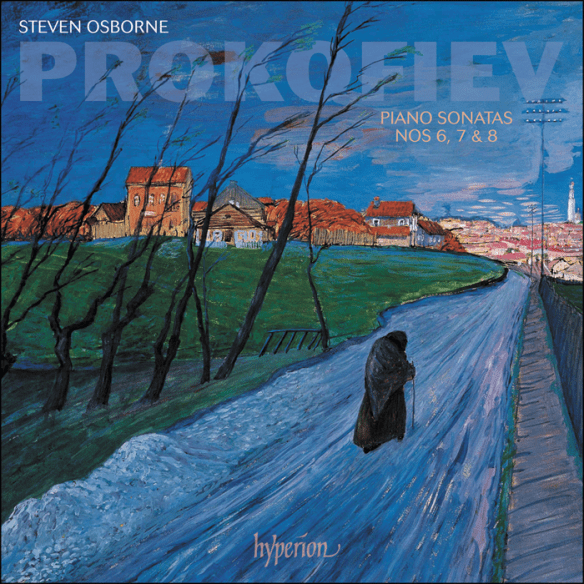
On record – Steven Osborne: Prokofiev: Piano Sonatas nos. 6-8

Steven Osborne (piano)

Prokofiev
Piano Sonatas: no.6 in A minor Op.82 (1940), no.7 in B flat major Op.83 (1942), no.8 in B flat major Op.84 (1944)

Hyperion CDA68298 [74’21”]

Producer Steven Johns
Engineer David Hinitt

Recorded February 2019, St Silas the Martyr, Kentish Town, London

Written by Ben Hogwood

What’s the story?

Steven Osborne has been an advocate of Sergei Prokofiev’s piano music for a number of years now, receiving rave reviews for his performances of the sonatas in particular. This release has therefore been keenly awaited for some time, as Osborne takes on the composer’s so-called ‘war trilogy’.

Prokofiev himself did not label the pieces in this way, but he did work on them simultaneously between 1939 and 1944, as the full horror of the Second World War became apparent. While the composer’s public facing side was preoccupied with writing music of which Stalin could not disapprove, the Piano Sonatas are more private works, the composer left with his real thoughts alone at the piano.

Prokofiev himself gave the premiere of the Sixth Sonata in 1940, after which the following two works were left in the considerable hands of Sviatoslav Richter (1943) and Emil Gilels (1944). Each premiere was given in Moscow.

What’s the music like?

While the Piano Sonata no.7 is found in concert relatively often on account of its virtuosity and dramatic impact, the two around it are lesser spotted companions. They are however two of the composer’s most substantial and meaningful works. The Seventh itself is restless, like a cat on a hot tin roof in the fast outer movements, but pausing for deep and soulful reflection in the second.

The Piano Sonata no.6 has a great depth of feeling. Its first movement presents a caustic but memorable main theme, while the second, a scherzo, is equal parts dry humour and studied, chromatic reflection. A waltz follows, its long and delicate melodies reminding us of Prokofiev as a composer for the stage, before the finale brings forward an extraordinary theme, quick and quiet initially but building to a close of formidable power.

Meanwhile the Piano Sonata no.8, while retaining the key of the seventh, is a very different beast. Prokofiev’s most substantial work for solo piano, it has much longer musical phrases and appears to portray the composer’s innermost thoughts.

Does it all work?

Wholeheartedly. Osborne has the measure of Prokofiev’s music, producing a devastating combination of virtuosity and deep-set feeling.

In the Piano Sonata no.6 there is no doubt of the force of the composer’s emotion, his despair and anger at the unfolding conflict tampered by music of a much softer touch. The abrasive start, major and minor chords clashing, tells you all you need to hear, yet perhaps even more striking are the quieter passages, which Osborne plays with pointed delicacy, the ticking sound in the first movement drawing the listener in, and the ripples of lyricism in the third presenting a compelling scene. Yet there is great resolve here, which comes to the fore in the finale, Osborne driving forward with the main theme but lowering the temperature considerably with a haunting reappearance of the main tune from the first movement.

The Seventh Sonata is terrific, played right on the edge of the cliff but again with keen dramatic instinct. The first movement dances around its central key of B flat major with edgy impatience. Osborne’s dynamic range is hugely impressive, ranging from intimate asides to the clanging percussive passages Prokofiev loves to use. Turning inwards for the slow movement, he goes deep into some of Prokofiev’s most moving music for piano, the lilting contour of the left hand at the start building to a powerful apex in the middle. The third movement Toccata is gone in a flash, driving incessantly forward, grimly determined as though looking to escape its pursuers but trampling on them by the end!

Despite these impressive achievements Osborne’s Eighth Sonata is the crowning glory of this set. He allows the ruminative first movement plenty of time to air its thoughts, Prokofiev in contemplative mood for an unusually concentrated stretch, before the more abrasive thoughts of the previous sonatas bubble to the surface.

The second movement offers a chance for repose, its relatively gentle demeanour helped by a triple time lilt that Osborne paces attractively. The finale brings renewed energy, a valedictory air around both its first theme and the commanding central section, which the pianist takes by the scruff of the neck, leading to a barnstorming closing page.

Hyperion’s sound is ideal, Osborne placed in excellent digital perspective but with plenty of room for Prokofiev’s very biggest sound. There is a huge dynamic range in this music and thankfully we get the best of all worlds.

Is it recommended?

Absolutely. These sonatas have had some fine recordings over the years, and Osborne’s join those right at the top of the digital list. An outstanding achievement from all involved.

Listen and Buy

You can listen to clips from this disc and purchase a copy at the Hyperion website here

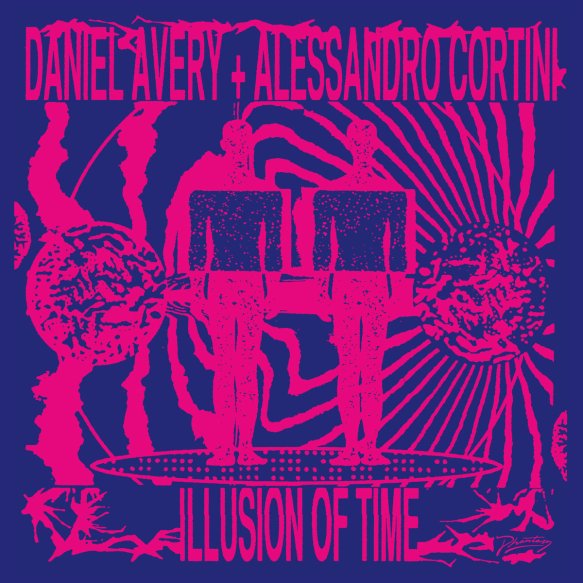
Switched On – Daniel Avery & Alessandro Cortini: Illusion of Time (Phantasy)

reviewed by Ben Hogwood

What’s the story?

Daniel Avery and the Nine Inch Nails’ Alessandro Cortini began working together in 2017 with the remotely-achieved collaboration Sun Draw Water, a limited release whose promise hinted heavily at greater things to come.

They completed Illusion of Time a year later when both were touring with the Nine Inch Nails themselves. Since then Avery has delivered Drone Logic, one of 2018’s finest electronic albums, and Cortini has also excelled in a solo capacity with Volume Massimo, clearing the decks for the release of this 45-minute work.

What’s the music like?

Illusion of Time is all about atmosphere, and the ability to press pause on life itself, achieved through an often fascinating blend of analogue electronics and atmospherics. The description from the promotional material of ‘quietly powerful’ is very accurate, and is achieved without any use of drums or percussion.

While that implies much less emphasis on rhythm, Avery and Cortini use textures, pitch and slowly drawn out melodies to create considerable tension and release. The likes of Enter Exit, an expansive track on a bed of white noise, or the first track Sun, emerging through a crackle of white noise and atmospherics, embody this. They alternate slowly between pitches, with indistinct sounds passing across the stereo picture. The title track then gets a more definitive loop that oscillates at an easy pace.

Inside The Ruins is ominous, to these ears at least painting a picture of oppressive history within a decrepit building. It may stand still but there are dark shadows and unseen hazards at hand. By complete contrast, At First Sight has a wonderful depth to surround its soft-centred loop. This steady pulse is the closest Illusion of Time gets to percussion, the bass notes marking time beneath thick swirls of ambience and a piercing melody of otherworldly beauty.

Water, the longest piece of music, is literally a deep dive, dark hues of blue and purple coming to mind as the music gains wonderful depth. It runs seamlessly into Stills, a coda based on a single, warm chord with a foamy crescendo that sinks back to nothing.

Does it all work?

Yes. Time spent listening closely to this album brings the most rewards, for Avery and Cortini are masters of their craft, carefully selecting their blend of sounds to describe the unseen subject matter. Their music is ultimately calming, but with frissons of danger and darkness around the edges.

Is it recommended?

Yes. Illusion of Time is a fascinating meeting of minds, which ends up being the ideal collaboration in the sense that we end up with an equally divided – and united – musical approach. It may fall into the category of ‘ambient’, but with descriptive picture painting and ever-shifting sounds it has a great deal of depth too.

Stream

Buy