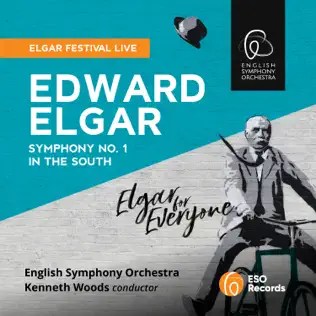
On Record – English Symphony Orchestra / Kenneth Woods: Elgar Festival Live – Symphony no.1 & In The South (ESO Records)

Elgar
Symphony no.1 in A flat major Op.55 (1907-08)
In the South (Alassio) Op.50 (1903-04)

English Symphony Orchestra / Kenneth Woods

ESO Records ESO2501 (80’10″]
Producer and Engineer Tim Burton

Live performances at Worcester Cathedral on 4 June 2022 (In The South) and 3 June 2023 (Symphony)

Reviewed by Richard Whitehouse

What’s the story?

There could hardly been a more fitting release to launch the English Symphony Orchestra’s own label than these performances drawn from past editions of the Elgar Festival, with both of them a reminder of the ESO’s formidable prowess over the range of symphonic writing.

What are the performances like?

The First Symphony may not have the usual number of strings to complement its triple wind, but due to the resonance of Worcester Cathedral this is not evident as regards internal balance. Not least in an opening movement whose motto-theme is never indulgent, setting the tone for an Allegro where expressive variety goes hand in hand with formal focus. Especially fine is a hushed transition into the reprise, then a coda that distils the equivocal mood as this subsides into ruminative calm. Woods is mindful to invest scherzo and trio with consistency of pulse, so if the former feels reined in on return, the latter has an ideal poise and wistfulness. Nor is the transition other than indicative of the Adagio’s profundity, Woods negotiating its soulful main theme and wistful episodes with unerring rightness through to the ineffable closing bars.

If the finale has any marginal falling-off of inspiration, it is not apparent here. Sombre if shot through with expectancy, its introduction launches an Allegro whose alternating incisiveness and suavity holds good over an impulsive development, then a transformation of the codetta whose pathos intensifies for an apotheosis where the motto-theme carries all before it. Not that the closing pages are bombastic or grandiloquent in import – rather, they set the seal on a work whose affirmation is made the greater for its having been so purposefully attained.

As for In the South, the main issue is in setting a tempo flexible enough to accommodate this concert overture’s extended sonata design without it becoming episodic. Here a surging main theme, its speculative transition and suave second theme emerge seamlessly – the underlying tension carried into a development whose impulsiveness is maintained across the intervening first episode. Amply evoking the grandeur of ‘empires past’, this is astutely handled such that its implacability eschews bathos. If the second ‘canto populare’ episode is just a little reticent, its expressive raptness – and Carl Hill’s eloquent playing of its indelible viola melody – more than compensates. Nor is there any loss of continuity during the reprise, Woods’s building of momentum near the start of the coda ensuring an irresistible yet never overbearing peroration.

Does it all work?

Almost always. ESO concerts at the Elgar Festival have yielded numerous performances of note, with In the South among the finest yet in vindicating a work that can all too easily fall victim to its seeming indulgencies. Nor is that of the First Symphony far behind in revealing the formal intricacy and expressive variety of music as personal as is any of this composer’s major works. Anyone who may have harboured doubts about either piece is likely to be won over, confirming an empathy as augers well for the Second Symphony at this year’s festival.

Is it recommended?

Absolutely. These readings are far more than mementos of their concerts, this being ‘Volume 1’ suggests that further performances from the Elgar Festival will be made available. Note too the first instalment of a Sibelius cycle is downloadable as the second release on ESO Records.

Listen / Buy

You can read more about this release and explore purchase options at the ESO website Click to read more about the English Symphony Orchestra, conductor Kenneth Woods and the Elgar Festival 2025

Published post no.2,536 – Sunday 18 May 2025

On Record – Hallé / Kahchun Wong: Bruckner: Symphony no.9 (fourth movement revised by Dr. John A. Phillips) (Hallé)

Bruckner, ed. Kito Sakaya Symphony no.9 in D minor WAB109 (1887-96)
with performing edition of finale by Nicole Samale, John A. Phillips, Benjamin-Gunnar Cohrs and Giuseppe Mazzuca (1983-2012) as revised by John A. Phillips (2021-22)

Hallé / Kahchun Wong

Hallé CDHLD7566 [two discs 88’24’’]
Producer Steve Portnoi Engineers Tony Wass, Edward Cittanova

Recorded 26 October 2024 at Bridgewater Hall, Manchester

Reviewed by Richard Whitehouse

What’s the story?

The Hallé furthers its association with principal conductor and artistic advisor Kahchun Wong in this recording of Bruckner’s Ninth Symphony, the finale heard in a new edition prepared by John A. Phillips as the ostensible culmination of a process extending back across four decades.

What’s the music like?

Although his introductory note leaves no doubt as to his advocacy for Bruckner Nine, Wong’s approach is not an unqualified success overall. Doubts such as they are centre on the opening two movements, the first of which lacks that sustained inevitability and cumulative intensity necessary to make its extensive span cohere. Aptly contrasted in themselves, its three themes follow on each other without establishing any greater continuity and while the approach to its development yields tangible ominousness, the ensuing climax conveys less than the ultimate terror, though its coda does attain a fearsome majesty. Wong’s take on the second movement succeeds best in its trio’s speculative flights of fancy, which only makes the relative stolidity and emotional disengagement of its Scherzo sections the more surprising and disappointing.

The highlight is undoubtedly the Adagio. Without intervening unduly in its evolution, Wong ensures cohesion over a movement manifestly riven if not outright fractured by the starkness of its thematic contrasts. The journey towards its seismic culmination feels as eventful as it is absorbing and while that climax is less shattering than it can be, the clarity afforded its dense harmonies could not be bettered. Wong is mindful, moreover, not to allow its coda to broaden into an extended postlude but instead to keep this moving in anticipation of what is to follow.

This is hardly the place to go into the whys or wherefores of the ‘SPCM’ edition of the Finale. Given his intensive research into the issues of what is extant and what Bruckner intended for the crowning movement of his grandest symphonic design, Phillips is ideally placed in making his revisions to a completion which renders some striking yet often disparate material from a focussed and convincing perspective. The main alterations are those made to its latter stages, more streamlined and with less overt rhetoric than in the 2011 revision as recorded by Simon Rattle (Warner) though, to this listener at least, the 2008 revision as recorded by Friedemann Layer (Musikalische Akademie) still remains the most convincing in context. Whatever else, Wong conveys the extent of this gripping torso right through to the elation of its apotheosis.

Does it all work?

How well this performance succeeds depends on how one judges the necessity of that closing movement and the persuasiveness of Wong’s interpretation as a whole. Pertinent comparison might be made with the Hallé’s previous recording (also on its own label) – Cristian Mandeal drawing a response that, in the first two movements, has a power and intensity in advance of this newcomer. Interesting he should eschew the finale while instilling into those three earlier movements a sense of completion which, whether or not intentionally, is its own justification.

Is it recommended?

It is, whatever the reservations here expressed. This is not the final word on a four-movement Bruckner Nine any more than on Wong’s evolving interpretation though, with realistic sound alongside Phillips’s detailed while informative annotations, it is evidently a mandatory listen.

Listen / Buy

You can read more about this release and explore purchase options at the Hallé website

Published post no.2,518 – Wednesday 30 April 2025

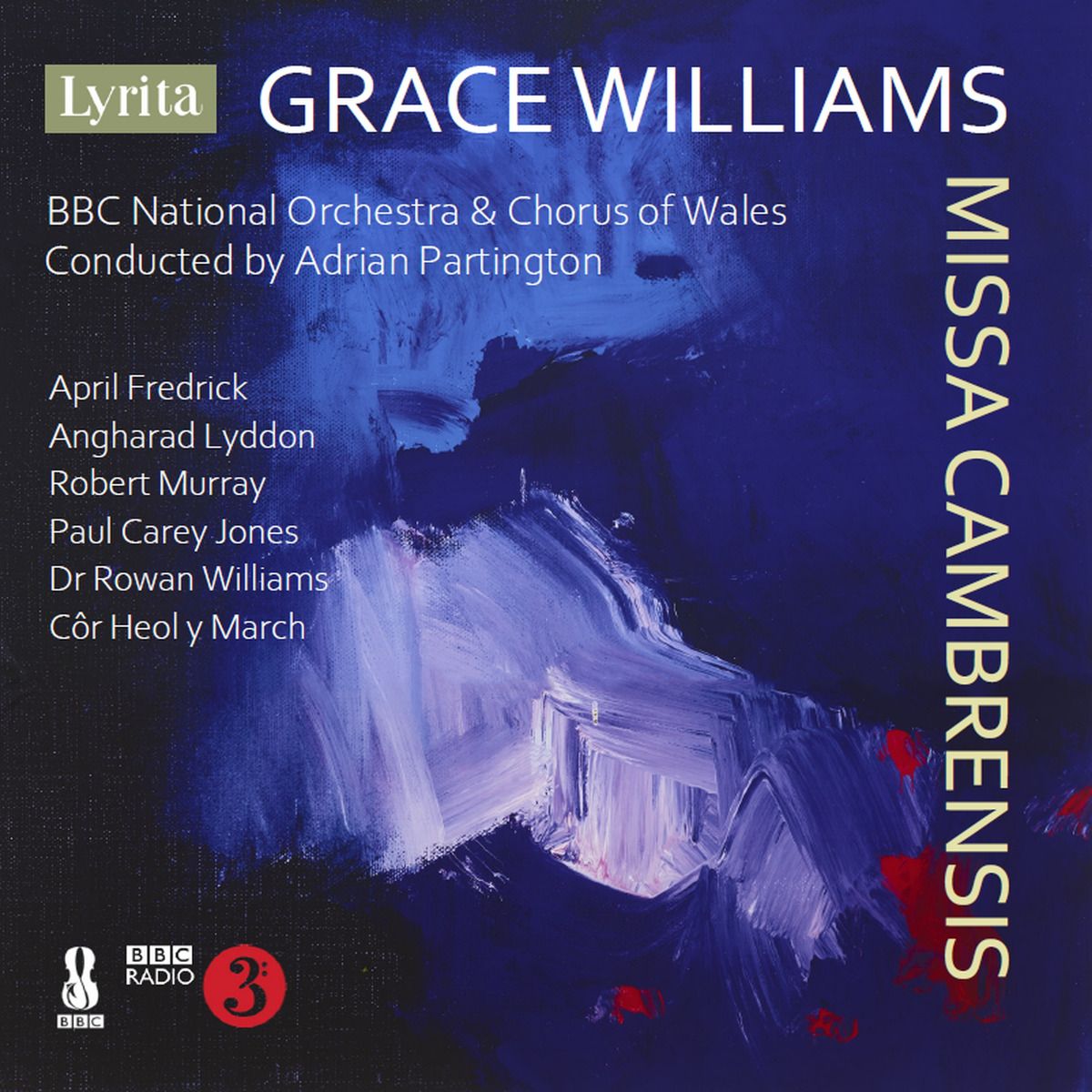
On Record – Soloists, BBC National Chorus and Orchestra of Wales / Adrian Partington – Grace Williams: Missa Cambrensis (Lyrita)

Grace Williams Missa Cambrensis (1968-71)

April Fredrick (soprano), Angharad Lyddon (mezzo-soprano), Robert Murray (tenor)
Paul Carey Jones (bass), Dr Rowan Williams (narrator); Côr Heol y March, BBC National Chorus and Orchestra of Wales / Adrian Partington

Lyrita SRCD442 [66’41’’] Latin / Welsh text and English translation included
Producer / Engineer Adrian Farmer, Engineer Simon Smith

Recorded 20-21 January 2024 at BBC Hoddinott Hall, Cardiff

Reviewed by Richard Whitehouse

What’s the story?

Lyrita continues its coverage of Grace Williams (1906-1977) with her largest concert work, Missa Cambrensis, in a recent studio recording which confirms it as the defining statement from a composer who, almost half a century since her death, is only now receiving her due.

What’s the music like?

As Paul Conway observes in his typically thorough booklet notes, Missa Cambrensis is one among a number of works by Williams that is Welsh only in a titular sense. Premiered at the Llandaff Festival in 1971, it was well received by fellow composers, critics and public alike but not heard again until 2016 in a performance one recalls as originally intended for release on Lyrita and which can be heard via the composer’s dedicated website. Not that the present account is other than successful in conveying the essence of this powerful yet elusive piece.

Many settings of the Mass since Haydn have unfolded a symphonic trajectory, but Williams goes further with the division into five clearly defined movements. The initial Kyrie Eleison not only introduces most of those salient motifs but also establishes that tone, mystical in its undulating equivocation, such as characterizes this work’s long-term expression: the contrast here between choral and soloistic textures duly accentuated by their hieratic and supplicatory quality. This duly sets up an emotional contrast intensified in the Gloria, outwardly the most straightforward part of the work but with a calmly ecstatic response at Laudamus te then an eloquent Dominus Deus that are nothing if not personal, together with an intensely wrought Cum Sancto Spiritu whose culminating Amen’s convey a distinctly ambivalent affirmation.

As most often, the Credo is the most substantial portion but Williams rings the changes by dividing this into halves, a pertinent division coming at Et homo factus est and Crucifíxus étiam pro nobis. In between are interpolated a setting of Saunders Lewis’s Carol Nadolig (A Christmas Carol) for children’s voices with viola, cello and harp of melting pathos, offset by a starkly narrative treatment of the ‘Beatitudes’ prior to a mostly ruminative resumption of the Credo. Pivoting between contemplation and elation, the Sanctus is rounded off by a joyful Hosánna in excélsis which is not to be heard again after the subdued eloquence of the Benedictus. An anguished response to the Agnus Dei feels the more acute, as also a searching Dona Nobis Pacem which brings the work full circle to its contemplative close.

Does it all work?

Yes, and with an understated while readily identifiable personality that surely makes this the most potent setting of the Mass from a Welsh composer. Subliminal influences might not be hard to discern, among them Britten’s War Requiem, but they never detract from Williams’s own idiom. The soloists cannot be faulted in terms of commitment, with Rowan Williams a notably incisive reciter, while Adrian Partington secures a lustrous response from his choral and orchestral forces. Overall, it is hard to imagine the work given with greater conviction.

Is it recommended?

It is indeed, not least in the hope that further live hearings of Missa Cambrensis may prove forthcoming. Good news, moreover, that Lyrita has now acquired the premiere performance of Williams’s only completed opera, The Parlour, which is scheduled for imminent release.

Listen & Buy

You can read more about this release at the Wyastone website

Published post no.2,516 – Monday 28 April 2025

On Record – Anna Huntley, Gwilym Bowen, Thomas Mole, BBC Women’s Chorus of Wales, ESO / Kenneth Woods – Walter Arlen: The Song of Songs, The Poet In Exile (Signum Classics)

Arlen arr. Bekmambetov / ed. Woods The Song of Songs (1953)
Arlen ed. Woods The Poet in Exile (1988, rev. 1994)

Anna Huntley (mezzo-soprano), Gwilym Bowen (tenor), Thomas Mole (baritone), BBC Women’s Chorus of Wales, English Symphony Orchestra / Kenneth Woods

Signum Classics SIGCD879 [52’21’’]
Producer / Engineer Phil Rowlands, Engineer Andrew Smilie

Recorded 17-20 February 2022 at BBC Hoddinott Hall, Cardiff

Reviewed by Richard Whitehouse

What’s the story?

Kenneth Woods and the English Symphony Orchestra continue their exploration of music by composers murdered or forced into exile during the Third Reich with this release of Walter Arlen, whose recent death at 103 enabled him to experience a renewed interest in his music.

What’s the music like?

Although he remains best known through his trenchant music criticism for the Los Angeles Times, the Vienna-born Walter Arlen (Aptowitzer) also made a distinguished contribution to music administration and left a not inconsiderable output. Several albums featuring his songs and piano music can be heard on the Gramola label, while this latest ESO release provides a welcome introduction to two of his works that involve larger forces – the one drawing on an ancient Jewish source and the other upon poems by a seminal author from the post-war era.

Whether or not The Song of Songs is the harbinger of monogamy in the Judeo-Christian moral code, it contains some of the eloquent expression found in either Biblical testament. In just 30 minutes, Arlen’s ‘dramatic poem’ takes in the main narrative, its lively initial chorus featuring intricate polyphony for female voices and incisive orchestral textures. As the piece unfolds, its emotional emphasis is placed on the solo contributions – whether those of Solomon sung with burnished warmth by Thomas Mole, those of the Shepherdess with poise and insouciance by Anna Huntley, or those of the Shepherd given with virility and tenderness by Gwilym Bowen. Nor is the BBC Women’s Chorus of Wales wanting in intonational accuracy. If the resolution does not bring expected closure, this direct and unaffected setting certainly warrants revival.

The real discovery is The Poet in Exile, a song-cycle to texts by Polish-born American author Czesław Miłosz. These profound poems are not easily rendered in musical terms, and it is to Arlen’s credit that he goes a considerable way to achieving this. As the composer states, they ‘‘dealt with situations echoing my own remembrance of things past’’ – as holds good from the trenchant rhetoric of ‘Incantation’, via the sombre rumination of ‘Island’ then wistful elegance of ‘In Music’ or controlled fervour of ‘For J.L.’ (with its striking harpsichord obligato), to the confiding intimacy of ‘Recovery’. Some may have heard these songs with Christian Immler and Danny Driver (GRAM98946) but this orchestration by Woods, after the arrangement by Eskender Bekmambatov, offers a wider-ranging context for assured singing by Thomas Mole.

Does it all work?

Pretty much, and not least because the ESO is heard to advantage in the spacious acoustic of Hoddinott Hall while directed by Woods with unerring sense of where to place the emotional emphasis – especially important in conveying the meaning of the songs. A pity, however, that neither texts nor translations could be included here – not least as that by Leroy Waterman of The Song of Songs is appreciably different from those which have been previously set, while the Miłoz poems are worth savouring on their own terms and need to be approached as such.

Is it recommended?

It is. If not a major voice, Arlen’s music is always approachable and often thought-provoking. Initiates and newcomers alike will enjoy getting to know these works and hearing them given so persuasively – a worthy present, indeed, for this composer as he neared his 102nd birthday.

Listen & Buy

Click on the names to read more about performers Anna Huntley, Gwilym Bowen, Thomas Mole, the English Symphony Orchestra and conductor Kenneth Woods. Click on the name for more on Walter Arlen

Published post no.2,515 – Saturday 26 April 2025

On Record – Ensemble MidtVest – Matthew Owain Jones: String Quartet no.1, Wind Quintet; Nielsen arr. Jones: Aladdin (First Hand Records)

Matthew Owain Jones
String Quartet no.1 ‘Deletia’ (1993, rev. 2012)
Wind Quintet (2016)
Nielsen arr. Jones
Aladdin, FS89: Nine Pieces for wind quintet, string quartet and piano (1917-19, arr. 2018)

Ensemble MidtVest [Charlotte Norholt (flute), Peter Kirstein (oboe), Tommaso Lonquich (clarinet), Yavor Petkov (bassoon), Neil Page (horn); Matthew Owain Jones, Karolina Weltrowska, Ana Feitosa (violins), Sanna Ripatti (viola), Jonathan Slaatto (cello), Martin Qvist Hansen (piano)]

First Hand Records FHR163 [63’53’’] All world premiere recordings
Producers / Engineers Michael Ponder (String Quartet, Wind Quintet), Morten Mogenson (Aladdin)

Recorded 6 December 2017 (String Quartet), 11 January 2018 (Wind Quintet), 29-31 August 2018 (Aladdin) at Den Jyske Sangskole, Herning, Denmark

Reviewed by Richard Whitehouse

What’s the story?

First Hand Records makes a welcome addition to its contemporary catalogue with this release of music or arrangements by Matthew Owain Jones, all performed by the extended outfit that is Ensemble MidtVest and among whose varied personal the composer himself can be found.

What’s the music like?

Fifty last year, Jones has had a diverse career as a musician as is recounted in his personable booklet notes. Composing has often taken a back seat in his activities, the works here written almost a quarter-century apart, yet there can be no doubting the idiomatic nature of his music.

Composed when barely out of his teens, the First String Quartet is evidently the product of a gifted if unfocussed musical talent. Jones admits as much by appending the subtitle ‘Deletia’ to its revision almost two decades on – the original four movements having been reduced to just two, albeit substantial entities. These duly complement each other in almost all respects – the initial Andante exuding a warmth and fervency that is questioned, without being denied outright, by the ensuing Allegro whose ‘minaccioso’ marking underlines its capricious while sometimes ominous nature. The result is uneven yet engaging – making it a pity that, after a musical co-written with his sister, Jones should have left composing somewhat in abeyance.

It was the positive reception accorded that revision of his quartet which encouraged Jones to return to composition in earnest, and among the first fruits of this resumption was his Wind Quintet. Its substantial single movement falls into four continuous sections such as outline a relatively Classical design (albeit with an intermezzo-like section placed second), and Jones cannily exploits those incremental changes in timbre or texture without recourse to extremes of tempo and mood. The outcome is music demonstrably within the lineage of a genre more extensive than often supposed and, though its content breaks little new ground, this is never less than expertly conceived for the medium and affords a pleasurable listen in its own right.

The locus classicus of wind quintets has to be that written just over a century ago by Nielsen, music by which composer ends this collection. Although its suite is periodically revived, the lavish incidental music (not a ballet, as is referenced several times in the notes, though there is a notable element of dance) for Adam Oehlenschlager’s play Aladdin proved too ambitious even at its Copenhagen premiere. Surprising, perhaps, that the nine numbers included here translate so well into the medium of a mixed decet – preserving the distinctive nature of music from Nielsen’s maturity (it comes mid-way between his Fourth and Fifth Symphonies) and thus making it freely available to practitioners for the very different context of the recital room.

Does it all work?

Pretty much. Much of the attraction of this collection lies in the respect which the members of Ensemble MidtVest have for Jones and his music, thereby making for performances that could scarcely be improved upon in terms of technical refinement or interpretative insight.

Is it recommended?

It is, not least as the sound conveys the immediacy but also delicacy of this music with ideal clarity and perspective. Jones must feel vindicated by the enterprise, as indeed he should, and one looks forward to more releases of both his compositions and arrangements in due course.

Listen & Buy

Click on the names to read more about composers Matthew Owain Jones and Carl Nielsen, and the performers Ensemble MidtVest

Published post no.2,515 – Saturday 26 April 2025