

At 1pm on Monday June 1st, live music-making returned to the Wigmore Hall and BBC Radio 3.
While we have been incredibly fortunate to enjoy live streams of music from around the world since lockdown began, this felt like something extra special. A whole month of lunchtime concerts, served up by our finest chamber music venue in conjunction with BBC Radio 3, and streamed on the Wigmore Hall website. With a selection of top class artists, all of whom live close enough to journey in and play, all that was missing was the audience – but this added extra poignancy, offering us private moments with the musicians in our own home, a deluxe version of what BBC Radio 3 has been giving us for decades. A note should be made for presenter Andrew McGregor‘s broadcasting manner, expertly paced and perfectly weighted.
The musical riches in the first week have been many and varied. The first concert was ideally placed, Steven Hough giving us Busoni’s epic realisation of Bach’s Chaconne in D minor and Schumann’s lovelorn Fantasie in C major. In some performances of the Bach-Busoni the virtuoso elements of the piece take over at the expense of feeling, but not here. Hough shaped the phrases with great care, bringing out the gusto when it was needed but giving an incredibly well-balanced account of a familiar showpiece.
With Schumann’s Fantasie he gave a flowing performance of a notoriously difficult work, made all the more poignant because of its circumstances, written in isolation by a composer pining for his wife Clara. There was joy, too – the march theme of the second movement ringing out with bell-like clarity, while the resolution at the end, softly voiced, left a lasting smile.
Tuesday’s song recital from soprano Lucy Crowe and pianist Anna Tilbrook had the themes of Hope and Longing – appropriately in the awful context of world events, which saw the concert begin with a two-minute period of reflection on racial inequality and violence.
Crowe began on high, judging her vibrato beautifully for Thomas Arne’s aria O ravishing delight, before three Schumann songs found her vocal control matched by her communication with the audience, in spite of the empty hall. The sound world of Berg’s 7 frühe Lieder is very different, with challenges of tricky melodic intervals and words by seven different poets, but the soprano handled them effortlessly, helped by Tilbrook’s painterly application of light and shade for the corners of Berg’s nocturnal settings.
The pair moved on to a selection of poignant folk songs, none more so than the unaccompanied She moved through the fair, before English lyrics old and new from Thomas Dunhill, Ivor Gurney, Vaughan Williams and Madeline Dring. It was a touching recital with both soprano and pianist clearly on the same page.
Few guitarists would expect to receive compliments on the quality of their quiet playing…but that was what stood out immediately from Sean Shibe’s solo recital on the Wednesday. With a collection of attractive Scottish dances the listener was drawn in from the start and borne to the beauty of the Highlands, the tunes carrying on the air in performances of extraordinary intimacy.
The same could be said for Shibe’s performance of Bach’s Lute Suite in E minor, carefully studied but delighting in the expressive interplay between the parts, bringing Bach’s notes clean off the page. Steve Reich’s Electric Counterpoint was even better, Shibe moving to a Fender to play the 12th part of this multilayered composition. The waves of sound echoing around the Wigmore as the guitarist, now barefoot, completely lost himself in the music.
Oboist Nicholas Daniel and pianist Julius Drake, both Wigmore regulars and musical partners for 40+ years, crammed their Thursday lunchtime with music old and new, all of personal significance.
They included two short premieres, the wide open textures of Huw Watkins’ haunting Arietta and the uncertainties of Michael Berkeley’s A Dark Waltz, written in lockdown. There was a rarity,too, in the first broadcast performance of Liszt’s darkly coloured Élegie, originally written for cello and piano but here in a recently unearthed version with for cor anglais.
Howard Ferguson’s arrangement for oboe and piano of Finzi’s substantial Interlude was beautifully paced and deeply felt in that slightly elusive way in which the composer writes, Drake absorbing the extra parts with ease. Meanwhile Ferguson’s arrangements of three pieces for pedal piano by Schumann studies were also nicely done. Later we heard three attractive shorter pieces from Madeline Dring, and finally Nicholas Daniel showed off the oboe’s versatility in three rewarding arrangements of popular songs, including The Girl From Ipanema and capped by All The Things You Are. A note, too, for the pair’s deeply felt and beautifully observed Bach encore, Jesu, Joy of Man’s Desiring, prefaced by a sensitive introduction.
Last but not least, Pavel Kolesnikov and Samson Tsoy reminded us what an intimate form of communication the piano duet can be. As the pair live together they have experienced isolation in each other’s company, and that in itself brought an extra poignancy to their lovingly played selection of Brahms’ Liebeslieder Waltzes, a profound Schubert Impromptu in A flat from Tsoy and a bittersweet clutch of six Waltzes, Ländler & German Dances from Kolesnikov.
Together the pair enjoyed the humour and lightness of touch in Beethoven’s 8 Variations on a theme of Count Waldstein, but the best was saved for last and a wonderful performance of Schubert’s Fantasia in F minor. Recognised as one of the finest works in the piano duet repertoire, it received a performance led by Tsoy that moved from almost painful introspection to passionate outbursts five minutes later. The scherzo section had plenty of cut and thrust, while the whole piece, ideally paced, built to an almost overwhelming strength of feeling, capped by an intensely dramatic pause before the softly voiced opening theme returned.
What a musical week it has been – and looking at the roll call it looks like we are in for another three weeks of equally fine and moving insights. You can catch up with all the concerts on the links above and are strongly advised to do so, for there are some incredibly fine performances waiting to be heard. Live concerts may not be with us for a while yet, but in the meantime these intimate hours with some of our best classical music artists are an ideal substitute.
You can see the schedule for forthcoming Wigmore Hall livestreams here, the series resuming courtesy of cellist Steven Isserlis and pianist Mishka Rushdie Momen on Monday 8 June.

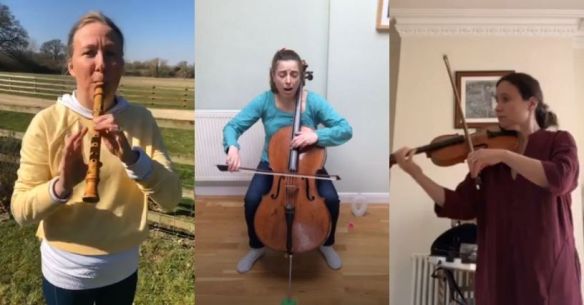
 Also well worth exploring is Chamber Music Scotland, who are offering a weekly series of streamed concerts and lectures. Future appearances are scheduled from guitarist Sasha Savaloni and a trio of flautist Georgia Browne, violinist Tuomo Suni and harpsichordist Tom Foster.
 Finally a nod in the direction of Sandy Burnett, who is running a summer-long online Listening Club. Every Tuesday at 11am Sandy, a highly respected broadcaster and musician, will offer his own insights into a chosen classical work in his typically engaging and informative style. The next, on Tuesday 26 May, will focus on Bach and his Sonata for Solo Violin in G minor – while future instalments will include works by Weill, Mozart, Monteverdi, Messiaen and Beethoven. You can join the Listening Club
  Arcana.fm