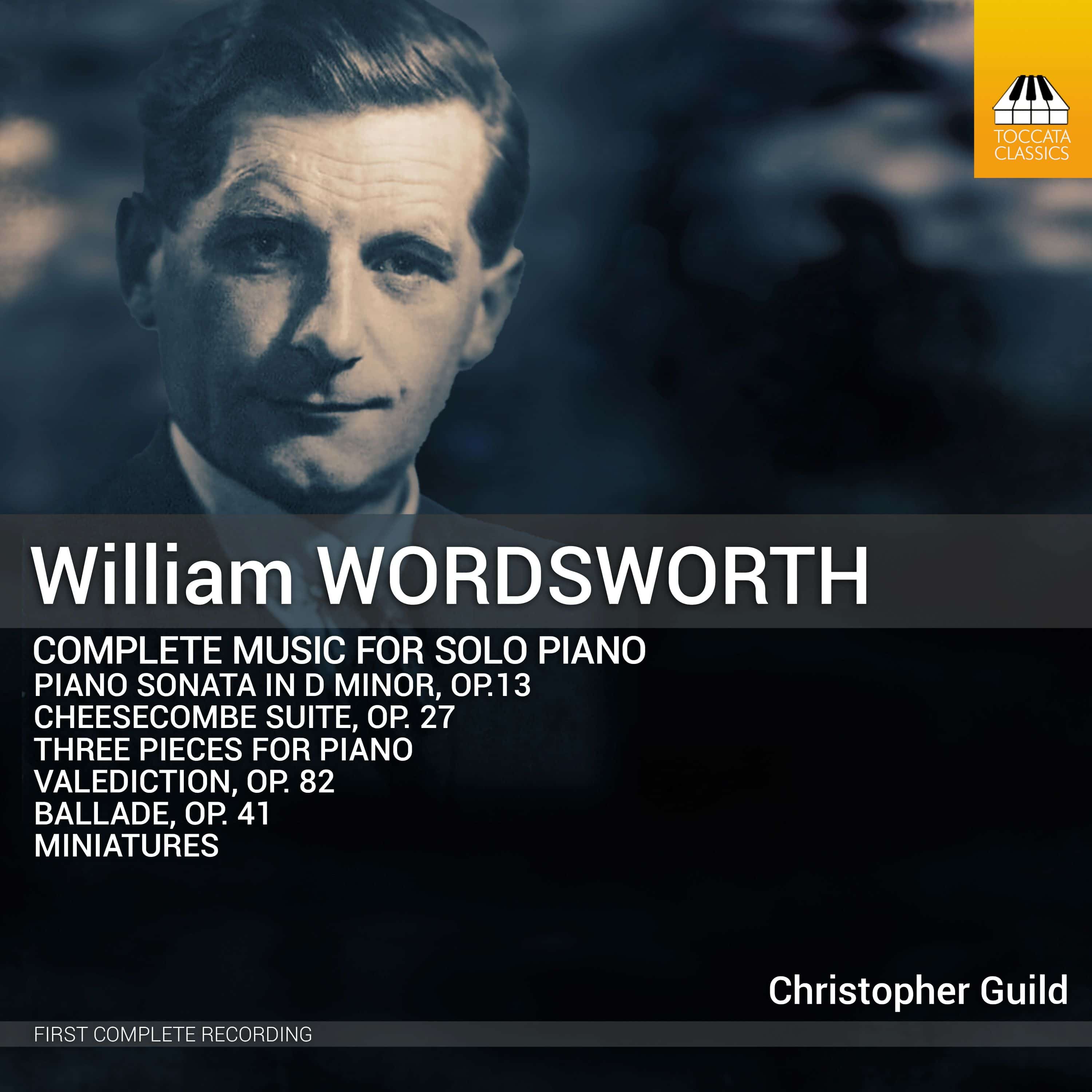
On Record – William Wordsworth: Complete Piano Music (Christopher Guild) (Toccata Classics)

William Wordsworth
Piano Sonata in D minor Op.13 (1938-9)
Three Pieces (1932-4)
Cheesecombe Suite Op.27 (1945)
Ballade Op.41 (1949)
Eight Pieces (all publ. 1952)
Valediction Op.82 (1967)

Christopher Guild (piano)

Toccata Classics TOCC0697 [81’08”]
Producer and Engineer Adaq Khan

Recorded 13 April, 29 May 2022 at Old Granary Studios, Beccles, 2 April 2023, Wyastone Hall, Monmouthshire (Three Pieces)

Reviewed by Richard Whitehouse

What’s the story?

Toccata Classics intersperses its continuing survey of William Wordsworth’s orchestral music with a release devoted to that for solo piano, including several works not otherwise recorded and all ably performed by Christopher Guild, who already features prominently on this label.

What’s the music like?

Although not a large part of his catalogue, piano music features prominently in Wordsworth’s earlier output – notably a Piano Sonata that ranks among the finest of the inter-war period. Its first movement is introduced by a Maestoso whose baleful tone informs the impetuous while expressively volatile Allegro. The central Largamente probes more equivocal and ambivalent emotion before leading into the final Allegro, its declamatory and martial character offset by the plangent recall of earlier material prior to a denouement of surging and inexorable power.

His status as conscientious objector found Wordsworth engaged in farm-work in wartime, the experience duly being commemorated in his Cheesecombe Suite whose pensive Prelude and dextrous Fughetta frame a quizzical Scherzo then a Nocturne of affecting pathos. Written for Clifford Curzon, Ballade is a methodical study in contrasts which makes an ideal encore; as, too, might Valediction – though here the emotions run deeper and more obliquely, as befits this inward memorial to a lifelong friend from comparatively late in its composer’s creativity.

This release rounds out our knowledge of Wordsworth’s piano music with two collections not previously recorded. Among his earliest surviving works, the Three Pieces comprise a taciturn Prelude, fleeting Scherzo then soulful Rhapsody which between them find the composer trying out whole-tone figuration with resourcefulness but also a self-consciousness that might have decided him against publishing. Published by Alfred Lengnick as part of its five-volume educational series Five by Ten, the eight miniatures wear their didactic intention lightly; only one of these exceeding two minutes, yet all evince a technical skill that is never facile along with a pertinent sense of evocation that should commend them to amateurs and professionals alike. Here, as often elsewhere, Wordsworth proves a ‘less is more’ composer of distinction.

Does it all work?

Very much so and Christopher Guild, with admirable surveys of Ronald Stevenson (Toccata) and Bernard Van Dieren (Piano Classics) to his credit, is a natural interpreter of often elusive yet always rewarding music. His charged and often impetuous take on the Sonata has more in common with the pioneering account by Margaret Kitchin (Lyrita) than the overtly rhetorical one by Richard Deering (Heritage). Similarly, his approach to the Cheesecombe Suite and the Ballade draws out their depths if occasionally at the expense of their expressive immediacy. Interestingly, Valediction is played from a copy by Stevenson that alters aspects of keyboard layout or pedalling if not the notes themselves; resulting in a greater emotional ambivalence and textural intricacy which Wordsworth, had he heard it, would most likely have endorsed.

Is it recommended?

Indeed, not least when the sound of both Steinway D’s are so faithfully conveyed and Guild’s annotations are so perceptive. Those who have the Deering release should consider acquiring this one also, while those new to this music need not hesitate in making this their first choice.

Listen & Buy

For purchase options, you can visit the Toccata Classics website. Click on the names to read more about pianist Christopher Guild and composer William Wordsworth.

Published post no.2,500 – Thursday 10 April 2025

New music – Francesco Tristano: Bach – English Suite no.2 in A minor: Prelude (naïve)

adapted slightly from a press release received earlier today:

After a special release in Japan, Bach: The 6 English Suites by Francesco Tristano will be released globally on May 23rd on naïve, a label of Believe Group, under his imprint intothefuture. As a first glimpse into this highly anticipated album, the Prelude from the English Suite no.2 is released today.

Following Bach: The 6 Partitas, the new recording continues Tristano’s deep exploration of J.S. Bach’s keyboard works. With his distinctive style, he brings a dynamic and immersive interpretation, capturing the rhythmic vitality and expressive depth of these suites, composed in the 1710s. Listen here:

Published post no.2,478 – Wednesday 19 March 2025

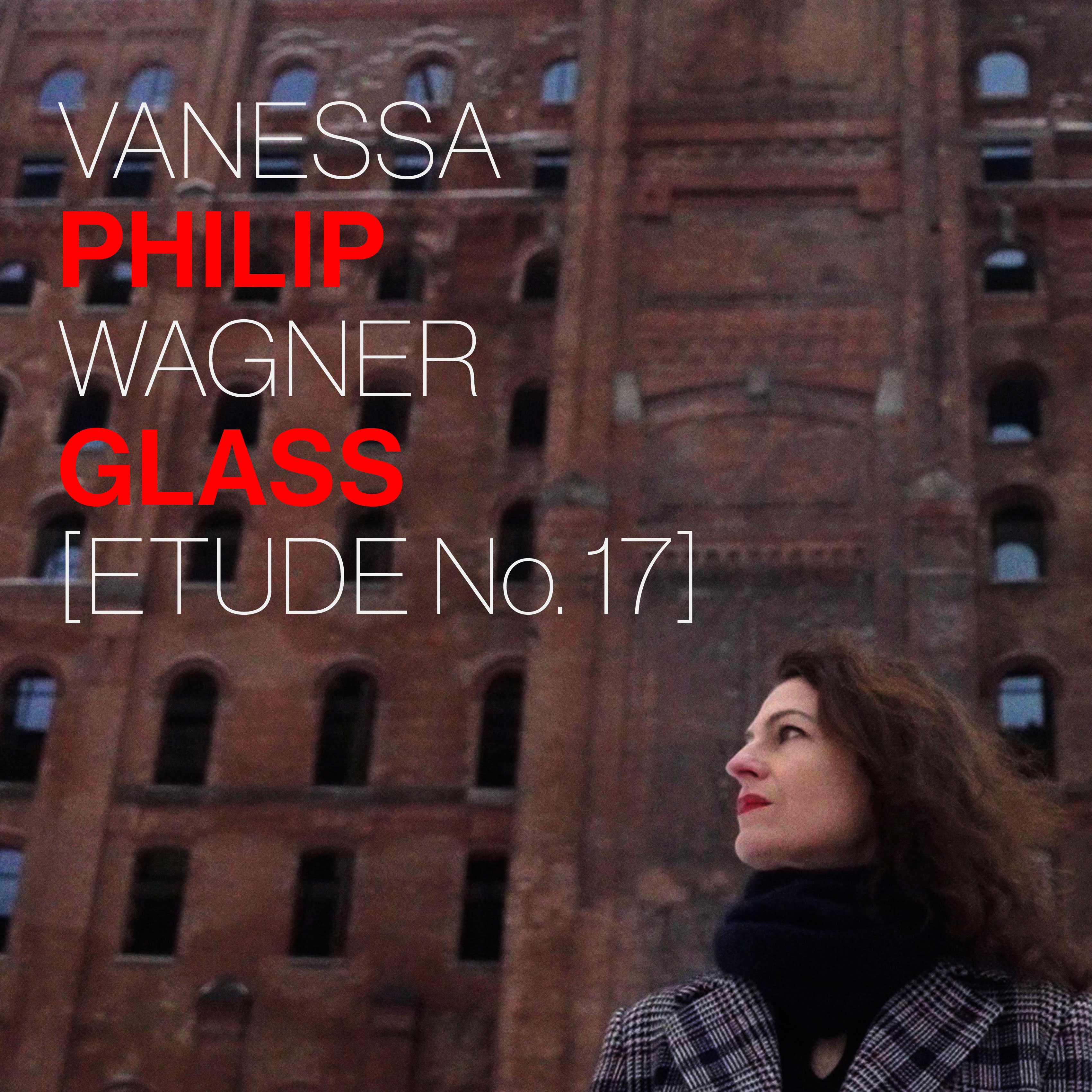
New music – Vanessa Wagner: Philip Glass – Étude no.17 (InFiné)

by Ben Hogwood

Today brings us news of an important project from Vanessa Wagner, a favourite of these pages. Étude No. 17 is the first excerpt from her complete recording of Philip Glass’s Études for Piano, set for release later in 2025 on the InFiné label.

The InFiné press release goes into detail on Glass’s etudes, which are fast becoming the most recorded area of his music:

“Through her approach, Vanessa Wagner helps establish these two books as a major cycle within the grand repertoire, on par with the études of Ligeti, Pascal Dusapin, and, before them, Chopin and Liszt.

While the first book was conceived as an instructional manual to push Glass’s technical limits with a piano, the second book envisions an imagined virtuoso pianist, demanding both precision and dexterity. Glass himself has rarely performed more than a few pieces from the second volume.

Legend has it that while working on his final four études, Glass pulled a collection of poetry by Allen Ginsberg from his bookshelf. A mythical figure of the Beat Generation, Ginsberg inspired a whole generation’s desire for travel—journeys that took the young Glass across Europe (notably France) and India, infusing his work with a singular tone. As he flipped through the book, he reportedly rediscovered a personal manuscript for a piece titled Magic Psalm, which would later become his Etude No. 17.

Through her interpretation, Vanessa Wagner brings to light the delicate balance between serenity and tension in this mesmerizing composition, capturing both its poetic, wistful quality and its cinematic contrasts—inviting listeners on a journey that is as reflective as it is unsettled, much like the ever-shifting landscapes of the Hudson River.”

Watch it here:

Published post no.2,477 – Tuesday 18 March 2025

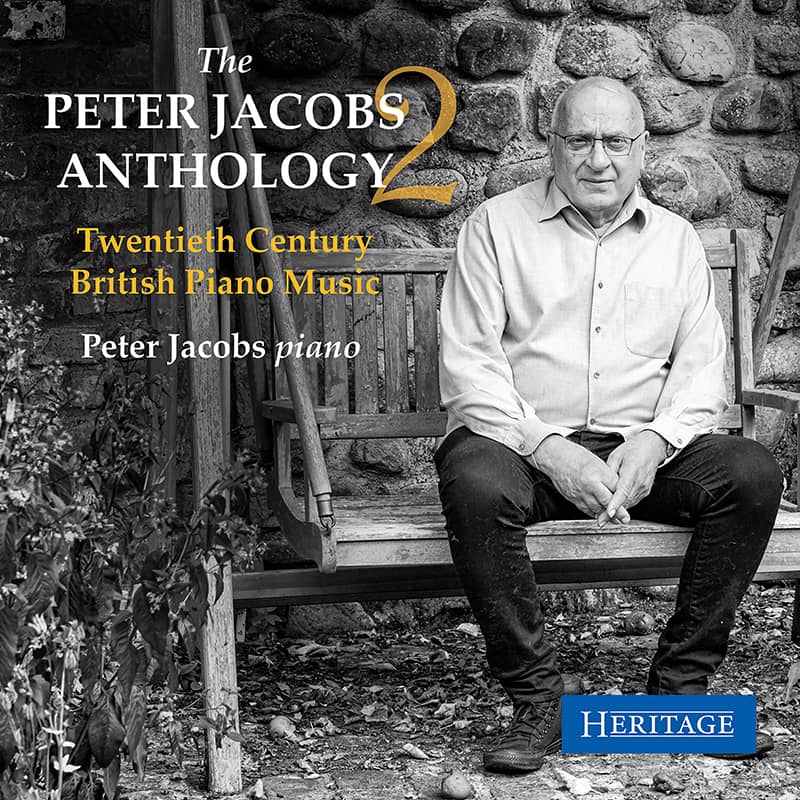
On Record – The Peter Jacobs Anthology Vol. 2 – Twentieth Century British Piano Music (Heritage)

Coleridge-Taylor Petite Suite de Concert Op.77 (1911)
Cooke High Marley Rest (1933)
Delius Mazurka and Waltz for a Little Girl RTIX/7, 1 & 2 (1922-3)
Headington Toccata (1963)
Rubbra Eight Preludes Op.131 (1967)
Scott Lotus Land Op.47/1 (1905)
Armstrong Gibbs Lakeland Pictures Op.98 (1940) – no.2, After Rain (Rydal Beck); no.8, Quiet Water (Tarn Howe)
Baumer Idyll (1935)
Mayer Calcutta-Nagar (1993)

Peter Jacobs (piano)

Heritage HTGCD131 [73’30″]
Producer & Engineer Paul Arden-Taylor

Recorded 14 & 16 September 2014 at Wyastone Concert Hall, Wyastone Leys, Monmouth

Reviewed by Richard Whitehouse

What’s the story?

Heritage extends an already extensive discography of British music with its follow-up to the Peter Jacobs Anthology, a further volume featuring collections of or standalone miniatures with a wide range of musical idioms given focus through the persuasiveness of the pianism.

What’s the music like?

Among the miscellaneous pieces included here are Greville Cooke’s ruminative ‘portrait’ of the home of pianist (and his former teacher) Tobias Matthay, Delius’s respectively pert and fey offerings, or Christopher Headington’s scintillating study for John Ogdon. Cyril Scott’s evergreen is treated to a subtly understated reading, while two out of a set of eight by Cecil Armstrong Gibbs provide enticing evocations of Rydal Beck then Tarn Howe – their innate Englishness sounding removed from the overtly Russian manner of that from Cecil Baumer.

Forming the backbone of this collection are three sets that in themselves attest to the variety of the music featured. Best known in its orchestral guise (a recording of which can be found on Heritage HTGCD249), Samuel Coleridge-Taylor’s Petite Suite de Concert is light music of a superior kind – witness its flighty initial Caprice, its ingratiating Sonnet or its lively closing Tarantelle, though its ostensible highlight is Demande et Réponse whose alluring sentiment helped with keeping the composer’s memory alive prior to his belated rediscovery.

Other than figuring among its composer’s later works, the Eight Preludes by Edmund Rubbra could hardly have been more different. As with his Eighth Symphony written soon afterward, these short while arresting pieces likewise focus on specific musical intervals rather than any overall key scheme, though their cohesiveness heard as an integral sequence could never be in doubt. Introspective without being inscrutable, this is wholly absorbing music and Jacobs accords ample justice to what is only the second complete recording this set has yet received.

As the most unlikely inclusion, John Mayer’s Calcutta-Nagar proves nothing less than a total delight. Known primarily for his syntheses of Indian and European elements, notably through the group Indo-Jazz Fusions, Mayer wrote extensively for Western media with this collection a notable instance. Only two of its 18 pieces last over a minute, yet their capturing of places recalled from the Calcutta of the composer’s youth is absolute. Jacobs notes his favourite as being the 13th (Kali Temple), but listeners will doubtless come up with their own favourites.

Does it all work?

Yes, whether as a judiciously planned collection or an anthology from which one can select individual items as preferred. The three collections are each among the most distinctive of its kind, while they and the various individual pieces provide ready-made encores in recital. Evidently this is music which Jacobs has long included in his repertoire, the performances exuding that combination of technical finesse allied to a probing insight as have long been hallmarks of his interpretations. Those who are unfamiliar with this music are in for a treat.

Is it recommended?

Indeed, not least as the sound has a combination of clarity and warmth ideal for piano music. The pianist pens informative notes, and one hopes that there will be further such anthologies. Meanwhile, Jacobs approaches his 80th birthday (this August) with his pianism undimmed.

Listen & Buy

For purchase options, you can visit the Heritage Records website

Published post no.2,448 – Monday 17 February 2025

On Record – George Lloyd: The Piano Works – Solo & Duo (Anthony Goldstone & Caroline Clemmow, Kathryn Stott, Martin Roscoe (Lyrita)

George Lloyd
Aubade (1971)a; Eventide (1989)a; The Road Through Samarkand (1995)a; The Lily-leaf and the Grasshopper (1972)b; The Transformation of that Naked Ape (1972, rev. 1987)c; Lullaby ‘Intercom Baby’ (1975, arr. 1987)c; An African Shrine (1966)c; The Aggressive Fishes (1972)c; St. Antony and the Beggar (1972)c. The Road Through Samarkand (1972)c

Kathryn Stott (b), Martin Roscoe (c) (pianos)
Anthony Goldstone and Caroline Clemmow (a) (piano duo)

Lyrita SRCD.2423 (two discs, 70’16” and 77’55”)
Producers bcHoward Devon, aAnthony Goldstone and Caroline Clemmow with George Lloyd Engineers bcHoward Devon, aAnthony Goldstone and Caroline Clemmow with George Lloyd

Recorded b2 June 1987 at Henry Wood Hall, London; c18 & 19 June 1987 at St. Barnabas, North Finchley, London; a4 & 5 November 1996 at St. John the Baptist, Aldeburgh

Reviewed by Richard Whitehouse

What’s the story?

Lyrita continues its ‘Signature Edition’ of music composed (and conducted) by George Lloyd with his works for one and two pianos, admirably performed here by a line-up of international stature including those pianists who recorded his concertos for this instrument (SRCD.2421).

What’s the music like?

As Lloyd himself recounted, training as a violinist rather prejudiced his writing for the piano, despite his wife’s prompting. It was hearing the young John Ogdon in the early 1960s that led to Scapegoat, this first piano concerto being followed by three others and several other works for piano over the ensuing decade. For all their diversity of inspiration, they have in common a determination to avoid wanton virtuosity in favour of a technical precision as never inhibits their composer’s aim to realize his musical intentions – whether idiomatically or individually.

This is evident in Lloyd’s earliest and arguably finest work for solo piano, An African Shrine. Written for Ogdon, who played it regularly and recorded in his 1970 EMI anthology Pianistic Philosophies, this takes in several sections – the vividness of whose expressive contrasts are balanced by the seamlessness with which they merge into an unbroken formal continuity. As an evocation of mindless violence, it is highly affecting and its cohesion as a one-movement ‘sonata’ makes for an indispensable addition to British piano music during the post-war era.

Lloyd followed this with the even more expansive Aubade, composed for Ogdon and his wife Brenda Lucas. Described as a ‘fantasy’, its eight sections outline a dream-like scenario which takes in charcoal burners, tin soldiers, a song then dance for two lovers, a medley of bells and chants, then moths; framed by an Introduction and Finale as set the scene thematically then sum it up unerringly. Enticingly realized for its medium if too diffuse overall, this would likely enjoy wider exposure if it were shortened and orchestrated as the ballet it cries out to become.

The year 1972 saw Lloyd immersed in the solo piano. Among these shorter pieces, The Road Through Samarkand is the most directly appealing with its amused if never sarcastic send-up of Krishna adherents in central London with many taking the journey from Calais to Calcutta, though whether the outcome is one of utopianism or disillusionment is left unanswered by the peremptory close. St Anthony and the Beggar is a direct corollary to the Biblical parable, here with an outcome of demonstrable catharsis, while The Aggressive Fishes evokes the allure yet danger of certain tropical species in music alternately atmospheric and ominous. Inspired by a citing from the banks of the Avon, The Lily-Leaf and the Grasshopper is a subtler interplay of contrasts – the insect’s quizzical demeanour emerging out of then back into a rapt waterscape.

The most substantial of these later pieces is The Transformation of the Naked Ape. Taking its cue from Lloyd’s consideration of the essential difference between animals and humans, these six movements (each longer than the last) deftly outline a progression from external to internal properties – hence from Her Hair, via those of Tongue, Eyes, Brain and Mind, to Her Soul – though any inference of increasing spirituality is scotched by the capricious final number of this highly diverting sequence, in which pleasure and provocation have been pointedly elided.

Lloyd wrote little more for piano in either medium, though his arrangement of the violin-and-piano Intercom Baby 12 years on as Lullaby turned one of his most ingratiating shorter pieces into this ideal encore – wistful and playful by turns. Drawing on a carol written when he was just ten (then used extensively in his opera John Socman), Eventide emerges as a fantasy on this tune such as adumbrates a journey from innocence to experience of deceptive simplicity and has enjoyed greater exposure in a no less effective arrangement for brass band two years on. Finally, The Road Through Samarkand makes its reappearance arranged for two pianos – the inherent virtuosity of its writing more equably realized in this medium if, as is suggested here, those elements of struggle and assumed repose more potently realized by the original.

Does it all work?

Almost always. There is a sense of this music (rather its composer) fighting against precedent as regards idiomatic piano writing, for all that the outcome feels never less than effective and often much more so. The performances are highly sympathetic and often inspired – particularly Kathryn Stott with her contributions, though Martin Roscoe affords no mean insight and lucid pianism with his larger selection. The duo of Anthony Goldstone (much missed) and Caroline Clemmow is heard to impressive effect, but sound here could do with rather greater definition.

Is it recommended?

It is. Paul Conway’s annotations feature many pertinent observations, while the solo items are recorded with ideal clarity and spaciousness. Not the first port-of-call for those new to George Lloyd, maybe, but a collection where several items warrant inclusion in the modern repertoire.

Listen & Buy

For further information visit the dedicated page for the George Lloyd Signature Series. For more on the composer himself, head to the George Lloyd website, while for more on the artists click on the names to read about Martin Roscoe, Kathryn Stott and the Anthony Goldstone & Caroline Clemmow duo.

Published post no.2,248 – Tuesday 23 July 2024