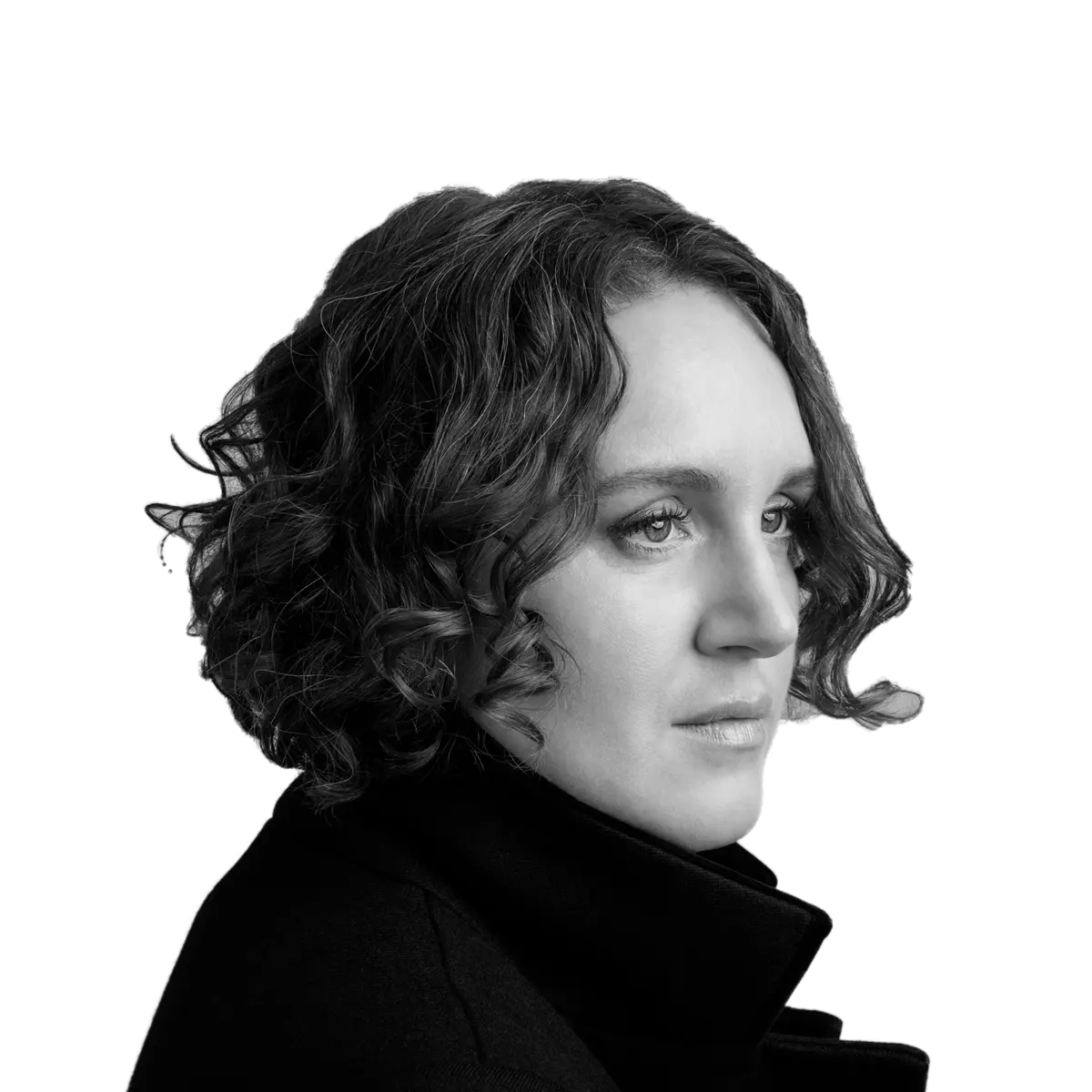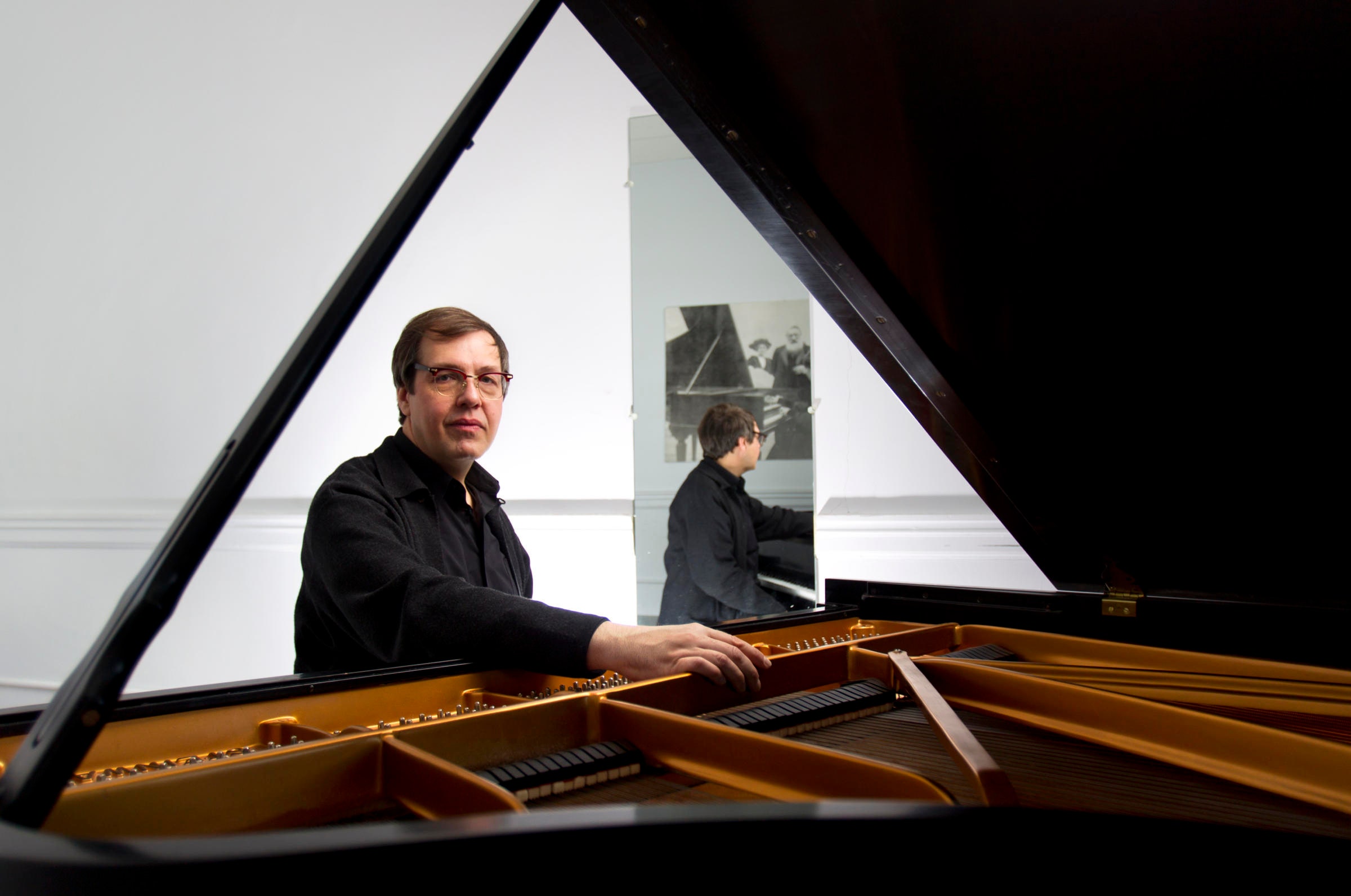
Paul Wee is a true one-off. An in-demand commercial barrister by day, he is also an extraordinary pianist, capable of taking on some of the most demanding pieces in the repertoire. The combination of a passion for his art and thirst for a challenge has led to award-winning recordings of the music of Thalberg and of Beethoven arranged by Liszt, both for the BIS label.
Yet arguably his greatest recording achievement to date concerns the music of Charles-Valentin Alkan, the 19th-century French composer who was one of the great virtuosos of his day. Wee has mastered two massive works by the composer – his Symphony for Solo Piano and the Concerto for Solo Piano. The latter will form an entire lunchtime concert with which he will make his eagerly anticipated Wigmore Hall debut, on Saturday 15 June. A tempestuous hour of music lies ahead – so while he flexes his muscles in preparation, Arcana managed to get some time with him to explore not just Alkan but a number of other irons he has in the fire.
Firstly, Paul recalls vividly his first encounter with Alkan’s music. “It was when I was in high school, in New York City”, he says. “I heard a live recording of Marc-André Hamelin playing the Symphony for Solo Piano, and I was awestruck immediately!”
His decision to take on the concerto was inspired by similar feelings. “I was immediately taken by the Concerto for Solo Piano when hearing it for the first time: it’s an astonishing musical construction, which makes an extraordinary and unforgettable impact. I didn’t know of any other work like it in the repertoire and knew that I had to give it a go myself.”
The piece is notorious for the demands Alkan makes on the performer, but as Wee confirms the rewards are greater still. “The technical challenges are reasonably self-evident; in the numerous passages where Alkan is displaying the ‘virtuosity’ of the (virtual) ‘soloist’, the writing – whilst always remaining very idiomatic and practical, characteristically for Alkan – can sometimes approach the limits of conventional pianism”, he says. “The emotional (or musical) challenges are mainly twofold: first, bringing to life the (extraordinarily theatrical) drama and rhetoric in the second movement Adagio; and second, maintaining the intensity of the Concerto’s narrative arc across its 50-minute wingspan. But when these challenges are met, it makes for one of the most incredible experiences that the piano repertoire has to offer.”
Wee has recorded the concerto for BIS, an album released in 2019. Has his view of the piece changed since then? “Yes – in relation to both the Concerto’s sound world, and also its pacing, especially in the Allegro assai. As ever it’s difficult to explain this in words, so the best thing for anybody interested is to come and hear it live!”
Alkan is a composer who inspires great dedication among his fans, and Wee considers the elements of his music that lead to these feverish reactions. “I think it is the sheer power and quality of his finest works, which offer extraordinary experiences quite unlike anything else that the 19th century has to offer. The fact that Alkan and these works are not as widely known as they should be can often lead to fans of Alkan’s music to (rightly!) encourage others to discover this music for themselves. That’s exactly what I hope to be doing myself when bringing the Concerto to Wigmore Hall.”
Anyone approaching Alkan’s music for the first time is in for a treat. “It depends on what work they are hearing. If the Concerto, they should prepare themselves for an epic, but nevertheless very accessible, musical narrative; a very wide variety of pianistic experiences, from some of the greatest heights of 19th-century virtuoso piano writing, through to tender intimacy and lyricism, with much quasi-operatic dramatic intensity and rhetoric along the way. Overall, the listener should prepare themselves for the extraordinary cumulative impact of the work, which builds across all three movements and which in a good performance can be utterly overwhelming.”
Presenting this work in the Wigmore Hall is something of a dream for Wee, who recalls his most memorable musical experiences in the venue. “Wigmore Hall is probably my most visited concert venue, and my own personal highlights reel would be too long to list in full! But some illustrative examples would have to include recitals by Marc-André Hamelin playing Haydn, Mozart, Liszt, Fauré, and Alkan in November 2009; Benjamin Grosvenor playing Mendelssohn, Chopin, Ravel, and Liszt in June 2016; and Mark Padmore and Paul Lewis in Schubert’s Winterreise in June 2022.”
Expanding from Alkan, Wee has somehow found time to discover and record concertos by two names unfamiliar to many devotees of classical music – Adolph von Henselt and Hans von Bronsart (above). It is another addition to his small but formidably constructed discography for BIS – and not a recent discovery, either. “I discovered the Henselt in my teens,”, he says, “after reading about it in books by Harold Schonberg and David Dubal, and seeking out recordings by Raymond Lewenthal and Marc-André Hamelin. I came to the Bronsart later, after being captivated by Michael Ponti’s recording of the slow movement.”
The recordings Wee mentions were made with a symphony orchestra, but for the new album he is paired with the Swedish Chamber Orchestra, under Michael Collins. “One of the greatest difficulties of the Henselt lies in making the piano part, with all of its detailing and intricacies, audible over the sound of the orchestra”, he explains. “In nearly all cases, large swathes of the passagework (especially in the finale) are simply swallowed and inaudible beneath the weight of a modern symphony orchestra. In teaming up with the Swedish Chamber Orchestra for this recording, I think we have been able to present a different view of the Henselt in particular, which presents Henselt’s (quasi-Mendelssohnian) piano writing with a new immediacy and clarity, whilst maintaining power and heft where needed. Of course, the Swedish Chamber Orchestra is not just any old chamber orchestra; it has a particular reputation for being “the chamber orchestra that can sound like a symphony orchestra”, and I think that anybody hearing (say) the opening tutti of the Bronsart Concerto will be astounded by the vigour and intensity that the Swedish Chamber Orchestra brings to the proceedings. I think they have been the perfect partner for this recording.”
He continues to move forward with recording plans…“but as there are still a few moving pieces here and there, all I will say for now is to watch this space. But my future recording plans with BIS are very exciting, and I’m looking forward to sharing them when I can say more…”
Looking further afield, what other music would he like to explore? “The list is far too long: the piano literature is so wide and so rich, and I find many things to love in nearly every one of its corners. In addition to that, the music that I might want to play and enjoy for myself will not necessarily be the same as the music that might be thought to sell well if I were to record it. So there are many dimensions to this question, which do not necessarily interrelate. Again, I think that all I can say is that there are some very interesting projects in the pipeline, so watch this space!”
In the meantime he will continue with his two complementary disciplines. “Absolutely: I have no desire to give up my legal career and become a full-time musician. I enjoy my work as a commercial barrister; it’s challenging, constantly stimulating, and ultimately very satisfying. On the musical side, I wouldn’t be averse to playing a few more concerts here and there, but probably nothing more than that. I wouldn’t ever want for the piano to become my day-to-day life. I am much happier with the piano being my escape from everyday life, which (for me) is my career at the Bar.”
He expands on how the two very different elements of his life are complementary. “The most important factor is that each presents an escape from the other. When my legal practice is especially demanding (which, as any lawyer will tell you, can frequently be the case), I can take a quick 5- or 10-minute time-out at the piano, and for that window, I am completely disconnected from the strains and stresses of the law: I return to my desk refreshed. In the other direction, my legal career has helped me hugely as a pianist by (perhaps paradoxically) ensuring that the piano is not my day-to-day life, as I mentioned above. Whenever I sit down at the piano, it’s never out of obligation, but out of joy. These days I have a completely different relationship with the instrument than what I used to have when I thought (as a teenager) that I wanted to be a concert pianist. I think the freedom that underpins my relationship with the piano these days has been essential in making me the pianist that I have become.”
Finally, he considers the music he anticipates seeing as a concertgoer this year – when time allows. “As it happens, this year I am going to far fewer concerts than usual, given the demands of family life (our second daughter was born in December and is just six months old). So I’m often going to concerts at shorter notice than usual. That said, I’m hoping to see Benjamin Grosvenor in the BusoniConcerto at the Proms, and I have Igor Levit’s September 2024 recital in my diary, where he’ll be playing the Liszt transcription of Beethoven’s Seventh Symphony: these are fabulous transcriptions that should be played in concert far more frequently, so I’m delighted to see him bringing this to London. I’m also planning to see Nikolai Lugansky at Wigmore Hall in December 2024, where he’ll be playing (among other things) his own stunning transcription of scenes from Götterdämmerung. I’m sure there will be many other concerts along the way!”
For information on Paul’s Wigmore Hall debut, on Saturday 15 June at 1pm, click on this link. You can read more about Paul at his website, and explore his discography at the Presto website
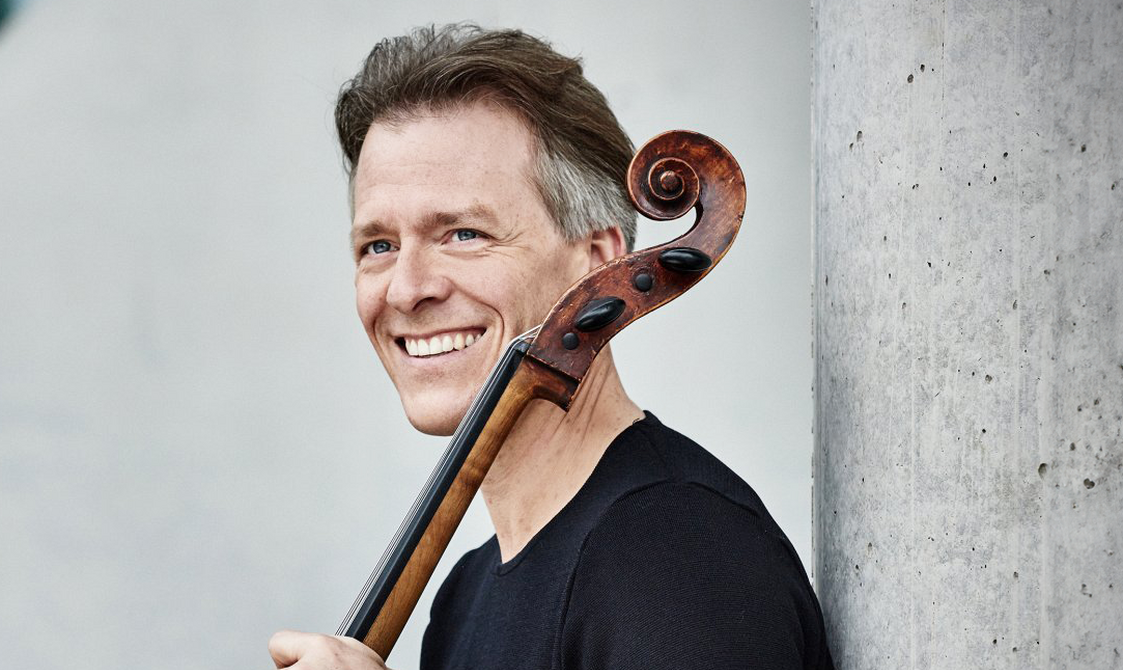
Composer Unsuk Chin and cellist Alban Gerhardt are featured musicians at the 75th Aldeburgh Festival this year. They have been linked in music since 2009, when Alban was the soloist in the premiere of Unsuk’s Cello Concerto at the BBC Proms in 2009. They talk to Arcana about how the piece has evolved and their hopes for this year’s festival.
by Ben Hogwood
The 75th Aldeburgh Festival of Music and the Arts is upon us – and Arcana is in the very fortunate position of talking simultaneously with two of its Featured Musicians, Korean composer Unsuk Chin and German cellist Alban Gerhardt. Unsuk is checking in from her Berlin residence, where she is deeply ensconced in composition work – of which more later. Gerhardt, as is often the case, is touring – and is about to join us from his hotel lobby in Spain, where he played the Lalo concerto the previous night.
The two have a strong musical bond, cemented by the Cello Concerto Unsuk composed for Gerhardt, first performed at the Proms in 2009 with the BBC Scottish Symphony Orchestra. Gerhardt will bring it to Aldeburgh in 2024 with the same orchestra, under Ryan Wigglesworth, on 20 June.
Firstly, however, we welcome Unsuk to the chat. Her youthful countenance is complemented by an intense focus on her music – which comes to the fore as soon as we begin to discuss Alaraph, a quarter-hour piece for orchestra receiving its first UK performance at Aldeburgh this season. Subtitled Ritus des Herzschlags (Rite of Heartbeat), it is a powerful and dramatic piece, in which Unsuk is drawn to the concept of so called ‘heartbeat stars’, that have a regular pulsation.
“I’m very interested in science”, she says, “and I was very interested in the different types of stars. These heartbeat stars have a certain rhythm of changing the brightness, and immediately I imagined a certain type of rhythm where I could compose a piece with this idea. The second idea in Alaraph came from Korean traditional music. We have very vivid, dynamic folk music, and I was always very impressed by its rhythms and melodies, and I wanted to bring them all into one piece. Lots of percussion instruments will be needed there!”
In spite of the large percussion section, the piece ends quietly, which if anything heightens the drama. “The piece is a kind of ritual,” she explains, “and the six percussionists play a very big role. The sound is moving from left to right and right to left, and at the end of the piece they repeat the cymbal sound. Then they should stand and show the cymbals, as a kind of ritual.”
On a much smaller scale, we will hear a group of Chin’s Piano Etudes, in concerts from Joseph Havlat and Rolf Hind. Talking about the Etudes almost inevitably draws parallels with Unsuk’s teacher György Ligeti, whose own Etudes for piano have proved revelatory in the course of the instrument’s recent development. Were they intimidating when she started to write in the form? “When I studied with Ligeti he had just finished the first cycle of six etudes, and I was at the premiere of those pieces”, she says. “On the other hand, I have played the piano since I was four, so it was for me the main instrument. I certainly got some influence from him in writing piano pieces, but even if he had not written piano etudes, I would have written my etudes for sure!”
At this point Alban joins the call, and Unsuk greets him enthusiastically. “Your hairstyle is new!”, she exclaims, but he shakes his head. “No, just less hair!”, he says, smiling. Gerhardt is being modest, for he too looks bright-eyed and in good spirits. Talk inevitably turns to the Cello Concerto Unsuk wrote for him, and they recall their first meeting. “We met first in 1999 in Helsinki”, she says. “It took a couple of years, but then I had some idea of how it would be very nice to write a cello concerto for him. That was the beginning, but then he had to wait almost seven years while I got the piece ready!”
Gerhardt was not impatient for the piece, however. “I am glad you mentioned that, because it proved to me that you are not slow or lazy, but very respectful for the genre of the cello concerto. I remember at first that you were very hesitant, and that’s a wonderful quality, because these days it’s like everybody should be writing a cello concerto. One of the most difficult tasks nowadays, with a big orchestra, is that you want to use it as a composer. But if you use it, then you lose the cello. You were aware of that huge challenge, and you took your time. It got postponed a few times, and at the Proms too, but I’m so happy – because this piece works! The truth is that it was performed in Berlin by another cellist, Alisa Weilerstein, which is fantastic. Which other modern cello concerto can you say that about, that it was performed in the same city at 10 years difference by a top-class cellist? I’m very happy about that!”
Chin smiles in gratitude. “You are always supporting me!” she laughs. “The first time we met was through Lisa Batiashvili”, recalls Gerhardt, “and she is a close friend but also grew up together with Unsuk’s husband, Maris Gothóni. I knew about Maris first, and then I met Unsuk and was shocked by her charisma and aura, and then when I heard the Violin Concerto I thought, “she needs to write a cello concerto!”
The concerto makes some fearsome technical demands, wasting no time in pitching the soloist right to the core of the action – an aspect that Gerhardt applauds. “Actually, the beginning is among the easiest bits of the whole piece! It’s not easy at all, but compared to what comes later, I’m not afraid of the beginning. I’m happy to start right away because if you sit there forever, you start thinking and getting nervous, which is not a good thing.”
“For me the working process was very interesting”, Chin interjects, “because often the artist and composer will have conversations and contacts, but with us it was not like that. I just wrote the piece to the end, and I delivered, and he delivered his playing. It was extremely professional, and there was not a need to change anything because of his technique. I wrote what I wanted, and he played it at the premiere by memory. I couldn’t believe that a human being could do that!”
At this point, Gerhardt has a confession to make. “This is the biggest shame of my life, because I was big headed, and I got lost three times – I was not happy. The most beautiful and difficult part in the last movement, which is like 80 seconds, is very wittily written and difficult to play. It is probably the 80 seconds I have practised most in my life, and I completely missed them in the world premiere. I’m so grateful that I have had 30, 40 more times now to play it. For me that is the biggest thing. I have not played so many world premieres, but each one is the worst performance – it always gets better. You need to give it a chance to grow – not with the memory slips, but the piece settles. With this piece the more I play it the more beauty and intensity I discover, and the more I understand it. There is so much to understand that you cannot grasp it all at first sight.”
He is relishing bringing the piece to the Aldeburgh Festival. “I am very happy to play it there, after 15 years and having premiered it with the same orchestra. It will be a completely different performance, and I would bet my life it will be a much better one!”
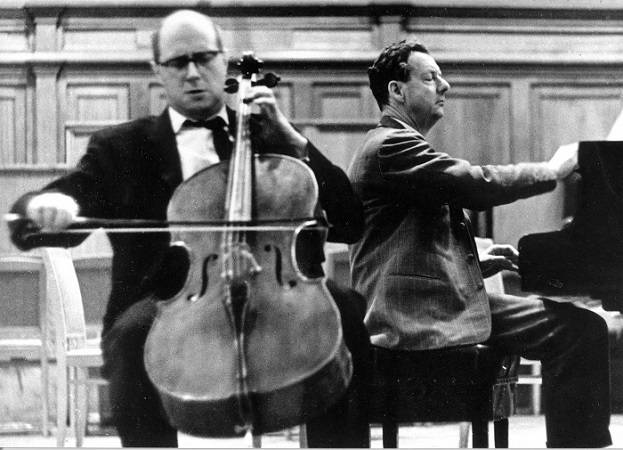
As well as the concerto Alban will be teaming up with regular recital partner, pianist Steven Osborne, in a recreation of a legendary recital given by Mstislav Rostropovich and festival founder Benjamin Britten (both above) in July 1961, where the world premiere of Britten’s Cello Sonata took place. Gerhardt considers the rapport both performers have in that recital. “Britten was a fantastic pianist and a wonderful musician, besides being a great composer. I wouldn’t say Steven and I have the same rapport because none of us is as creative as these two guys. Rostropovich was a composer himself, not a great composer, but he wrote some quite witty pieces, and conducted and played the piano. He was really a complete musician, although I don’t agree with everything he did interpretation-wise – which is perhaps bad taste on my part – but they were two giants of music! I think Steven and I understand each other well because we are closer in age and Western, whereas the Russian and the Brit – that’s quite a mix!”
He considers the concert further. “You have no idea how brave I actually am because two nights before I am playing Dvořák in Chicago, and I arrive in the middle of the night at 1am the day of the recital. I’m already very scared of that day!” We agree that Rostropovich would probably be in favour. “Yes, he would approve of doing something stupid like that!”
Both Unsuk and Alban are intensely honoured by their roles this year. “I heard lots of things about Aldeburgh and Benjamin Britten, who I really admire as a composer”, says Chin, “and it’s a really great honour to be played at the festival”. Sadly she won’t be attending in person, due to the composition of her opera Die dunkle Seite des Mondes (The Dark Side of the Moon) getting to the stage where it can’t be left. “It should be finished by the end of this year!” she confirms. “I’m not coming to Aldeburgh, then!” jokes Alban on hearing the news. “For me it’s an honour, but it is also an honour for the festival to have Unsuk, because she is one of the two or three best living composers. Anybody should be honoured to play her music.”
He recalls his first visit to the Suffolk town. “I think I was first there 20 years ago. A few months ago I went to the Red House for the first time, and saw the manuscript of Britten’s Cello Suite no.1, and it was beautiful to see the handwriting. It had a lot of the fingerings and bowings of Rostropovich on it, and I didn’t like that because I wanted to know what Britten actually said.”
He applies the same argument to the newer commission. “That’s why when we made an edition of Unsuk’s concerto I was very hesitant of putting too much of me in there, because I want the next performer to come up with their own ideas. For example, some of the metronome markings of Unsuk I cannot play, but I like that! The question is – should we change them to what I could do? I said no, because it’s good to know that she had that in mind, and the next player should try to get to it. Metronome markings are not the rule of law, but it gives us an idea of what the composer had at some point in their mind. I would hate if people came and took my interpretation as the one to do. The one to do is in the score, and what was in Unsuk’s head. I don’t think it helps much to ask her how to play it!”
Unsuk nods in agreement. “I think you said once it’s like a child you give birth to”, says Gerhardt, “but then it grows, maybe in a direction you’re not happy with!” The only few things you told me”, he recalls, “were about some slides in the first movement, which happened by accident. The great thing is that we have these scores, which are like a protocol, which give us an idea of what to do and then we do it. Every interpretation should by definition be different, if each one is the same then something went wrong. We become in a way an assistant to the composer ourselves, and if the interpretation is always presented the same then that is a job badly done. We have to be different!”
Playing solo Britten at Aldeburgh, as Gerhardt will do with the Cello Suite no.1, presents a special challenge. “It was scary when I did it the first time”, he admits. “but now the scary part is out I’m just going to enjoy it. András Schiff told me once that the older he gets the more nervous he gets. I find the older I get, the less I care about other people and what they think. I want to transmit what I feel about the music, and the older I get the more I dare to really do what I want, and not follow rules or guidelines. I take Gustav Mahler as an example, and where he reduced the Adagietto of his Fifth Symphony from nine minutes to seven minutes when conducting. Less is more!” As a listener, it is good to hear of artistic development in this way. “As a listener, I don’t want to be bored”, says Gerhardt. I hate it when people celebrate something where there is nothing to celebrate, like a dog stopping at every tree!”
Unsuk, meanwhile, will be totally immersed in competing her new opera. “I am writing the libretto myself as well”, she says, “because I created the story. It is based on the relationship between an Austrian physician Wolfgang Pauli and Karl Gustav Jung. It is a very complex story, and I can’t digest it in pure texts. It is about a man who is a genius but who has a very complicated private life and very interesting, wonderful dream every night. He is suffering, and therefore wants to be helped – so goes to Karl Gustav Jung and they start analysing Pauli’s dream. I took this biography as the base and put some fiction in there to write a story like a new version of Faust. I’m writing the music and the libretto myself, in German.”
The opera is due to be premiered in May 2025, at Hamburg State Opera, conducted by Kent Nagano, and staged by the English / Irish team Dead Centre. In the meantime a much smaller piece, Nulla est finis, will act as a companion to Thomas Tallis’ great 40-part motet Spem in alium, in a festival performance from Tenebrae at Ely Cathedral. “It is very small”, she says modestly. “It is not a piece, more a small prelude to the Tallis piece.” Has she listened to much of his music previously? “Not much, but I knew this piece. The commission came from Sweden, and they wanted a small prelude to Spem in alium, so I thought it would be nice to compose a kind of entrance where the choir are whispering, and slowly the tones come in and it goes to Spem in alium.”
Beyond the festival, Gerhardt has a typically busy year – but first a holiday. “I only think up to June”, he says, “and then I think I have three weeks free!” There are recording plans afoot with Hyperion, which remain under wraps for now. The Dvořák concerto, which he is performing in Chicago, would be a wonderful contender. “My view of it has changed, because I had a look at the facsimile of the piece and a lot of new ideas popped out, so it will be quite different. I think it’s more like what Dvořák had in mind, and I have to tell conductors off sometimes now! I find the same with Brahms symphonies, where people do these same, silly rubatos, and they are lacking in inspiration, because they cannot come up with their own!”
Finally, the question has to be asked – might there be a Cello Concerto no.2 from Unsuk Chin? She laughs, a little nervously! “At the moment there is no plan, but you never say never!” she says. “I would never push for a second one,” says Alban, “because the first one is so great, and I’ve never played it that I’m 100% happy with myself. If any other cellist was to ask for a second one, I would urge them to play the first one five or ten times, and then we can talk! For me that is one of the reasons why there are so few concertos added to the repertoire since Dutilleux. There is so much one can do with this piece, so much fine tuning one can do. We as performers should strive for higher, not for perfection necessarily but for musical expression. I don’t think the world needs number two, we should be very happy and blessed that there is a number one!”
The conductor talks to Ben Hogwood about his forthcoming debut at Garsington Opera, where he will conduct Rameau‘s Platée – a work in which he has also sung the title role. Agnew talks about Rameau but also Handel, considering why now is a good time for British audiences to embrace the music of the French Baroque.
On a dark, dank winter’s day there is something incredibly heartening in having a discussion about the prospect of a summer opera season. Arcana has teamed up with conductor (and former tenor) Paul Agnew to do exactly that, and he is in optimistic mood. “It will arrive quickly, with the spring and the daffodils, and then we’ll find ourselves in Garsington!” he says. It will be his first visit to Wormsley Park, and to the festival. “I’m really looking forward to it. It’s one of those very original places, and it isn’t a dark theatre. It has windows, and so each production has to take into account that you’re going to have a part of that show in the light. I’ve never done that sort of thing, and the team is very nice. We had the model showing so we’ve seen the set, and the concepts, and it looks great. It will be a lot of fun, which it should be – but with that hint of tragedy, which is always lurking in Platée.”
He is talking about Rameau’s comic-tragic opera, which he will lead with a new team of soloists and The English Concert. It is the first excursion for Garsington into the world of French Baroque opera, but Agnew is returning to a piece he knows well. Indeed, he first encountered Platée as a singer. “I didn’t sing Platée – I sang Thespis in the Prologue. I was quite a young thing, and it was a production with the Opera de Paris. It’s a really hard role, extremely high – and obviously you go on at the top of the show. It’s a bit nervy. Then almost immediately I took on the role of Platée in that same production in Japan. That was released on DVD, which had a lot of success.”
He explains why. “Laurent Pelly did a genius job – and they found just the right balance in order that when we get to the end, where the audience have been cheerleading with the rest of the chorus and these horrible characters, and they find themselves in fact implicated in this terrible humiliation. I think he just found the right click. There was a gasp from the audience when they understood quite what a terrible thing this is. I wouldn’t want to exaggerate, but there is something political about it, and within the operas of Rameau – Les Indes galantes and certainly Les Boréades. They tend to have slightly monarchical reflections, and there’s a sense – if you know the film Ridicule – about how close you can get to the king but then you know you made a mistake, you didn’t use the right wig and so on, and you get sent straight back to the back of the queue. There’s a sense of that in Platée and the ridicule, as you would expect Jupiter – who essentially is Louis XIV – to be the hero. In fact, he’s the villain! It’s not exactly dangerous, but not politic either – Louis XV by then.”
Agnew has enjoyed a close affinity with Rameau throughout his career. “The very first thing I did in France, with William Christie and Les Arts Florissants, was record the Rameau Grands Motets. They’re relatively youthful pieces compared with the operas, which he didn’t start until he was about 50 years old. I love Les Grands Motets, partly because it’s surprising to find such incredibly sensual music for the church. They just seemed to suit my voice, and in fact it was one of the very first French Baroque things I did at all. You know you have those lucky things in in a long career where you ‘meet’ a music and you think, “Oh, my goodness, I’m really made for this!” I love the sentimentality of it, in the best sense of the term, I love the melody and I love the sensuality of the harmonies. That leads you through the line and tells you where you’re going constantly, so you can make the music into such a strong experience.”
Things moved quickly. “Almost immediately we started on the operas in the Opera de Paris, so we did Hippolyte et Aricie, then various roles in Les Indes galantes, and then we did Platée, which was with Marc Minkowski and Les Musiciens du Louvre. Then we did Les Boréades, the last opera, which was never staged in his lifetime – he was 80 when he wrote it. It’s amazing to think he lived to 80, but happily he did! It’s an astonishing journey, very much like Platée but in a much more heroic way – he’s a real prince. So I did all those operas, and I’ve sung others – Castor et Pollux for instance – in concert. I’ve done a lot of the ballets, too. I’m a big fan, as you would expect! It’s the most extreme the Baroque gets, even more complicated in some ways than Bach. He was an amazing technician, and he’s stating things relatively clearly, whereas there’s a complexity of emotions in Rameau which really predate going into Gluck and then early Mozart. He didn’t die until 1764, so Mozart has already composed his first piece before Rameau dies. There is a big influence on Gluck, and everything that he says about the reform operas is what Rameau has been trying to do for years.”
Performing the operas as both a singer and a conductor has given Agnew a unique perspective. “It’s very helpful”, he agrees, “for the singers too. I’m naturally a singer’s conductor, as I want them to be able to breathe and recover and so on, because that’s the best for us. I’m not going to push them into a tempo which they can’t do, so we want to find the right tempo for the singer. If you’re a singer you understand that more clearly. It’s a good place to have been, whatever the music – I’ve sung a lot of Handel and Purcell, and now I conduct a lot of Handel and Purcell too. Having sung Platée itself, it makes me smile and I’m not in the least bit jealous about being on stage. I wouldn’t want to sing it again or go through that experience. It’s a long evening, and you’re on stage a lot. There’s a lot to sing, it’s quite hard, and it’s quite physical because it’s a comedy. There’s a lot of running around, and jumping – if you’re a frog! – and I’m happy to leave that to other people. I still absolutely love the piece, and to have that long association is very useful.”
Visitors to Platée’s page on the Garsington Opera website are presented with the image of a flamingo and a beachball (above), an immediately appealing prospect in the depths of winter. “I think it’s going to be a lot of fun. I really like the way it’s being approached. We’re quite used to women playing men – that’s been around in Handel‘s Rinaldo, for instance, but the other way round is very much rarer. The only way in which the piece works is if she’s just a woman, you just get over it. I think Rameau’s idea was to define the strangeness to that person. It’s not about sexual politics, but not a woman as the gods would know – maybe asexual thing rather than being particularly transvestite or drag. I think we’re in the right direction in this production, where we just need to forget that the singer is a man, and just accept that this is a strange woman. She’s a nymph from the marshlands – we don’t know really what she is, a creature from the blue lagoon.”
It is the first time Agnew has encountered the work of director Louisa Miller and designer Christopher Oram. “I’m not sure they’ve done much Baroque before, so I wouldn’t have encountered them as that’s more or less my world. I like them very much. It’s not a very easy piece to approach dry – just to get your head around what Rameau could possibly be thinking about is quite hard. Right from the very first meetings we were clearly on the same page, and Louisa clearly knows the piece, which is very reassuring. As a singer you often get to the first rehearsal and find out the director doesn’t really know the piece very well, and you find yourself having to subtly guide the director through towards a good solution. That’s definitely not the case here! Chris’s designs are very good, it’s funny and relevant and they work throughout the piece. Sometimes at a first rehearsal you think, “This will work great in Act One, and Act Three, but Acts Two and Four will be a disaster because it just simply won’t work in this concept. This concept will work the whole way through, so I’m really encouraged. We’ve got a lovely cast, and also decided at the beginning we would take a cast where nobody had sung it before. Nobody arrives with preconceptions about how their role is, or how they would like to play it.”
There is a sense of great excitement that this is Garsington’s first foray into Rameau’s output. “Yes, and they’ve chosen well!” he says enthusiastically. “We’ve got a great band in the English Concert. I sang with them in my 20s, with Trevor Pinnock, and what an honour it is to direct them.” He expands on the repertoire at hand. “I’ve done French Baroque music with English bands before, and it is quite tricky. They’re technically such fantastic players, but it has a tricky accent, and you can’t get it just by reading the books. Again, it’s useful to be a singer in those situations because you can sing the sensuality of the line much more easily than you can describe it. I always end up singing quite a lot of rehearsals because it’s a visceral, physical reaction to what you hear, which makes it much easier. It will be a challenge for the band to get that accent right, but they’re eminently capable, and I’m massively looking forward to working with them.”
They are complemented by a strong team of soloists, who have equivalent challenges. “Equally, the singers are all English, so we need to get that right – and that’s not just question of pronunciation. There are all sorts of things about how the phrases are constructed, and how the ornamentation helps the grammar of the music. We will have time and we have a good cast, so that doesn’t worry me. You have to go quite deep into these pieces, especially doing this repertoire for the very first time in an opera house. It’s very rare to hear Rameau at all in the UK. I think Platée is the only piece that has been properly staged in the past, and that was a long time ago with the Royal Opera House. It’s very exciting, and there is a lot of interest from the public in French baroque music, so I look forward to that encounter! It is very complicated to put on, you need a ballet, an orchestra that knows their beans, and a cast willing to take risks with the ornamentation. It’s a courageous choice, but not an impossible one.”
Is the boundless supply of great music by Handel (below) in some ways to blame for the relative lack of French baroque music in the UK? Agnew smiles. “Handel’s an interesting one, because he would say, “You do get French Baroque – because if you look at the dances in Alcina, the overtures – you’re not missing out, I’ve written it myself!” In some ways, yes – but you could never say Handel’s at fault, because a house without Handel would be a disaster. You have to think as well that if Purcell had lived longer than the whole history of English music would have been very different. He died in 1695, and then they had a few abortive attempts to create English opera. Then there was an extraordinary moment where Handel arrives, and he creates this strange bastard form of Italian opera for English people, written by a German! You think it’s never going to work but he has this immense success, at least until the early 1740s.”
He goes into more detail behind Handel’s successful formula. “He is much more straightforward, he has the advantage – and I don’t mean to be disrespectful – that what you see on the page is what you get. Twenty to thirty years earlier, the ‘affect’ is everything. Once you start an aria you stay in that in that emotion until the end of the aria, and then a recitative will tell you what kind of emotion you’re going to go to in the next one. With Rameau it’s much, much more fluid than that, because things are changing very fast, and he goes towards complications where the likes of Pergolesi go towards simplicity. You get that break that comes around the time of French Revolution, a time of an immense social and cultural change. Handel is a chancer, isn’t he?! He’s in Italy, and then he knows that George of Hanover is going to be the next king of England, so he immediately goes up and gets a job in Hanover. The first thing the Hanoverians say is go to England, as a sort of spy-come-diplomat or equerry.”
The rest – as they say – is history, and Agnew relishes recounting the events. “And then, of course, George I turns up and it’s all set up for him to have this contact with the nobility, and the prestigious arrival of the king at his operas and so on. He’s bright, and gets it sorted right at the start! The other thing is he turns up in Italy, and produces these works that are effectively for the Catholic nobility and cardinals, and he is a straight, up and up Protestant Lutheran. And yet – business is business, you do what you want! He produces something for a public that don’t know anything about anything. Rameau can produce something much more technically difficult and also psychologically complex, because he’s simply joining the train. We’ve had Lully, Charpentier, Campra, and all the rest – and Handel arrives and takes all that on board, that melange between the original French style – which wasn’t French anyway, because Lully wasn’t French – and then he puts this new Italian virtuosity in. He’s joining this great movement, and dominates England completely!”
We move on from Agnew’s fascinating dissection of Handel and Rameau to talk about one of his mentors and accomplices, conductor William Christie (above). “He’s a theatre man, he wants to pick up the music and shake it and I love that. When you’re a singer, you absolutely want that because you don’t want someone saying, “Careful with the D sharp”, you want someone saying, “Come on, tell me the story!” I always much prefer those people – and John Eliot Gardiner as well – who pick up the music and shake it, and have enough courage to say this music needs interpreters. The composer wants you to take it and make a show of it. That’s what Bill does, and absolutely what I try to do now as a conductor. You should take risks with it! These people were pragmatists, so if you’ve got someone who can sing this note but not that one, go with it. If you look at the history of Handel’s operas, or Messiah – there’s no definitive Messiah. He changed all the time, because he wanted to get the best out of who he had. It wasn’t saying, “This is my definitive work of art, have some respect and do it correctly”, it was, “Today it’s going to be like this, tomorrow it’s going to be different again, because I need to get the best that you have! I need to get great performance out of you. And that’s why it changes constantly. We don’t quite have that variance, but nonetheless you still have to have that attitude that you have to make a show. That goes straight through to Mozart – he is a show man. You want to start Cosi fan tutte with the overture thinking that you are making a show, not a homage. It’s an entertainment. You should laugh and cry and be frightened and happy, and all those things!”
Turning to Rameau again, he considers the composer’s standing. “He can be very funny, in the likes of Les indes galantes – and Platée is genuinely funny too. Rameau is always known as a surly bugger, when you read about him he is not at all a nice person – but he is really genuinely funny. To do comedy, as everyone knows, it’s much harder than just telling a joke – you have to have that special talent. He has that. It doesn’t mean that Boreades or Hippolyte aren’t amazing pieces, but when he wants to be funny he can be very funny.”
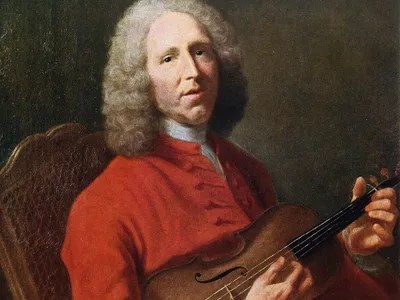
Rameau (above) is a colourful composer, too. “Everything is about colour”, agrees Agnew, “and he’s the first to really properly orchestrate, not just saying to the flutes to play the same as the violins. This is music just for flutes, just for the oboe, and then we’re just going to hear the strings coming in when when we need harmony. And then of course we’ll have a big string moment. It’s the beginning of colour in its best sense, not only harmonic colour but audible colour. The players suddenly find themselves pretty exposed in Rameau, particularly the bassoon parts. He’s a genius of the bassoon writing, and you get these incredible melodies, in Dardanus for example, with these sombre, reedy, mournful qualities. Some amazing colours.”
There is more, too. “And then he’s a great dancer! I think he has to be the best dance composer before Stravinsky. He has this incredible variety, within the ‘stock’ dances. Everyone knows straight away if it’s a Galliard or a Bourree, but they are so incredibly different. It’s a joy when the band understand it, too. I did Platée with the Dresden Staatskapelle, and a more serious orchestra you could not find – but once they got the idea that you could have fun and you could play out and take risks, they really went for it and it ended up great fun. There was a sort of trigger moment where we were doing a dance, and I kept on trying to get them to bow shorter, because they do hugely long bows, with fabulous, resonant instruments – nothing like the English Concert will play in Platée. I was trying to get them to play shorter and closer to the bridge, get a slightly sharper sound out of it. The shorter they got with the bow, the more they understood it and wanted to play out. It took off! Legato is a kind of aberration in this opera, everything else is short – so we charmed them out of certain – very good – habits.”
We bid farewell with one thing clear – Platée is in very good hands and a highly entertaining night is in prospect. “The main thing to say is that it’s a fun evening. You don’t need to worry if you don’t know much about French, or Baroque, or history. Just come and have a ball, it’s a fun evening, a fun piece with some very sharp twists!”
You can read more about the forthcoming production, and book tickets, at the Garsington Opera website
Pianist Bruce Brubaker is a man who likes a challenge. A prolific and highly respected performer of music by Philip Glass, Steve Reich and Meredith Monk – and recent collaborator with Max Cooper, Brubaker has in recent times turned his attention to the music of Brian Eno. In November he released an album of piano interpretations taken from the former Roxy Music keyboard player’s solo work – including a complete account of the seminal Music For Airports. The album, Eno Piano, has been released on the InFiné label, Arcana sat down with him to discuss the project, gleaning some fascinating insights into Brubaker’s world of contemporary and classical piano playing.
Given his impressive CV up until now, the music of Brian Eno appeared a logical step – albeit not an easy one. The genial pianist takes up the story. “No, because as you know, Music For Airports and almost all of Brian’s earlier work in this ambient area was studio music and he made it without really any kind of reference to live performing. There were no scores, no plan even! On Music For Airports he provides these little drawings showing you about the patterns involved, but the idea of playing it live was really very far away.
The prospect of recording Eno on the piano had great appeal. “I’m fascinated by the idea of using the wrong tools to make this music. In the original they are physical tape loops that have been used to make the sounds of Music For Airports, so when you hear a particular pattern of notes, and it’s repeated, you are literally hearing the same thing – the exact micro timings the exact balances are the same. In our version I’m playing those things by hand each time, so they’re not the same thing. It’s an interesting problem, and I kind of like it!”
It also resonates with Eno’s methods of composition. “You know Brian did that thing with Peter Schmidt called Oblique Strategies, with the deck of cards – one of my very favourite Oblique Strategies is “Repetition is a form of change”. That’s really a big part of this, so even when you use a tape loop, and play the same notes exactly in the same rhythm, exactly the same way, the effect to the listener / human is not exactly the same. We’re impinging on that, in a slightly different way, because now things are not identically the same. Perhaps the listener perceives this, perhaps they don’t. I think all that ambiguity is right in the neighbourhood of what he was doing in the first place.”
Certainly in music of this kind, the fifth instance – for example – of a melodic phrase is very different from the first, because of the listener being more ‘in the zone’. Brubaker agrees. “Absolutely. I think that as each person hears a piece of music, because of all the things you’ve heard before, the place you live, the sound environment you’re in, every single person – as they hear musical sounds – makes a new piece of music by listening. For everybody sitting in a room, at a concert or hearing a recording there’s a somewhat different piece of music being completed as they listen. That appeals very much to me and our sense of our own time, where people’s participation in the process of music is, I think, much greater. It’s not a passive thing. When you’re hearing something like Music For Airports, you really are invited or allowed to be inside and to make those connections yourself. It’s infinitely variable. Then when you come back and hear it again, it will also vary, so if you hear it for the tenth time, you probably don’t hear the same thing as you did in the beginning. I’m thinking of If on a Winter’s Night a Traveler by Italo Calvino, where he says something like, “I returned to the books that I read when I was a young man, and I find that they have changed”. Of course, he knows that they haven’t, the physical printed book is exactly the same – but different when he reads it. I think that that’s where we were trying to be with this.” The question also arises that if Brian Eno sat down to write Music For Airports today, we would end up with something very different. “Definitely”, he agrees.
In spite of its ambience, Music For Airports has a number of interpretative issues and is an intense experience for the performer. “One of the challenges was to figure out how much to allow these repetitions of the same material to vary, or how much to try to make them the same. As a human being, if repeat something over and over again, each one will be different. Do you intentionally push them to be different or not? It’s actually not that much different than playing other minimalist or repetitive music like Glass because I think it’s the same thing. I always found in Glass that if you intentionally varied something, it usually seemed like too much. The better way to do it was to be more like an observer and not really a participant. If you can get yourself into a state of being where you’re listening to the sound as it happens, but to be outside and hearing it happen, and then responding to whatever is unequal but not really making it happen. That is true here too, as it goes by, you monitor and notice the things that vary, but you’re not really making them happen. If you try to do that, then it almost always seems like a heavy hand too much.”
Brubaker’s detail is fascinating, as he moves on to consider his topic further. “I guess it’s true of a lot of kinds of art. One of the strange things about music that’s improvised versus music which is planned beforehand is that a lot of the music that we like, which is planned in advance, aspires to a quality of improvisation. Even if you’re listening to a Beethoven symphony, probably the best performance is the one that seems like it’s not written down, the one that seems like it just happened – even though we know that’s not true. If you map that on to the world of movies or theatre, that’s exactly the same, right? In a movie, for the most part, you understand the actors have learned their lines and rehearsed them many times, but if you’re lucky, you forget all about them. You have the sense that whatever the action is, in the scene you’re watching, it’s really happening. The same thing is true in music, you want to be engaged in what’s happening so that it seems like it’s just a spontaneous event.”
Although he cannot remember his first encounter with Eno’s music, Brubaker admits to a connection with the minimalism of the 1960s and 1970s. “I did get this idea of trying to play Music For Airports on the piano quite a while ago, but then there always seemed to be this big problem, which was how we can make very long sustained notes, because that’s such a feature of the piece – and some parts of the music actually have human singing. Then I heard this jazz pianist in America play a concert where he had modified one of these devices that electric guitar players use, the E-bow – and cut it down to put on one string inside a piano. He did an improvisation around this long droning note. I started to think maybe you could do that with the piano and use a bunch of E-bows to make long notes. Then almost by chance I was talking to one of the people at my record company who happen to know of an inventor in France, who had started working on a system like this, specifically for the piano. We met and started talking about it, and that is what we used for this album.”
He explains the methodology. “There are these electromagnets suspended over a piano string, and the string is allowed to vibrate either by putting down the pedal on the piano or in some other way where you can raise the damper. The electromagnet creates a signal that causes this vibration in the spring, which can be controlled very specifically with frequency. You can also produce overtones. Then we found with the lower strings, if you continually excite one of those strings, which are wrapped with another kind of metal, you actually get a pulse. This also fascinates me because we’ve never heard a piano string that was vibrating continuously! When you’re hearing piano sounds in a normal piece of music, you’re always just hearing the decay of that sound, you’re not really hearing the impulse and you’re the impulse for just a little tiny bit of time. What we’re doing now is we’re actually making the string vibrate for a long period of time, like you would on a violin. And so, you know, the nature of the tone, in some cases was really surprising because we’ve never heard it before.”
A new instrument, even! “I was joking about this, but I think it’s true. Eno Piano is not just the title of the album, it’s also an instrument. A long time ago Brian said that the studio is a musical instrument, so it is turning it around and showing that an instrument can also be a studio! The way we’re using it is something that really couldn’t have happened very, very long ago.” The emphasis falls on the string part of the piano rather than its percussive element. “There are other examples of course, in John Cage, and the American composer C. Curtis Smith, who wrote a whole bunch of music for pieces of string or fishing line were used inside the piano. I also played a Cage piece where you had to thread the strings through, and we were able to make a long tone that way.”
Brubaker had the pleasure of meeting Cage on several occasions. “I actually played with him a couple of times. I played Radio Music with him once, and a new chamber music piece he had written. I always found his effect was really very powerful and a spark towards something more. This chamber music piece, called Seven, he had notated using a heavy Japanese brush with ink, and so a lot of it was very difficult to read. The brush was irregular and some of the notes were very thick and some of them were very thin and scrappy and you couldn’t really tell what the notes were. I remember saying, “Mr Cage, can you tell me what the notes are in this chord?” He probably gave the ultimate advice that you could give to any musician in any situation. He said, “Just listen, and you’ll know what to do”, which I thought was pretty good. At the time I just wanted him to tell me what the notes were, but he wouldn’t do that!”
He also recalls a musical example. “I played a little solo piece called Dream, with a long meandering melody, a pretty piece like a lot of his music from the 1940s and early 1950s. I played a concert where he was giving a commentary and had played it from memory. One of the audience asked Cage, “What would happen in the performance if the pianist got lost?” Right away Cage said, “That would be wonderful!” That was good – and that touches this illusion of spontaneity, the illusion of something that isn’t planned. By getting lost, you might be found again. Even in the 19th century, it’s pretty well documented that pianists giving concerts from memory was a kind of substitution for people who didn’t improvise. When Liszt played his own music in public, he always held up the score so that people would know he was not improvising. That back and forth between what the music is and how it sounds is something very interesting, especially with the recent importance of sound artists. A lot of these people come from the visual art world, using sound not as music but as something that they can manipulate and sculpt. I think that actually connects back to Brian Eno. You could say he wasn’t really making music but more creating this sound environment, this space to be inside. That boundary between written music and the world of sound has got much closer, and that will probably continue to be the case.”
One of Eno’s more recent compositions, the single-track album Reflection from 2017, comes to mind. “I think that’s the greatest achievement, being on the cusp of paying attention, or not paying attention”. Some of the pieces chosen on Brubaker’s album – By This River and The Chill Air – sound as written. In the live show we are using those two short pieces in the middle of Music For Airports which I was very sceptical about at first, but I think it does help and is good for the audience.”
Though Brubaker’s recent recorded output is more minimal, his background is steeped in classical music. “I trained as a classical pianist, and I taught at Juilliard for a long time. Even now the students I teach really are primarily interested in Beethoven and Liszt, not even going very far into the 20th century. Sometimes I feel like I almost have a double life! When I go out and do my own artistic work it tends to focus on much more recent things, but when I go back to teaching it’s Beethoven all the time. On the other side I still feel there’s a long connection, and that some of the things we’re talking about with non-directional music, which is to be completed by the listener, connect to what was happening in European music, maybe in the 10th and 11th century. If you go back long before the Classical period, before the composer identity was so formed, there were many other ways of making music, and in other musical cultures outside of European music. One of the things that happened, say with minimalism in the 1960s, is that some of that authority of the composer was lessened. It’s not so much a kind of top-down hierarchical format, and instead the listener, the performer are much more included in the complete art. I think that’s a good thing.
We always seem to blame Beethoven, but he really created a kind of art where the composer really was operating as a kind of God and, and making this musical experience where you weren’t really invited to be a participant. I’m probably overstating it a little bit because I think these different ways of using music exist in lots of kinds of music, so you can approach almost any piece with various ways of participating. But I think Glass actually is the one who said that he found that when you listen to a symphony by Beethoven, the climax generally happens at the same place every night and the organisation of the overall peace really remains the same. His contrast was going to see a play by Samuel Beckett, where the play seemed like a different experience each time he saw it. It was much more of a of a network of relationships rather than this narrative of beginning and development and progression to some kind of goal. It was less teleological if you want to go that way! A lot of European art of the 18th and 19th centuries was directed towards a goal, which could be very satisfying, and then there’s some kind of conclusion. On the other side, with a lot of minimalist music and repetitive music, you can argue that there is no ending – and no beginning either. You’re just in the middle. And of course, isn’t that the experience of life? You don’t remember being born and you haven’t died? So here we are, and I think that’s a very appealing art for our time.”
Finally we move on to discuss Brubaker’s work with Max Cooper, where the pair reinterpreted the music of Glass. “That was a really good project for me, I enjoyed it a lot. It was quite unpredictable, because there was this algorithm in use in the software that translated the signals from my piano playing. Every time we did the performance, those signals would vary slightly, depending on the precise touch, the dynamics, everything about the pedalling, and then those signals were controlling Max’s computers and his synthesizers. Every time we did the performance, that information that he received was really quite different, so what I would hear from him was really varying every day. So it was quite unpredictable, and sometimes it was a little confusing because it could be quite chaotic. What you hear on that album is actually a live show from Paris, and he did a little bit of changing because he didn’t like the quality of the sound. It was quite a voyage!”
Brubaker hasn’t spoken to Eno about his new project – yet – but the pair have conversed previously. “He’s working on the rehearsals for The Ship live show, which are using up all his time, as well as a bunch of other things. I started talking to him about this a long time ago, and I think he’s very open to the idea now of other people taking his music. I always wonder about that with very iconic pieces. I did some piano transcriptions of music by Meredith Monk, and that was a very interesting project where she was really very involved. It was complicated for her because she liked the idea that it was going to be her music heard in a different way, but at the same time she really wanted to be sure it was what she wanted. And I think Brian is not like that and has a very different attitude. In that sense, he is probably much open to other possibilities.”
Eno Piano rewards focussed listening – as well as giving the listener the option to draw back and observe from afar. Typically Brubaker, before he goes, is able to introduce another point of reference. “You probably know this piece that Erik Satie wrote at the beginning of the 20th century, called Furniture Music. My understanding is that he wrote it for some kind of art gallery, some kind of show that was being given. He had the musicians in the room, and he told the audience not to pay attention to them – but he got unhappy because when the musicians started to play the audience got quiet! They were listening intently, and Satie was unhappy because he wanted them to ignore it. I rather liked that.”
Soprano Katharine Dain and pianist Sam Armstrong are on the other side of a screen, talking to Arcana from the Netherlands – where Katharine lives, and where Sam stayed during lockdown. Their musical partnership blossomed in that time, yielding the intriguing collection Regards sur l’Infini, grouping songs by Messiaen, Delbos, Debussy, Dutilleux, and Saariaho. The sequel – and principal topic of conversation here – is their new recording Forget This Night, a carefully curated selection of songs by Lili Boulanger, Karol Szymanowski, and Grażyna Bacewicz on 7 Mountain Records. Headed by Boulanger’s special cycle Clairières dans le ciel (Clearings in the sky), its subject matter is very different.
“In some ways we were worried that the music was going to be too similar, very thoughtful and intense”, says Katharine, “which the first one also was. As we went along, we realised that no – thematically and musically, it’s very, very different. It is a continuation, we hope, but not anything directly related to the first. It’s all the kind of material that we gravitate to anyway, and of course it’s helpful to be validated in our choices the first time, to realise that people really do respond to them in the same way that we do if it’s presented thoughtfully and at the best level we’re able to give. For us we had already started to think about the next music we wanted to look at, before we knew the kind of reach our first album would have. Yeah. So this Lili Boulanger cycle was really the beginning of the second project, but it’s already something that you begin to think about when you’ve spent so long on one programme. Your brain immediately starts to wander, and both ours had started to do that!”
Given the intensity of the songs chosen, and their heady, emotional content, did the music take a toll on the performers? “The Boulanger cycle is particularly intense,” agrees Sam, “and it’s great to see Boulanger getting much more exposure in concerts and also recordings. With this cycle the emotional scope doesn’t fully reveal itself unless you hear all 13 songs together. The last song is devastating, and Katharine doesn’t always make it with dry eyes. It’s a really intense cycle.”
The fact we have any music at all from Lili Boulanger is remarkable, given her story of life and death from tuberculosis at the age of 24. “I think so too”, agrees Katherine. “Before we embarked on this project, I knew her name and a few pieces, but didn’t really know a lot of her music. I had been influenced, I realised in retrospect, by this idea of her as a fragile flower who died before she could really do anything significant. I couldn’t disagree more with that now that I do, but it took some real investigation of the music itself, of what turned out to be a major work. As Sam said, you don’t know it unless you go into it completely and find out what’s there. It was a real revelation, worth all the intensity and being drained after the performances!”
Throughout Clairières dans le ciel the singer needs an unusual amount of vocal control, with some long notes to master. Katharine laughs, modestly. “That’s very true! It took a long time until I felt I was typically integrated with what she asks. The original singer who premiered it was a tenor, and that gives it a different sound of course, but it’s not easy for a tenor as it’s for a high voice that could be a soprano or tenor. There is an amazing story that I find very touching, which is that when she wrote the piece it was the beginning of World War One. Normal performances weren’t really happening in France, and she was busy with the cycle, doing her best in her first year after winning the Prix de Rome composition prize. She wrote this major piece and had to do a private ‘try out’ of the premiere, where she sang all 13 songs herself and Nadia played the piano. That was the only time she ever heard or experienced her own song cycle live, when she sang it. I thought about that so much because the songs are so challenging to sing, they’re really tough and ask a lot of you. Yet somehow Lili, not a professional singer or even a performer, managed to do it in a home for a few friends as an unofficial premiere. Something about that inspires all of us – professional or not – to try to meet the challenges of these amazing songs!”
The challenges are by no means restricted to the singer, with the pianist battling some quasi-orchestral writing to evoke a whole range of colours. Armstrong smiles. “Towards the end of the cycle it really opens out in scale, and suddenly all these changes and fragments, and the breaking apart of everything to represent what’s happening emotionally give it a bigger scale than the standard song repertoire. It’s emotionally very intense, and a lot of the transitions in the music are directly related to the psychology of the text. They are difficult to navigate and you really have to think about you do that. The counterpoint is not simple, either!”
To complement the Boulanger’s cycle there are two more of her songs and two piano pieces, along with works by Szymanowski and Bacewicz. As Polish composers, their language is a marked but welcome contrast to the French songs. “I’m so glad, if that’s how it feels to you”, says Katharine warmly. “That’s certainly how it felt to me in preparing it. Polish is a really tough language in which to sing. I had done a bit of Szymanowski in the past but not a lot, so it was a big hill to climb, but it also created different chapters in terms of my ability to assimilate the music. It really directly affects how you think about the score, the way the vocal line unfolds. Once you learn about the way sounds travel in Polish through the mouth – vowels and consonants – it’s very different from other languages, but it has the same kind of specificity as French. They both have to be really precise, the position in the mouth, the position of each of the parts of the mouth – the tongue, how the lips are shaped, what the space inside is like – all of these things are super specific, and I had great help with that. Once I began to get a handle on the Polish, not that I am singing it like a native speaker would, I began to understand the music better too. That allowed me to understand the emotional temperature of the songs as a result, so it really was an important part of the preparation. If it feels like differentiated sections on the programme then I’m very glad because that was something we were aiming for.”
The songs are an area of Szymanowski’s output that feel ‘off limits’ in recent times. “I find it so strange”, says Katharine, “as his piano and violin pieces are a lot better known, and his opera King Roger has been done in London not that long ago. It’s a stunning piece, and I think that’s how you got to know it?”, she says, turning to Sam. “Yes”, he confirms. “I’ve done the Myths for violin and piano but that really reignited my imagination for his sound world. It’s really special. “The songs are quite hard to programme though”, says Katharine. “I’ve known songs of Szymanowski for a long time, and I’ve really loved them – but I’ve sung one complete cycle of his which is the Songs of The Infatuated Muezzin, a particularly beautiful piece. Apart from that, I have never done a complete song cycle of his. When we were thinking about what to put on this disc, we loved the music and knew it would be a great pair with Boulanger, but then which cycle or chunks of songs to choose? We figured out that’s probably why we don’t hear the songs more often. Every cycle has a big challenge, a big thematic difficulty, not all of the songs are of equally high quality, or dramatically it doesn’t create the kind of story we look for in song cycles. So we decided what we would love to do is think about the developing theme of the program, which is how do we cope with things that vanish or things that disappear, and pick and choose with that?
Their approach paid dividends. “The whole world of Szymanowski opened up to us in a beautiful way and suddenly many things became possible that are not possible when thinking of his own groupings of songs. I would hope more people can start to think outside the box of just the groupings, the cycles, the opus numbers, because it’s such a rich and beautiful repertoire and you don’t have to think of it that way to make a nice programme.”
It is an easy trap to fall into with songs, thinking they should only be sung in the groups in which they were published. Is it the case of some composers randomly putting songs together but all of them being published at the same time? “That’s exactly it”, confirms Katharine, “and this is the funny thing about the song cycle, this term that we’ve come to associate with anything from 3 to 24, any number of songs. It meant different things at different times, and to different composers. There are some famous 19th century examples of pieces that were conceived complete, but for the most part they were mostly songs published at the same time for a commercial reason, which is that someone could take home a book of songs and get to know them. With Szymanowski he was such a prolific song composer, and some of the groups have a real cohesion and a reason for them being together. We found the songs don’t necessarily suffer if you sample them out of context and are stronger as a result than if you just try to stick to an opus number. For us it was an eye=-opening approach.”
The songs of Bacewicz were an unexpected find. “That was a real discovery. I found out that Bacewicz is a figure known in orchestral circles and in chamber music circles, because she was a violinist and wrote beautiful music for strings. A lot of string players and pianists I know had played her or a few of her pieces. Singers know nothing about her, because she didn’t write very much vocal music at all. She only has 11 songs, I think – a very small number. They were only recorded for the first time as a collection of her complete songs for voice and piano in the year before our recording, so it was luck that I was able to actually hear them.”
There is an intriguing historical context, too, meaning her music fits the collection hand in glove. “I had come across her name, and liked her string music once I started to listen to it, and I found this interesting biographical continuity, because Lili Boulanger and Szymanowski lived at the same time. They didn’t meet each other but they were inspired by many of the same things, writing music that was fearless, imaginative, colourful and with no ceiling on the kind of emotional intensity. There was something really common between them, but then we were hoping to find some sort of cooler composer in terms of the emotional temperature of the music, to mop up all that intensity but still be in the same world. We thought for a while about Lutoslawski, and there are some beautiful ones by him that are more known, but eventually I just bumped into Bacewicz, I came across her almost by accident. A friend mentioned the name of this composer and I said, “Wait, who’s that? That sounds Polish?” “Well, yes, she was Polish.” “Wait, she?! Who is this?!” So that that was how it began.”
Her fascination with the composer deepened. “Once I started looking into it, and found out that the songs had just been recorded, I thought they were fantastic. It turns out she was a student of Nadia Boulanger in the 1930s, so there’s something a little bit different in her influence. She was the generation after Szymanowski, so would have known Szymanowski she was studying at Warsaw when he was the head of the Conservatory. There seemed to be a continuation of the family of music that was coming as a result of all Szymanowski’s innovations and from the Boulanger sisters, but by then she was really doing her own thing. I found it very interesting, very fresh, and the music very beautiful. Although it’s also intense, it does have a different way of interacting with the emotions of the texts, than Szymanowski or Boulanger.”
One poem, Parting by Rabindranath Tagore, appears on the album in contrasting settings by Szymanowski (in German) and Bacewicz (Polish). One wonders when they encountered it in their lives and how that affected them? “I find it so interesting”, says Katharine. “In that one poem that is on the album twice, although in different languages. Szymanowski’s approach is so melancholy and so hopeless, and Bacewicz has no fear in expressing anger. I’ve thought about the pressure on women, and women composers, and then women composers of songs, what kinds of pressure they have to create things that are just very beautiful. For a long time I think that’s what people expected women to produce – songs in a domestic form, rather than a big orchestral form met for the concert hall, things that were beautiful and pleasant to listen to. Bacewicz really broke all those moulds, writing music that is rhythmic and super spiky. That setting of that song I found it very cool that the setting was completely different than Szymanowski’s and was very angry. I really liked that about it.”
Armstrong’s approach to Bacewicz’s music was similarly fresh. “Her music was new to me. Interestingly I was teaching a class of students about the Piano Sonata no.2, which is quite beautiful, and has been played quite a lot in Eastern Europe. Unfortunately there is not much music for piano by Lili Boulanger, though two of her three pieces are on the album – and then with Szymanowski I did some of the chamber music actually. Szymanowski is more familiar to me by ear than stylistically, he is very specific but also quite accessible. With Boulanger the influences are obvious in a sense, certainly Wagner and Fauré I hear in there, but the voice is really her own, especially in the song cycle, where the forms are quite unconventional. It is a question of finding your way in and the prose, the essence of the language. As Katharine was saying, in Bacewicz it’s much more paired down and concentrated, in a way that I think is more expressionist than Szymanowski.”
Dain and Armstrong worked in each other’s company through lockdown, where their creative relationship was cemented – enough for them to have plans for further collaborations. “We always have far more ideas than we can ever implement or use!” laughs Katharine. “Coming up with interesting ideas and music that I love and want to explore further is never the challenge. With this project, because we’re not Covid-locked down anymore, we’ve spent as much time on this as we did on the previous disc, probably more. The question is that in the end it’s going to require a huge investment, so what is going to light such a fire under you that you’re willing to put in the amount of time that we want to? Not everybody approaches recording in the same way, but what’s been so rewarding for us has been giving ourselves as much time as we can until the answers arrive, and you can’t force them. The Boulanger cycle we started by performing live, and did one recital, and it blew our minds how amazing it was – but that only came by performing it. We realised in rehearsal that this is a major piece, more than we realised, but only in performance did it really hit us what an impact it can have. That was already more than two years ago, since when we’ve performed it as much as we could, and every time we do we have to go back and spend another few days or a week revisiting it, uncovering new things, and trying to set aside our old ways of coping with the score’s challenges in order to get to a truer version each time, a version that’s more honest. It’s really hard but it’s also the biggest pleasure of the work.”
Looking forward, “I have an idea – one at the top of my mind – and many others lining up behind that idea! We just have to see as we begin to try music together, and that’ll be the next step. We’re always doing that for fun, thinking about future recital programmes, whether they become recording products or not, and finding out what really makes us so passionate that we have to spend the time and we have to do all that discovery.”
Turning to live performance, Katharine has Finzi’s Dies natalis on her concert schedule in the Netherlands, where they both live. Is the piece a curiosity for Dutch audiences? “It’s my first time performing it, and it’s so amazing, but Finzi is really not very well represented here. I would say in general English language – American and British – is not performed so often. I really jumped at the chance when this opportunity came along. It was going to be a Christmas concert, and the Netherlands Chamber Orchestra – a wonderful orchestra – had their programming already, but when they proposed this and I had to do it! I never get to do Finzi unless it’s on recital, and I choose it for fun with Vaughan Williams or English composers in the same period. Mostly it’s me having to advocate for them, so that was very exciting!”
Is their hope for the new album a similar aim, to bring in new listeners – as well as retaining those who enjoyed the first album? “Both of those are equally important to us”, she says, “and whether we’re thinking about people who are inside or outside of the experience of listening to art song albums already. There’s a very niche market for people who already know what they’re getting when they see this, even within people who like song. We’ve discovered that these are three composers that – although the combination might be intriguing – people really have no idea what they’re going to hear. There are several simultaneous goals. One is that for people who love song, but don’t know that there are good songs by these people, that they will listen and realise that the song repertoire is fantastic. The Boulanger is an overlooked masterpiece, and people don’t know that yet because it’s not heard very often. But then we felt equally passionately about Szymanowski and his songs. If you think you love hearing song recitals, but haven’t heard any of these composers represented on a song recital yet, you can listen on a recording at home and realise there’s really good stuff here. Let’s let’s try to get into performance!”
They have clearly considered their output, for Armstrong nods in agreement as Katharine talks. “In the end”, she says, “we also didn’t want to make something that only would be of cerebral specialist appeal. We hoped to make something that if you know nothing about any of this music at all, you could still listen from beginning to end if you chose, to feel an emotional shape and hear very beautiful songs in a very thoughtfully laid out sequence – the same way you would for anything else, like pop music. That’s why we spend all this time digging up music that people haven’t heard yet, because it turns out to be super emotionally powerful and direct and beautiful.”
She cites a recent event supporting their approach. “Last week we did a release concert for the album, and someone in the audience was a pop musician I know who had seen how passionate I was about this project, though this person had absolutely no experience listening to classical songs. They came to the show with an open mind, and they write pop albums, concept albums, single songs. At the end of the show, they loved it – and said “It’s the same as what I do, they’re songs! They each have a feeling, or series of feelings, and they go on a journey from start to end. There’s no difference in what we do except that the style is different!” To me that felt like such a happy validation, and the work that we do to build bridges. This is actually just music that you haven’t heard yet, but anyone can relate to. We feel equally strongly about these two goals for the album.”
The example adds fuel to the theory that Schubert was, in fact, one of the very first writers of the early pop song. “I completely agree!” says Katharine, “and I didn’t instantly like song when I heard it on recordings. When I was 19 years old and encountered Schubert I had no experience with it before. I liked pop songs and choir music, and that was how I got into singing, not through classical solo singing at all. When I first encountered it I found it strange and stylized, and a bit off putting, but when I heard it live and realised that it’s just about how someone is putting across a story in a different way, I found the music is really beautiful once you get a chance to experience that more easily.” How reassuring – to hear a singer’s own story behind an initial struggle to love song, for this is an area of classical music receiving less column inches than most. The next part of the process is for you, the reader, to get out there and start listening – for the same transformative experience can most definitely be yours.
Katharine Dain and Sam Armstrong present their new album Forget This Album on 7 Mountain Records. You can order the album at the 7 Mountain Records website, or listen below: