Garsington Opera has had a brilliant summer. With stellar reviews for its productions of Orfeo, Così fan tutte, Rusalka and The Turn of the Screw, the festival has further cemented its status as an unmissable part of the British classical music calendar. And yet there is one more ace up the sleeve in the form of Dalia, a community cricket opera from composer Roxanna Panufnik and librettist Jessica Duchen about a Syrian girl who triumphs over adversity to follow her dream. The opera engages local participants of all ages from diverse backgrounds, including choirs from Syria and Palestine.
The parallels between opera and the most English of sports are surprisingly logical. Test cricket, it could be argued, becomes a four act drama – one for each innings – while the relatively recent phenomenon of 20-20 cricket pivots effortlessly to a pacey, two-act thriller. For some reason composers have tended to shy away from the stumps in creating works with bat and ball, but under Panufnik’s guidance Dalia strides confidently out to bat. As the composer arrives at the batting crease to receive an over of questions from Arcana (enough cricketing puns! – Ed) she takes up the story of what is by all accounts an amazing project.
“Thank you”, she says modestly, “and without wanting to sound too egotistical, I agree! It’s grown so much, beyond what we could have imagined with this involvement from with the choirs from Syria and Palestine. It’s just been extraordinary. We never dreamed it would reach the parts that is already has.”
This is not the first time Panufnik and Duchen have worked together on the Garsington stage and pit. “These are always large affairs”, says the composer, “and for the last one we did, Silver Birch, there were 180 people on stage! It was always going to be big, because if you’re going to do something that’s all inclusive, then it’s got to be inclusive for all. That’s the principle behind it.”
The issues at the heart of Dalia (above) could hardly be more relevant to today’s world. “When it was commissioned, and the concept evolved two years ago, there was a refugee crisis but now it has been hugely magnified, with Afghanistan and Ukraine. It just seems even more relevant.”
The collaboration with Jessica Duchen was a natural fit. “Jess and I are old, old friends, possibly reaching 30 years!” she says warmly. “We’ve done lots together. She’s not just my opera librettist, I can count on her for translations of poetic text too. She is very much my writing partner, although she has done other operas for Garsington. This is only my second but she has a fourth on the way I think. That’s another thing that’s mushroomed!”
Rehearsing with the choirs began on Zoom. “I wasn’t involved with the early rehearsals, they were led by our director Karen Gillingham”, she explains. “I haven’t been directly involved in rehearsing them, but the initial contact with the Amwaj Choir in Palestine came from a friend of mine who runs the Bethlehem Culture Festival, which has just had its second season in London. She was saying that I must hear this choir, and was there anything they could do? It couldn’t be more perfect, and I had an arrangement of Dalia’s main song, which I distilled for them. In the opera it is spread out over various parts, but they performed it absolutely beautifully! They were rehearsed by their music directors in Palestine, and they sent me an edit, but other than commenting on balance my input was minimal. It’s really wonderful what they came up with.”
The musical language of Dalia’s Song is striking and moving, an indication of the composer’s aim to bring forward the positive identifying aspects of faith and culture. “The principle behind a lot of the multi-faith and multicultural work that I’ve done over the last 20 years or so has been that whenever we hear about these other cultures or these faiths it’s usually in the context of conflict, especially on the news and in social media. I’ve really been on a mission to show that there are such beautiful aspects of these cultures and faiths and so much that we have in common. I think it’s really, really important to keep reminding people of that.”
As a lighter aside, could this be the first ever opera we about cricket? “Well, as my husband says, and he is a cricket lover – cricket is an opera!” She reveals several first-hand inspirations from the England touring party. “I have had fantastic help and support from a couple of members of the Barmy Army, including Billy the trumpeter. He let me use his mariachi motif in the cricket song and dance number. The pianist Anna Tillbrook is also a Barmy Army member, and she has been brilliant – and another person who has been a key consultant is the BBC cricket commentator Eleanor Oldroyd. She was very involved in the libretto with Jess. She lives near me, and we became great friends a few years ago. She has been very involved in making sure we have all the right terminology and that the cricket action scenes make sense and are all correct.”
Roxanna relished the challenges of writing for the assembled forces. “Every commission that I fulfill, whether it’s for people that are 100% professional and very experienced or if it’s for amateurs, is absolutely tailor made for the people that I’m writing it for. I’ve done an opera for Garsington before, and so I had an idea of the community and youth elements here. Throughout the piece, and I do this with every commission, I send sketches and MIDI files to the people I’m writing for, for constant input and collaboration. That way there are no nasty surprises at the end, and everybody knows that they’re getting something that they are not going to be struggling with.”
Panufnik was not beyond stretching her performers, however. “Having said that, it is a little bit challenging for our community chorus, but when I did that for Silver Birch they rose magnificently to the challenge. We also have these incredible people training them, fantastic coaches who are so talented. It’s a great position to be in. Lea Cornthwaite, who’s coaching the chorus made MIDI files of all the parts, so everybody had stuff to listen to and learn before they actually come to rehearsal.
The effect on the performers is clear from the video. “It is, and it has been emotional for me too. Sometimes I think, “What am I doing with my career; am I doing anything remotely useful? It feels like navel gazing, but when you see the effect on people who are either moved by it or who gain confidence through doing this it’s really gratifying. I’m really grateful to be able to do that. I also hope it will give the performers confidence to try other things they wouldn’t normally do. They might say, “I didn’t know anything about opera, but I went for it and succeeded. So let’s have a go at this!”
It was important for Panufnik to integrate Syrian modes into her musical language. “Dalia’s Song is actually a very well known Syrian folk song, Hal Asmar Ellon. Most of the people in the Palestinian and Syrian choirs knew that tune, and it immediately gave them something to sit between this completely new musical experience and what they know. That mode really influenced the rest of the piece. It was the first song I wrote in the opera, and everything grew out of that.”
Roxanna herself has had a varied musical upbringing, well beyond that handed down to her as daughter of the Polish composer Sir Andrezj Panufnik, who took up British citizenship in the 1950s. “I’ve always loved Middle Eastern music, South Asian music and African music”, she explains. “I did one of those ancestral DNA tests, and discovered that I am actually 1% Egyptian, which explains my love of that kind of music. The test also said I had 1.8% from the Levant region, which is probably through my mother’s Jewish heritage. I also love Balkan music, and I have Balkan DNA as well. I’m a bit of a musical nomad!”
It is gratifying to see her channelling this unique DNA and those influences into a stage work. “The thing about this opera and the people is that I think it’s a good reflection of the cultural mix in the UK today. I think it’s really important that we mirror that.” The opera addresses racism, too. “There is no shying away from that.”
With the current plight of Ukraine, it feels valuable to have such a vivid reminder of the plight of Afghanistan and Syria too. “I am very worried”, she confesses. “It was amazing, the outpouring of sympathy for Afghans fleeing Afghanistan last August, and for Ukraine now, but I worry that people are forgetting that there are still something like 11,500 Afghans here still waiting to be housed, and languishing as one family to one hotel room. I would really want that to be visible still.”
Panufnik is a busy composer. “I’m very excited that having written so much in the last 20 years for Christian worship, I’m just finishing off a commission for the Liberal Jewish synagogue, a piece for their Yom Kippur service in October, so that’s my first Jewish liturgical commission. I’m also writing a piano piece which will take its inspiration from Iraqi Jewish music, for the pianist Margaret Fingerhut. The Jewish stuff is coming up quite a bit. Although I’m a practising Catholic, because my mother is Jewish I am technically Jewish, and feel those roots very strongly. I’m really excited about that.”
How refreshing it is to have a positive discussion about religion. “It’s great to be talking about religion, like you say, in a celebratory way rather than talking about conflicts. I’m sure one of the biggest things about religion is being mindful of other people’s beliefs, isn’t it? It’s just nice to be thinking about that, and also being aware of all the things we have in common. During Lent, I remember some lovely nun friends who suggested taking something up rather than stopping anything. Thanks to their inspiration I took up reading scriptures from other faiths. Last year I read the Quran, and this Lent I’ve read the Hindu scriptures, the Bhagavad Gita. It’s so exciting to see how much there is in common with our faith, in the moral principles especially. I find it incredibly uplifting, and I want other people to be aware of that, which is why I try and put it in my work.”
Panufnik’s eclecticism as a composer is illustrated by her recent projects, including a commission from the City of Birmingham Symphony Orchestra and Youth Chorus. “I took a piece of my father’s, the Five Polish Peasant Songs, for unison upper voices and a few wind instruments, and I orchestrated it with some new translations of the words. They’re funny folk tales, with little twists, all based on Polish folk songs. Then just recently I have had the premiere of a new work (God’s Mirror) in Bath Abbey, which they commissioned for the 25th anniversary of their Girls Choir. Then there is the premiere of the new piece I wrote for Margaret Fingerhut, Babylonia, at Ryedale Festival on 20 July.“ After that, of course, the baton – or should we say, cricket ball – passes to Dalia.
Dalia looks set to be a wonderfully uplifting and thought provoking work for Garsington, not to mention an important milestone in the careers of its performers. More details on the work and its performances, which take place at 7.30pm on 28, 30 and 31 July (which includes a 3pm matinee), can be found at the Garsington Opera website, while to book directly click here
Arcana has an audience with cellist Jennifer Kloetzel, on Zoom from Nebraska. Kloetzel and pianist Robert Koenig have been spending a good deal of time with the music of Beethoven, and the fruits of their labours have just been released to critical acclaim by Avie. Beethoven: The Conquering Hero is a trible album bringing together all of the composer’s works for cello and piano. It is the completion of a long-held dream for the cellist, whose enthusiasm for her project bubbles over from the off.
“I’m still celebrating!” she says of Beethoven 250, the composer’s bicentenary having been cruelly cut up by the pandemic. “This album was supposed to be released right after the 250, but we got waylaid by the pandemic, and couldn’t get into the studio to finish. I don’t think Beethoven would care that we were late though!”
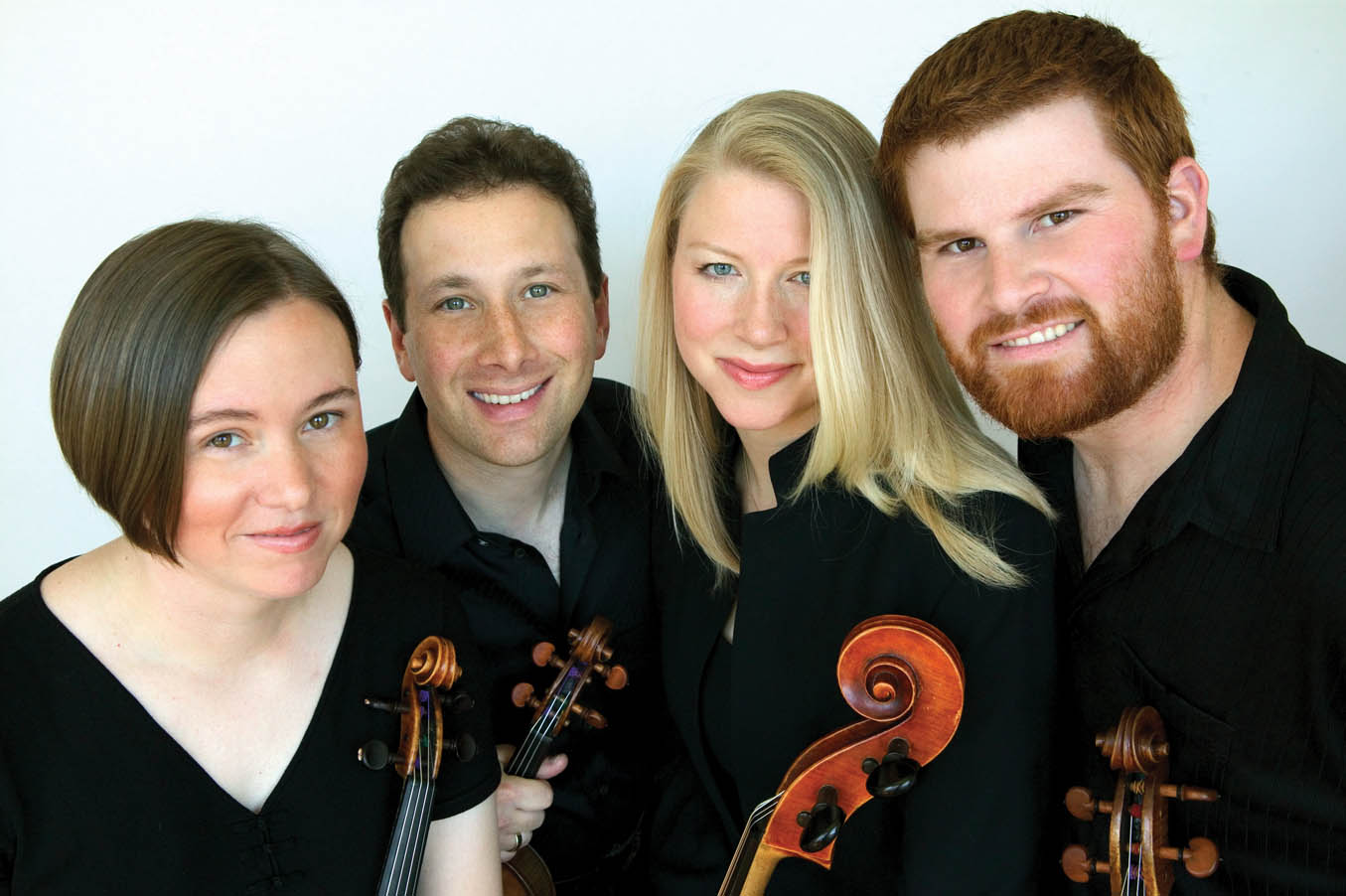
Kloetzel’s route to the Beethoven sonatas came by way of the complete string quartets, which she recorded as cellist of the Cypress String Quartet (below). “We recorded the late quartets first”, she remembers, “and then, many years later, we did the middles, and then, finally, just a quick two years before we disbanded, we did the earlies. It was fascinating to go backwards through his string quartet writing. If I had started the other way I would have thought the Op.18 quartets sound Mozartian, but seeing them from that way I saw everything that was going to happen later early on. It’s like when you look at a baby picture of somebody, it’s hard to tell what they’re going to look like as someone older, but later when you look back, you see them.”
She thought carefully of the ordering on the new cello release. “I didn’t record them straight from beginning to end, but I decided to put them in that listening order. If someone wants to sit down for three hours, they can go from 1796 to 1815, and have the experience of his writing for cello and piano with that little fun arrangement of the Horn Sonata thrown in. The thing that made me pause when I was doing that was the third, fourth and fifth sonatas, which are considered the biggest ones, and you have to wait for the entire third disc.”
Kloetzel includes the variations Beethoven wrote for piano and cello, and the ‘Conquering Hero’ title of the disc takes its name from the source of the first set of variations – Handel’s chorus See The Conquering Hero Comes, from the oratorio Judas Maccabaeus. “I had a lot of pushback on that title from people”, she says. “It’s more about Beethoven being the conquering hero, and what he conquered and became – the deafness, the lack of love. Everything after the battle with his nephew, and the fact he kept turning to music to write and express himself. That’s why I decided on the title, because in my mind, he is a conquering hero.”
Throughout the three discs, Kloetzel and Koenig (below) give off a pure enjoyment of Beethoven’s work. “I love the way things are put together, and I was reminded as I was doing this project, how clever Beethoven is. One of my favourite traits in all humans is cleverness, and Beethoven has it in spades. He’ll do something where the cello is in a certain range, and he’ll make sure that the piano parts are really not anywhere near that. When I was studying it for the recording, I would look to see where the piano part was. It is really interesting and thoughtful orchestration, carefully done. There is something perfect about that endless cleverness, and the dialogue back and forth. I was telling someone the other day that I was working on the Handel Variations, and it cracked me up that Beethoven doesn’t even give the cello the main theme until the tenth variation! Even then the piano has it in canon, low in the left hand.”
The sonatas are laced with feeling. “The G minor sonata, Op.5 no.2, has some serious drama, and I hear the Op.69 A major sonata with a degree of wistfulness and sadness, which I think brings something a little different to my interpretation, that it’s not all conquering joy. The music is so varied, too – he never does anything twice! When I was in college, I wrote a paper about the last two sonatas and how they are the turning point. They contain the hallmarks, the trills, the canons and the fugues.”
She agrees that the opening of the first of Beethoven’s two Op.102 sonatas feels like the opening of a new door. “I think so. One of the things that I find fascinating is that with both the third and fourth sonatas, he begins with solo cello. I read that Beethoven said, “Art demands of us that we never stand still.” And so he never does that same thing twice. In this case, he kind of does except it’s a really different type of melody, but it definitely is a signpost towards equal partnerships. The earlier works have a bit more weight to the piano, but of course it would have been him playing it! For almost all of that early stuff, up until about 1802, that’s the case, but after that, it’s not implied anymore. Part of the reason I find this music endlessly fascinating is that it’s always surprising, even to me, or in the way the contrast and the content is set up. If you follow the markings on his music, you find that buried treasure. So many people add in crescendos and the like, but I think he knew what he was doing!”
Kloetzel also follows Beethoven’s markings for repeats, whereby sections of the sonata movements are heard for the second time. “I included every repeat in all of these works, as I am a believer in the form, and I think that he knew what he was doing. In the G minor Sonata, the first movement has a double repeat. Now I know it makes the movement 21 minutes long, but I think it’s fascinating. I never performed it that way, but as I was studying it for the recording, I realised that he meant this!”
She confesses to playing the Second Sonata when just eight years old, which begs the question – at what age did Kloetzel actually start playing the cello? “I started at age six”, she says. “My mother is an opera singer, and in my family, I’m one of four children. You had to play piano and one other instrument. When I was five I heard the sound of the cello and I said, “I want to play”. My parents were like, “You’re too young, too little.” I begged for an entire year to play the cello, and so they finally rented a half-sized cello. After about six weeks, I get my first recital, which we have a tape of, by the way!” I did my own variations on Twinkle, Twinkle Little Star, but I couldn’t quite tune the cello, so it sounds a little modern! A few weeks later my teacher came to my mother and said, “She’s scaring me, she’s learning so fast. Please take her to Baltimore and find a teacher for her there. That’s where I did 10 years in the pre-college there, before going to the Juilliard School.”
Kloetzel and Koenig both met at Juilliard. “Bob and I were there around the same time. He was one of the collaborative pianists, playing mostly with violins. Then six years ago when I got the job at University of California in Santa Barbara, he was the person to reach out to me and say, “Hey, we have a job opening. I see your quartet is just ending.” So I applied, and as part of the audition we actually played the Third Sonata together, because he played with me for the audition. That’s six years ago, and we started playing together right away. We played the G minor Sonata just a few months later, and my mother said how she was blown away by the two of us, it was like ‘hand in glove’. I think the two of us come from a similar background of making chamber music and really listening and responding, which makes it a very special partnership. I just knew he was the person to do this with me!”
Kloetzel has two points of reference for running through Beethoven’s output from early to late – the string quartets and now the sonatas for piano and cello. Is there a noticeable development in his writing for cello? “Let’s look at Opus 59 no.1”, she says a little unexpectedly, turning to the first of the Razumovsky Quartets. “A middle period work, one of my favourite quartets – it’s such a cello quartet, with the Russian theme. It’s like the Op.69 sonata, we’re right in that same middle, heroic period where he’s using all the voices equally. When we get to the later quartets, some of the cello parts are extremely high. When we get to Op.132 there’s a whole passage where the cello is way up high, soaring in octaves with the first violin, versus Op.131 where it’s very low.”
Mention of Beethoven’s Op.131 quartet, in C# minor no less, prompts a discussion on his use of keys. “It is fiendishly difficult, outrageous!”, Kloetzel agrees. “I remember really studying the key relationships, and how many he had written in each. F major is important, with three works, and E flat major too. I don’t see that as much in the cello sonatas. My friend Will Meredith, who wrote the booklet notes, he has given lectures on what keys mean to Beethoven. That’s like the language of flowers! His point though was that these things mattered. E flat was the heroic key – and you think of Op.127.”
Jennifer has a sudden realisation. “You know what I need to do next, right? The piano trios!” It would be a wholly logical step. “I have played them all, and the string trios too! We’ll see though. Stay tuned!”
Speaking from my own perspective as a part time cellist, I am curious to find out the technical demands as the cycle of cello sonatas progresses. “I don’t find they are as demanding as the quartets because of the length of the pieces”, she says. “With the quartets you can sometimes feel like you are about to climb a mountain when you start the piece. When you have a great pianist in the cello sonatas, you don’t have to fight to get your sound out – and that’s partly Beethoven’s writing. The hardest thing in a way is making sure all the ranges make sense. I read once that Beethoven didn’t think the cello could really be a solo instrument, because it couldn’t cut through. That is fascinating to me given they were playing with a fortepiano.”
Kloetzel is convinced that Beethoven knew the right people – particularly two cellists he met at an opportune time. “I think when he met the Duport brothers, in the Prussian court, that changed his opinion. I think we have them to thank for this body of work, and with the Mozart Prussian Quartets, freeing up the cello a little bit. In between the Duport brothers and Antonin Kraft, Beethoven heard very good cellists and knew what was possible. Interestingly we don’t have a fully-fledged slow movement in the sonatas, or the Triple Concerto. It’s a very short slow movement, and he puts the cello very high, like a violin. The Fifth Sonata has the closest thing to a slow movement, it spins and then goes into the fugue. The arc of that work is difficult, because it’s a short first movement and then you have to make it work. With the fugue, I’ve heard it played wildly fast. For my masters recital at Juilliard, I did all five sonatas on one programme, with two intermissions. It was such a great journey.”
Kloetzel has received advice on the sonatas from a close friend, Steven Isserlis, who has himself recorded the sonatas. “I adore him”, she says warmly. “He’s crazy and wonderful. He gave a class to my students a couple of years ago, and we reconnected after. I met him a while back, and he gave me a very difficult lesson on the fourth sonata many years ago, when I was a student living in Prague and he came through. Boy did he read me the riot act, for not doing my homework better – but out of that was born a friendship, so that was wonderful!”
Kloetzel and Koenig’s new recording complement Isserlis and Robert Levin, on the fortepiano, rather nicely. “I purposely didn’t listen to his recording of the Horn Sonata before ours”, says Jennifer, “as I didn’t want to be influenced by it. It’s hard when you’re preparing for a big project like this. I have multiple versions of the pieces, and favourite versions for sure, but one is elegant, one is passionate, one is exciting.” As to the piano, she says, “You realise how much Beethoven was playing with textures in the five sonatas”. The Horn Sonata is rather different. “There are more long lines within the cello / horn part, and moments where it’s like ‘No, he didn’t write anything like that for the cello. That is why I loved including it. There is a version of the Kreutzer Sonata played on cello, but I’m not so sure! It’s in a different key, and Bob was not sure about the piano part either. When I was trying to put this together I wanted it to be what Beethoven himself wrote”.
Although Beethoven is a huge part of Kloetzel’s work, especially recently, so too is contemporary music. It is clearly important for her to manage a balance between the different established and new classical works. “Absolutely, because in a way we’re only playing older music. We’re historians, right? We’re putting a fresh look at a moment in history, so I feel it is very important to look at the music of today, so that we not only continue to start but when people look back, they see what’s being written today. I also I have a whole passion of finding what I like to call the ‘living Beethovens’, composers whose music is interesting, thoughtful and clever – all the elements I love in Beethoven. Only yesterday I was on the phone with a composer who’s writing a Cello Concerto for me, and she’s just at the very beginning of writing so we were talking about ideas. She likes to have inspiration from something I’m thinking about, so it becomes a personal thing. I definitely think it’s important to play, and then not only to premiere works, but to champion them, so they get recorded.”
This approach has stayed with her. “When I was in the quartet, we had a whole process for choosing composers to commission which involved three of us not knowing where the music had come from. We would listen to the pieces on a playlist, and had a voting system to give our verdict, and then we would find out the composer. We called it ‘blind listening’ and it was great; it was about listening to the core of the music.”
“Just like I get obsessed with Beethoven I get obsessed with new music too, and the same thing happened with the string quartet he himself was writing for, the Schuppanzigh Quartet! Over the pandemic I was of course playing a lot of Bach, because I could, and that was a part of what kept me going when all the concerts went away. It was difficult, when what you are destined to do is gone, and live streaming was not the same. I said to myself “If nothing else, let’s play a little bit of Bach!” I made sure I played it every day, and I started to craft a project where I was commissioning companion pieces for each of the suites. I have five of the commissioned works so far. I went to my ‘go tos’ first but then I wanted to go further afield. That’s the old and the new again.”
She elaborates on the composers writing alongside the Bach. “There is Elena Ruehr, who wrote with the First Suite, and then a French composer Philippe Berson, he is amazing. He wrote a piece titled Sarabande for the Second Suite. For the Third Suite I turned to the very first composer I commissioned for the quartet, Dan Coleman, who was a colleague of mine at Juilliard and lives in Arizona. For lives in Arizona, and then for the fourth a colleague of mine from Santa Barbara, Sarah Gibson, a young female composer and pianist, I love the piece she wrote! The Fifth Suite is proving a little difficult, that’s the one I’m still waiting for, the person I wanted to do it was just too busy. I’m going to give that a little space, but then for the Sixth Suite I commissioned Aaron Clay, an African-American bass player from Virginia who is a very fine composer. Four of those are unperformed, and I hope not too much time goes by before they are.
There are other pieces that have been postponed. “There is a concerto by Joel Friedman that was supposed to be premiered during 2020 but has been postponed for another year or so. It is a Double Concerto, Inferno, for viola and cello – based on Dante’s Inferno. It has a political theme of what was happening, you know, in our country there for a while. It’s electrified, and we have to do all sorts of insane things – there’s a whole Skrillex effect I have to do. I’ve spent a lot of time figuring out pedals, with delay and looping. I’m excited about this piece, and art demands of us that we never stand still! There are too many things I would like to do but not enough hours in the day.”
You can listen to Jennifer Kloetzel and Robert Koenig’s Beethoven: The Conquering Hero at the Avie Records website where you can also explore purchase options.
Brett Dean is enjoying a productive start to 2022 in London musical life this year. Late January saw the UK premiere of his Piano Concerto, with Jonathan Biss and the BBC Symphony Orchestra, while the following month Lawrence Power gave a performance of the Viola Concerto with the London Philharmonic Orchestra. The viola is Dean’s ‘home’ instrument, but more recently he has cast his eye further down the stringed instrument range to write for the cello. This work – the Cello Concerto – has had a number of high-profile performances around the world with its dedicatee Alban Gerhardt as soloist. Gerhardt now brings it to the UK for the first time, completing a date originally scheduled during the pandemic.
Australian composer Dean lives in the UK, and Arcana join him on a Zoom call from his home in a village near Newbury. We start by talking about the concerto’s genesis, which runs right back to when composer and soloist met for the first time. “I have known Alban for a long, long time,” he reveals. “His father, Axel, was a colleague of mine when I was playing in the viola section of the Berlin Philharmonic. They all have musician’s names – Alban, Cosima, Pamina – all quite quirky but very definitely music related names. I first encountered Alban when he was a teacher, and I taught his elder sister Manon the viola. For quite some years she has played in the viola section of the Deutsche Oper in Berlin. I’ve known the family and known Alban since he was 16 or 17, and I played in the Berlin Philharmonic when he gave his debut, which would have been in the early 90s. He played the Tchaikovsky Rococo Variations and so it was coming full circle to write not only the Cello Concerto but prior to that I’d written him a piece for cello and piano, which he premiered with Steven Osborne. We’ve been collaborators for quite some time, and in recent years we have played in a string quintet which tours occasionally. It’s been a very special time, and great to unpack this piece with him.
Gerhardt is a fierce advocate of contemporary music. “With even the brand new pieces, he plays them all from memory”, reveals Dean. “He has an extraordinary dedication. He would play that down and say simply that he plays better from memory, but that’s underestimating what must go into that because it’s not easy to commit brand new pieces to memory.” Committing this new piece must have been a labour of love, given the distinctly shaded cello part? “It’s hard for me to judge, but it does have motifs and things you can remember. I do think my instrumental writing does allow and certainly uses motifs that you can remember. At the same time there is plenty of variation and modification and manipulation of those motifs such that it must be easy to end up going down the wrong path! That can happen in standard repertoire, having played quite a few viola concertos from memory – it is a very particular skill. It is liberating, I remember – although it’s been a while since I’ve played any of the big concertos from memory – but it is a great feeling when you get to that point.”
Was Brett writing the Cello Concerto as much for Alban the player as he was for the cello as an instrument? “Certainly”, he says emphatically. “The piece actually started life as a piece for solo cello, which strictly speaking I didn’t write for Alban. It was actually a competition piece for the Feuermann competition in Berlin, back in 2014 or 2015. It was called 11 Oblique Strategies, which was inspired by Brian Eno and Peter Schmidt‘s pack of cards. It is a pack of cards that they put together, and you pull out a card. It was meant for creative artists, in Eno’s case in a studio and stuck for an idea. You go to the pack, pull out a card and it will have some sort of aphorism on it, like building bridges, burning bridges, or “You are sitting in a very large room and it’s very quiet” – things that get the mind ticking over. It became quite a thing back in the ‘70s. Famously David Bowie used these strategies when he was in his Berlin phase, writing Low and Heroes.”
Dean’s approach differed slightly. “With this piece it doesn’t have the spontaneity that Brian Eno built into the idea, because I actually chose eleven cards beforehand and ordered them. I was fascinated by the concept though and given that it was a competition piece for young cellists it seemed an appropriate thing to write a piece that somehow was about the creative and the recreative process. Alban was part of it, because he was the first cellist I ever showed the piece to, and he would run through it for me and with me. That meant I had a profound cellist’s approval. It seemed somehow fitting then when the concerto commission came up to take these ideas, because I was really happy with how the solo piece turned out, as it seemed to be one of those solo pieces that was opening multiple windows for me. He explains further. “Some pieces lead you further than other pieces do, and this piece cracked a few hard nuts for me compositionally. It seemed appropriate to use it as the basis of a piece for Alban, given he’d been part of its early stages. It is for Alban, and also for the cello.”
Dean has a confession to make. “The cello is the instrument I probably would have liked to have been playing. I love the viola, it has been good to me, but there is something about the whole gesture of cello playing that is quite stupendous and grand, and all the mastery and the range it has, I have always enjoyed writing for it. Even with chamber pieces of mine that feature the cello, it ends up having a good time! My quartets have a full prominent part, while I’ve written for the twelve cellos of my former colleagues in Berlin, the piece Twelve Angry Men. So, it was a wonderful and pleasing opportunity to write a concerto and above all for Alban, who I’ve known so long.”
The Cello Concerto has a long, continuous span across its single movement, so while there are some distinct divisions it is very much one broad section. Dean considers his answer. “I mentioned the cracking of difficult nuts with that solo piece, and I think the thing I was able to unify in that piece, in its many short movements, was the first time I felt I’d been able to approach something in the manner of a composer like György Kurtág, who I admire greatly. The Kafka Fragments are a good case in point. They are around 60 minutes long but are made up of so many small components, and yet it somehow is this single statement. I’ve always been fascinated by how he does that. With the solo cello piece I felt I got somewhere along that path. I had these very contrasting and different eleven sections that somehow hung together in a way that I found pleasing, and that was somehow more than the sum of its parts. It was building on that to come up with this big span in the Cello Concerto, and I’m really pleased that comes across because that’s not a given by any means.”
Another feature of the concerto is its striking orchestral colours, which prompts the question – does he find it advantageous writing for the orchestra having been part of one? “I’m sure”, he says emphatically. “I can’t imagine writing for orchestra without having had the background I’ve had. I’ve always felt it’s a bit like a home game writing for orchestra, because I go back into my orchestral mindset. I do still get a printout of the viola part and play through it, to see what it feels like. Even when I finished writing Hamlet, I got the viola part and slogged through it over a couple of days. It was bloody hard! It doesn’t necessarily make all that much sense. Just the viola part of an opera, but you know, the viola part of something like a cello concerto, given the action in in the divided strings, it gives you an indication of whether the energy is working correctly. It’s incredibly valuable in orchestrating contemporary music to know how to gauge energy. I find it really important to write parts that are challenging for orchestral players, but in that challenge it needs to be achievable, not too complex. That’s what I really liked about pieces in my own time in a professional orchestra. In the early years of the Berlin Philharmonic, it didn’t include that much really contemporary music, but I also did a lot of chamber music, and that included a lot of contemporary music with like-minded younger members of the Philharmonic. Yet as Claudio Abbado took over from Herbert von Karajan, and then Simon Rattle took over from Abbado, the repertoire changed significantly anyway.”
In writing for orchestra, Dean drew inspiration from one of his contemporary composers, Helmut Lachenmann (above). “As he said, an orchestra is an incredible kind of fascinating machine. It’s got 100 moving parts, and they all have a human brain, but getting them all to move in the same direction at the same time is another matter altogether! I met him a few times, and never had lessons with him, but we did talk a bit about those sorts of things. It was fascinating to also see the very different and quite extraordinary sound world that he creates. It’s much more about particular sounds and noises that you can get out of instruments. He could tell a brass player exactly where to put the embouchure to get exactly the sound he needs, which is why he’s been so convincing when he steps in front of an orchestra. On the page they look daunting, but he knows it’s achievable, and I learned a lot from that, to make it somehow a really positive challenge for each and every member of the orchestra rather than giving them a page load of black, notes everywhere! You won’t get the orchestra on side that way.”
The concerto is a collaboration of forces, rather than a contest between them. “That was something I was pleased about. The solo piece had a title Oblique Strategies, but it was about the creative process. It’s not necessarily trying to tell a story in the way quite a few of my pieces, including a couple of the concertante pieces, do. The first movement in my Trumpet Concerto, which I wrote for Håkan Hardenberger (below), is called Fall Of A Superhero. It is about pushing this trumpet to the max, so that actually the trumpet conks out at the end of the first movement. My Clarinet Concerto is called Ariel’s Music, and is a requiem for Elisabeth Glaser who was one of the first but one of the most prominent early campaigners in the AIDS era. She had been infected with HIV in a blood transfusion, and possibly because she was not from the gay community but from a straight community she had traction with the Reagan administration at the time, which was doggedly blaming it on lifestyle choices. That is also very much a ‘one pitted against many’ scenario. In the Cello Concerto I was pleased to try writing a concerto that was more about a collaboration. It is about the cello initiating ideas that get picked up by the orchestra, then sometimes the other way around, and about finding colours of the solo cellist with the orchestra rather than being in competition with them.”
Dean agrees that it is gratifying having the concerto performed several times as part of major orchestral programmes, each time with Gerhardt as soloist. “It’s obviously thrilling for me as a composer, even despite quite a few performances getting ‘Corona’d’! The performance in London was going to happen in 2020 but got rescheduled. That’s the big advantage of having a soloist like Alban, who is such a genuine champion of new music. There are many soloists who, dare I say it, feel it is a good move to commission a new concerto every now and then, but Alban is very committed to the idea in itself. Again, as in Håkan’s case as a trumpeter, you’ve got to build the repertoire. Yes, you can play Haydn and Hummel all your life, but that’s what his guiding principle has been, to create repertoire for the trumpet as a solo instrument. In the cello’s case, there are plenty of great pieces you can rely on, but not as many as the violinists or pianists. Alban’s dedication to really forging new repertoire is extremely genuine, and the other advantage is co-commissioning to get several guaranteed performances, because you’ve got various stakeholders in in the game, which is a blessing. It really makes a huge difference for me as a composer.”
Dean’s mention of Brian Eno earlier in the interview deserves to be revisited, as it implies the composer has been very open in his musical education and what he takes on as a composer. It wasn’t always that way. “The irony is that my education, my practical upbringing, was very much classical. I learned violin as a kid and progressed to the viola and chamber music. Then I went through the conservatory, and it was all classical music. However, the person that really got me fired up as a budding composer, and who awoke the latent, ambitious composer in me was a rock musician, a guy called Simon Hunt from Sydney.”
The two struck up a firm friendship and musical relationship. “We discovered a likeminded need to explore territory other than where we were, other than our day job. I was enjoying hugely my time at the Berlin Philharmonic, and yet I was aware of its limitations. The late von Karajan era was Richard Strauss and Bruckner, Beethoven and Brahms, and not a lot else. He was getting sick of I-IV-V chord progressions, if you like! He was the ‘interesting sounds’ person in this otherwise not especially enterprising rock band, and we started improvising together. It was through that, with close mic-ing of the viola and a piano frame and an early sampler, I was learning as much from being in a studio with Simon as I was playing in the Berlin Philharmonic. Somehow the ambition to compose came as much from retracking sessions in divey studios in inner city Sydney when I was back on holidays, or this little studio we had near Checkpoint Charlie, in the days before the Berlin wall came down. It was very enterprising and kind of pioneering, and I found it was a great complement to donning the tails and playing Bruckner, to be in alternative music cafes playing this new music. I still need the electronic geek to find my way around the studio! I’ve never really learned to operate the studio myself, but it liberated my ear to musical potential, even if it was a recording of shattering glass. Those sorts of things became part of the pieces that Simon and I were making, often for short films. They became part of the vernacular or the vocabulary of sound that I was only too keen to expand. Quite a few pieces of mine, particularly early on, included electronics.”
The appeal of his first discipline is clear, however. “Increasingly, whilst I will still have a kind of an extra few sounds created electronically, I do like to get as much variety of colour as I can out of the orchestra itself. In the Cello Concerto I have written for Hammond Organ for the first time, for example! I couldn’t say why, but there was something about it that was the sound I was after. I like the bizarre aspects of it, the oddness that it brings.”
On a more sombre note, our talk turns to the influence of the recently departed Harrison Birtwistle (above), who Dean has checked as a reference point even in the notes for the concerto. The two did meet, it turns out. “The first time we met was at a concert at the Wigmore Hall in mid-2019. It was a feature of his own music with the Nash Ensemble, including a premiere of a new piece for viola and cello, Duet for Eight Strings, which was performed by Lawrence Power and Adrian Brendel. We chatted together afterwards in the downstairs bar, having been introduced, and as it turned out Harry was staying the night in the Garrick Club. We ended up sharing a taxi together, and I had to pinch myself! Here I was chatting away in the back of a taxi with one of my all-time heroes. I must say that I’m working on a new opera at the moment, and I’m happy to admit I have a vocal score of The Minotaur on my desk. I have to say there are scores of his that I turn to as much as anybody else and more than most. There is a strange arch of clockwork in his music, and yet I find it just so liberating. It frees up the imagination just to listen to it, let alone how he goes about it. It’s like a refresher course for your brain, and emotionally so engaging. I can’t say I knew him well, but I feel very connected to him through some of his pieces – in particular Pulse Shadows, one of my favourite Birtwistle pieces. It is a miracle of invention.”
Dean confirms the opera he is working on, for Bavarian State Opera, is called Two Queens. “It examines the relationship between Mary Stuart and Elizabeth I, but it does so not through Schiller / Donizetti but uses their own words, which have been beautifully put together and distilled by Matthew Jocelyn, who I worked with on Hamlet. It is due to be premiered in two short years, so I’ve got to get my skates on! It is progressing though, and I’m having fun with it.”
With that our allocated time is up – but Dean has shown in that time a keen and alert grasp of the music he is working on and its place in time, with reference to his time with the Berlin Philharmonic, his work within rock music and his vocation as a composer. Go to watch the Cello Concerto in its first London performance and you will get an idea of what he is all about.
Alban Gerhardt is the soloist, with the London Philharmonic Orchestra conducted by Edward Gardner, in Brett Dean’s Cello Concerto at the Royal Festival Hall on Wednesday 27 April. The concerto will be complemented by Britten’s Sinfonia da Requiem and Vaughan Williams’ Symphony no.5. For more information on tickets, click here
written by Ben Hogwood Photo of Julia Fischer (c) Felix Broede
Arcana has an audience with Julia Fischer, the multi-skilled violinist and pianist who is Artist-in-Residence with the London Philharmonic Orchestra. Her most recent concerts have contained a complete cycle of Mozart’s five Violin Concertos, along with the Sinfonia Concertante and a chamber concert with LPO soloists. The Mozart will shortly be available to view online, after which Fischer will be busy rehearsing the Elgar Violin Concerto for performance with the orchestra in April.
Our online call finds her bringing a little sunshine to an otherwise grey morning, full of enthusiasm as she greets us from her home city of Munich. To begin, she recalls her first encounters with the Mzart concertos. “The G major Concerto, no.3, was taught by my first violin teacher when I was really very little. I must have been eight, and I remember hearing Arabella Steinbacher play it. I think that was my first encounter with that concerto.”
Perhaps not surprisingly, Fischer does not have a vivid memory of the impact it had on her – but was soon reacquainted with the piece. “A few months after that I actually performed the first movement of the concerto for my then teacher Ana Chumachenco so when I auditioned with her, it was with that first movement of the G major Concerto.”
Fischer recorded the concertos for Pentatone with Yakov Kreizberg and the Netherlands Chamber Orchestra, recordings that have aged will in the 15 years or so since she made them. Having spent a relatively long time with them, has her view changed at all? “I suppose, yes, but not in a conscious way. I learned them between the age of eight and fourteen, when I played the Fifth Concerto, then the Fourth Concerto when I was 16. The First and Second concertos I learned for the recording in 2006. After that I performed the cycle two or three times, and of course there are always things changing from one performance to the next, but my emotional approach didn’t change much.”
There are smaller considerations to be made, however. “Maybe the technical approach, the bowings, the note relations have changed a little, as there is always something you can discuss. You can do it with a large or small orchestra, with a conductor or without a conductor, with a harpsichord or without. There are many options, and I don’t think that any of those options are wrong. For the moment you have to find a good approach, and it depends on the people who are involved and who you play with.”
February seems a good time of year to be discussing and playing these essentially sunny, optimistic works. She smiles. “Let’s hope that we can be optimistic, you know?!” The concerts have interesting and exciting programmes around the Mozart works. Many of them will be given under Thomas Dausgaard, a conductor Fischer has worked with before. “Yes, he is a wonderful conductor. He is a very kind man, a wonderful musician. I specifically asked for him for these concerts.”
Dausgaard it was who chose the Richard Strauss pieces accompanying the Mozart – Don Juan and Tod und Verklärung with the Third and Fourth Concertos, and Till Eulenspiegels lustige Streiche with the Sinfonia Concertante. Meanwhile Fischer herself took charge of one concert. “I will always play and direct the first and second concertos, because I really don’t need a conductor there. I put together the first two concertos with the TchaikovskySerenade for Strings, and he did the rest of the programming.”
With the Mozart works, is there an assumption that the works are too easy to perform? “Yes. You can always find difficulties in any piece, but I think when you do the cycle it is important that each concerto has its own character, so that they don’t all sound the same. The First and Second Concertos are very different from Three, Four and Five, they are still very much from a perspective coming out of the Baroque-ish way of playing. I think Mozart probably had Vivaldi and Tartini in his mind, as they are much more difficult than Three, Four and Five.”
She expands on these three pieces. “The Third is probably the most lyrical one, and has the beautiful aria as its second movement, With the Fourth, it is a beautiful work, and as well as the portmanteau the second movement has this singing part. The Fifth is very different because it has the famous Turkish March finale, but with Three and Four you have to be careful that they don’t get too similar.”
Throughout the concertos, Fischer finds elements of Mozart’s operatic style. “I think it is everywhere”, she says emphatically. “In any Mozart, one has to see him first as an opera composer, and then it’s far easier to perform his instrumental pieces.”
From her answers above you will have gathered that Fischer learned the violin at an extremely young age. Indeed, she met Yehudi Menuhin well before her teens. Did she speak to him about the Mozart concertos at all? “Actually I played the Fifth Concerto with him, when I was 13, maybe 14. I remember playing that with him, but I don’t really remember the musicality of it. I also played the Beethoven Violin Concerto with him and that had a huge impact on me. We had a conductor for the rehearsals so he spent more time with me personally, and we worked on it together. The Mozart was a one-off concert in France, so we just met very briefly for that.”
As part her Mozart season with the London Philharmonic Fischer programmed a chamber concert, placing herself as soloist in the DvořákPiano Quintet no.2 – for she is indeed a fully-fledged concert pianist. It is an extra challenge, but one that she warms to. “I have played the first and second violin parts in that piece, and the piano part!” Does she find chamber music an essential complement to playing concertos? “There’s no difference”, she says. “It’s not as if I use a different technique or different perspective. For me it’s very natural that music is about communication, and communication is crucial to chamber music as well as orchestral pieces. For me it is not a different way of playing.”
As part of the chamber programme, Fischer included the little-heard Octet for Strings by Max Bruch – a composer who is all too often solely represented by his First Violin Concerto. “I love many pieces of his, I think they are really fantastic. The Octet is such a great piece of chamber music, and of course it’s fun to play. My first violin part is like the Mendelssohn Octet, it’s very challenging, and I like the double bass added to it which makes it almost like an orchestral piece. Whenever I am in residence with an orchestra, I try to programme the Bruch because usually I don’t get the opportunity to perform it.”
Fischer is relishing being back on the road and performing to audiences overseas. “In November I did my first tour in one and a half years, so that was very interesting!” she says with characteristic understatement. “Then I lost the LPO tour to Germany in December, and in January I was supposed to have a tour with my quartet. We were supposed to have nine concerts but in the end we had three. It’s a little bit frustrating but I’m very happy to have had this residency to perform.”
Playing the violin was not a challenge during the initial lockdown of 2020, but there were more immediate challenges. “It was very easy for me to keep playing”, she says. “I have no problem with making myself practice every day. I’ve never had a problem with that, but I am a mother to two school-age kids, and German schools were closed altogether for something like two months in the first lockdown. In the second lockdown my son was not in school for around six months. I had problems other than if I practiced or not!”
While she was grateful for the freedom to keep playing, Fischer was aware of the hardship caused. “There were certain professions that had to suffer the most, and we belong to those. Some people kept working through the entire pandemic, and I was basically without work for one and a half years. Of course I am lucky because I didn’t have any financial issues, and have a house and great family and everything, but from a professional point of view, artists were suffering a lot.”
Turning back to the more immediate future, Fischer will be performing the ElgarViolin Concerto with the London Philharmonic Orchestra and Vladimir Jurowski in early April. “It was my debut piece with the LPO in 2004”, she remembers, “it was my first performance with them. It was the first season that I played it in concert, but I learned it two years before that when I actually graduated from school. For my graduation I took five months off from concerts, so I didn’t perform for five months. My teacher said, “OK, let’s learn a few concertos in that time”, so I learned the Elgar and the Khachaturian. That was when I first learned it. I had it on my London Philharmonic tour with Vladimir Jurowski to Asia three years ago. And yeah, we actually wanted to play it on the December tour to be prepared for the April concert, which didn’t happen, so now we have to start over again, but I’m very much looking forward to it.
She is fulsome in her praise for the conductor. “Jurowski is absolutely phenomenal in these huge pieces, because it’s so big. You have such a big orchestra, the piece is very long, and you really need a conductor capable of finding the architecture of such a huge piece, and also one who is capable of accompanying because it is a very free concerto. You need somebody who can really follow you well, so I’m very much looking forward to that.”
She did not get a chance to converse with Yehudi Menuhin about the Elgar. “I remember when I met him, I started to collect his recordings. I have the recording of him when he was 16, with Elgar conducting, and that’s when I first heard the piece. My first encounter was with his recording, but I never talked to him about it.”
The Elgar concerto will be coupled with the Second Symphony of George Enescu, a typical example of Jurowski’s imaginative approach to his concerts. “I know Jurowski is pretty amazing with programming”, Fischer says. “When I need to find new programmes I text him and ask for his opinion, because I know that it’s not my strength, programming – so I always try to get inspiration from somewhere else!”
Fischer has not yet recorded the Elgar – is that something she would like to address? “I was supposed to record it a few times, and then something always just didn’t happen. We are recording the concert in April, so I’m looking forward to seeing that. I don’t think the Elgar is a piece I would want to record in a studio, because it’s so long. It’s hard to find the excitement through the piece, but in a concert recording I think it is entirely possible.”
In the longer term, are there other pieces Julia would like to learn and record? “I have always been very curious, and I used the pandemic to read through a lot of music and learn a few pieces. I don’t have a master plan though. When a conductor asks me to learn something I think about it. For example I’m playing in a year from now in Warsaw with Andrey Boreyko, and he asked me to learn the Violin Concerto by Karłowicz, which dates from around 100 years ago. I’m very happy to do that. I think it’s tough to judge a piece, because usually with many pieces you only know if they are going to work or not when you are on the stage. It’s worth learning and performing them once to decide if that is a piece you are going to keep in your repertory or not.”
Julia has a busy performing schedule for the rest of the year – pandemic permitting, of course. “Well, let’s see what’s going to happen! I’m very much looking forward to touring Europe with the Academy of St. Martin-in-the-Fields in May. The past two tours fell apart and this is a big tour. The problem with touring is that if you lose one country then the entire tour can fall apart. Unfortunately it is usually Germany that is the country with the most strict rules, and with the least support for arts, I have to say. I don’t think as many concerts have been cancelled anywhere as they have been in Germany. Or, even worse, when they don’t cancel but have these 25% or 50% rules. Until last week in Bavaria we had 25% and rules of being vaccinated two or three times. Some people wanted to come but it was too much of an effort, and in Austria it was the same. With those restrictions it is impossible to programme anything, so we will see – but for May the prognosis is good. That sounds hopeful but what we’ve learned in the last two years is not to be certain of that!”
She remains busy as a teacher, “a bit busier than I should be! I have too many students, which was a great thing during the pandemic of course. I was teaching every week, and that gave me a lot of joy, with a wonderful class and wonderful students, some very interesting musicians. We even did little concerts for each other just so that we could keep on performing, even if it was four or five of us we continued to do that. I am a very happy teacher!”
Julia Fischer performs and directs Mozart with the London Philharmonic Orchestra in two concerts set for broadcast on Marquee TV on 5 March and 12 March. For more details click here.
In the first concert she is soloist and director in the first two concertos, while Thomas Dausgaard conducts in the third. The second concert pairs the Fourth and Fifth concertos, while viola player Nils Mönkemeyer joins for the famous Sinfonia Concertante.
Fischer will perform the Elgar Violin Concerto with the LPO and Vladimir Jurowski in the Royal Festival Hall on Wednesday 13 April, with Enescu’s Second Symphony. Tickets for that concert can be found here.
Finally, for more information on Julia Fischer’s European tour with the Academy of St. Martin-in-the-Fields, click below:
Arcana is paying a visit to the studio of musician and producer Leo Abrahams. We are there to talk primarily about Scene Memory II, his recent solo guitar album – sequel to a first Scene Memory of 2006. Perhaps inevitably discussion wavers during the course of the interview, and we end up talking about a number of the prestigious musical acts with whom Abrahams has worked and about influences on his music, who range far and wide.
We begin, however, in Siberia – which is where Scene Memory II has its musical origins. In what seems an unlikely turn of events, Abrahams was touring the region. “I have a Russian friend, a promoter, and it’s his life’s project to bring obscure music to the far reaches of Russia. For many years he’s organised what are effectively travelling festivals, which start out in the west of Russia, and drive all the way across to Vladivostok, gigging all along the way. It’s quite incredible, and it’s almost like a performance art project. He’s quite a mischievous character, but very passionate about what he does. The tours are called Muzenergo, and back in 2013 I did one of those tours with a project I had called Amoral Avatar, and before that, when I did the Scene Memory album in 2006 he got me over to do some gigs in Moscow. That was where we started our association. The Amoral Avatar tour was a killer, with virtually no sleep – two hours a night on a coach, juddering down these roads. It was really brutal but a wonderful experience.”
The audiences proved engaging, too. “Everywhere you went, even in the very small towns in Siberia, everyone would turn out to hear it. They want to hear challenging music, they’re very interested in it. They’re partly interested because Western musicians have bothered to come to thi very remote place, and partly it’s a legacy of Soviet arts education, or the meaning of art in the Soviet system – it’s kind of a hangover from that. There’s something important, something for everybody that’s worth experiencing. So I started having the idea of making another solo guitar record some time ago, but I was struggling to write it. I thought the best solution would be to actually go on tour and force myself to improvise, and see what comes out. That coincided with my friend Iouri offering me this opportunity to tour together. I don’t think I would have been able to break the block if it hadn’t been for that experience. It was quite difficult, because although I have experience with live improvisation I have no experience with solo live improvisation. It is a whole different ballgame, because you don’t have anyone else to spark off. It was an immensely rewarding experience – it didn’t always go well, but even the failures were instructive.”
There’s no better environment for coming face to face with your limitations, and then finding ways around them. I think a lot of what I found on that tour was that I was trying to be too clever, and trying to hide behind the technology a bit. When I listened back to the recordings, I could hear my nerves. It wasn’t all bad, but it made me what I had to change to make it a viable record, as opposed to a novelty act – like look how many sounds this bloke can make with his guitar! Some nights people came to the show, and because I’d played with Roxy Music people were expecting to hear proper guitar solos. Some guys came up to me at the end and said, “Why didn’t you play guitar? It was all backing tracks!” It was guitar, but they just weren’t ready for that. In one way that validated my sonic aspirations for it, but in another way it was a failure because it felt like there was no performance for the uneducated listener to latch on to. That was also instructive. I did one gig in a Science University, outside Moscow, which was absolutely incredible because all these young students completely understood intuitively all of the structural principles that I was trying to implement. They got all the Morton Feldman-inspired ideas of imperfect symmetry and inaccurate memory, all these playful techniques. I was really not – and still am not able – to execute them properly, but they still saw those principles. and that was astounding. We finished the concert and then they all came up to the stage when we had this little seminar. It was quite amazing, and I thought I’ve finally found my audience after 20 years – science students!”
Some of the material on Scene Memory II, and the space created – for your interviewer at least – harks back to early ECM records, and a sense of time and place that seems to fall in with Pat Metheny’s solo work for the label. Could this be the case with Abrahams, reflecting his Siberian surroundings? “Maybe it was an ingredient, yeah – but even before I was in Russia, I was reaching for some of that sense of space. I would always refer it to the people who work on ECM who were in turn influenced by John Cage and Morton Feldman. It’s in this area, harmonically and structurally, that is in between – I don’t want to say classical and jazz, but more of a liminal space. I think part of that could be related on some level to the wide openness of Siberia, but in the end it’s a holistic feature rather than a linear progression of influences.”
Given the time Abrahams takes to work with other artists, did he need to devote special time to his solo work? “Yeah. I do find it difficult to switch back and forth. I always feel like I need at least five clear days, without even doing a session or mixing for anybody. I need to know I’ve got a week to just go into my own space and to waste time if I have to waste time. That’s important, but
Fortunately it’s always been the case that I’ve had these little pockets of time. Sometimes they don’t come along for a long time because I’m busy working for other people. It means that whenever I run out of work there is a backlog of ideas that I’m keen to jump into. I really love working with other people, and I never work on anything that I don’t like, which is an enormous privilege. It has also meant that I don’t have to make my own music work for me economically. It’s a passion, and it feeds into my work with others, but I’ve never thought of it as a career. It’s always something that I want to investigate for myself. In a way it’s like my little holiday.”
This would seem a relatively unusual spot for a musician to be in, but in a good way. “Yeah. It goes back to seeing one’s career as a sort of ecosystem, in a holistic way. It’s an area that fertilises other areas, a part of the whole. All other things are tangential.” It is possible to imagine a Venn diagram, with the solo work as one element. “Yeah, and to be honest, in future I think I would like it to be a bigger part of the picture. This record is the first one I really wanted to go and promote. I have made all my other records out of curiosity than anything else. Once they were finished, and I could listen to them, and they were released, that was the end of it. This one is more like the beginning of an area I would like to keep exploring, and to do live performances. I feel like I’ve found an area I want to explore again, and making a completely different record next time, which is what I’ve always done before.”
The earlier albums are certainly a different style to Scene Memory II – which is a guitar-only album, if using a number of techniques to secure the sounds. There is one effect that sounds like bowing, but Abrahams reveals how he gets it. “It’s the sustained elements, made with something called the Plus Pedal. It looks like a piano sustain pedal, and it freezes little bits of the sound. There have been pedals that have done that before, based around. granular synthesis, but the way this particular thing does it is very pure, implemented very beautifully. All the predecessors have been somewhat clunky or even a bit abrasive. This pedal opened up a lot of possibilities I hadn’t considered before. The way the pieces on the record are made is through the guitar going directly into the computer on one channel, and then changing the plugins. There’s another channel that goes to the Plus Pedal, and then that goes into another block on the computer – and there’s a whole other set of chains of plugins. It becomes like duetting with oneself, not looping in the sense that you’re playing over the previous idea, but you’re always resampling tiny bits of what you’re playing, sometimes with unexpected results – and that’s the fun bit.”
Abrahams uses the extremities of the guitar’s range, from high harmonics down to glitchy, percussive throbs that sound like drums pads but aren’t – such as the track above, Spiral Trem. “Literally every sound on the record is the guitar”, he confirms, “because it’s so processed. That particular sound is like a distortion gating, which gives you a thud. Then you EQ the thud, and it acts as a kick drum. Some of these things go so far away from the source sound that it’s arguable whether it really is guitar. There is an analogue physical instrument at the start of that chain, which by its nature is inconsistent. Rather than feeding the same thing into that system all the time it’s always changing, and I think that’s what helps give the music a sort of irregularity that relates it to a real instrument, rather than it being a sample.”
He expands further. “I did actually try playing acoustic guitar through those patches, but it was very difficult to make it work live because obviously, being an acoustic instrument, it picks up everything that’s coming back. It became slightly ungainly. I’m still thinking about ways to solve that. A lot of the pieces were made with this Telecaster”, he says, turning to the stand of guitars next to him and picking up a metallic instrument. “It has a hollow metal body and still feeds back quite easily. The body itself is kind of microphonic but feels really alive, but it’s stable enough not to compromise the performance by getting the wrong material into the patches. That’s definitely one of the areas I want to explore, to bring in more acoustic properties.”
The feeling is that Abrahams is at the start of a longer-term project. “I think so, and I feel excited about it. It’s as much the restriction as the openness which is inspiring, because some days I come in and sit down and have lots of synths and piano, and have all these colours. What do you do? It has to be dictated by either the musical idea, which is exciting, and then you orchestrate the idea, or it’s the idea of a framework that’s exciting. It’s like looking through a tiny hole into quite a big world, and that’s how I feel. After a lot of dabbling back and forth I have realised the guitar is my instrument, and I wanted to explore sounds but through the guitar.”
Abrahams has worked with a wide variety of musicians, including Brian Eno, Katie Melua, Jon Hopkins and Paul Simon, to name just four different examples. Has he shared any music with them, or is it a private project? “No, I’m quite shy about it. I think it’s out there, if people want to find it, but I don’t force it on people. I struggle even to use my mailing list. Sometimes I read the press that I’ve done and I come off as being almost pathologically self-effacing. I do think what I’m doing is interesting, but I do struggle to promote myself and I think that’s what differentiates artists from whatever it is I am – maybe artisan. There’s a really positive thing that makes people want to share, and I don’t really have that. I more enjoy just making it, but some artists have an extra gene.
One of Abrahams’ collaborators is former Wild Beasts vocalist Hayden Thorpe – he played the well-received second album for the singer, Moondust For My Diamond, earlier in 2021, and produced the first, Diviner, in 2019. “I’m really lucky because I do believe in all the collaborations that I do, and my heart’s in all of them. I feel like that part of me is quite satisfied, but as I said before, there’s something about this record which has made me want to try and reach out a little bit more. Last year, I did a couple of collaboration records, which I found really rewarding, and it ignited something in me, and gave me the confidence to do something solo again. That was really positive. In terms of sharing, I’ll show people if they’re interested, but if they’re not, I won’t. Brian Eno, for example, constantly has people trying to show him their music. I never wanted to be one of those people. I understand why people do it, but he is actually, after all this time, first and foremost my friend. If he wants to hear what I’m doing he’ll ask, and sometimes he does. I don’t want to impose.”
Sometimes it works the other way round. “I played on the last Harry Styles record, and he was so nice and really engaged. At the end of the session, with a great deal of sincerity, he took me aside and said, “Let me know when you’re doing a gig, I’d really like to come.” He’d heard all these ambient guitar sounds and he was into it. And I will. I could tell he wasn’t just being polite, he was interested, as a human being.” One of the Styles tracks on which Abrahams appears is the single Falling. “The thing is on those sessions, though, is that you do ten tracks or so but don’t know which ones made it through. I did a lot of tracks and I think I got on to three or four on the final mix. Falling is a beautiful song. He (Styles) is definitely in it for the same reason as somebody who maybe isn’t working in such a mass market. He’s fundamentally interested in music, which shouldn’t really need to be said, but it’s obvious.”
It occurs to me that the friendship with Brian Eno is helped by this lack of persistence on Abrahams’ part. “Maybe. I think the more time you spend with someone, the more you come to understand them and consider things.” The two worked closely together on Eno’s 2010 album Small Craft On A Milk Sea, which was billed as Brian Eno with Leo Abrahams and Jon Hopkins. “That was characteristically generous”, he says of the billing, “especially at the time before Jon was quite as huge as he is now. It was a really nice thing to do. He does a lot of jamming with people, and that record came out of jamming, but on this occasion he finished it quite unexpectedly. At that point he was often giving me big batches of files that he’d made with different people, and asking me to help him edit and mix them. Sometimes it would be released and sometimes it wouldn’t, but with the Small Craft record he just e-mailed Jon and I one day and said, “By the way, I finished that record!” We were both really surprised, and glad about it. He must have felt quite strongly about it.”
With the earlier reference to Morton Feldman, it is fascinating that people perceive the music as being ambient because it’s slower, and that it wouldn’t have intensity – but as Small Craft On A Milk Sea shows, that is not the case – and also Scene Memory II. The album could be listened to as an accompaniment, but never as background music. It remains an intense experience. Abrahams agrees. “That’s right. In a way it invites you in to have a different experience. Within the category of quiet music or even within ambient music there is a lot of different kinds of intention on the part of the composer.”
He gives a specific example. “Even the hypnotic quality that Feldman might want to induce as opposed to Brian or Jon is for very different reasons, and by very different means. The thing that really touches me about Feldman is that it is quiet music, but it is also very hyper-focused and dense. Sometimes it is quite fast in terms of its rate of change. It is written music, and sometimes his music is a conversation with the performer, and even quite playful, challenging the performer in playful ways to heighten their attention, so that what the audience experiences is not some kind of blissed-out manifestation, it’s a hyper concentrated and focused performance of something that is quiet and spacious. For example, quite often he will notate the music in a purposefully complicated way because he wants you to count in a certain way that’s more difficult, so that the music comes out sounding a certain way. It’s a little bit like the Rite of Spring. Somebody in 1917 wrote out the Rite of Spring in 4/4! You could do the same with Morton Feldman but you would definitely lose something. That is key, because what I definitely wasn’t trying wasn’t trying to do was make a pad and then disappear in variations to maintain interest, but essentially in a static space. I definitely didn’t want to do that. I think I wanted it to be more like seeing the elements of each patch as being like sculptures in a gallery. You’re moving round and looking at a sculpture from different angles, and I wanted to contemplate this sonic object, without sounding too pretentious! I wanted it to be focused, and not drifty.”
Abrahams talks in a way that suggests he has explored a good deal of modern classical music. “When I was a teenager, I thought I was going to be a ‘classical’ composer. I went to the Royal Academy of Music, and I quite quickly realised when I got there that it probably wasn’t for me – not just because I didn’t want it, but because I wasn’t really good enough. I showed enough promise to get in, but I don’t think I really had what it took to be a professional composer. Also, in those days, there was something called crossover, and my teacher was a wonderful composer and teacher called Steve Martland (above). He was a great person and artist, but he was in this category called crossover, which in a way was a bit unfair. His teacher, Louis Andriessen, had the same thing – because the music was rhythmic, or used ‘band’ instruments, it was termed as crossover. Thankfully, due in large part to their innovations, that term is gone now and it’s just music. That’s definitely a good thing. I think the difference is much more in the composer’s intention rather than the finished results. Experiments in notation and incorporating improvisation, or aleatoric elements, have been around for a very long time – 100 years or so – and I think we’re still playing in that ambiguous world about how much is written and how much isn’t. There is a certain quality that makes some quiet music clearly meditative, and other quiet music is clearly cerebral – and there’s a lot in between.”
Our talk moves to the shorter piano pieces of Schoenberg and Webern, with which Abrahams is familiar. “Those pieces are so, so wonderful”, he exclaims. “It’s really interesting, I think because their compositional philosophy was so intimidating and intellectual that it closed their music off to a lot of people who might enjoy it on a visceral level. They didn’t want people to enjoy their music on a visceral level, it was just that time in early 20th century, when people were ‘manifesto-ised’ to an insane degree. I love that period of art history, Russian Suprematism. In that area there were so many manifestos coming out from artists, but it doesn’t mean we have to experience the art as a manifesto anymore, because it’s part of history. One of the CDs I listen to most is a double CD of Schoenberg and Webern piano music, and I love Berg’s Piano Sonata too. It’s like he had the heart of a romantic and the head of a 20th century composer.”
“It’s moving to think of those days”, says Abrahams. “Because art meant so much, and orchestral music meant so much, people would travel from all over Europe to experience it. The victory of those people who broke the mould is that we now live in a creative world where there aren’t really those borders – but maybe there isn’t quite as much passion either.”
Returning to the inspirational figure of Steve Martland, what did he learn from his teacher? “It’s a very hard question because in a way, I think I was too young (to be kind to myself), or maybe too incompetent (to be unkind to myself), to really have learned compositional things that I might have been able to learn. Maybe he saw that. But what I really remember of him is his passion. He cared so deeply about justice. He had very clear ideas about what was right and wrong in music, and would express them in quite provocative ways. He knew that he was going too far sometimes, but he also did really believe it. He had very passionate views, which was fine and inspiring, even if you disagreed. He set up his own band too. I met him when I was fifteen, on a course called Strikeout. He would take us all to a retreat, and we’d write a piece for two weeks which would be performed by the band. It was an incredible thing to do. He must have had some sort of Arts Council funding, but it was a passion project.”
Things did not always run smoothly, however. “His main gripe with the academy at the time, where he eventually became a visiting professor, was that they didn’t take music seriously enough. He was very frustrated by that. He felt he was supposed to be the enfant terrible of the situation, but he was actually the only one taking education seriously. He sort of stormed out in the end, because one day a student reprimanded him for coming in dressed in a T-shirt and jeans, which tells you a lot about the place because the seriousness of intention and the love for what you’re doing was far exceeding that of anyone else working there. That was a terrible day. He was a wonderful man.”
His hairstyle and disposition are not too dissimilar from another self-professed enfant terrible, Nigel Kennedy. “It’s partly a class thing”, says Abrahams, “but Nigel Kennedy had a sort of a dissolute quality, which isn’t cultivated – that’s just who he is. Steve was more like a Marine, with discipline – discipline with a smile behind it, which you can hear in his music. That was who he was. He was a humanitarian without a doubt, but in art he liked precision and discipline, and sharp edges. When he died, I still felt as if people weren’t getting to the core of the person. He was a mystery, even to some of his closest friends, but I’ve always carried this deep fondness and appreciation for him.”
There is a final, classic, Martland story. “We were on this composition retreat, and I sat down to rehearse with the band. I’d written myself an electric guitar part, and we started playing. I was 15 or 16. He stopped, and said to me, “When you’re playing the guitar, please can you try and look less like you’re having a shit!” That has literally stayed with me until now. Sometimes I’m on stage and I think, have I got that face on?!”
Turning to the future, Abrahams has plenty of irons in the fire. “Yeah, I’ve actually just finished quite a few productions and mixes and stuff like that this week. One of them’s a Syrian composer called Maya Youssef, who plays in Canada – her music is beautiful, and I’m really happy to have worked on that. I’ve got some guitar sessions dotted around, but I want to try and use the next couple of months to work on my own music. I’ve got quite a lot of unfinished ideas in a slightly more ambient or even neoclassical form, than this kind of atonal and abrasive world that I’ve been in. Some of it will be pure synth, and no guitar. I’d like to try and finish those pieces. There is also one of the collaboration records that I did last year called Krononaut, with a jazz drummer Martin France and trumpeter Arve Henriksen on trumpet. We’re going to do another record, I’m not sure if Arve can but Martin and I are going to get together here in January. It’s another one of those times where I’ve got not quite such an intense production schedule, and I want to use it.”
Now the studio is where he wants it, is the writing more fluent? “It’s early days because I’ve only been here since July, and since then it’s been non-stop work. When I used to work from home in a little bedroom studio, I used to sort of fall out of bed and start work. I knew I’d had a good day when I’d not got out of my dressing gown by lunchtime!”
Scene Memory II is out now on figureight records. You can listen to and purchase the album via this Bandcamp embed: