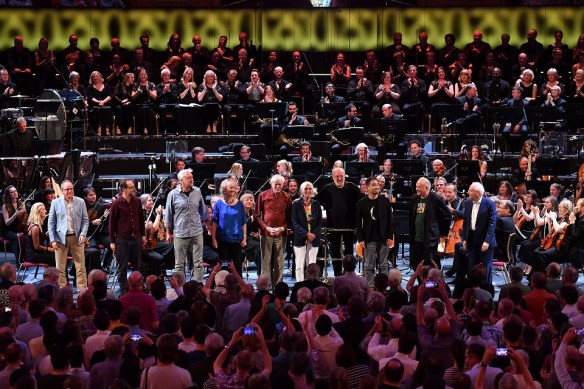
On screen: Goldschmidt: Beatrice Cenci

Goldschmidt Beatrice Cenci (1949/50)

Prague Philharmonic Chorus; Wiener Symphoniker / Johannes Debus

C Major Blu-ray 751504 [107’] 1080i / 16:9. PCM Stereo / DTS-HD MA 5.1.

Sung in German with English, Japanese and Korean subtitles. Regions A, B and C Video Director: Felix Breisach.

Recorded live at Bregenz Festival on 18th July 2018

Reviewed by Richard Whitehouse

What’s the story?

The first DVD release for the opera Beatrice Cenci by Berthold Goldschmidt (1903-96), in a production at the Bregenz Festival in 2018 – continuing the lineage of stage-works by once forgotten and suppressed composers to have been presented at this event over recent years.

What’s the opera like?

Finished midway through the last century, Beatrice Cenci might have been expected to revive its composer’s career two decades after reaching its peak with the premiere of his first opera Der gewaltige Hanrei and 17 years after he fled Germany. A Covent Garden staging failed to materialize and it stayed unheard until a concert performance in 1988, with a full production six years later. Drawing on the 1819 verse-drama by Shelley, librettist Martin Esslin created a succinct and cohesive text where tension rarely lets up over the opera’s 105-minute duration.

Musically things are a little more ambiguous. Goldshmidt’s intention was to revive the art of bel canto and Beatrice Cenci indeed focuses attention on vocal writing to a degree unusual in post-Wagnerian opera. That said, melodies per se are in relatively short supply across a work that, for all it drama and immediacy, is arresting rather than memorable in content. Musically the idiom is still rooted in the ‘neue sachlichkeit’ found in the stage-works of Hindemith and Weill 25 years earlier, such that genuine emotion feels reined-in even at dramatic highpoints.

Johannes Erath‘s staging further exacerbates this impression, its lurid tone and over-wrought action suggestive of a gothic overkill that Goldschmidt was surely anxious to avoid. Katrin Connan‘s sub-expressionist sets, Katharina Tasch‘s faux-Renaissance costumes (redolent of Peter Greenaway during his 1980s heyday) and Bernd Purkrabek‘s lighting with its extremes of darkness and light further ensure the outcome has an exaggerated, even two-dimensional quality which leaves little room for subtlety or finesse in delineating character and incident.

Does it all work?

Only in part, but this is hardly the fault of the singers – among whom, Gal James comes into her own as the cruelly mistreated Beatrice with her soliloquy in the final act, with Dshamilja Kaiser eloquent as her step-mother Lucrezia and Christina Bock no less sympathetic as her weak half-brother Bernardo. Christoph Pohl is almost too suave to convey the sheer evil of her father Francesco, while Per Bach Nissen treads a fine line between humour and caricature as the cardinal Camillo, and Michael Laurenz brings purpose to the vacillating prelate Orsino.

The Prague Philharmonic Chorus is heard to impressive effect in those banquet and execution scenes that bring the outer acts to their climax, with Johannes Debus securing a trenchant and committed response from the Vienna Symphony players.

Understandable that the production should have been given in the composer’s own translation of the original libretto, yet this in itself tends to underline the sardonic and darkly comic aspects which, whether in accord with Esslin’s absurdist convictions, inevitably militate against Goldschmidt’s expressive priorities.

Is it recommended?

Yes, in that Beatrice Cenci is a significant and (given its historical context) valiant attempt to renew certain dramatic qualities at a premium in opera of that era. This Bregenz production makes for compulsive viewing, if rather less in the way of affective or empathetic listening.

Further information can be found at the <a href=”http:/www.cmajor-entertainment.com”>C major</a> website

In concert – Christian Tetzlaff, Philharmonia Orchestra / Esa-Pekka Salonen: Weimar Berlin – Angels and Demons

Christian Tetzlaff, Philharmonia Orchestra / Esa-Pekka Salonen (above)

Royal Festival Hall, Southbank Centre, London
Thursday 26 September 2019

Hindemith Rag Time (well-tempered) (1921)
J.S. Bach arr. Schoenberg Two Chorale Preludes: Schmücke dich, o liebe Seele BWV654; Komm, Gott Schöpfer, heiliger Geist BWV667 (1925)
Berg Violin Concerto (1935)
Hindemith Mathis der Maler Symphony (1934)

reviewed by Ben Hogwood

This year the Philharmonia Orchestra have been exploring the music of Weimar Berlin as it was in the 1920s and 1930s, with fascinating results. Their most recent concert, subtitled Dreams and Demons, may have been relatively short, but it gave plenty of food for thought and the musical rewards were considerable.

A rather older composer who worked in Weimar made himself known throughout the concert, for the music of Johann Sebastian Bach was quoted, refracted and alluded to in each of the four pieces on the programme. Firstly we heard the opening notes of the Prelude in C minor from The Well-Tempered Clavier, part of an affectionate and brilliantly ‘worded’ joke by Hindemith, whose Ragtime started the concert with a swagger. Esa-Pekka Salonen clearly enjoyed its gruff humour, but found the touches of elegance beneath the surface too.

The Ragtime’s surge to the close in E flat minor blossomed with a cleverly executed join into the first of two Bach chorale prelude arrangements by Schoenberg. Here we wondered at his audacious orchestration, taking on what he saw as ‘the first twelve tone music’ and sharing it around the orchestra with typically inventive pointing towards the melodies. Timothy Walden’s cello probed elegantly at the inner melodic lines of Schmücke dich, o liebe Seele, while the exuberant close of Komm, Gott Schöpfer, heiliger Geistdrew heralded the Hindemith work we were about to hear.

Berg’s Violin Concerto quotes from a Bach chorale, Es ist genug (It is enough) at the height of its remembrance of Manon Gropius, daughter of Alma Mahler. Subtitled To the Memory of An Angel, the work traverses a wide range of emotions in its thought processes, from brief oases of calm to fraught periods of activity. The clarinets of the Philharmonia, in all ranges, were superb, whether in the lighter Ländler theme of the first movement or the solemn chorale itself, their imitation of a pipe organ ghostly and – when the solo violinist’s harmonics were in play – ethereal. This was because soloist Christian Tetzlaff (above) also brought a wide range of sounds to the piece, from the fragility of the opening strings of the start to the surging faster music where he took the music by the scruff of the neck. His was a technically brilliant yet musically sensitive performance, closely joined to Salonen’s deft work with the orchestra.

All the while this wonderful piece was heading for the final bars and the ultimate rest, the sort of chord you would want to go on forever as Berg’s orchestral colours mingle with the highest note the violin reaches in the whole piece. Together Teztlaff and Salonen ensured the pacing was ideal, helped considerably by the light and shade of the Philharmonia’s contribution.

After the interval came a regrettably rare chance to hear some Hindemith in the concert hall in the shape of the Mathis der Maler Symphony, a three-movement work drawn from the opera of the same name. This oft-maligned composer exerts a good deal of influence on the tonal music of the second half of the 20th century, more than he is credited for, and his own works are instantly recognisable. Nor, as Salonen and the Philharmonia illustrated, is there a lack of colour or personality in his orchestral writing.

This was a superb performance of a piece Salonen clearly holds close to his heart, having conducted it at the Proms and recorded it for Sony in 2004. The expectant hush from the strings at the start was magical, the effect like walking into a sacred building, and this was reinforced by a solemn intonation of a chorale from the trombones, those Bach influences coming quickly to the surface. Salonen’s slower tempo here worked well.

The silvery strings enjoyed the moments of confluence in Hindemith’s writing, with the added note chords allowed to breathe, but Salonen was not above letting the grittier parts of the music off the leash, pushing forward through the faster phrases. The Philharmonia woodwind and brass were superb, the bell-like clarity of their playing bolstered by deeper shades. With all these qualities noted, Engelkonzert (Angelic Concert) unfolded beautifully, with a grand sense of ceremony at the end, while in response Grablegung (Entombment) was initially thoughtful, its ruminative woodwind then replaced by a brass-dominated climax which Salonen controlled immaculately.

Most dramatic of all was Versuchung des heiligen Antonius (The Temptation of Saint Anthony), with a ravishing tone from the Philharmonia strings at the outset. As it progressed the movement had a terrific cut and thrust, its tension released with impressive stature in the closing pages. Mathis der Maler is a wonderful score, one of Hindemith’s finest achievements – and by no means the only peak of his orchestral output. Here it put the seal on a fascinating and immensely rewarding concert, with superb musicianship throughout.

Further listening

You can hear the music played in this concert on the Spotify playlist below, including Salonen’s account of the Mathis der Maler symphony:

This playlist offers a broader view of Hindemith’s orchestral output, with the ballet suite Nobilissima Visione, the Concert Music for Strings and Brass and the vastly underrated piece for piano and orchestra The Four Temperaments:

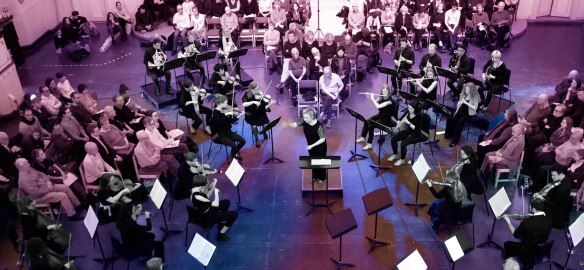
In concert – Southbank Sinfonia / Rebecca Miller: Discovering Dorothy Howell

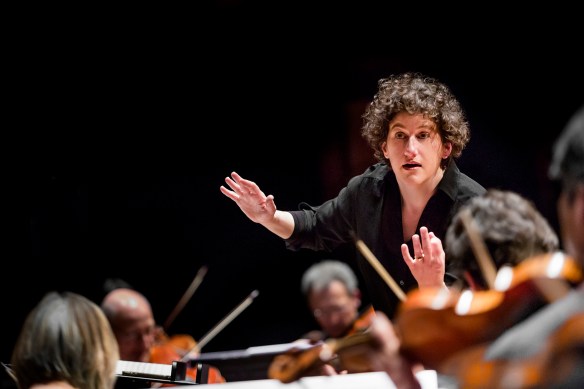
Southbank Sinfonia / Rebecca Miller

St John’s, Waterloo, London
Thursday 19 September 2019

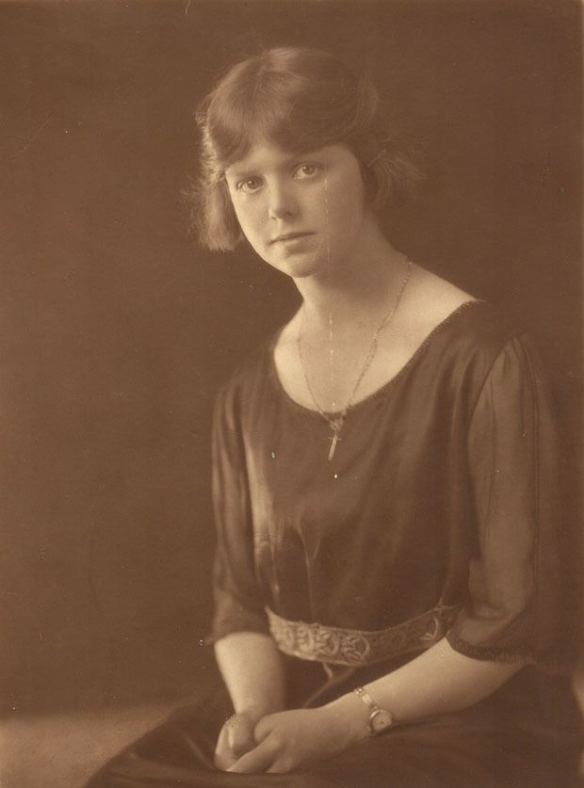
Dorothy Howell
The Rock Overture (1928)
Divertissements (1950)
Humoresque (1919)
Koong Shee Ballet (1921)

reviewed by Ben Hogwood
photo credit (Rebecca Miller) Richard Haughton

It remains an acute embarrassment to classical music that even today it is still so male-orientated when it comes to composers and conductors in particular. Happily measures are in place to address the imbalance, which means that not before time Dorothy Howell (1898-1982) gets some of the attention her music should have been getting 100 years ago. Great credit for this should go to the Southbank Sinfonia and their associate conductor Rebecca Miller, a devotee of the composer who had led the orchestra in a week-long exploration of her music, working with members of Howell’s family.

The result was an hour of music making that everyone enjoyed. It has been a while since I have watched an orchestra with so many smiles, yet still on their game. There were many smiles as Miller teased the syncopated dance rhythms out of the music, revelling in the composer’s nickname of ‘the English Strauss’.

Such a nickname is a little dangerous, as it immediately brings parallels to the waltz, and a tendency toward lighter entertainment rather than anything substantial. With that in mind it should be pointed out that Howell’s output of 150+ works includes a Piano Concerto (recorded by Miller and her husband, pianist Danny Driver, for Hyperion) and some substantial chamber music.

Dorothy Howell (above)

This ‘rush hour’ concert began with an overture / tone poem. The Rock, contrasting with Rachmaninov’s moody symphonic work of the same name, still felt like a place for nature to let itself go. Bright woodwind and an expansive orchestral picture transported us out onto the windswept coast, where attractive flute melodies and tonal harmonies combined to give a breezy outlook. There were a few pitfalls below the surface, Howell occasionally hinting at something darker in the lower strings, but this was a persuasive and energetic account.

Next we heard the Three Divertissements, a short but appealing work with its roots in the dance. Published as Howell’s last orchestral work, its three movements are each in triple time, furthering the Strauss connections – but in the first one working a nice line in syncopation to make the beat elusive for even the keenest of dancers. Rebecca Miller (below) enjoyed these, dancing on the podium herself, and the players clearly did too, with the heat haze created by the strings in the slow second dance particularly memorable. Clarinet, flute, oboe and cor anglais once again excelled, with a special mention for triangle and tambourine, putting the finishing touches to a performance with a smile on its face and a spring in its step.

The short Humoresque was cut from the same cloth, but the Koong Chee ballet felt much more substantial. Based on a Chinese crockery pattern, the work derived from a plot in a lush garden, with a lake populated by pelicans and flamingos, and with the daughter of the owner promised in marriage falling instead for the gardener. Lovestruck, she was swept away – or not, as the case may be, for Howell left an elusive ending.

The colours of this work would have resonated with those who enjoy the Eastern-leaning orchestral works of Holst or John Foulds, but again Howell’s edge could be felt with the light rhythmic touch she was capable of adding. In Miller she had the most passionate advocate, the conductor admitting in her introduction that it is an ambition to stage the work with dancers one day.

That would be an enjoyable experience, for her introduction was ideal and gave us helpful pointers for the point in the story where the woman is imprisoned (Rebecca Watt’s cor anglais solo was heartfelt here) or when the woman’s father shoots at the gardener, his two arrows hitting their target where the percussion were concerned.

My interpretation of the ending would be that it was bittersweet, the father regretting his decision to shoot the arrows but exonerated as the gardener did not die. At least, that’s what the music told me – for once again it was a colourful and committed account that fired the imagination.

The Southbank Sinfonia should be applauded for their dedication to Howell’s cause, their dedication and enthusiasm creating a wholly enjoyable concert. The welcome to audience members should also be praised, creating an environment where concert-goers new and old are equally welcome. More power to their elbows!

Danny Driver and Rebecca Miller recently released their recording of Dorothy Howell’s Piano Concerto on Hyperion, with more details below:

Arcana at the Proms – Prom 53: Sir Andrew Davis conducts Vaughan Williams, Hugh Wood and Elgar’s The Music Makers & Huw Watkins

Prom 53: Stacey Tappan (soprano) Dame Sarah Connolly (mezzo-soprano), Anthony Gregory (tenor), BBC Symphony Chorus, BBC Symphony Orchestra / Sir Andrew Davis

Vaughan Williams Fantasia on a Theme of Thomas Tallis (1910)
Hugh Wood Scenes from Comus (1965)
Elgar The Music Makers Op.69 (1912)

Royal Albert Hall, Thursday 29 August 2019

Reviewed by Ben Hogwood
Photo credits Chris Christodoulou

You can listen to this Prom on BBC Sounds here

A knight of the realm and a dame performing Elgar. It doesn’t get much more English than that! Yet on this humid night in the Royal Albert Hall the continental aspects of the music chosen were just as evident, Sir Andrew Davis securing a trio of very fine performances from the assembled forces.

To begin, the solemn but radiant strains of Vaughan WilliamsFantasia on a Theme of Thomas Tallis, written in the wake of his studies with Ravel in France. That opening chord never fails to transport the listener to another place, and Davis has more experience with it than most. The BBC Symphony Orchestra strings responded as one, their unity as evident in the swelling of the music as it was when the parts were divided. The four soloists at the front – violinists Igor Yuzefovich and Dawn Beazley, viola player Norbert Blume and cellist Susan Monks played beautifully, as did the group of nine instruments on a raised platform at the back of the stage. With these judicious placements Davis ensured the balance of the music – both audibly and emotionally – was firmly aligned.

Hugh Wood’s Scenes from Comus approach Englishness from a very different perspective – that of the Second Viennese School, headed by Schoenberg. Notorious for its rejection of tonality, the school was an incredibly innovative part of 20th century classical music, and Wood was one of several English composers to fall under its spell. Often the accusation is that music without tonality lacks emotion, but Wood refutes that emphatically.

Scenes from Comus may not have an obvious key centre but it treats its story in a powerfully expressive way. The orchestra told the story with strongly rendered colours, with particularly fine playing from principal horn Martin Owen with the opening theme. Soloists Stacey Tappan and Anthony Gregory (both above) found an ideal balance with the orchestra, and the story – where an Attendant Lady, lost in a ‘wilde wood’, is kidnapped by Comus – came to life. The 87 year-old Wood was present in the audience, waving cheerily at Sir Andrew Davis in acknowledgement of an excellent performance of his piece, performed for the first time at the Proms in 1965.

Elgar’s The Music Makers, a setting of Arthur O’Shaughnessy’s Ode, has tended to fall short of critical acclaim, which is unfortunate as it contains some very fine music. In it the composer recycles some of his greatest melodies, quoting and redressing them in the manner of a greatest hits compilation. If anything that approach, when complemented by new musical ideas, makes the piece even more personal, speaking to us of his own favourite moments in music while wrought with worry about the onset of later life and the prospect of war.

The memorable opening line, ‘We are the music makers and we are the dreamers of dreams’, was magical in the hands of the BBC Symphony Chorus, subdued but wonderfully clear as they are in a recent recording made with Sir Andrew Davis for Chandos.

Also on the recording is Dame Sarah Connolly, and her first notes in this particular concert (‘they had no vision amazing of the goodly house they are raising’) sent a shiver down the spine, sung with raw emotion and urgency. She was a dominant figure from her on, passionate yet fully in control of her phrasing, responding forcefully to O’Shaughnessy’s text.

Elgar’s liberal quotations enhanced the music, none of the melodies present for the sake of it, and each reimagined with O’Shaughnessy’s text. The melodies from the Enigma Variations, the Symphony no.1, the Violin Concerto and, most tellingly, The Dream of Gerontius, all contributed to a reading of really impressive gravity and poise. The BBC Symphony Chorus sang with great unity of purpose, aided by sensitive accompaniment from the orchestra and their heartfelt account of the winsome melodies. Sir Andrew Davis is a master Elgarian, and here his credentials were handsomely reinforced.

You can listen to the new recording by these forces of The Music Makers on Spotify below:

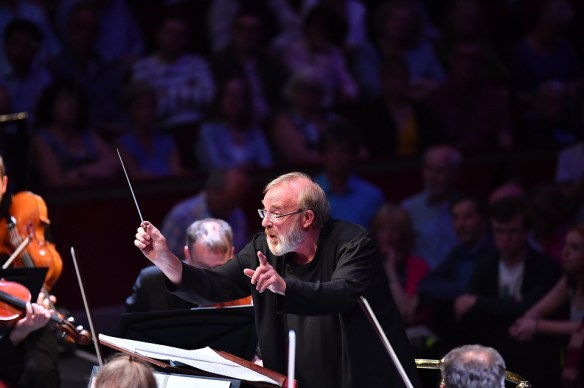
Arcana at the Proms – Prom 35: Martyn Brabbins – Enigma Variations

Idunnu Münch (mezzo-soprano), William Morgan (tenor), Nadine Benjamin (soprano), David Ireland (bass-baritone), English National Opera Chorus, BBC Singers, BBC Scottish Symphony Orchestra / Martyn Brabbins (above)

Various composers Pictured Within: Birthday Variations for M. C. B. (2019, BBC commission: world premiere)
Vaughan Williams Serenade to Music (1938)
Brahms Schicksalslied (Song of Destiny) Op.54 (1871)
Elgar Enigma Variations Op.36 (1899)

Royal Albert Hall, Tuesday 13 August 2019

Reviewed by Richard Whitehouse
Photo credits Chris Christodoulou

You can listen to this Prom on BBC Sounds here

It was clearly a great idea that the BBC commission a piece to mark Martyn Brabbins’s 60th birthday, this concert also being his 36th appearance at these concerts, as well as featuring 14 composers with whom this most stylistically wide-ranging of conductors has been associated.

The result was Pictured Within: Birthday Variations for M.C.B, each composer contributing a variation on an anonymous theme in what is an inverse take on Elgar’s procedure in his own Variations on an Original Theme – whose ground-plan also furnished the formal framework. Space precludes more detailed discussion, though it is worth noting the degree to which these composers (the full list is here) were inhibited or liberated by their placing in the overall scheme. And as this theme yielded its potential more from a harmonic then melodic or rhythmic angle, the most successful made a virtue of such constraints – not least Judith Weir in her engaging 10th variation and John Pickard in a finale, The Art of Beginning, whose deft mingling of portentousness with humour might yet become the springboard for an entirely new venture.

Vaughan Williams’s Serenade to Music (premiered in this venue – but not at these concerts – 81 years ago) was conceived for 16 solo singers and the choral alternative inevitably loses some of the original’s intimacy, though not the distinctiveness in its setting of lines drawn from Shakespeare’s The Merchant of Venice. Joining the BBC Singers and members of the ENO Chorus were participants on the Harwood Young Artists programme, of whom Nadine Benjamin brought a wide-eyed wonder to the soprano solos which motivate the latter stages.

Less often heard in the UK, Brahms’s Song of Destiny is among his most ruminative choral works. Its setting of the eponymous poem by Friedrich Hölderlin might be seen as continuing from A German Requiem in its subdued fatalism, albeit with a more animated central section as hints at that starker resignation which overcame the composer in his later years. Brabbins presided over an unforced yet insightful account of a piece that, for its relative unfamiliarity, has garnered numerous distinguished admirers – among them the composer William Walton.

Closing this concert with Elgar’s Enigma Variations made for an effective symmetry as well as bringing the programme full circle. Brabbins is no stranger to the work and duly galvanized the BBC Scottish Symphony Orchestra in a performance which gave full rein to these widely contrasted portraits (never caricatures!) of the composer’s friends while also ensuring an overall unity to the greater design – with the only lengthy pause coming after a luminous account of the ninth Nimrod variation – that carried through to a finale whose elation was shorn of any bombast. There were various delights on the way, not least a winsome take on the fifth variation, with the numerous instrumental solos eloquently taken. Hard to believe Elgar extended that final variation only at the urging of others, so inevitably does this build to its resplendent ending.

Some might have wondered whether building a full Prom around the birthday of its conductor was excessive but, given the regard in which Brabbins is held and the conviction he invested into each of these pieces, that decision was manifestly justified. Many Happy Returns M.C.B!

Martyn Brabbins has recorded Elgar’s Enigma Variations with the BBC Scottish Symphony Orchestra for Hyperion. More details can be found on their website, or on the YouTube clip below: