Proms at … Cadogan Hall 4: Aris Quartet play Schubert, Sirmen & Haydn

Aris Quartet [Anna Katharina Wildermuth, Noémi Zipperling (violins), Caspar Vinzens (viola), Lukas Sieber (cello)]

Schubert String Quartet no.1 in G minor / B flat major D18 (1810/11) (2:03 – 18:14 on the broadcast link below)
Maddalena Laura Sirmen String Quartet No. 5 in F minor (publ. 1769) (20:20 – 31:43)
Haydn String Quartet in B flat major Op.76/4 ‘Sunrise’ (1796-7) (33:04 – 54:33)

Cadogan Hall, Monday 12 August 2019

Reviewed by Ben Hogwood

You can listen to this Prom on BBC Sounds here

The BBC Proms are charting 800 years of history in their Proms At…Cadogan Hall concerts this season, and the fourth instalment brought an examination of the string quartet towards the start of its existence. It was great to see Haydn – the acknowledged father of the form – given top billing for once, with one of the six masterpieces published as his Op.76, the mature peak of his chamber music output.

Before that, the youthful Aris Quartet brought us music by an even younger composer. Schubert was only just into his teens when he delivered the first of fifteen published string quartets, and even at this point – with a work given its first performance by the family quartet in their home – he was finding a distinctive and adventurous voice. Schubert played viola in his own piece – and it was published when he turned 15.

The String Quartet no.1 inhabits two keys, G minor and its major key ‘relative’, B flat. The first movement (from 2:03 on the broadcast link above) has a tender slow introduction but becomes surprisingly stern as its main theme kicks in (3:47), with brisk tremolo figurations. This is complemented by a less stern, major key theme later on (5:24). The Aris Quartet gave it the appropriate depth, before moving on to the silvery elegance of the Menuetto (7:56), where the quartet are instructed to use mutes. This had a nice rise and fall to its dance steps in the Aris performance. A warm Andante followed (11:30), now in the sunnier climbs of B flat major, before a bright and breezy finale (14:31) in the same key confirmed the young composer’s progress not just with writing for strings, but in his already enviable grasp of form.

Very little has been heard to date of Maddalena Laura Sirmen, but thanks to the BBC Proms we had confirmation that women composers were indeed alive and well in the 18th century. Thankfully performances of their work are starting to break through, and to hear Sirmen’s String Quartet no.5, published alongside Mozart’s early works, was to hear a voice rooted in Venetian Baroque traditions but very much looking forward.
Sirmen’s work opens with a short but quite austere Largo (20:20), which the quartet played with a bit less vibrato, gradually using more as the music became warmer. Then at 21:30 they gave a nice, full sound to the first Allegro, an attractive movement and a busy affair where the parts are closely intertwined. Sirmen’s style is free of padding and the players enjoyed its conversational style. The Largo returned at 26:26, casting a shadow before the Minuetto (27:40) drew us back to music of optimism and charm.

Haydn wrote a great many string quartets – thought to be 68 in all – but the six published as Op.76 are among his finest achievements in the field. He somehow manages to find a fresh approach with each of his works, and in the case of the ‘Sunrise’ it is through a musical portrayal of the very beginning of the day (from 33:04). He had already successfully tried this approach in a symphony (the introduction of Symphony no.6 (Le Matin) the best example) but this is a more intimate affair.
The performance here was beautifully shaded to catch the first light, with a sensitive and beautiful solo from Anna Katharina Wildermuth, but the ensuing busy passages – the players following the composer’s directions – were much more forceful, as though the sun had woken a gale force wind too.

This was a very fine performance, enjoying Haydn’s invention and wit, but giving each return to the ‘Sunrise’ material the magic of the first hearing. The second movement, marked Adagio, was expansive but also softly voiced (41:18), an example of one of the composer’s later, radiant slow movements. There was still plenty of room given to the first violin part, and Wildermuth took full advantage with excellent intonation.

A typically lively Minuet followed, with a smile and the odd knowing glance through its chromatic melodies (45:59). With it came a contrasting Trio section which had something of the march about it (57:35), over a steady drone from cellist Lukas Sieber, with the Minuet repeated at 49:01. The fourth movement (50:02) was elegant, light on its feet and with fine ensemble playing, the quartet enjoying Haydn’s presentation of the theme and its variations right up to the brisk finish.

Once off air the quartet gave an encore of the last movement of Dvořák’s American string quartet, disrupting the progression through 800 years for the live audience rather, but again playing with plenty of energy and virtuosity.

Listen

The music in this concert can be heard on Spotify below:

The six Surmen quartets can be heard on Spotify in this collection from the Allegri Quartet:

Meanwhile Haydn’s collection of Op.76 quartets can be heard here in a fine set of recordings from the Takacs Quartet:

Arcana at the Proms – Prom 28: Tadaaki Otaka conducts the BBC National Orchestra of Wales in Rachmaninov & Huw Watkins

Prom 28: Iurii Samoilov (baritone), Natalya Romaniw (soprano, below), Oleg Dolgov (tenor), BBC National Chorus of Wales, Philharmonia Chorus, BBC National Orchestra of Wales / Tadaaki Otaka (above)

Takemitsu Twill by Twilight (1988)
Huw Watkins The Moon (2018-19) (BBC commission: world premiere)
Rachmaninov The Bells (1912-13)
Borodin Prince Igor – Polovtsian Dances (1869-87)

Royal Albert Hall, Thursday 8 August 2019

Reviewed by Ben Hogwood
Photo credit (Tadaaki Otaka) Chris Christodoulou

You can watch this Prom on the BBC iPlayer here

Given his commission brief, to write a choral piece celebrating the 50th anniversary of the first Moon landing, Huw Watkins must have been tempted to set Neil Armstrong’s immortal ‘one giant leap’ quote to music. Instead however he opted to ‘capture our experience of viewing the moon from Earth’. In doing so he set four intriguing texts pre-dating the first manned visit to our original satellite – two from Percy Bysshe Shelley, and one each from Philip Larkin and Wilfred Owen.

The four were stitched together like phases of the moon in a continuously running 20 minutes, with plenty of opportunity for the orchestra to have their say in between. Watkins has an interesting musical language, always rooted in tonality but using evocative colours and harmonies hinted at in works for chorus and orchestra by Holst, Vaughan Williams or even Hugh Wood.

The Moon had a very satisfactory flow to it, and was passionately delivered by the 130-strong BBC National Chorus of Wales, who clearly enjoyed the experience. Given its length it makes a tricky piece to programme or to appraise on one listen, but it is to be hoped in this anniversary year we get more chances to acquaint ourselves with a composer who writes in a very human voice, and found the ‘definite and bright’ description of Larkin’s verse. That may sound like an obvious statement to make, but surprisingly few composers form a connection with their audience as pronounced as Watkins did here, and even less make the words as clear as he did.

He was of course helped by his ‘home’ orchestra, conducted by a returning prodigal in Conductor Laureate Tadaaki Otaka. Making his first visit to the Proms since 2015. Otaka opened with a piece by his dear friend Toru Takemitsu. Twill By Twilight, in memory of Morton Feldman, was in clear thrall to the Debussy of Nocturnes, creating a dreamy atmosphere. The piece is typical of Takemitsu’s compositions in its dealing with orchestral colour, melody and harmony on equal standing, and it runs slowly if inevitably. In this performance it panned out beautifully, the expansive orchestral sound guided by Otaka’s steady yet relaxed direction.

Otaka has a special place for the works of Rachmaninov, having recorded the symphonies and piano concertos for Nimbus back in the early 1990s. Yet the Russian composer’s choral symphony The Bells was absent from this project, and it was great to hear it in such full-bodied form here. The BBC National Chorus of Wales were boosted still further by the 100-strong Philharmonia Chorus, making a terrific bank of sound that carried all before it – and yet which, thanks to Otaka’s careful balancing, was complemented by the orchestra.


Loud Alarm Bells, the third movement, was suitably terrifying especially at the end, Otaka driving at a quick tempo, and this balanced out the relative joy felt in the first movement, Silver Sleigh Bells, where tenor Oleg Dolgov was a fulsome presence. Soprano Natalya Romaniw sang beautifully in Mellow Wedding Bells, the second movement, her voice effortlessly soaring up to a top B flat without a hint of effort, while baritone Iurii Samoilov offered a darker hue for the depths of Mournful Iron Bells, whose late shift from darkness to light was beautifully done. Rachmaninov’s choral epic has been well served by the Proms in recent years – I remember a terrific outing directed by Vladimir Jurowski – and this was another fine advocacy.

Finishing with Borodin’s Polovtsian Dances was a masterstroke, sending the audience home with several tunes in the locker that simply refused to leave for the rest of the evening! What a gifted melodist Borodin was, and how frustrating that because of his day job – a chemist – he did not leave more for us to enjoy. What he did leave still gives much pleasure, however, and the Polovtsian Dances benefited from such a big choir at their disposal.

The women floated the tune of the Young Girls’ Dance beautifully, while the men – while not quite hitting the passion of Russian voices in this music – were still fulsome and bold. Several orchestral solos stood out, not least from clarinetist Robert Plane, while Otaka’s pacing and linking of the sections was ideal. At 71 the conductor still looks in fine fettle, and his ‘sleep’ gesture at the end was borne more of mischief than genuine fatigue. It seems he, like the rest of us, was fired anew by the passionate Russian music of the concert’s second half.

Proms at … Cadogan Hall 3: The English Concert / Kristian Bezuidenhout

The English Concert / Kristian Bezuidenhout (harpischord, above)

Purcell (1659-95)
The Virtuous Wife (before 1694): Overture (1:45 on the broadcast link below)
The Fairy Queen (1692): Hornpipe (4:38)
The Virtuous Wife (before 1694) – First Act Tune (5:41)
The Indian Queen (1695): Rondeau (8:41)
Chacony in G minor (c1678) (10:21)
Marchand (1669-1732)
Pièces de clavecin, Book 1: Allemande (publ. 1702) (17:33)
de La Guerre (1665-1729)
Violin Sonata in D minor (publ. 1707) (20:46 – 35:45)
Telemann (1681-1767)
Sonata in A minor, TWV 43:a 5 (unknown date) (39:43 – 48:47)
Handel (1685-1759)
Trio Sonata in G major Op.5/4 (publ. 1739) (50:02 – end)

Cadogan Hall, Monday 5 August 2019

Reviewed by Ben Hogwood

You can listen to this Prom on BBC Sounds here

This was a really interesting hour of music from the English Concert and director / harpsichordist Kristian Bezuidenhout, and it was all the more refreshing for a willingness to look beyond the more conventional repertoire you might have expected as part of the Proms’ look at 800 years of music in the Cadogan Hall chamber concerts this year.

Petroc Trelawny, always a consummate professional when introducing at the venue, gave helpful context behind the works chosen, and explained how each was looking to emulate the French style that was so fashionable thanks to the tastes and influence of Louis XIV, the ‘Sun King’.

First up was Henry Purcell, who was of course a popular figure and well enough established in England – but the choices here were not conventional. The Virtuous Wife, a comedy for the stage (beginning at 1:45 on the broadcast link), is just one example of many works Purcell wrote for the theatre in England. In this performance the overture was perhaps a touch too virtuous to begin with, though by the time the music broke at 2:43 a natural tempo and phrasing had been reached. The Fairy Queen’s Hornpipe (4:38) was vigorous, with a satisfying twang to the theorbo strings of William Carter.

The First Act Tune (5:41) was pensive but nicely phrased, showing off Purcell’s rich chromatic spectrum, and was followed by a graceful Rondeau, dancing slowly but elegantly (8:41), before the Chacony (10:21), one of his most famous instrumental pieces that we often hear today for string orchestra. It is a powerful set of variations over a ‘ground’ (a pre-set bass and chord progression) that gathers in intensity.

Next we had solo harpsichord, Bezuidenhout showing off his instincts in an improvisatory Allemande by the French composer Louis Marchand (17:33), with some expansive harmonic twists. That was followed by a dazzling Violin Sonata no.1 in D minor by Élisabeth Jacquet de La Guerre (20:46). Written in 1707 as part of a set dedicated to Louis XIV, it was deftly handled here by Tuomo Suni, with its six short movements marked as Prelude (20:46), Presto (23:20), Adagio (25:18), Presto-Adagio (26:00), Aria (29:53) and Presto (33:36). The Presto-Adagio showed not just only Suni’s clear tone, without vibrato, but the punchy ‘continuo’ accompaniment from Bezuidenhout and viola da gamba player Piroska Baranyay. A similarly crunchy sound inhabits the final Presto, after a graceful Aria.

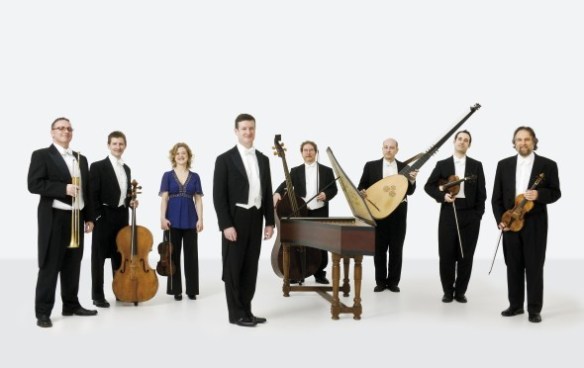
Telemann’s enormous output can sometimes mask his achievements as a composer, and the Sonata in A minor – little known, it seems – showed itself to be an accomplished and dramatic piece, ‘praising the instrumental texture’ as Bezuidenhout explained. Bolstered by the double bass of Christine Sticher, the English Concert (above) really benefited from the extra depth to their sound, meaning a Trio Sonata had seven people on the platform managing the three parts!

The short suite made references to Poland, France and Italy in a Grave (39:43), Allegro – Adagio (40:32), Allegro (44:10), Largo e staccato (45:43) and final Allegro (46:15). The stylish performance had a rustic feel in the faster movements, with an earthy snap to the staccatos of the fourth and a brilliant cut and thrust to the final Allegro.
Finally Handel, and a brightly voiced Trio Sonata in G major Op.5/4, the kind of which he would surely have played with friends in his Brook Street flat in London. This performance played the piece in a different order to the norm, beginning with the ‘second’ movement, marked A tempo ordinario (50:02), which had an enjoyably full texture from the seven instruments, and then moving onto the ‘first’, an Allegro (53:55), where the violins took a more prominent role. An elegant Minuet (56:04) followed, then a Passacaille (58:02), with increasingly elaborate lines spun over a recurring bass line – which itself became enjoyably coarse.

An enlightening hour of music, then, which you are encouraged to enjoy on the link above.

Listen

The playlist below replicates the concert in available recordings, and includes the Gigue movement of the Handel which appears to have been omitted from the original concert:

Meanwhile to enjoy the many and varied delights of Purcell’s complete Theatre Music, the below recording from Christopher Hogwood and the Academy of Ancient Music will bring much pleasure:

Talking Heads: Labelle

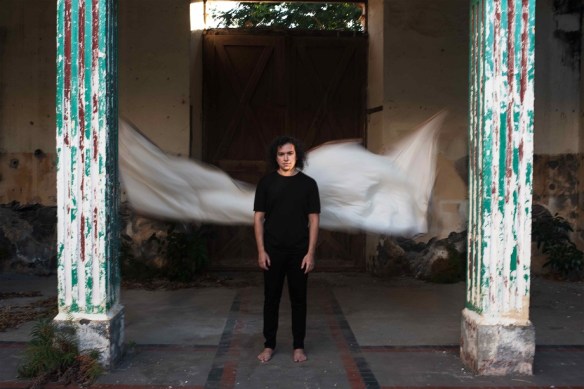
Arcana chats with Jérémy Labelle, the prodigiously talented composer and performer signed to InFiné, about his album Orchestre Univers. This ambitious project looks to bring classical and electronic music together, as well as the musical cultures of Europe and the Indian Ocean. We explore his methods behind that combination, beginning with the inevitable first question…

Can you remember your first encounter with classical music?

Not exactly, it was at primary school. But the first piece that really did stand out for me was Stravinsky’s The Soldier’s Tale:

You say your family home had a wide range of styles – was it important for you to reflect this in your own music?

Yes, it’s very important as this wide range of styles is an expression of the multiculturalism in which I was brought up in and through which I define myself. Actually, these different styles belong to the same world for me. If you look beyond the differences, you can see what links them.

What dance music did you grow up with? The InFiné site makes reference to Derrick May and Jeff Mills.

I discovered Detroit techno when I was around 10/11 in 1995 and 1996, thanks to my older brother. It was the first type of music I played when I was a DJ and from then on it was the base of the music I was composing.

Was it a long (but enjoyable!) process getting the musicians together for ‘Orchestre univers’?

Getting the musicians together was actually pretty fast (a few weeks). It was the writing process that was very long (but enjoyable!)

It is very difficult to place the music of ‘Orchestre univers’, in a good way. Was it important for you to bring these contrasting styles of music together?

Yes it was very important for me as it’s how I see music for ensembles. A music that is capable of integrating instruments from other cultures but more importantly to find space for the body again. It had become too disconnected from the mind in certain contemporary expressions throughout the ’90s and the ’00s. The body and the mind are a whole for me, a single unit with which I try to communicate.

Where did you learn your skills for making colour with orchestral forces?

I learnt to write at university when I was studying music. But what I did really learn was to understand the different schools of thought and genres that have existed in the history of classical and contemporary music and how and when these genres appeared. Practical exercises allowed me to understand and appreciate the mechanics of these music. But beyond learning, I also have teachers that gave me the keys to understanding the space and the dimensions inside a piece as well as contemporary orchestration and time.

How did you arrive at such rhythmically driven music too?

Rhythm is a fundamental part of maloya and how the trance emerges. It’s in this spirit that rhythm expresses itself. I can’t not work with rhythmic instruments 🙂

The track Oublie-voie-espace-dimension brings in some remarkably strong percussion to go with the held chords. What were you describing in this music?

It’s exactly the beginning of the trance! You have to understand the title as a succession of states. Oublie = forget, forget your markers, letting go; Voie = path, the path that appears at that moment ; Espace = space, the feeling of vertigo, of depth that having chosen this path brings to you ; Dimension = a new dimension opens up (the one that expresses itself in O).

You did a concert recently at the Philharmonie in Paris? What was that like

The concert at the Philharmonie was one of the most beautiful concerts of my young career. The feeling of the acoustic space when you’re on stage is incredible. You can really feel how the sound moves in the room, it’s beautiful. Also the energy that the stage catalyses and disperses is out of this world. The stage seems to float in this circular movement with the audience. The room is unique.

What else can we expect from you this year?

Starting from now until the end of the year, I’m going to be working on my next piece, which is written for a string quartet, as well as on my next album. I’ll also be touring my solo electro-maloya act from the end of August till mid September for the promotion of Digital Kabar with my friend BoogzBrown and the Sheitan Brothers! A special night will happen at La Réunion early Octobre (Digital Kabar – Le Club) with many of the artists that appear on the compilation! Finally, for the first time I’m organising a night dedicated to experimental music on the island. It will happen at the end of Septembre.

What does ‘classical’ music mean to you?

The term “classical” is rather distorted actually. Musicologists refer to MOTE (musique occidentale de tradition écrite = western music of written tradition) and it’s in this sense that I understand classical as a traditional music just like other traditional music in the history of humanity.

What other musical plans and ambitions do you have for the future?

Writing pieces for large instrumental ensembles! But also develop the trance and dancing. I want to stay in touch with the club world and the festival world while writing pieces for orchestras that have this unique combination of classical instruments, electronics and the percussion from maloya.

You have contributed to the new InFiné compilation Digital Kabar. What does the word ‘kabar’ mean to you?

Historically, the kabar is the place and time of maloya, but for me it’s also the place and time of all the maloyas: electronic, electric, pop etc…

The track ‘Block Maloya’ has a strong rhythmic drive. How does maloya manifest itself in your writing?

It’s actually in the rhythms but it also manifests itself through other means! The distant pad that introduces the track is an ancestral reminiscence that carries the track through its development. It’s this relation to ancestors and customs that’s particular in maloya. Maloya is also a spiritual music when it’s played in ceremonies.

Could ‘Block Maloya’ become a really substantial track in a live performance?

Yes and that’s exactly what you’ll hear in my solo electro-maloya live act that will be touring for Digital Kabar in August.

If you could recommend one piece of music from this year to Arcana readers, what would it be?

I know I should think about other artists but right now I’m thinking of my piece Playing at the end of the Universe from Orchestre univers 🙂 It’s a song that always surprises me. I wrote it for my previous record Univers-île but it took another dimension on my new record.

Labelle’s third album Orchestre univers is out now on InFiné, who have also just released the Digital Kabar compilation which can be heard below:

Arcana at the Proms – Prom 18: Edward Gardner conducts the BBC Symphony Orchestra in Mahler and Britten

Prom 18: Stuart Skelton (tenor, above), Claudia Mahnke (mezzo-soprano), Leif Ove Andsnes (piano), BBC Symphony Orchestra / Edward Gardner (above)

Britten Piano Concerto Op.13 (1938)
Mahler Das Lied von der Erde (1908-1909)

Royal Albert Hall, Thursday 1 August 2019

Reviewed by Ben Hogwood
Photo credits Chris Christodoulou

You can watch this Prom on the BBC iPlayer here

Mahler’s Das Lied von der Erde (The Song of the Earth) received its Proms premiere in the year 1914, long before the huge upturn his music experienced in the 1960s. It is an example of Sir Henry Wood’s instinct for new music that it reached the Proms so soon, though the programme labelling of the piece as a ‘Henry Wood novelty’ does the work a massive disservice. A certain Benjamin Britten was on to it too, describing in 1937 the impact of its final set of poems, Der Abschied, and how it ‘passes over me like a tidal wave’.

Mahler was one of Britten’s foremost influences, specifically the Fourth Symphony, which you can hear at the Proms later in the season on Sunday 11 August. There is not much Britten this year, but what there was in this concert was brilliantly performed. The Piano Concerto has a youthful spring in its step, treating the instrument equally as a creator of percussion and melody, following in the traditions of Prokofiev and Shostakovich as it does so.

This performance showed it off in full. Leif Ove Andsnes (above), who has lived with the work for 25 years and performed it on his Proms debut in 1992, had its measure. Technically he was superb, leading from the front with an account of targeted bravura, never showing off for the sake of it and always keeping a melodic shape to even the most percussive of chord sequences. Edward Gardner and the BBC Symphony Orchestra offered solid support, if very occasionally falling behind the piano rhythmically – though that could also have been the Royal Albert Hall acoustic playing tricks. The strings were beautifully shaded in the quieter moments of the Impromptu, whose emotional depths hinted at a darker presence behind the technical feats – perhaps the presence of the Second World War, only a few years away.

Andsnes delivered an unexpected encore in the first movement of Mompou’s Suburbis, stylistically close to Ravel and Falla but still evoking its own individual nocturnal scene.

The Mahler followed the interval, lasting just over an hour – but given the quality of the performance the time passed in a flash. To date Edward Gardner’s encounters with Mahler have been relatively minimal, but the natural gravitas he gave to the orchestral writing in Das Lied von der Erde, not to mention the room made for the chamber-like instrumental solos, showed his instincts are ideally suited to the composer. The BBC Symphony Orchestra wind – fully deserving of their curtain call at the end – were on top form, as were the strings, their quiet thoughts during the final song in particular staying rooted in the memory.

Fine as the orchestral playing was, the two singers rightly shared the limelight. Stuart Skelton’s tenor was a thing of wonder, called into high register action at a daringly early stage in proceedings but delivering wholeheartedly from the off. His characterisation of the two drinking songs was spot on, the gestures and body language wholly at one with the words, giving him the creative licence to exaggerate a note or two. Here he had support from BBC Symphony Orchestra leader Igor Yuzefovich, and a suitably inebriated violin solo during Der Trunkene im Frühling (The Drunkard in Spring). Meanwhile in Von der Jugend (Of Youth) some nimble negotiation by Skelton of Mahler’s score gave the song an invigorating freshness. That he was able to project these natural and very human elements of phrasing without ever sounding contrived spoke volumes for the degree to which he has clearly inhabited this piece, as evidenced in his contribution to the Proms Twitter feed a few hours before.


Mezzo-soprano Claudia Mahnke (above) was equally assured in her delivery, the voice and its phrasing again completely comfortable with Mahler’s demands in Der Einsame im Herbst (The Lonely Soul in Autumn) and Von der Schönheit (Of Beauty) before, in the celebrated Der Abschied (The Farewell), time stood still and the music became a thing of wonder. These otherworldly contemplations felt as though they extended from the Arena floor of the Royal Albert Hall right up to the stars, far beyond the dome, and Mahnke’s rapt expression spoke of how she too was experiencing the same transporting effect. Gardner’s operatic instincts stood him in good stead, particularly in the recitative-like sections, where orchestral players held notes like baroque continuo staples, but the overall effect was in aid of the contemplation of life itself.

The rude interjection of a mobile phone did nothing to break the spell, for these two singers, and the 80 or so instrumental singers behind them, had created something very special together.