The Cello Concerto made quite a splash at the BBC Proms this year, and you can watch Sol Gabetta playing it with the Orchestre Philharmonique de Radio France conducted by Mikko Franck below:
Meanwhile a good place to start for the uninitiated is by taking on Kremer’s two discs on ECM. The first of these comprises the four chamber symphonies and the Piano Quintet:
Meanwhile the sequel is an enticing collection of miscellaneous works from the Weinberg pen, including the Symphony no.10:
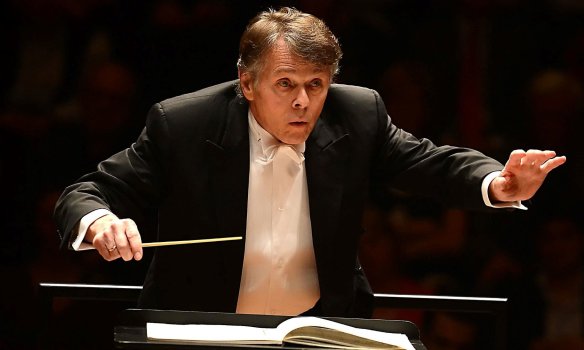
Like many lovers of classical music, Arcana was sad to learn of the death of Latvian-Russian conductor Mariss Jansons last weekend, at the age of 76.
Jansons was a great conductor, and I was fortunate enough to see him in a number of concerts. Particularly memorable was a Prom with the Royal Concertgebouw Orchestra in Lutosławski‘s ConcertoforOrchestra and Brahms‘ Symphonyno.1 – and several years later another outing at the Royal Albert Hall with the Bavarian Radio Symphony Orchestra in RichardStrauss‘s Also Sprach Zarathustra and Sibelius‘ Symphony no.2.
Jansons leaves an extremely strong and varied recorded legacy, from which the playlist below draws a few excerpts. The Lutosławski is included, along with two excellent recordings he made when chief conductor of the Oslo Philharmonic Orchestra, Honegger‘s Symphony no.3 and Tchaikovsky‘s Symphony no.1 (Winter Daydreams).
However a personal favourite, and one I reviewed for Arcana, was his stellar recording of Tchaikovsky‘s Queen of Spades opera, a superb and dramatic account:
These are just hints of what Jansons could do – but show him on his best form. He will be greatly missed.
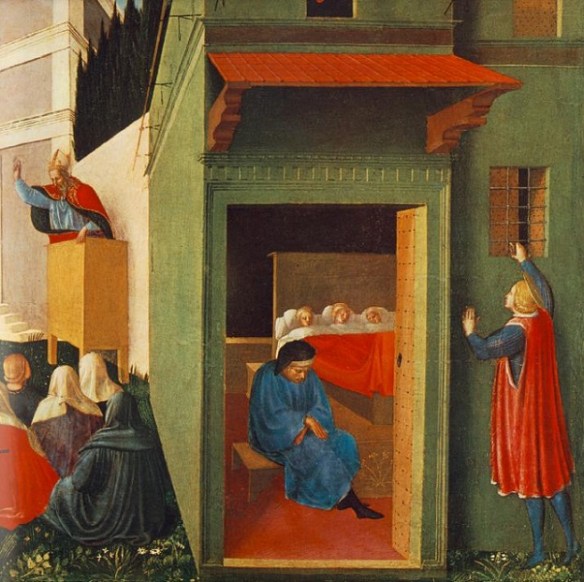
Today is a celebration of the feast of St Nicholas, the early Christian bishop who died on this day all the way back in the year 343. Nicholas is the model for the modern Santa Claus / Father Christmas, but he is also the inspiration behind a major piece of classical music, completed by Benjamin Britten in 1948.
Arcana’s sister site, Good Morning Britten, has this to say about the cantata:
St Nicolas is scored for tenor solo, chorus, semi-chorus, four boy singers and string orchestra, piano duet, percussion and organ. It was written to text by Eric Crozier, for performance at the centenary celebrations of Lancing College, Sussex, on 24 July 1948.
Background and Critical Reception
Britten’s honouring of the Christmas saint was timed for the centenary of Peter Pears’ old school, Lancing College in Sussex. Yet Saint Nicolas did not receive his first performance there – in fact it opened the very first Aldeburgh Festival in June 1948. Critics were requested not to write about the piece until its primary function at the school had been performed. The highly acclaimed libretto is from Eric Crozier, with whom Britten wrote Albert Herring.
Donald Mitchell, in his biography of the composer, observes that ‘for a year his music continued in the blithe spirit that Albert Herring had engendered’. He also notes how the work combines professional and amateur, Britten seeking not to exclude anybody on the grounds of musical talent. ‘There are testing but rewarding parts for the amateur singers and instrumentalists; congregational hymns, and one of the catchiest of his tunes for The Birth of Nicolas.’
This gives the strong sense Britten was writing for all ages and beliefs, and is reinforced by Stephen Arthur Allen. Writing in The Cambridge Companion to Benjamin Britten, he declares it as ‘not purely a work for religious digest’. Furthermore, ‘A duality of narrative may be perceived through the dilemma between Nicolas’s public and private world:
“Our eyes are blinded by the holiness you bear,
The bishop’s robe, the mitre and the cross of gold.
Obscure the simple man within the Saint.
Strip off your glory, Nicolas, Nicolas, and speak! Speak!”
He warms to his theme. ‘The transparent nescience of The Birth of Nicolas is reinforced by its A major setting. The presence of the tritone, governing the stepwise movement of the sequence in each phrase, demonstrates that Britten is able to write music that children can engage with and sing easily, while embodying sophisticated intervals and a symbolic dimension that offsets generic expectations otherwise associated with such material.’
After that, perhaps the words of Michael Kennedy are key: ‘There is little need to examine this cantata in detail; it is best experienced whole and without analytical preparation.’
Thoughts
The advice from Michael Kennedy to refrain from analysing Saint Nicolas too much is sound indeed, for this is a dramatic piece that works best taken on face value.
Once again it is possible to witness Britten’s ability to write dramatic sacred music, and as in The Company of Heaven he bolsters that with sympathetically set hymn tunes. There is a strong sense of progression through the life of Saint Nicolas, too, and at his birth he gets a really catchy tune, written for the boys’ choir in a joyous A major. As he journeys to Palestine Britten colours his relatively small orchestral forces with a glassy, oscillating line for the two pianos and wispy held strings.
Meanwhile the tenor soloist – Pears, of course – gets frequent opportunities to exploit his talent for legato singing, with some extremely lyrical writing that would seem to me to have a strong Italianate flavour, that of Verdi perhaps.
The hymn quotations invite the involvement of a congregation, another element in common with The Company of Heaven. However Britten cannot resist the odd piece of harmonic mischief, and All People That on Earth do dwell, so beloved of Vaughan Williams, gets some unexpected minor chords. I couldn’t help but think that was a deliberate thumbing of the nose!
There is, however, a certain amount of homage being paid here, deliberate or otherwise. I was sure in places I could detect hints of Elgar’s The Dream of Gerontius – especially in the way the two works end, alike in key in harmony, while there are passing elements of Handel and Bach, via Mendelssohn.
Once again Britten uses the performing spaces to his advantage, positioning the children’s choir a distance away from the main action. This is especially effective after the swell of the choir towards the end of His piety and marvellous works, which cuts to the trebles singing ‘Alleluia’ in the distance. It is a magical moment.
Equally fine are the climactic closing pages, the death of the saint marked by the singing of the Nunc Dimittis chant, Lord, now lettest Thou Thy servant depart in piece, which seals the deal on a very fine and enjoyable work.
Watch and listen
Below you can hear the late Sir Stephen Cleobury talking about the work, and how he went about the 2013 album he made with King’s College Cambridge Choir to mark Britten’s centenary:
On the Spotify link below you can listen to the album Cleobury conducted, which also includes the unaccompanied choral masterpiece Hymn to Saint Cecilia and the celebratory anthem Rejoice in the Lamb, again under the direction of Cleobury.
C Major Blu-ray 751504 [107’] 1080i / 16:9. PCM Stereo / DTS-HD MA 5.1.
Sung in German with English, Japanese and Korean subtitles. Regions A, B and C Video Director: Felix Breisach.
Recorded live at Bregenz Festival on 18th July 2018
Reviewed by Richard Whitehouse
What’sthestory?
The first DVD release for the opera BeatriceCenci by BertholdGoldschmidt (1903-96), in a production at the Bregenz Festival in 2018 – continuing the lineage of stage-works by once forgotten and suppressed composers to have been presented at this event over recent years.
What’stheoperalike?
Finished midway through the last century, BeatriceCenci might have been expected to revive its composer’s career two decades after reaching its peak with the premiere of his first opera DergewaltigeHanrei and 17 years after he fled Germany. A Covent Garden staging failed to materialize and it stayed unheard until a concert performance in 1988, with a full production six years later. Drawing on the 1819 verse-drama by Shelley, librettist MartinEsslin created a succinct and cohesive text where tension rarely lets up over the opera’s 105-minute duration.
Musically things are a little more ambiguous. Goldshmidt’s intention was to revive the art of bel canto and BeatriceCenci indeed focuses attention on vocal writing to a degree unusual in post-Wagnerian opera. That said, melodies per se are in relatively short supply across a work that, for all it drama and immediacy, is arresting rather than memorable in content. Musically the idiom is still rooted in the ‘neue sachlichkeit’ found in the stage-works of Hindemith and Weill 25 years earlier, such that genuine emotion feels reined-in even at dramatic highpoints.
JohannesErath‘s staging further exacerbates this impression, its lurid tone and over-wrought action suggestive of a gothic overkill that Goldschmidt was surely anxious to avoid. KatrinConnan‘s sub-expressionist sets, KatharinaTasch‘s faux-Renaissance costumes (redolent of Peter Greenaway during his 1980s heyday) and BerndPurkrabek‘s lighting with its extremes of darkness and light further ensure the outcome has an exaggerated, even two-dimensional quality which leaves little room for subtlety or finesse in delineating character and incident.
Doesitallwork?
Only in part, but this is hardly the fault of the singers – among whom, GalJames comes into her own as the cruelly mistreated Beatrice with her soliloquy in the final act, with DshamiljaKaiser eloquent as her step-mother Lucrezia and ChristinaBock no less sympathetic as her weak half-brother Bernardo. ChristophPohl is almost too suave to convey the sheer evil of her father Francesco, while PerBachNissen treads a fine line between humour and caricature as the cardinal Camillo, and MichaelLaurenz brings purpose to the vacillating prelate Orsino.
The PraguePhilharmonicChorus is heard to impressive effect in those banquet and execution scenes that bring the outer acts to their climax, with JohannesDebus securing a trenchant and committed response from the ViennaSymphony players.
Understandable that the production should have been given in the composer’s own translation of the original libretto, yet this in itself tends to underline the sardonic and darkly comic aspects which, whether in accord with Esslin’s absurdist convictions, inevitably militate against Goldschmidt’s expressive priorities.
Isitrecommended?
Yes, in that BeatriceCenci is a significant and (given its historical context) valiant attempt to renew certain dramatic qualities at a premium in opera of that era. This Bregenz production makes for compulsive viewing, if rather less in the way of affective or empathetic listening.
Further information can be found at the <a href=”http:/www.cmajor-entertainment.com”>C major</a> website
Christian Tetzlaff, Philharmonia Orchestra / Esa-Pekka Salonen (above)
Royal Festival Hall, Southbank Centre, London
Thursday 26 September 2019
Hindemith Rag Time (well-tempered) (1921) J.S. Bach arr. Schoenberg Two Chorale Preludes: Schmücke dich, o liebe Seele BWV654; Komm, Gott Schöpfer, heiliger Geist BWV667 (1925) Berg Violin Concerto (1935) Hindemith Mathis der Maler Symphony (1934)
reviewed by Ben Hogwood
This year the Philharmonia Orchestra have been exploring the music of Weimar Berlin as it was in the 1920s and 1930s, with fascinating results. Their most recent concert, subtitled Dreams and Demons, may have been relatively short, but it gave plenty of food for thought and the musical rewards were considerable.
A rather older composer who worked in Weimar made himself known throughout the concert, for the music of Johann Sebastian Bach was quoted, refracted and alluded to in each of the four pieces on the programme. Firstly we heard the opening notes of the Prelude in C minor from The Well-Tempered Clavier, part of an affectionate and brilliantly ‘worded’ joke by Hindemith, whose Ragtime started the concert with a swagger. Esa-Pekka Salonen clearly enjoyed its gruff humour, but found the touches of elegance beneath the surface too.
The Ragtime’s surge to the close in E flat minor blossomed with a cleverly executed join into the first of two Bach chorale prelude arrangements by Schoenberg. Here we wondered at his audacious orchestration, taking on what he saw as ‘the first twelve tone music’ and sharing it around the orchestra with typically inventive pointing towards the melodies. Timothy Walden’s cello probed elegantly at the inner melodic lines of Schmücke dich, o liebe Seele, while the exuberant close of Komm, Gott Schöpfer, heiliger Geistdrew heralded the Hindemith work we were about to hear.
Berg’s Violin Concerto quotes from a Bach chorale, Es ist genug (It is enough) at the height of its remembrance of Manon Gropius, daughter of Alma Mahler. Subtitled To the Memory of An Angel, the work traverses a wide range of emotions in its thought processes, from brief oases of calm to fraught periods of activity. The clarinets of the Philharmonia, in all ranges, were superb, whether in the lighter Ländler theme of the first movement or the solemn chorale itself, their imitation of a pipe organ ghostly and – when the solo violinist’s harmonics were in play – ethereal. This was because soloist Christian Tetzlaff (above) also brought a wide range of sounds to the piece, from the fragility of the opening strings of the start to the surging faster music where he took the music by the scruff of the neck. His was a technically brilliant yet musically sensitive performance, closely joined to Salonen’s deft work with the orchestra.
All the while this wonderful piece was heading for the final bars and the ultimate rest, the sort of chord you would want to go on forever as Berg’s orchestral colours mingle with the highest note the violin reaches in the whole piece. Together Teztlaff and Salonen ensured the pacing was ideal, helped considerably by the light and shade of the Philharmonia’s contribution.
After the interval came a regrettably rare chance to hear some Hindemith in the concert hall in the shape of the Mathis der Maler Symphony, a three-movement work drawn from the opera of the same name. This oft-maligned composer exerts a good deal of influence on the tonal music of the second half of the 20th century, more than he is credited for, and his own works are instantly recognisable. Nor, as Salonen and the Philharmonia illustrated, is there a lack of colour or personality in his orchestral writing.
This was a superb performance of a piece Salonen clearly holds close to his heart, having conducted it at the Proms and recorded it for Sony in 2004. The expectant hush from the strings at the start was magical, the effect like walking into a sacred building, and this was reinforced by a solemn intonation of a chorale from the trombones, those Bach influences coming quickly to the surface. Salonen’s slower tempo here worked well.
The silvery strings enjoyed the moments of confluence in Hindemith’s writing, with the added note chords allowed to breathe, but Salonen was not above letting the grittier parts of the music off the leash, pushing forward through the faster phrases. The Philharmonia woodwind and brass were superb, the bell-like clarity of their playing bolstered by deeper shades. With all these qualities noted, Engelkonzert(Angelic Concert) unfolded beautifully, with a grand sense of ceremony at the end, while in response Grablegung (Entombment) was initially thoughtful, its ruminative woodwind then replaced by a brass-dominated climax which Salonen controlled immaculately.
Most dramatic of all was Versuchung des heiligen Antonius (The Temptation of Saint Anthony), with a ravishing tone from the Philharmonia strings at the outset. As it progressed the movement had a terrific cut and thrust, its tension released with impressive stature in the closing pages. Mathis der Maler is a wonderful score, one of Hindemith’s finest achievements – and by no means the only peak of his orchestral output. Here it put the seal on a fascinating and immensely rewarding concert, with superb musicianship throughout.
Further listening
You can hear the music played in this concert on the Spotify playlist below, including Salonen’s account of the Mathis der Maler symphony:
This playlist offers a broader view of Hindemith’s orchestral output, with the ballet suite Nobilissima Visione, the Concert Music for Strings and Brass and the vastly underrated piece for piano and orchestra The Four Temperaments:



 Arcana.fm