
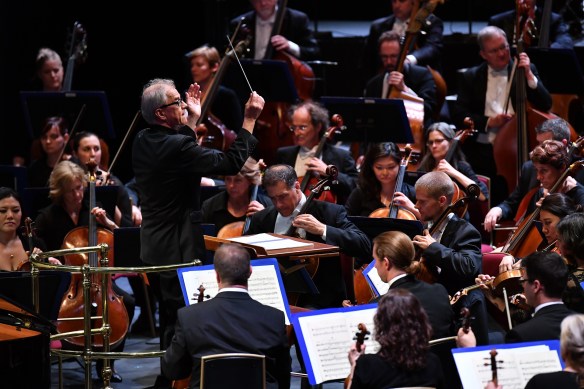
Prom 31: Inon Barnatan (piano), Minnesota Orchestra / Osmo Vänskä
Bernstein Candide Overture (1989)
Gershwin Piano Concerto in F major (1925)
Ives Symphony no.2 (1897-1902, 1950)
Royal Albert Hall, Monday 6 August 2018
Reviewed by Ben Hogwood Photos (c) BBC/Chris Christodoulou
One of music’s greatest properties is making its listeners happy – and judging by the audience for the Minnesota Orchestra prom, wreathed in smiles as they left the Royal Albert Hall, this was an objective handsomely achieved by the orchestra and its music director Osmo Vänskä.
Making their first BBC Proms appearance since 2010, they had programmed a concert in honour of Leonard Bernstein the conductor, rather than the composer – but that still meant we got a chance to hear one of his most popular concert showstoppers, the Candide Overture. As a collection of catchy tunes and toe-tapping dance rhythms it is difficult to beat, and Vänskä conducted a performance light on its feet, affectionate and warm – if lacking a little of its composer’s highest spirits.

The performance of Gershwin’s Piano Concerto set that to rights. Taking the solo part was Inon Barnatan (above), whose command of the composer’s bluesy melodic style was well-nigh perfect. Gershwin is not thought of as key Vänskä repertoire but he brought to the orchestral passages a level of clarity that brought the streets of 1925 Manhattan into sharp, nocturnal focus. The string sound was exquisite, while the trumpet solo of Manny Laureano in the slow movement was brilliantly affected and played, fully deserving of its cheer at the end.
Barnatan was a box of tricks, at one moment thundering octaves down from on high, while in the other hanging onto the slow notes with great affection, as though unwilling to let them leave. The transparency of Vänskä’s conducting told of the influence Ravel has on some of Gershwin’s writing, but the swagger of the orchestra, leader Erin Keefe practically sitting next to Barnatan in a visual show of unity, was irrepressible. Barnatan gave us a perfectly positioned encore too, Earl Wild’s virtuoso study on I Got Rhythm.
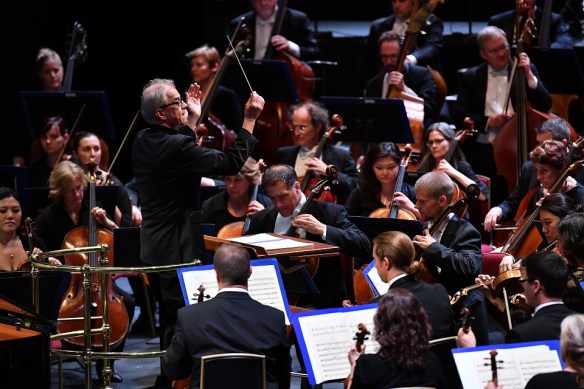
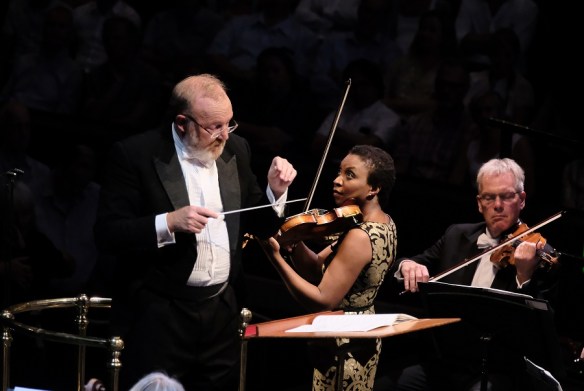
The music of Charles Ives has barely popped its head above the parapet at the Proms, but here was a chance to enjoy a work premiered by Bernstein himself, conducting the New York Philharmonic Orchestra in 1951. It’s fair to say that Vänskä (above) secured a reading with a good deal more sobriety and control than the master might have done, but that’s not to say it was without flair and pure enjoyment.
The Minnesota Orchestra, once again playing with a smile, enjoyed the dense packing together of tunes in the symphony, while the strings dug into the serious first movement, setting out the case of a symphonic argument with impressive gravity. Once again Vänskä ensured they made a beautiful sound, the brass chorales ringing out with great surety, but as the symphony progressed so did the sense of convention edging nearer to the window.
This reaches its height at the climax of the fifth and final movement of course, and like the fast second this was taken at quite a lick, the music careering along as though about to lose its footing. And so it did, the last chord sounding its sharp clashes and some in the audience taken aback by Ives’ unexpected but wholly typical daring. Was it a mistake? Were we heading there all along? Yes and yes – and in that second, as booklet writer Paul Griffiths so aptly put it, ‘’Reveille’ was sounded’.
Yet there was one more surprise. As I write this the Minnesota Orchestra are on their way to South Africa to mark Nelson Mandela’s 100th birthday in a series of high profile concerts. They gave a wonderful send-off, an arrangement of the traditional South Africa song Shosholoza, with the players joined in song as well as with their instruments. It was a joyful revelation, upping the spirits still further – and ensuring we will track their movements in South Africa with great interest.
 Proms at the Cadogan Hall: Dame Sarah Connolly (mezzo-soprano, above), Joseph Middleton (piano, below)
 Proms 29 & 30: Soloists, Swedish Chamber Orchestra / Thomas Dausgaard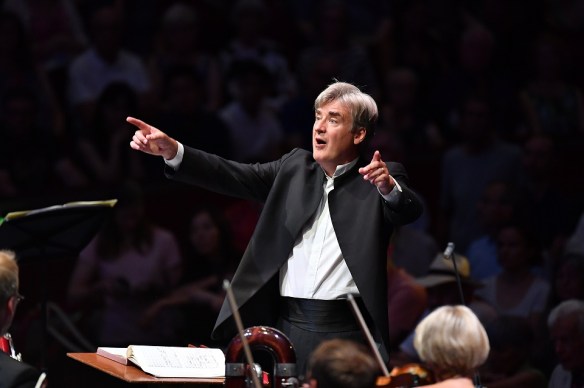

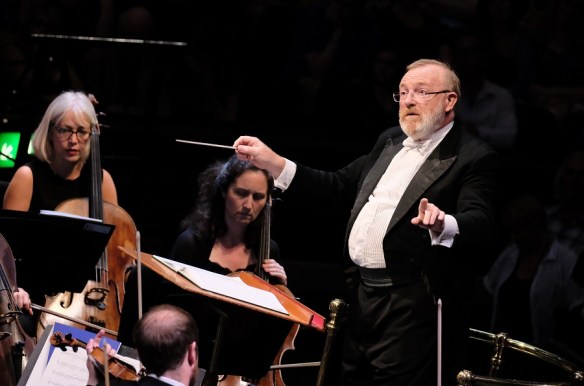 Prom 17: Tai Murray
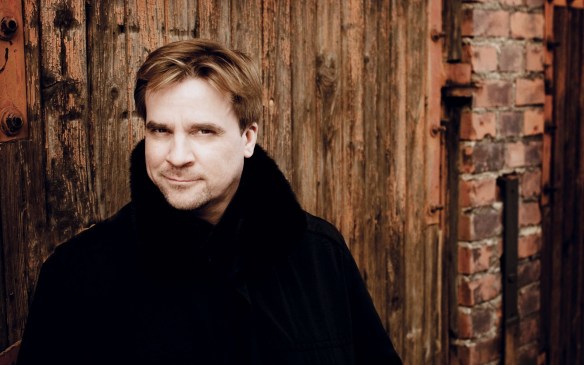
  The rapt stillness of Vaughan Williams’ A Lark Ascending followed, in which the audience were immediately relocated to the stillness of an English field to witness the freedom of the lark as its song spiralled upwards. Tai Murray (above) was the violinist inhabiting its character, and she allowed the music all the room it needed. Brabbins enjoying the softly burnished strings – some beautiful shading from the BBC Welsh – before the slightly more playful and folksy central section took hold. Her encore, a gravity defying account of Ruggiero Ricci’s arrangement of Tárrega’s Recuerdos de la Alhambra, felt a little misplaced but was played with exceptional athleticism and virtuosity.
 Vaughan Williams invested heavily in the First World War, not from a position of overwrought patriotism but from a sense of duty to his country. What he saw as an ambulance driver in France in 1916 is not fully documented, but it left a lasting impression fully realised in A Pastoral Symphony, his third – following musical depictions of the Sea (no.1) and London (no.2).
 Prom 14: Elizabeth Watts (soprano), Louis Lortie (piano), BBC Philharmonic Orchestra / John Storgårds
 Preceding this came a surprisingly dour account of the Prelude from The Mastersingers of Nuremburg. This grandest of Wagner music-dramas is also the most symphonic, not least its Prelude as it deftly outlines a four-movements-in-one format. While not being oblivious to this, Storgårds might have characterized these episodes more potently, though this may have been in line with his tendency to play down the music’s opulence and majesty. What resulted was a subdued and earnest performance that hardly marked him out as a budding Wagnerian.
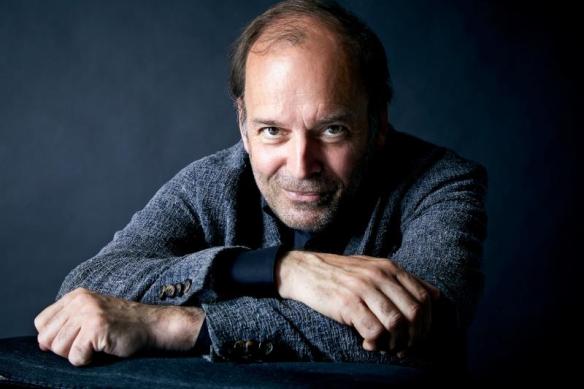 Time was when Liszt’s concertante realization of Schubert’s Wanderer Fantasy was a staple at these concerts, but this was only the second hearing in nearly six decades. 33 years ago, the soloist was Jorge Bolet at his unpredictable best, but Louis Lortie’s rendition (above) was altogether subtler as he brought out the pathos of the Andante then jocularity of the Presto. If the outer Allegro sections felt reined-in, this was not at the expense of that keen virtuosity informing Lortie’s playing in his solo passages or coruscating interplay with the orchestra at the close.
 Arcana.fm