
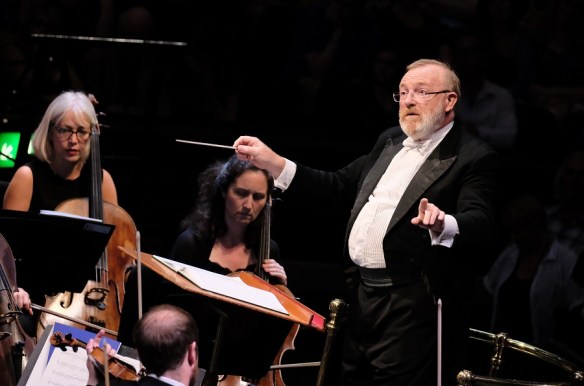
 Prom 17: Tai Murray (violin), Francesca Chiejina (soprano), Ashley Riches (bass-baritone), BBC National Chorus and Orchestra of Wales / Martyn Brabbins
Parry Symphony no.5 in B minor (Symphonic Fantasia ‘1912’) (1912)
Vaughan Williams The Lark Ascending (1914, rev 1920)
Parry Hear my words, ye people (1895)
Holst Ode to Death, Op.38 (1919)
Vaughan Williams A Pastoral Symphony (Symphony no.3) (1921)
Royal Albert Hall, Friday 27 July 2018
Reviewed by Ben Hogwood Photos of Martyn Brabbins and Tai Murray (c) BBC/Mark Allan
You can watch this Prom on BBC4 on Sunday 22 July here
This was a fascinating concert, a celebration of Sir Hubert Parry both in his music and the work of his pupils.
Parry – composer of the music to Jerusalem and royal anthem I Was Glad for many of us – wrote five symphonies, and it is bordering on ridiculous that only one of them, the Symphony no.5 in B minor, has been heard at the Proms before. Hopefully this excellent performance from the BBC National Orchestra of Wales under Martyn Brabbins will open the door to further hearings, for it presented the piece as an extremely coherent stream of consciousness.
With its Schumann-like dimensions, the Fifth flows for 27 minutes unabated, and is almost constantly melodic, its themes and motives passed through the instruments. There were some lovely moments of clarity in the first movement where a certain English splendour came through, whereas elsewhere Parry was in thrall to Richard Strauss and his hero Brahms without ever slipping into parody.
The programmatic nature of the piece is revealed in the titles of its movements (Stress, Love, Play and Now) and Brabbins shaped his response accordingly, lovingly tendering the phrases but enjoying the more adventurous and colourful aspects of the score.
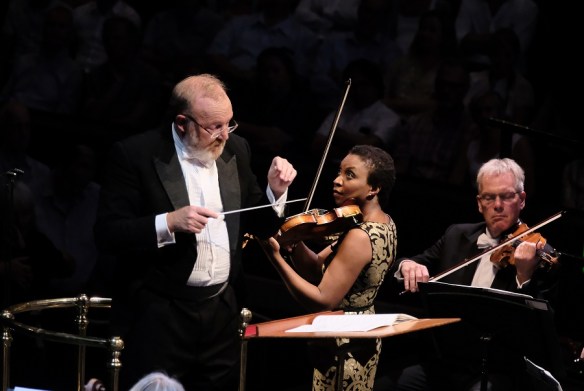 The rapt stillness of Vaughan Williams’ A Lark Ascending followed, in which the audience were immediately relocated to the stillness of an English field to witness the freedom of the lark as its song spiralled upwards. Tai Murray (above) was the violinist inhabiting its character, and she allowed the music all the room it needed. Brabbins enjoying the softly burnished strings – some beautiful shading from the BBC Welsh – before the slightly more playful and folksy central section took hold. Her encore, a gravity defying account of Ruggiero Ricci’s arrangement of Tárrega’s Recuerdos de la Alhambra, felt a little misplaced but was played with exceptional athleticism and virtuosity.
There was more music from Vaughan Williams’ teacher Parry after the interval, in celebratory festival mood for Hear my words, ye people. This presented a couple of tricky performance issues, with the soloists Francesca Chiejina (below) and Ashley Riches just in front of Sir Henry Wood’s bust at the back of the stage, with a 120-strong choir behind them. To the side were the brass of the BBC Welsh – but all gelled together in classic Anglican exultation, nicely held together by organist Adrian Partington, who delivered sensitive registrations on the Royal Albert Hall organ.
Parry’s celebrations were checked by a polar opposite in a work from another of his pupils, Holst’s Ode to Death – a choral setting of Walt Whitman. This left an incredibly powerful impact in an understated way, leaving us mindful of the First World War – to which the piece responds. The best Holst music takes its listener to the brink of another world and this was another such occasion, Brabbins overseeing a performance of subtlety and beauty but uncertainty too, especially when the composer’s oblique harmonies and silvery orchestration were at work. As in the Parry, the BBC National Chorus of Wales were superb.
 Vaughan Williams invested heavily in the First World War, not from a position of overwrought patriotism but from a sense of duty to his country. What he saw as an ambulance driver in France in 1916 is not fully documented, but it left a lasting impression fully realised in A Pastoral Symphony, his third – following musical depictions of the Sea (no.1) and London (no.2).
While ostensibly a peaceful work, there are hints around the edges that its composer is struggling to come to terms with peace in the wake of such a terrible conflict. Martyn Brabbins felt this too, and brought from the orchestra some beautifully judged phrasing, colourful textures and eloquent playing, none more so than Neil Brough‘s exquisite off-stage trumpet solo in the second movement.
Everything was headed for the appearance of soprano Chiejina at the height of the fourth movement, and the balance was ideal as her wordless vocalise sounded from on high – a touch too much vibrato for my taste, but leaving a strong impact nonetheless. In our uncertain times now, we would do well to heed Vaughan Williams’ subtle but incredibly powerful warning of the consequences of war.
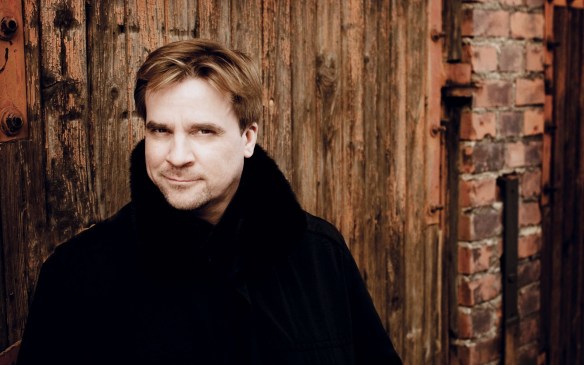 Prom 14: Elizabeth Watts (soprano), Louis Lortie (piano), BBC Philharmonic Orchestra / John Storgårds
 Preceding this came a surprisingly dour account of the Prelude from The Mastersingers of Nuremburg. This grandest of Wagner music-dramas is also the most symphonic, not least its Prelude as it deftly outlines a four-movements-in-one format. While not being oblivious to this, Storgårds might have characterized these episodes more potently, though this may have been in line with his tendency to play down the music’s opulence and majesty. What resulted was a subdued and earnest performance that hardly marked him out as a budding Wagnerian.
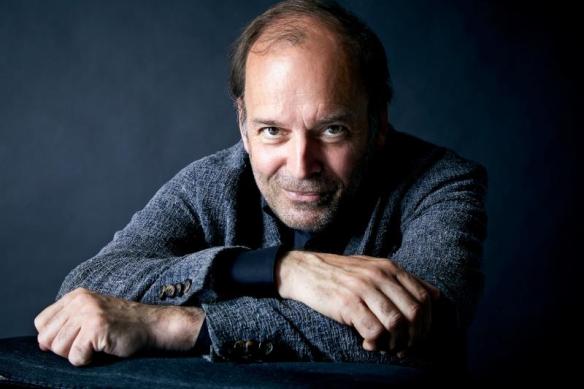 Time was when Liszt’s concertante realization of Schubert’s Wanderer Fantasy was a staple at these concerts, but this was only the second hearing in nearly six decades. 33 years ago, the soloist was Jorge Bolet at his unpredictable best, but Louis Lortie’s rendition (above) was altogether subtler as he brought out the pathos of the Andante then jocularity of the Presto. If the outer Allegro sections felt reined-in, this was not at the expense of that keen virtuosity informing Lortie’s playing in his solo passages or coruscating interplay with the orchestra at the close.


 Arcana.fm