
Prom 40: Stéphanie d’Oustrac (mezzo-soprano), Joshua Bell (violin), Cameron Carpenter (organ), Royal Philharmonic Orchestra / Charles Dutoit
Falla El amor brujo (1914-5)
Lalo Symphonie Espagnole (1874)
Saint-Saëns Symphony no.3 in C minor Op.78 (1886)
Royal Albert Hall, Thursday 17 August 2017
You can listen to this Prom here for 28 days from the date of the performance
On paper, a sultry Prom for the middle of summer, capped by a colourful French symphony. In reality, even more substantial – a concert whose tuneful demeanour and performance panache really lifted the spirits, bringing new perspectives to works we might have erroneously pigeon holed as over familiar or under performed.
Into the latter category falls most of the music of Édouard Lalo, whose Symphonie espagnole, a passionate five movement work for orchestra with violin soloist, is the one work to really gain a foothold in the Proms. Lately however it has fallen out of favour, and Joshua Bell was bringing it back for the first time in 15 years. His evidence was persuasive, a performance full of character, wit and commitment that showed the French composer’s Spanish persuasions in a very positive light. The first two movements were a little on the chaste side, but that only heightened the bravura of the Intermezzo, where Bell was really able to let his hair down.
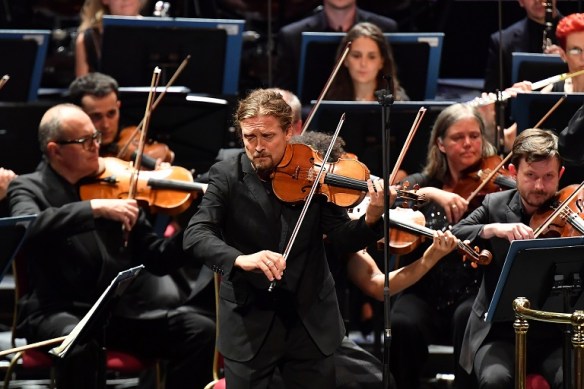
 The finale was also a winner, its tune (memorably upgraded by Keith Emerson and The Nice) leaving an impression long after it had departed, and completing a convincing performance of a substantial work. It would be good to see more Lalo revived to the repertoire, for he is a composer of tuneful appeal with colourful orchestration. Bell (above) gave us a substantial bonus in a gorgeously floated encore of Massenet’s Méditation from his opera Thaïs.
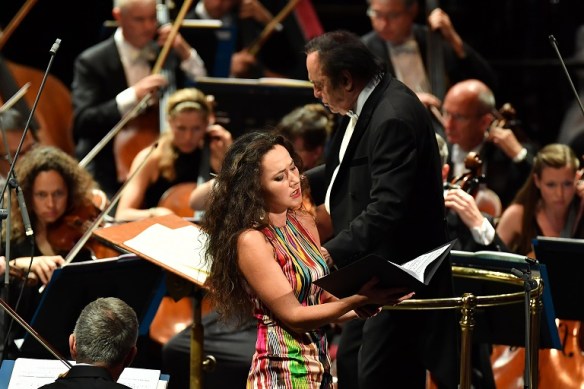 Manuel de Falla also fulfils those two qualities, though his way with a melody is if anything even more exotic. El Amor Brujo (Love, The Magician) is packed full of memorably scored dance music that played right into the hands of a skilled interpreter such as Charles Dutoit. Under his baton the Royal Philharmonic Orchestra swooned and sighed, though unfortunately the contributions from mezzo-soprano Stéphanie d’Oustrac (above) were not ideally balanced from our vantage point in the Albert Hall, her notes falling short of the back of the Arena. Because of that the dances were easily the high point of what was otherwise a high quality performance.
And so to Saint-Saëns, and his Symphony no.3 – the Organ symphony, billed on account of the instrument’s role in the final movement. It was surely the last ten minutes of this work – elevated by pigs in the film Babe – that caused such queues for the arena and gallery, but it was particularly satisfying to be reminded of the work as a whole and its inventiveness.
This was surely the first occasion an organ had been used in this way before, and not just that – a piano too, the four handed part beautifully incorporated by Dutoit into the whole. Dutoit ensured the rhythmic invention of Saint-Saëns was to the fore in the first movement, the strings’ lines shimmering in the half light, while the second movement bloomed in a wondrous shade thanks to well-chosen settings by organist Cameron Carpenter (below) for his accompaniment of the strings plaintive but increasingly powerful theme.
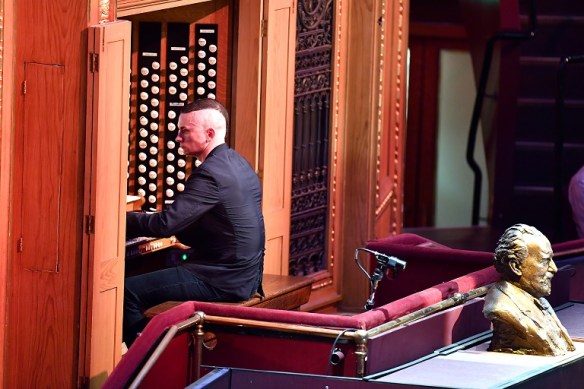
A quickfire third movement brought rhythmic impetus again, the motto theme drumming its way firmly into the consciousness, and then it was the finale, where the balance between organ and orchestra was ideal. Dutoit, who has conducted this work for well over 30 years, relished the drama of the chorale theme and the orchestra’s rapturous response, but also brought forward the inner workings that Saint-Saëns uses to drive it forwards.
A final, personal note on Charles Dutoit, receiving his Gold Medal from the Royal Philharmonic Society before we heard the Saint-Saens – which incidentally was commissioned by the same body in 1886. In his recordings with the Montreal Symphony Orchestra, Dutoit has made some very special insights into French music that are I’m sure on the shelves of many a classical collector today. Ravel, Debussy, Poulenc and Ibert are just five of the composers to benefit from his special relationship with the orchestra – and provide just some of the reasons behind the ever-adventurous conductor’s modest receipt of the medal. He may be 81 but the creative fires still burn very keenly!
Ben Hogwood, with pictures (c) Chris Christodoulou
Stay tuned for another in Arcana’s Ask The Audience series, where Jamie Sellers will give his verdict on the Royal Philharmonic Orchestra Prom. Coming shortly! Meanwhile a Spotify playlist celebrating Charles Dutoit is below, containing some of the music from this concert.


 Fleming’s contributions grouped into a loose theme of distant light and transformation. Barber’s Knoxville: Summer of 1915 is a love letter to the American home, and its dappled evening sunlight flickered beautifully under the hands of Oramo, the composer’s warm harmonies setting the scene for Fleming’s characteristically full bodied interpretation. She inhabited the storyteller’s guise with effortless and instinctive calm, though the animated middle section was also very well judged. With just the right amount of sentimentality, this was an ideal performance, and an aptly chosen encore of the song Sure on this shining night blazed a similar trail.
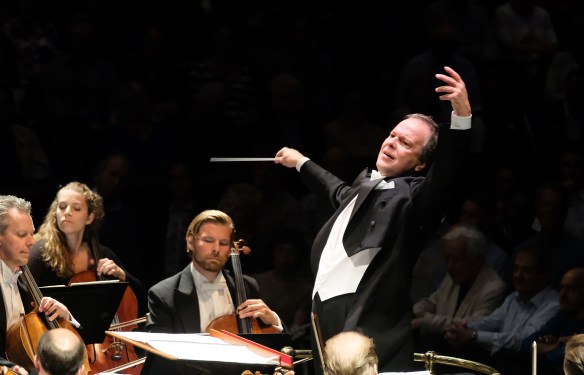 Finally we heard Carl Nielsen’s Second Symphony, ‘The Four Temperaments’, receiving its second Proms performance in three years after the festival’s complete neglect of it in the 20th century. It is a powerful piece, and this account made a strong impression. Although the feverish first movement (Choleric) was convincing and brilliantly played the emotional centre lay in the Melancholic third movement, where Oramo wrought music of impressive angst and depth. Nielsen’s struggles were resolved by the Sanguine finale, where the composer lets rip perhaps a little too easily, but again the structure and the melodic groups made perfect sense. Oramo has built a strong affinity with the Danish composer’s music over the years, and there was something very satisfying in these days of disunity at seeing a Finn conduct a Swedish orchestra in Danish music.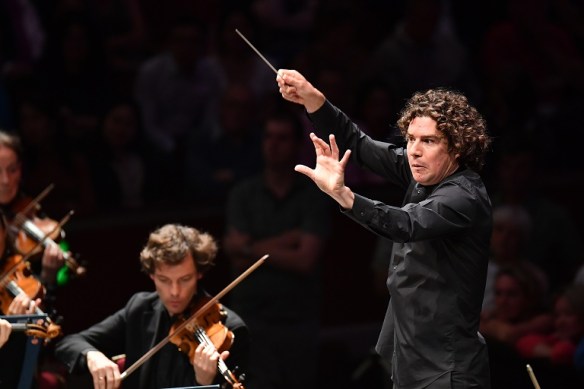
 Berg’s Violin Concerto contains music of similarly ominous qualities, in this case uncannily heralding the composer’s final year despite its dedication elsewhere. Though the violin begins with elegiac tones it has a broad emotional range, and Christian Tetzlaff (above) rose magnificently to the occasion, finding Berg’s many and varied colours but crucially balancing them with the excellent orchestral contributions.

 The Germanic second half began in more restrained mood with Schumann’s Cello Concerto. Rarely performed for decades (and more often in the transcription for violin), this deceptively genial piece is among its composer’s most ingenious in terms of form and motivic continuity. Alban Gerhardt (above) maintained a determined while never merely inflexible course across its three continuous movements, the BBC Philharmonic providing support as attentive yet unobtrusive as the music required. Interesting to hear that the soloist thought the finale musically the least successful, as this emerged as arguably the most successful part – not least with its engaging dialogue kept on its toes and with no sense of dourness or grittiness as regarded the orchestral texture. Overall, a perceptive and convincing account of a work still too easily overlooked.
 Storgårds then rounded-off the programme with a taut and tensile reading of the symphony that Hindemith derived from his opera Mathis der Maler. This retelling of cultural meltdown and social antagonism during the Thirty Years War proved too ‘contemporary’ for the Nazi regime to stomach, and it was no surprise that the premiere of the complete opera took place in Zurich. Storgårds had the measure of the Angelic Concert with its austere chorales and angular though never impersonal polyphony. The Entombment of Christ was affecting for all its brevity, while the climactic Temptation of St Anthony built surely and impulsively from its stark introduction, through a central interlude of tangible pathos, to a culmination such as blazed forth in affirmation. All credit to Storgårds for ensuring so cathartic an impact.
 Arcana.fm