
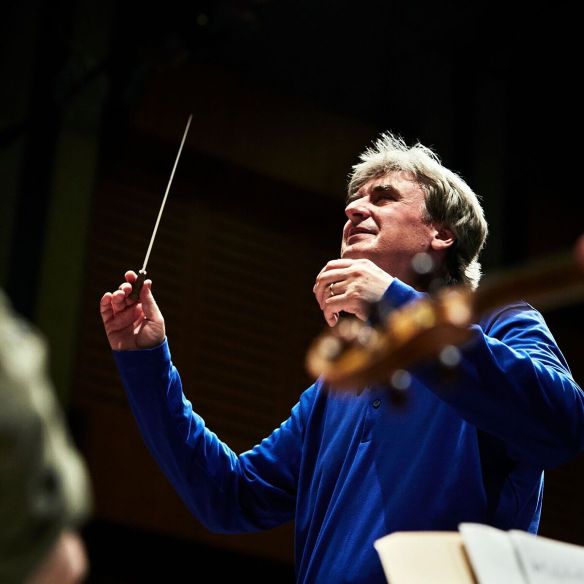
Prom 36: BBC Scottish Symphony Orchestra, Thomas Dausgaard (above)
Schubert Symphony No. 8 in B minor, D759, ‘Unfinished’ (1822)
Mahler Symphony No. 10 in F sharp, realized Deryck Cooke (1910; 1959-76)
Royal Albert Hall, Saturday 12 August, 2017
You can listen to this Prom by clicking here
Having made an auspicious start to his tenure with the BBC Scottish Symphony Orchestra, Thomas Dausgaard tonight brought the orchestra to the BBC Proms for its most ambitious concert this season – Mahler’s I, given in the ‘performing edition’ by Deryck Cooke.
Left unfinished at Mahler’s death in 1911, the work was partially premiered in 1924 though it was not for another four decades that a complete rendering was heard – Berthold Goldschmidt conducting the London Symphony Orchestra at the Proms in Cooke’s realization. Since when his (subsequently revised) edition has become the preferred option for those tackling Mahler’s last symphony in its entirety. Dausgaard recently won praise for his recording with the Seattle Symphony, and his account this evening proved no less successful as an overall interpretation.
Other than the notably deliberate tempo for the violas’ initial theme, such as made it almost an epigraph to the movement overall, the opening Adagio was flexibly paced; the wrenching theme heard on massed strings finding contrast with the sardonic, waltz-like music as passed between solo woodwind. The development’s polyphonic intricacy was eventfully unfolded, then the climactic dissonance – with its piercing trumpet note – was pointedly drawn into the whole so that the lingering coda evinced a serenity whose fulfilment was at best provisional.
The first Scherzo emerged even more impressively. Texturally the least cohesive movement as Mahler left it, its contrapuntal density allied to elliptical harmonic progressions make it the most radical (the earlier music of Hindemith and Weill tangibly within reach) and Dausgaard expertly integrated its increasingly close-knit sections into a stretto of mounting excitement. The brief, fulcrum-like Purgatorio which follows was a little matter-of-fact for its glancing irony wholly to come through, and Dausgaard ought to have made an attacca into the second Scherzo (the three movements of this second part ideally form a continuous whole). Not that there was much to fault in this latter as it pivoted between anguish and appeasement, before vanishing into that ‘tunnel’ of darkness whose nihilistic overtones were palpably to the fore.
Come the Finale and Dausgaard might ideally have deleted the opening drum stroke, while the climax of the central Allegro really needed underpinning from drums for its intensified reprise of the first movement’s dissonance to make its fullest impact. But these were minor flaws in a perceptive rendering overall – sepulchral opening brass making way for the most eloquent flute melody in the symphonic literature (not least as played by Charlotte Ashton), transformed into a radiant string threnody which brings about this work’s cathartic ending.

An impressive reading was fittingly programmed within the context of Schubert’s Unfinished, of which Dausgaard has made a fine account with the Swedish Chamber Orchestra. While his rapid take on the first movement (little ‘moderato’ about this Allegro) did not transfer ideally onto full orchestra (at least in the resonance of the Albert Hall acoustic), the ensuing Andante had no lack of poise: the hushed dynamics of its coda no less arresting than the blissful final cadence in which Mahler’s transcendent leave-taking, 88 years on, was not hard to perceive.
Richard Whitehouse (photo of Thomas Dausgaard (c) Thomas Grøndahl)
You can listen to Dausgaard’s recordings of these pieces on the Spotify playlist below:

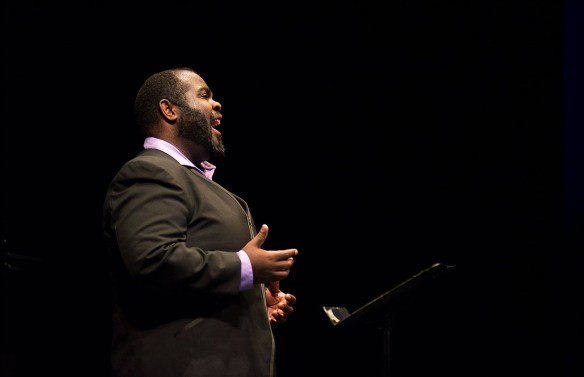 This was just the tip of the iceberg though. One of the great assets of the Monteverdi Choir is that its members are all potential soloists, making it a great team of individuals. Soprano Miriam Allan and bass Robert Davies dueted in the Aria and Chorale, and complemented each other very nicely, then tenor Hugo Hymas sang beautifully for the Recitative, while Mobley (above) once again impressed with his passionate and full-bodied tones in a duet with the tenor. The orchestra were once again on top form, though this time oboist Leo Duarte was keenly in focus, moving between the conventional wooden oboe, an oboe d’amore and an oboe di caccia (which looks rather like a banana!) with great dexterity and flair.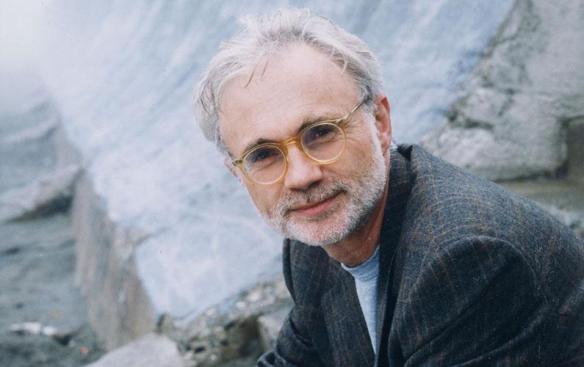
 This was no doubt intentional, for we were privy to a wonderful performance from French mezzo-soprano Marianne Crebassa (above). Shéhérazade is a magical song cycle when performed well, but here it transcended all expectations – in fact I don’t recall ever seeing a singer who gauged the acoustic of the Royal Albert Hall with quite the accuracy of Crebassa. Her direct communication with the audience was reinforced by the elegance and understated strength of her vocal delivery, a truly beautiful tone that caressed Ravel’s lines with clear love and affection.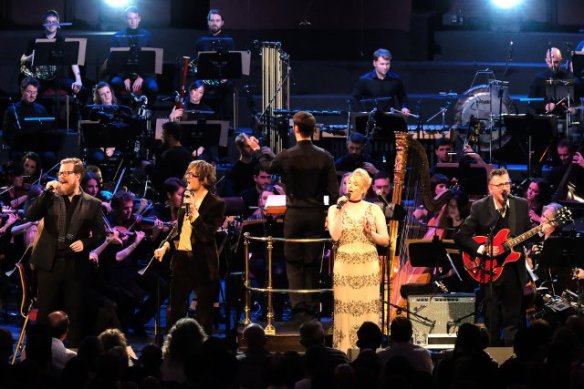
 As also would be one from Icelandic singer Susanne Sundfør (above), whose often brittle yet always focussed delivery teased out the deadpan humour from On Your Own Again then stripped Angels of Ashes of undue preciousness. Best of all was the edgy irony she brought to The Amorous Humphrey Plugg, another highpoint of Walker’s song-writing, while Hero of the War aligned anger and compassion to a telling degree. A slight pity that Long About Now, Walker’s one number intended for a female vocalist, was not featured. Maybe another time?
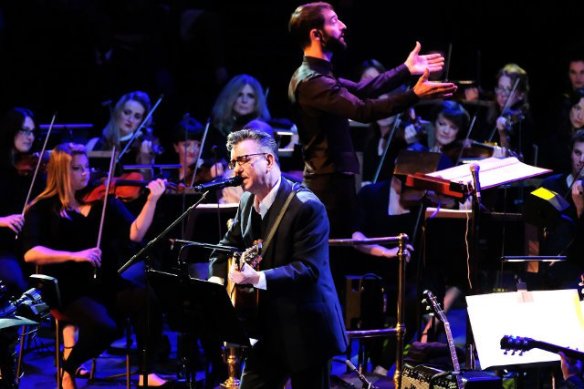 A fine guitarist and distinctive crooner, Richard Hawley proved as attentive to the tangible atmospherics of It’s Raining Today as to the warm evocation (so easy to sentimentalize) of Two Ragged Soldiers. Neither was there any dilution of that yearning for domestic bliss in Montague Terrace (in Blue) or sardonic humour in The Old Man’s Back Again (Dedicated to the Neo-Stalinist Regime) – a song which underlines Walker’s awareness of the political realities during this period, as has surfaced more obliquely in much of his more recent music.
 The Planets has, of course, never looked back over the near-century since it first astounded a public confronted with the terrors of mechanized war. Perhaps one should not be surprised that Wilson was at pains to play down its cinematic quality (hardly something of which Holst could have been aware in any case) – his vehement take on Mars proceeding an eloquent if slightly cloying Venus; itself followed by an almost dance-like Mercury and an incisive Jupiter at its best in a trio section that managed to eschew almost all trace of false solemnity
 Arcana.fm