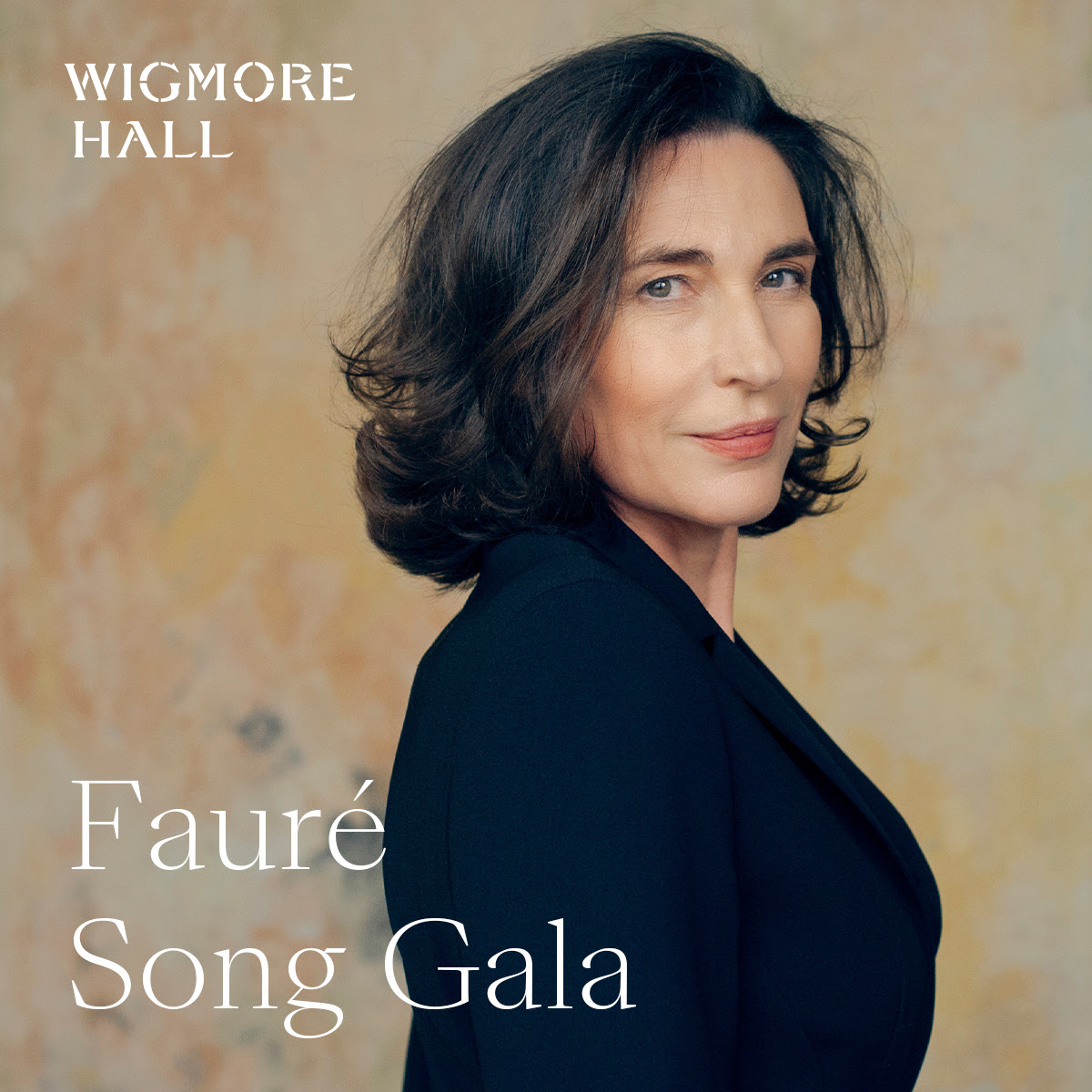
Véronique Gens (soprano), Fleur Barron (mezzo-soprano), Laurence Kilsby (tenor), Stéphane Degout (baritone), Susan Manoff (piano), Julius Drake (piano) – all performing on Friday 13 September 2024 at the Wigmore Hall
The Gabriel Fauré Centenary Celebrations open with a song gala involving some of Fauré’s finest contemporary interpreters, who explore the composer’s output at various stages, and all of whom share in the performance of his cycle La bonne chanson.
The concert will take place on Friday 13 Sep 2024, 7.30pm (click here for tickets) – and marks the start of a celebration which will cover the French composer’s celebrated chamber music.
You can read about the celebrations at the Wigmore Hall website, where you will find details of the five-day festival planned and curated by Steven Isserlis and friends, running from Friday 1 November to Tuesday 5 November. The programme will include all of Fauré’s chamber music, put in context of his friends and contemporaries. It will also give us the rare opportunity to hear both of the piano trios by his good friend Saint-Saëns.
Dvořák Cello Concerto in B minor Op.104 (1894-95) Suk Symphony no.2 in C minor Op.27 ‘Asrael’ (1905-06)
Anastasia Kobekina (cello), Czech Philharmonic Orchestra / Jakub Hrůša
Royal Albert Hall, London Tuesday 27 August 2024
reviewed by Richard Whitehouse Photos (c) Andy Paradise
First heard at the Proms in those testing times of 1969, the Czech Philharmonic Orchestra has since appeared at these concerts with some frequency during the past quarter-century, and this evening brought the first in a pair of concerts with its principal guest conductor Jakub Hrůša.
Each of these Proms features a Dvořák concerto, with that for cello undertaken by the highly regarded Anastasia Kobekina. The opening Allegro evinced an elegance and understatement abetted by the chamber-like interaction, Kobekina’s line faltering only marginally in its more intensive passagework, though the thrilling ascent up to the reprise of the second theme went for relatively little and its coda rather lacked decisiveness. Much the highlight was an Adagio of ruminative warmth and, after its restless central section, an exquisite poise when the main melody is entrusted to the soloist prior to a melting close. The final Allegro too went well for much of its length, but a tendency to drift came to the fore in its extended coda – Kobekina’s response rather selling short its pathos and, in turn, the inevitability of the orchestral pay-off.
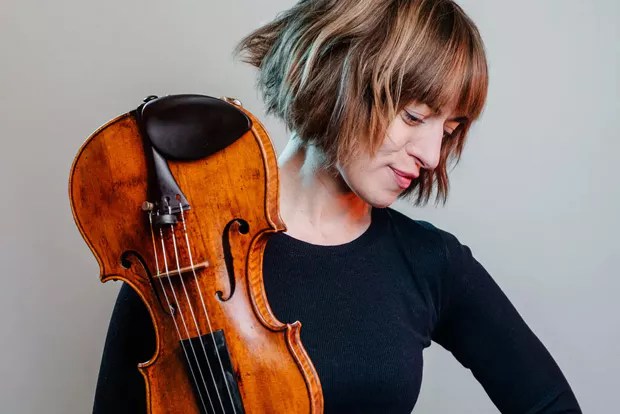
A fine if not overly memorable account, but Kobekina (below) is an artist of style and personality – as she demonstrated in the rendition of Gallardo (Variations on an Ancient Theme) by her father Vladimir Kobekin, Pavel Polívka providing tambourine accompaniment for this lively encore.
Having already made two recordings and given a memorable account with the Philharmonia a decade ago, Hrůša is evidently on a mission to establish Suk’s ‘Asrael’ Symphony in the wider repertoire and tonight’s reading did not disappoint. Especially impressive was his maintaining emotional intensity across those three movements that make up its first part – the introduction to the opening of them starkly drawn so what followed needed only an incremental impetus to sustain itself over a complex yet cohesive sonata design then on to a peroration whose despair was unremitting. The intermezzo found ideal an accord between its ‘otherness’ and that ironic ambiguity where Mahler’s influence is apparent, its teetering on silence a foil for the scherzo whose anxiety was soulfully waylaid by the trio before it exploded in fury towards the close.
What had begun as the commemoration of Dvořák (Suk’s teacher) became a memorial to his daughter Otilie (Suk’s wife) in its second part. Compassionate but never cloying, the opening Adagio was enhanced by some alluring woodwind and an eloquent contribution from leader Jan Mráček as underlined the significance of solo violin for Suk’s output overall. Its subdued close was brusquely denied by timpani at the outset of the finale – a relatively loose but never diffuse structure, the headlong clamour of whose central build-up carried over into a dramatic climax before this subsided unerringly into the lengthy coda. The composer was explicit as to the nature of the latter – its barely fulfilled serenity perfectly captured by Hrůša as this music reaches, if not benediction, at least that repose from where further creativity became possible.
Acknowledging considerable applause, Hrůša explained that no encore would be played given how apposite were the final bars in their countering the ‘‘crazy world’’ around us. Something which could overall be said of what was a highly perceptive and often profound performance.
Emma Tring (soprano), BBC National Orchestra of Wales / Martyn Brabbins
BIS 2721 [72’51’’] French text and English translation included
Producer Thore Brinkman Engineers Simon Smith, Mike Cox Recorded 29-31 March 2023, Hoddinott Hall, Cardiff
Written by Richard Whitehouse
What’s the story?
BIS continues its coverage of John Pickard (b.1963) with a pertinent coupling of his Second and Sixth Symphonies, heard alongside his song-cycle to poems by Verlaine, in what is the most wide-ranging release – whether chronologically or stylistically – to date in this series.
What’s the music like?
It hardly seems 35 years since the Second Symphony blazed forth at its Manchester premiere, so establishing Pickard’s reputation. The composer had earlier studied with Louis Andriessen, to whose confrontational minimalism this piece is indebted in certain particulars – but, unlike other among his contemporaries who were so influenced, Pickard was alive to its symphonic potential. Unfolding over six continuous sections, the work builds via an intensifying process of tension and release to a seismic culmination as marks a seamless, even inevitable return to its start. Those familiar with that pioneering version by Odaline de la Martínez (on YouTube) will find this new one hardly less attentive to the visceral power of what, given its predecessor remains unheard, is a symphonic debut with few equals and one that urgently warrants revival.
Almost 35 years on and the Sixth Symphony offers a very different though no less involving perspective on what this genre might be. The first of its two movements channels a modified sonata design such that an almost whimsical opening has become brutalized well before the despairing close. Its successor refashions the expected continuity from an even more oblique vantage – the music heading eloquently if funereally toward a plangent climax that subsides into a delicate intermezzo, infused with the sound of nature, then on to a final section which recalls earlier ideas in a mood of rapt anticipation. Not that this understatement offers in any sense an easy way out: indeed, the work concludes with its composer poised at a crossroads as much existential as musical, and from where the whole creative process can begin afresh.
Separating two substantial statements of intent, the Verlaine Songs continues Pickard’s recent involvement with poetic texts and, while Paul Verlaine might seem far removed from Edward Thomas or Laurence Binyon, his evocations fanciful while sometimes unnerving – hence Le sqelette with its graphic aural imagery – finds the composer reciprocating in kind. Coming in between scorings with ensemble or violin and piano, this version with orchestra finds Pickard enriching a lineage of French song-cycles from Berlioz, via Ravel and Messiaen, to Dutilleux.
Does it all work?
It does, not least because Pickard is conscious of the need for his music to determine its own course. However dissimilar these symphonies might seem, the sensibility behind them is the same and any stylistic differences more apparent than real. It helps when Martyn Brabbins is a conductor familiar with this idiom as to inspire a committed response by the BBC National Orchestra of Wales, with Emma Tring alive to the manifest subtlety of the vocal writing, and the recordings consistently heard to advantage in the spacious immediacy of Hoddinott Hall.
Is it recommended?
Indeed, in the hope this series will be continued. Both the First and Third Symphonies await recording, as do Partita for strings and large-scale choral work Agamemnon’s Tomb, so that Pickard’s discography has a way to go even without addition of new pieces to his catalogue.
Walton Prelude and Fugue ‘The Spitfire’ (1942) Korngold Violin Concerto in D, Op. 35 (1945) Heathfield JAZZ HORSE (2024) [World Premiere] Korngold arr. Russ The Sea Hawk – Suite (1940) Walton arr. Matheson/ed. Lloyd-Jones Henry V – Suite (1944, arr. 1963)
The Bradshaw Hall, Royal Birmingham Conservatoire, Birmingham Friday 23 August 2024
Reviewed by Richard Whitehouse
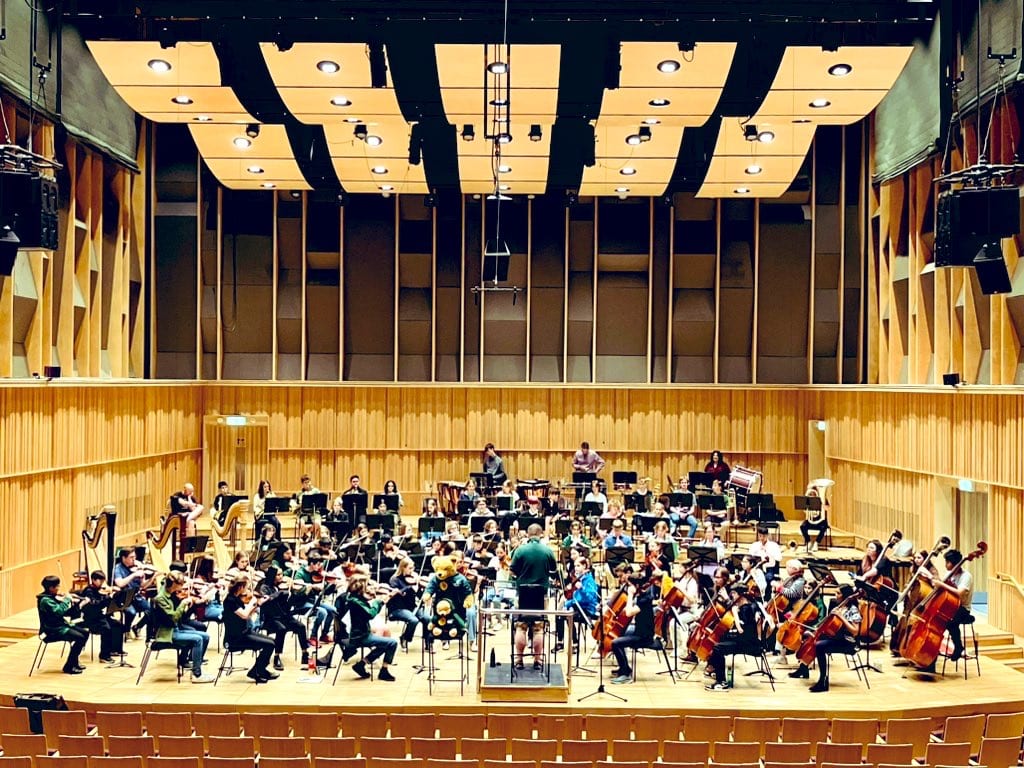
The English Symphony Orchestra’s annual Summer Course reached its climax this evening with a concert by its Youth Symphony Orchestra as ranged across film music from the mid-20th century, and in various guises from straightforward adaptation to wholesale reworking.
Whether or not those films for which he provided music have stood the test of time, Walton’s is a significant contribution to the cinema. As adapted from The First of the Few, his ‘Spitfire’ Prelude and Fugue remains one of his most characteristic such pieces and this performance did full justice to the prelude’s martial tread as to the fugue’s driving impetus, though James Topp was mindful to ensure the pastoral interlude (just before the return of the main theme) yielded an intimacy as underlined the essentially personal nature of this now underrated film.
Whereas Walton’s metier was in wartime or theatrical subjects, that of Korngold centred on Hollywood ‘blockbusters’ which required scores of suitably emotional opulence. Several of these found an equally appropriate home in the Violin Concerto completed at the end of the Second World War, whose formal cohesion prevents any risk of its expressive power losing focus. This was certainly the impression as conveyed by Fenella Humphreys – notably the ardency of her take on the opening Moderato, with a central Romance as ingenious in its trajectory as it was eloquent in content. Nor was there any lack of energy in a final Allegro with repartee between soloist and orchestra at its most engaging and not least in its closing stages, when a resplendent version of the main theme is outflanked by the uproarious coda.
After the interval, a sinisterly attired Finn Heathfield put members of the orchestra through their collective paces with JAZZ HORSE, described as ‘‘a collection of improvisations and performance exercise rooted by the rhythm section’s bass motif (thus F-Ab-Bb-Eb). It duly provided a telling foil to the suite (here arranged by Patrick Russ) from Korngold’s score to The Sea Hawk; a sequence capturing this film’s overall panache as surely as its resourceful writing for percussion and a reminder of a composer who should never be underestimated.
The programme concluded with more Walton and the suite from his score to Henry V – now remembered as a star-vehicle for Laurence Olivier, but which at the time played a necessary role in the British war-effort. Muir Matheson’s adaptation features most of the highlights and, as edited by the late David Lloyd-Jones, takes in more from the Overture in its evoking The Globe Playhouse via Elizabethan stylizations these players audibly relished. The sombreness of The Death of Falstaff and calm ecstasy of Touch Her Soft Lips and Part were rendered with no less insight, while the Charge and Battle placed between them brought a frisson of excitement set in relief by a poetic evocation of the Baïlerò at the close. Building intently to its joyous close, the Agincourt Song provided a rousing end to the suite and to this concert.
Another Summer Course Concert completed – its success not, as Topp indicated, to be taken for granted given the logistical and financial obstacles in bringing 91 musicians to this level of attainment. Hopefully such considerations will not become insurmountable in the future.
Sooner or later, Arcana’s Sunday serenade series had to arrive at the most famous one of them all – Mozart‘s Serenade no.13 in G major, known universally as Eine Kleine Nachtmusik.
The work was written for string quintet in 1787, but expands beautifully for string orchestra, as demonstrated in this version from the Wiener Philharmoniker and Karl Böhm. As is so often the case with Mozart, its beauty lies in simplicity, with memorable tunes that are developed with a pure musical instinct:



 Arcana.fm