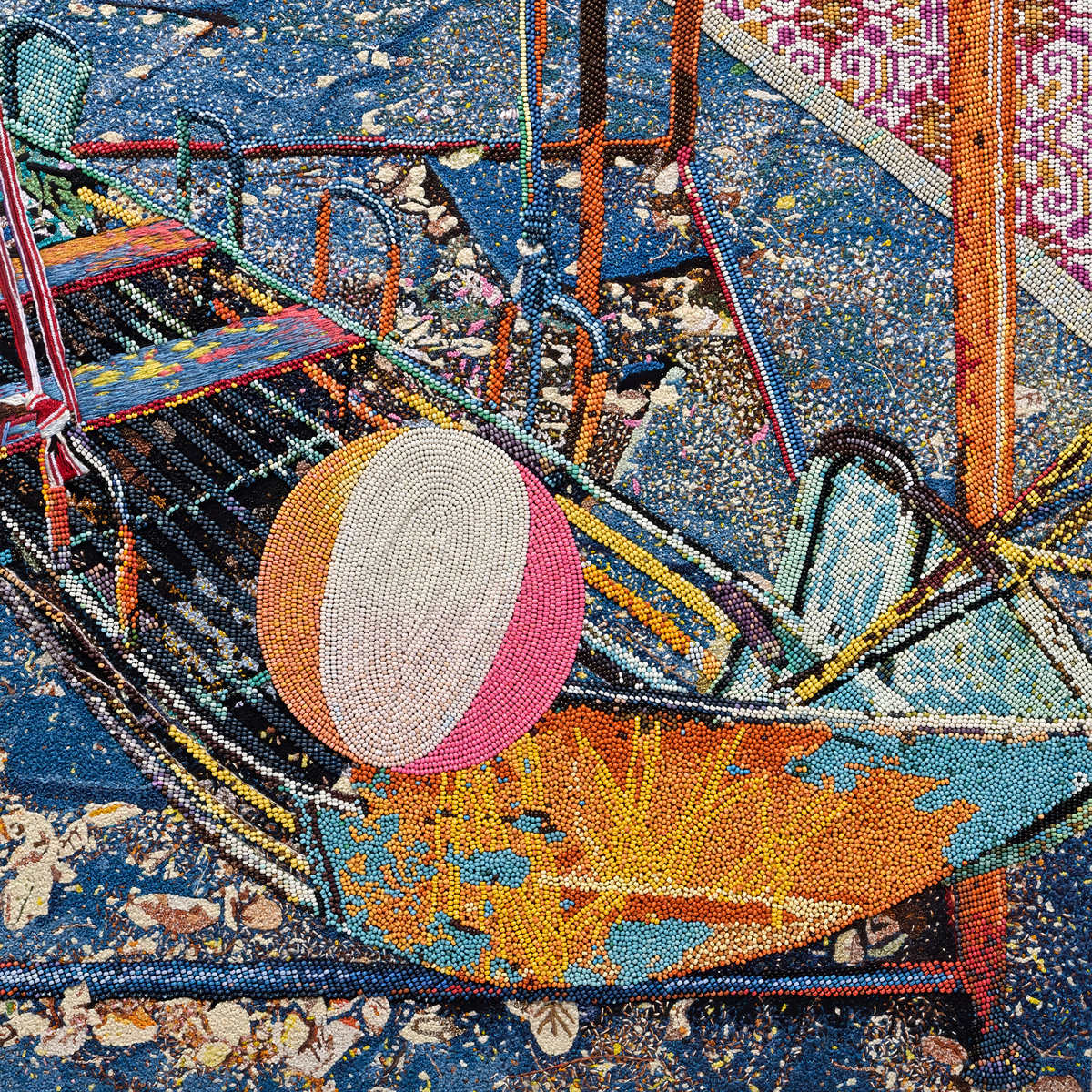
This is the fifth album from Lithuanian duo Merope, who are Indrė Jurgelevičiūtė (singer and kanklès) and Bert Cools (guitar and producer). They have built a lasting reputation for their individual blend of folk and ambient music, honed on the Stroom label since 2012.
Véjula finds them spreading their wings to welcome collaborations with like-minded musicians, including Shahzad Ismaily, Laraaji and Bill Frisell.
What’s the music like?
Merope are simultaneously soothing and stimulating. Their ambient credentials are very strong, and because of that Koumu Lil immediately takes you to a calm, meditative spot, aided by the Lithuanian chordophone known as the kanklès. Once there you can admire the inventive musicianship on offer, as the music shimmers and sparkles in front of your eyes.
Throughout there is an endearing richness of colour, with music that can meander on occasion (enjoyably so) before being punctuated by sudden pinpoints of focus. Laraaji’s zither on Namopi, brings rich swathes of sound, complemented by Shahzad Ismaily’s vocals and prompted by the bass. The thrumming of Vija is similarly hypnotic, while there are more intimate musings on Spindulé. Ismaily returns for O Underhill’s fascinating exercises in perspective, with fragmented bursts of sound.
Frisell plays electric guitar on Lopšinė, a rather wonderful reverie complemented by wordless vocals.
Does it all work?
It does. Merope don’t give the impression of working within rules, but their sense of structure is instinctive and ensures each of their musical explorations is expertly judged.
Is it recommended?
It is. A blissful 40 minutes in the company of a consistently inventive act, one whose colour and warmth is difficult to resist.
For fans of… Laraaji, Harold Budd, Penguin Cafe Orchestra, Bill Frisell
Listen and Buy
Published post no.2,371 – Saturday 23 November 2024
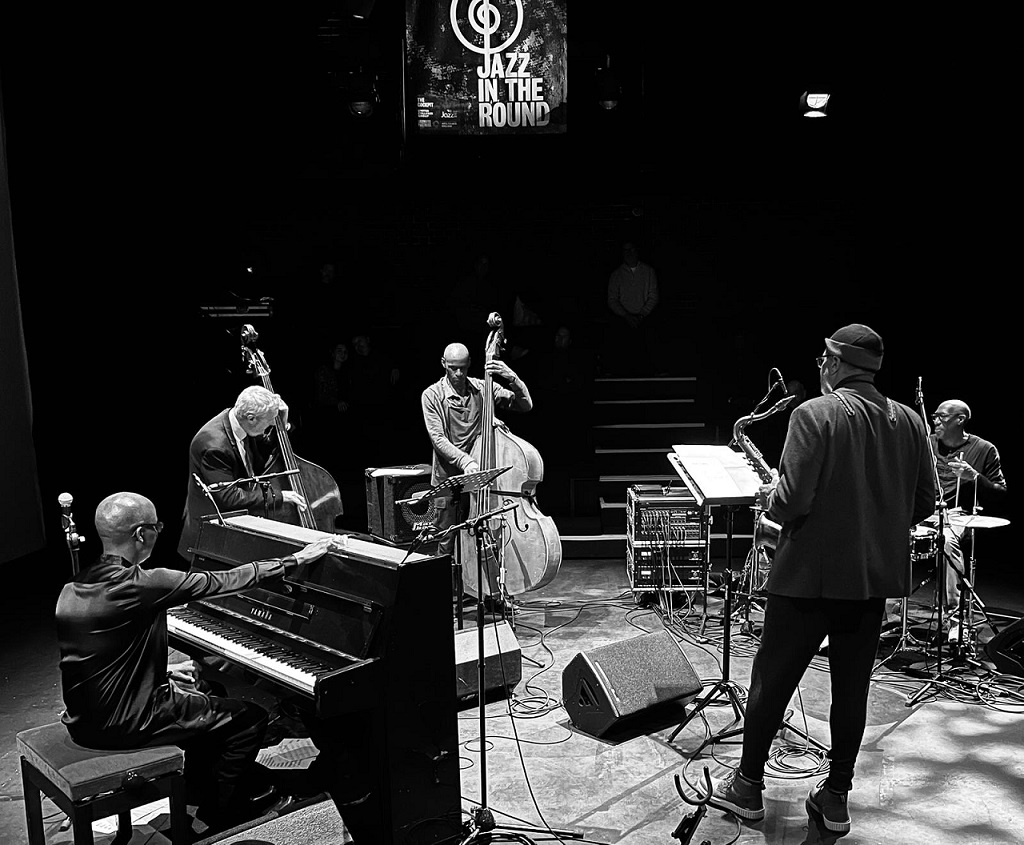
Robert Mitchell (piano), Jean Toussaint (tenor saxophone), Larry Bartley (double bass), Rod Youngs (drums) and Dave Green (double bass)
The Cockpit, London, 20 November 2024
by John Earls. Photo credit (c) John Earls
Jazz 625 was a BBC television jazz programme which ran for two years between 1964 and 1966.The show was first broadcast on BBC2 on 21 April 1964 (on what turned out to be the channel’s opening night). It is revered because in that period it brought into UK living rooms live performances by American jazz legends such as Dizzy Gillespie, Oscar Peterson, Thelonious Monk, Art Blakey, Dave Brubeck and Duke Ellington (who appeared in a gala presentation in the first show). It also showcased UK jazz musicians such as Tubby Hayes, Ronnie Scott and John Dankworth.
In May 2019, Jazz 625 returned to the BBC as a 90-minute live show on BBC Four called Jazz 625 Live: For One Night Only. The house band for that broadcast featured Robert Mitchell (piano), Jean Toussaint (tenor saxophone), Larry Bartley (double bass) and Rod Youngs (drums).
In celebration of Jazz 625’s sixtieth birthday this year, the band were reunited under Robert Mitchell at London’s The Cockpit as part of the London Jazz Festival for a performance also featuring the legendary UK bass player Dave Green. Green is one of only two people still alive who appeared on the show (the other being singer Cleo Laine, one of only eight women to have appeared on the show throughout those two years).
Green opened proceedings with a solo bass piece that highlighted his musicality, understanding, tradition, inventiveness and preparedness to take risks. It was a captivating and spirited performance.
The re-convened For One Night Only band fittingly started their set with a lovely Along Came Betty (written by Benny Golson and most famously recorded by Art Blakey), a tune they performed on the 2019 programme. The programme also saw Thelonious Monk’s Criss Cross, heard here with some excellent solos on sax (Joshua Redman did sax duties for this tune on the broadcast), piano and bass and classy drum intervals from Rod Youngs.
Youngs’ drumming style gives the appearance of him shrugging his shoulders and it was fascinating to watch his smooth brush strokes on the next tune, Ben Webster’s Body and Soul (which featured some soft and expressive piano playing by Mitchell) and some more energetic and hefty drum work on the next tune, an original whose title I didn’t quite catch (Mood Board?).
There then followed a Jean Toussaint-penned tune Calypso (also new?),a nice nod to the influence of oft-neglected Jamaican jazz musician and composer Joe Harriott (the tapes of his Jazz 625 performance were recorded over). It’s a sunny piece on which both saxophone and piano shone. It is also worth noting here Toussaint’s (and indeed Mitchell’s) role in supporting new UK jazz talent. One of the highlights of the For One Night Only programme is seeing Toussaint playing with saxophonist Camilla George (who he taught and mentored) for a performance of Harriott’s Tonal.
Finally, the band were joined by Dave Green for Blue ‘n’ Boogie, a 1944 jazz standard written by Dizzy Gillespie and Frank Paparelli. It’s the first time I’ve seen two double basses play together in a small ensemble and what a treat it was. To say that Green and Larry Bartley engaged in ‘battling basses’ would be to imply too much competition, whereas what was evidently on display was a mutual respect between two fine musicians that span generations. Bartley paid lovely tribute to Green in words and music. Their double bass exchanges were a joy.
John Earls is Director of Research at Unite the Union. He posts on Bluesky and tweets / updates his ‘X’ content at @john_earls
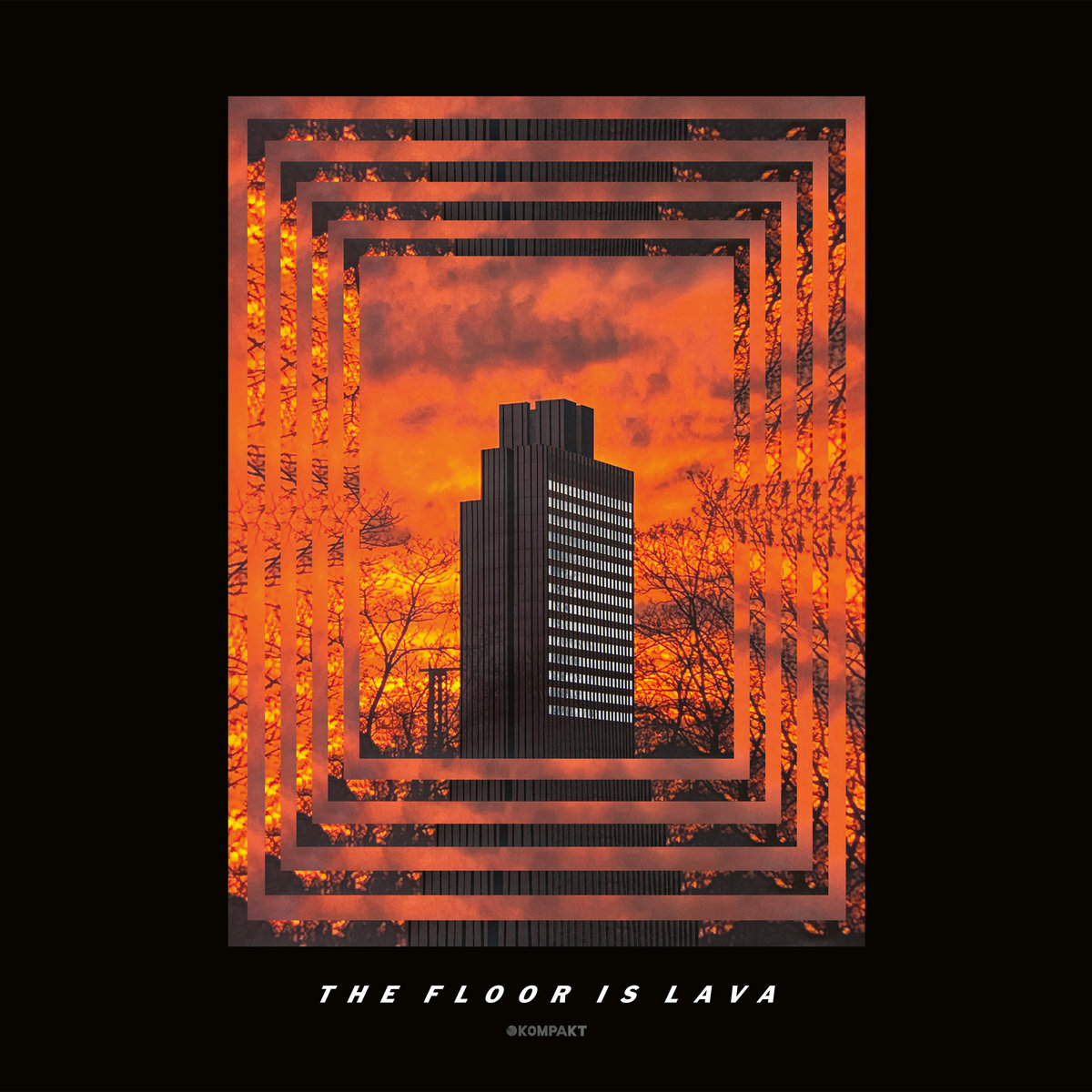
The Floor Is Lava is Michael Mayer’s first album in 12 years, since the collaborative long player Mantasy was released on !K7.
Here he is back on home ground at the label he runs, with an album tapping into his enormous experience as a DJ, conscious of his crowd’s attention span. “It’s a DJ album by a DJ that’s easily bored”, he says.
What’s the music like?
This is a fine piece of work, Mayer always conscious of keeping the dancefloor fully populated but getting a really satisfying ebb and flow as he does so.
The beats are established immediately, The Problem grinding into gear with deep beats and jazz-infused techno. Mayer’s beats are a prime focus on this album and they work to brilliant effect on the rolling contours of Brainwave, then the driving Sycophant, or in team with a superb, booming bassline on Ardor.
So good are the beats, in fact, that they are pretty much all you need – check The Solution for confirmation of this – but with plenty of goodness piled on top of them there is as much for the home listener to tap into as there is the club dancer.
Does it all work?
It does. Mayer takes his own sweet time with his solo albums, and the reward is a meticulous attention to detail on structure and production. Both reap their rewards here.
Is it recommended?
Very much so – The Floor Is Lava is a wonderful addition to the Kompakt co-supremo’s locker. Buy it and enjoy the compulsion to move!
For fans of… DJ Koze, Gui Boratto, Moderat, Ellen Allien
Listen & Buy
Published post no.2,369 – Thursday 21 November 2024
Charles Tolliver (trumpet and director), Darrell Green (drums), Camille Thurman (tenor sax and voice), Tony Kofi (alto sax), Danny Piers (piano), Larry Bartley (double bass), Cheikh Diop (percussion) and ‘A Big Band of London’s Finest’
Barbican Hall, London, 18 November 2024
by John Earls. Photo credit (c) John Earls
In my post-punk 1980s drumming days (yeah, I know) my list of favourite drummers included the likes of Charlie Watts (The Rolling Stones), Topper Headon (The Clash), Lindy Morrison (The Go-Betweens) and Brian Downey (Thin Lizzy). But it also included Max Roach, the legendary jazz drummer, composer and activist (who most of my musical contemporaries at the time hadn’t heard of). His 1968 Members, Don’t Git Weary album (of which more later) was an important part of my record collection. It still is.
I was also lucky enough to see Roach perform live (again at the Barbican) in 1999. So it was with great anticipation and excitement that I headed to the same venue some 25 years later for a London Jazz Festival concert put together and directed by Charles Tolliver, a friend and collaborator of Roach who played trumpet on Members, Don’t Git Weary to celebrate what would have been Roach’s 100th year (he died in 2007).
The first half of a two set concert saw Tolliver (trumpet and leader) joined by Darrell Green (drums), Camille Thurman (tenor sax and voice), Tony Kofi (alto sax), Danny Piers (piano), Larry Bartley (double bass) and Cheikh Diop (percussion) in a terrific seven-piece ensemble.
It got off to a ripping start with Powell’s Prances, a piece from Roach’s days with trumpet player Clifford Brown which also featured nice saxophone solos from Thurman and Kofi. This was followed by a poignant Effi from Members, Don’t Git Weary. Then came a terrific performance of Cole Porter’s I Get A Kick Out Of You which featured on Roach’s 1954 album with Clifford Brown and his Quintet, Brown and Roach Incorporated. This maintained the fizz and dexterity of the recorded version but, unlike the album, included vocals which were skilfully done by Thurman, who went on to demonstrate what a fine singer she is throughout the rest of the evening.
This was the case with the next tune, Always Loved You, which – in a nod to Roach’s spirit of innovation and risk-taking – was a new number, starting as a lovely ballad before livening up considerably, allowing Thurman to also display her saxophone prowess. The set ended with the Members, Don’t Git Weary tune itself. It remains a potent and powerful expression for the disenfranchised with its “I’m going to feast on the milk and honey…I’m going to march with the tallest angel” refrains.
The second set saw the first set’s ensemble (minus percussionist Cheikh Diop) joined by what the Barbican website described as ‘A Big Band of London’s Finest’, assembled by Toni Kofi. Let’s name them now for they deserve nothing less (they weren’t introduced by name on stage so here’s the personnel listed from the Barbican website): Donovan Haffner(alto saxophone, clarinet), Jean Toussaint(tenor saxophone), Denys Baptiste (tenor saxophone, clarinet), Charles Rothwell (baritone saxophone, bass clarinet), Josh Short (lead trumpet), Byron Wallen (trumpet), Dan Coulthurst (trumpet), Alexander Polack (trumpet), Matt Seddon (trombone), Harry Brown (trombone), James Wade-Sired (trombone) and Richard Henry (bass trombone).
Tolliver is a renowned big band composer and leader himself; his big band’s With Love album (2006) is fabulous. The set opened with a throbbing and steaming Suspicion, leading into some scat singing from Thurman and even Tolliver himself (advising us afterwards that it was “the only time you’ll hear Charles Tolliver sing!”). This was followed by Drum Suite, with deft saxophone solos from Jean Toussaint and Donovan Haffner allied to some nice smoky organ playing, before an amazing spiritual-like piece of vocal work (again) from Thurman. The Grand Max encore was rousingly appropriate.
I don’t know how much time this band had to rehearse as a collective but it was a formidable and engrossing performance – well done Toni Kofi.
Needless to say, to be the drummer in a performance honouring Max Roach’s 100th year must be a daunting experience but Darrell Green played with considerable aplomb and flair including some magnificent solos not least, not surprisingly, on Drum Suite.
Charles Tolliver is to be congratulated and commended for putting together a concert of such entertainment, joy and poise in tribute to his friend and fellow musician. I’m sure Max would have enjoyed it immensely. Those that were there certainly did.
John Earls is Director of Research at Unite the Union. He posts on Bluesky and tweets / updates his ‘X’ content at @john_earls
The albums mentioned by John in his review can be heard on Tidal, using the links below:
Published post no.2,368 – Wednesday 20 November 2024
Earlier today we learned of the sad passing of Hungarian violinist György Pauk, at the age of 88. A fitting tribute can be found on the Daily Telegraph website
As that obituary indicates, Pauk was a specialist in the music of fellow-countryman Béla Bartók, whose violin works he recorded for Naxos. The playlist below includes a couple of those recordings, put in context of works by Schubert, Tippett (the Triple Concerto) and Brahms, whose piano trios he recorded for EMI with his regular collaborators, pianist Peter Frankl and cellist Ralph Kirshbaum. You can listen to these recordings below:
Published post no.2,367 – Tuesday 19 November 2024