Perhaps surprisingly, this is the first album from Bonobo in five years. Simon Green – whose pseudonym this is – describes his new record as the most emotionally intense record that he has ever had to make. As with previous releases he takes a number of guest vocalists with him on the journey, dovetailing those tracks with instrumentals.
What’s the music like?
Familiar. If you have heard Bonobo’s music before, the manner of its construction on Fragments will tick a number of boxes. Beautifully orchestrated, the instrumentals work well with the broken beats that Green employs, which have more power and depth this time.
The vocal guests complement his sensitive work with some meaningful lyrics. There are strong contributions from Joji, Kadhja Bonet, Jamila Woods and O’Flynn, but pick of the turns is from Jordan Rakei, who lends a powerful tug to the heartstrings on Shadows.
The thicker set grooves may be welcome, but does the familiarity of Bonobo’s sound breed contempt? Certainly the chopped up vocals on Age Of Phase feel familiar, very much a continuation of what Bonobo does best. Rosewood is also a characteristically moody instrumental with vocal snippets, though Otomo is more acidic, dropping a heavy set beat. On the calmer side the shuffling beats of the comforting Closer work well, while the silvery strings to close out Tides are reminiscent of Ravel. Elysian also has alluring strings, especially when teamed with a harp.
Does it all work?
It does, but the feeling persists that this is music we have heard before – and possibly in more meaningful colours. In spite of the emotion invested by Green the music does feel grey at times. That may seem harsh on Bonobo, for the music is beautifully constructed and executed, but it is more than a little downbeat in a way we have experienced before.
Is it recommended?
It is for Bonobo devotees, as there are some good moments here – and especially the Jordan Rakei contribution – but for those new to his sound an album from earlier in his output, such as Black Sands, is arguably the best place to start.
FMS-80 is one of the pseudonyms used by Joseph Auer. It is shorthand for FM Synthesis 1980, and is influenced by the Yamaha DX FM compositions of that time – and especially those made by a number of Japanese producers in their environmental tracks.
Auer offers a nine-track album as the second in the Lifestyle series, released on his co-founded label Rednetic. The artwork and musical language suggest a close kinship with the music of the Far East, so expectations are high for a production as clean and invigorating as suggested by the cover.
What’s the music like?
Richly rewarding. Auer spends much of his time on this album in the treble range, exploring brightly coloured textures and a wide range of timbres. Many of these explorations use consonant harmonies, bathing the listener in a warm glow, but there is always an edge to the ambience that stops it from becoming too comfortable.
Beidaihe Loop, for instance, is scored for a body of metallic, percussive sounds, its effect like a peal of bells. By contrast later tracks on the album have more white noise and scattered beats, with Changgo House behaving like an active radiation counter and Swedish Container adding white noise to the picture.
Esplanade View is a warm-hearted gem, softening the timbres and creating a rich pool of sound, beautifully realised as a track to dive into at high volume. Housing Development has a glitchy texture but pans out quite a way, its effect akin to silvery droplets landing on a windscreen. Engawa Pergola paints a watery picture, while Sentul East Atrium offers a rather beautiful open vista and another bright view for the headphone-based listener.
Does it all work?
It does, and Auer knits together the different shades and moods in a rather seamless patchwork of ideas. The titles and music are borne of the far East but travel well.
Is it recommended?
Enthusiastically. The Rednetic label is hitting its stride as a positive force to be reckoned with in electronic music, and this is another feather in their cap.
Richard Strauss Don Juan, Op. 20 (1888) Mozart Vado, ma dove?, K583 (1789) Mozart La Clemenza di Tito, K621 (1791) – Non più di fiori Mahler Symphony No. 4 in G major (1899-1900)
Fatma Said (soprano), City of Birmingham Symphony Orchestra / Kazuki Yamada
Symphony Hall, Birmingham Wednesday 19 January 2022
Written by Richard Whitehouse
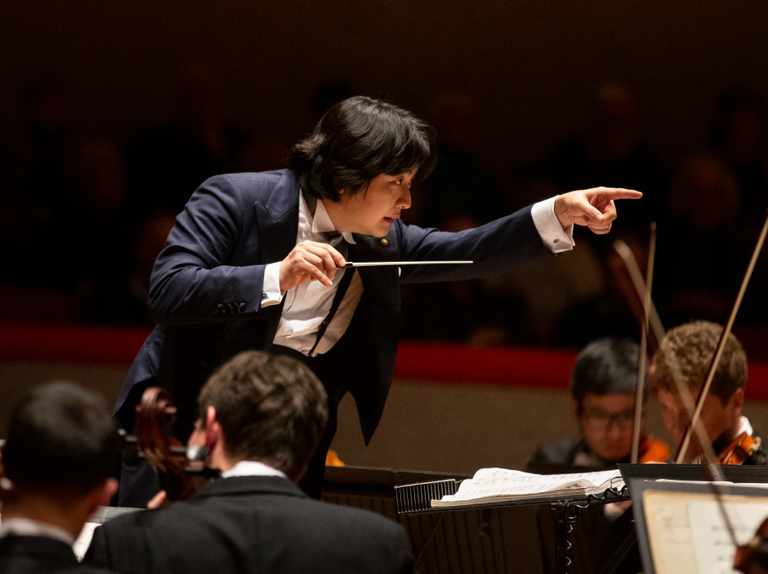
It may still be over a year before Kazuki Yamada becomes chief conductor and artistic advisor of the City of Birmingham Symphony Orchestra, but concerts such as tonight’s afford ample indication of just what can be expected from this already engaged and productive partnership.
If there any ongoing theme to this programme, it was one of transcendence – admittedly, one of negation in Richard Strauss’s Don Juan, though Yamada relished those encounters chivalrous and amorous during its course. The ‘carnival’ episode drew some especially incisive playing from woodwind and brass, and while the climactic restatement of the horns’ aspiring theme lacked nothing in grandiloquence, it did not detract from the starkness of a coda whose fatalism was to be encountered within this composer’s tone poems more regularly than might be supposed.
Strauss’s lifelong devotion to Mozart made two of the latter’s arias an appealing complement. Written as a replacement number for a long-forgotten opera by Vicente Martín y Soler, Vado, me dove? enjoys frequent revival as a standalone aria and, when elegantly rendered by Fatma Said, it was not hard to hear why. One of the (relatively few) highpoints from Mozart’s final opera La Clemenza di Tito, Vitellia’s aria makes greater expressive challenges to which Said rose accordingly – the trajectory of its ‘Ecco il punto’ recitative subsiding from anguish into that resignation from where the aria itself proceeds unerringly to the resolve at its close. All of which was eloquently conveyed, and while a further aria – the mellifluous Nehmt meinen Dank? – would have been welcome, there was more to come from this impressive singer.
Namely the finale of Mahler’s Fourth Symphony – hardly the rarity it was when Adrian Boult introduced it to Birmingham audiences 95 years ago, but easy to underestimate in the context of this composer’s overall output. As ‘unhurried’ as its heading indicates, the first movement exuded no little ambiguity – Yamada pointing up those myriad timbral and textural shadings that permeate the development and so make possible the heightened equanimity of the reprise. Sardonic but not unduly malevolent, the scherzo was tangibly evocative (Eugene Tzkindelean switching adeptly from his violin to its retuned doppelganger) – with breath-taking change of tonal perspective at the arcadian vision near its end. Visionary was no less apt to describe the slow movement, its variations alternating between fervour and anguish with seamless accord.
Felicitous playing from CBSO woodwind informed its progress on the way to its climax, with ‘heaven’s door’ briefly yet thunderously ajar prior to the transfigured calm of the closing bars. Stealing in just before, Fatma Said was an appealing guide to the setting of ‘Das himmlische Leben’ with its not always blissful recounting of the joys awaiting those who arrive there. Of particular note was the easefulness that spread across the final pages, when the singing ceases and the orchestra withdraws stealthily while raptly to leave just the harp’s pulsing resonance.
A lucid, often captivating performance of a work whose enticements Yamada realized in full measure. Anyone who can make it along to Symphony Hall for tomorrow afternoon’s repeat should certainly do so, while Kazuki Yamada will be back with the CBSO during this spring.
For more information on this concert visit the CBSO website. Meanwhile click on the links for information on the artists Fatma Said and Kazuki Yamada.
Schubert Mignon (Kennst du das Land) D321 (1815), Gesänge aus Wilhelm Meister D877: Heiss mich nicht reden; Nur wer die Sehnsucht kennt (1826) Clara Schumann Er ist gekommen Op. 12 No. 1 (1841); Sie liebten sich beide Op. 13 No. 2 (1842); Lorelei (1843) Robert Schumann Lieder und Gesänge aus Wilhelm Meister Op. 98a: Kennst du das Land (1849) Duparc La vie antérieure (1884); L’invitation au voyage (1870) Lili Boulanger Clairières dans le ciel (1913-14): Si tout ceci n’est qu’un pauvre rêve; Je garde une médaille d’elle; Vous m’avez regardé avec toute votre âme Debussy Les soirs illuminés par l’ardeur du charbon (1917); 5 poèmes de Baudelaire (1890): Le jet d’eau; Recueillement; La mort des amants
Wigmore Hall, London, 17 January 2022
reviewed by Ben Hogwood from the online broadcast
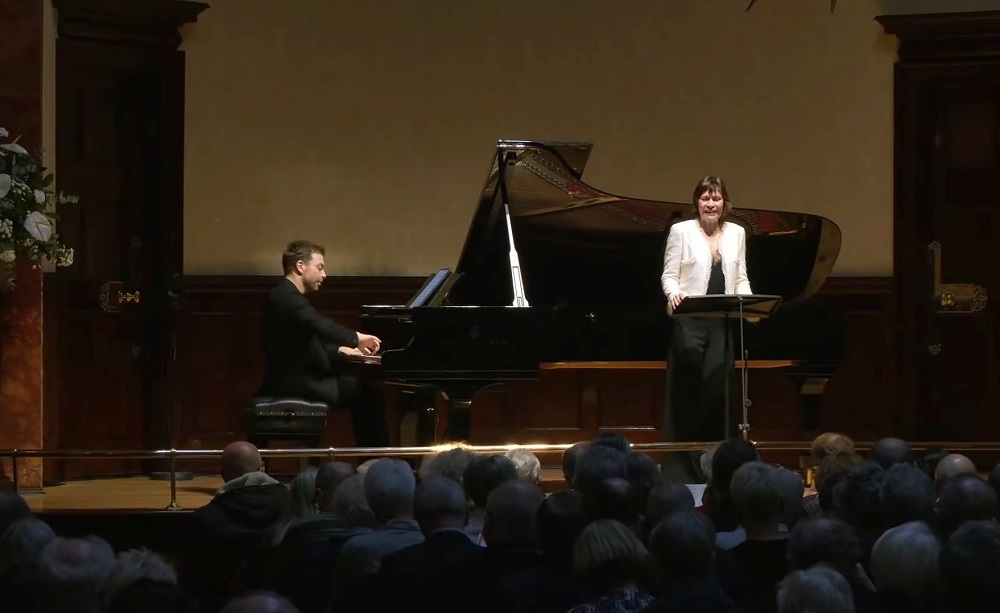
It was heartening indeed to see the Wigmore Hall at capacity for the visit of soprano Sandrine Piau and pianist David Kadouch, bringing with them a new program with the theme of Journeys: Longing and Leaving.
They delivered the songs in two ‘halves’, one of German Lieder drawn from the first half of the 19th century, the other of French song from the late 19th and early 20th centuries, giving us a smooth trajectory from Schubert to Debussy.
Refreshingly the journey took in substantial contributions from Clara Schumann and Lili Boulanger, three songs from each – as well as showing the increasing influence of Wagner on even the smallest forms of vocal music as the century turned.
Singing from a tablet, Sandrine Piau gave heartfelt performances and had the ideal foil in David Kadouch, whose brushstrokes on the piano were immediately telling. His chilly introduction to the third song in the Schubert group, Nur wer die Sehnsucht kennt, set the tone after a characterful first song and a sorrowful second, with a soaring vocal line from the soprano. Piau sang with arms outstretched, expressively capturing all the ornamentation and hitting the depths of the song’s turbulent middle section.
The Clara Schumann selection was fascinating, especially given the context of husband Robert’s well-known productivity in the years 1841-1843. The urgent Er ist gekommen was first, a heady song sitting high in the range, before a setting of Heine from just after Schumann’s celebrated year of song, a yearning and ultimately tragic number with a limpid commentary from the piano. The Loreley started in the same key, pushing restlessly forward. The only Schumann song in the program retained its intensity despite a noisy mobile phone introduction, a very different setting to the same text as tackled by Schubert at the start.
Turning to France, we heard two from the small output of Henri Duparc, whose entire output barely covers the length of a single concert. There is quality rather than quantity, however, and we heard the celebrated L’invitation au voyage, sumptuously performed with great poise. The two found the ideal pacing for La vie antérieure before it, solemn but quite open, and building to a powerful declamation.
Lili Boulanger wrote powerfully original music before her tragic death at the age of 24. Her orchestral tone poems have received greater exposure of late but the songs have remained relatively hidden. Piau and Kadouch put that to rights with three songs drawn from the wartime collection Clairières dans le ciel. They found an ominous tone in the lower vocal register from Piau, all the more so given the retrospective knowledge that Boulanger would only live for another three years from when the songs were written. The pained complexion at the end of Si tout ceci n’est qu’un pauvre rêve from Piau was profoundly affecting, then a slightly more optimistic Je garde une médaille d’elle led to the purity of Vous m’avez regardé avec toute votre âme.
Finally a selection from Debussy, prefaced by his final published piano piece Les soirs illumines par l’ardeur du charbon. This was a nice touch as an interlude, and was beautifully played. by Kadouch, We then heard three of the five Baudelaire poèmes, beginning with a babbling fountain shaded by Kadouch as Piau’s voice floated easily above. Recueillement (Meditation) found stillness initially but with the poet, distracted by darker thoughts, was mirrored by the music breaking from its reverie. Piau judged the awkward intervals perfectly, especially the final words with their harmonic transformation. The ultimate farewell was saved for last, La mort des amants quite a complex song. As with much early Debussy the harmonies travelled far but arrived at a strangely logical end point, both performers exhibiting exceptional control at journey’s end.
Piau spoke of the program giving ‘therapy after these two long years’, after which Beau Soir – one of Debussy’s celebrated songs – proved the ideal encore, though as the soprano warned, it was essentially saying, “Look at these beautiful things, because everybody goes in the same direction – death!”
Delius The Young Pianist’s Delius (1962, rev. 2005) Purcell Toccata (1955); The Queen’s Dolour – A Farewell (1959); Hornpipe (1995); Three Grounds (1995) Stevenson Little Jazz Variations on Purcell’s ‘New Scotch Tune’ (1964, rev ’75) Van Dieren String Quartet No. 5 (c1925, rev. 1931; transcr. c1948-1987); Weep You No More, Sad Fountains (1925, transcr, 1951); Spring Song of the Birds (1925, transcr. 1987)
Christopher Guild (piano)
Toccata Classics TOCC0605 [80’57”]
Producer / Engineer Adaq Khan
Recorded 5 – 6 September 2020, 5 January 2021 at the Old Granary Studio, Toft Monks, Norfolk
Written by Richard Whitehouse
What’s the story?
Christopher Guild continues his survey of Ronald Stevenson’s piano music with this volume comprising transcriptions of Purcell, Delius and Van Dieren – the latter’s Fifth Quartet fairly exemplifying Stevenson’s dedication to the spirit as much as the letter of the music at hand.
What’s the music like?
The essence of Stevenson’s re-creative approach is evident in his Purcell transcriptions, not least the Toccata with its deft changes of register and tensile rhetoric where Busoni’s benign presence can be felt. A lighter and more playful manner is evident in the Hornpipe, whereas the Three Grounds point up conceptual as well as musical links with Bach and, through their forming a ‘sonatina’ of unlikely cohesion, Beethoven. Greater license is demonstrated in the Little Jazz Variations, surely among Stevenson’s most delightful pieces in its blurring of the ‘boundary’ between transcription and composition and enhanced by its discreet take on pre-bop jazz idioms. The Queen’s Dolour looks to the poignant final aria from Dido and Aeneas for what is one of the most characteristic and, moreover, affecting Stevenson transcriptions.
All these pieces have been previously recorded, but not the remainder of this programme. A pity that The Young Pianist’s Delius is not more widely known, as this cycle of 10 miniatures drawn from across the composer’s output is a gift to pianists who have little original Delius to work with, whereas listeners who are unfamiliar with or deterred from investigating this easily misunderstood figure could hardly hope for a more representative or appealing breviary of his music. It helps that Stevenson’s transcriptions are straightforward but not in the least didactic.
Two songs by Bernard van Dieren – gravely eloquent as regards Weep You No More or deftly effervescent in Spring Song of the Birds – have secured a measure of familiarity when heard as encores. Not so the Fifth Quartet, never recorded in its original guise, whose transcription occupied Stevenson over almost four decades. Premiered in its revision in 1931, this work is among the most substantial from its composer’s later years as it unfolds from a discursive (if never rhapsodic) sonata design, via circumspect and headlong intermezzi, to a lively scherzo then soulful Adagio – before a resolute finale offers closure. Tonal ambivalence and textural intricacy are borne out in this recasting in terms of piano which lasts five minutes longer than the Allegri Quartet’s 1988 broadcast; not that Guild’s reading seems to lose focus in any way.
Does it all work?
Yes, given Stevenson’s command of keyboard technique and, moreover, his placing of this at the service of the piece in question. To paraphrase his comments on Liszt – were the classical repertoire suddenly to disappear, much it could still be accessed through those transcriptions that he made over the greater part of his career. Nor is the technique required of a consistently advanced degree, with the Delius and several of the Purcell pieces accessible to most capable pianists, though the Van Diren quartet necessitates an ability not far short of the transcriber!
Is it recommended?
Indeed. Christopher Guild is a resourceful and probing guide to Stevenson’s art; his Steinway D heard to advantage and his booklet notes readably informative. One final thought – the Van Dieren Quartets positively cry out for an integral recording: how about it, Toccata Classics?
You can discover more about this release at the Toccata Classics website, where you can also purchase the recording. To find out more about the composer, visit the Ronald Stevenson Society, while for more on Christopher Guild, click here




 Arcana.fm