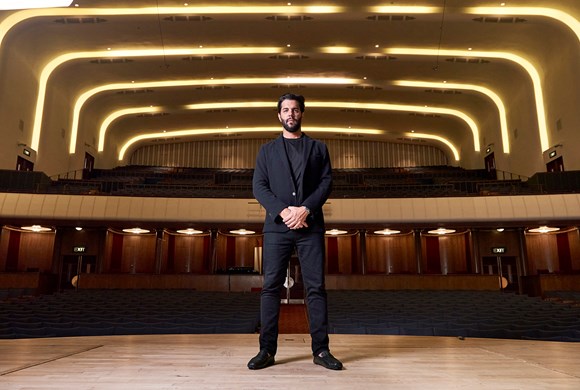
Talking Heads: Domingo Hindoyan

The new Chief Conductor of the Royal Liverpool Philharmonic Orchestra talks to Arcana about his appointment, the importance of an orchestra in its community and what he hopes to bring to the city of Liverpool.

interview by Ben Hogwood

It is a tall order indeed, following Vasily Petrenko onto the conductor’s rostrum at Philharmonic Hall, Liverpool. Domingo Hindoyan is the man chosen to fill the sizeable shoes of the Royal Liverpool Philharmonic Orchestra’s chief conductor, and he has joined Arcana to chat about the opportunities that lie ahead for him and for one of Britain’s finest orchestras.

He brings with him a positive energy, channelled through the most sonorous of voices. He could easily be mistaken for a baritone singer on this evidence alone, but his perspective as a conductor is brought immediately to the front. We begin by talking about one of his first appointments with the orchestra, his first Prom at the Royal Albert Hall in September this year. On the program were Dvořák’s Cello Concerto, with Sheku Kanneh-Mason as soloist, a new piece from Grace-Evangeline Mason (The Imagined Forest), Richard StraussDon Juan and finally Hindemith’s Symphonic Metamorphosis of themes by Carl Maria von Weber.

The concert received extremely favourable reviews and was a great experience for the Venezuelan conductor himself. “It was a unique moment, a special moment in my career and in my musical life. It was my first concert as chief conductor, and the very special atmosphere of the Proms is unique around all the concert halls in the world.”

We talk about his decision to end with the Hindemith Symphonic Metamorphosis. “It is a great piece, and I had a lot of fun working on it, especially comparing it to what Weber wrote with the piano pieces. It is very, very clever, and shows perfectly all the facets of the orchestra, stressing a little bit on the brass section and the percussion. We have a fantastic set of bells, so we could use them in the second Turandot movement. We had a lot of fun. There was of course a link between all these pieces, with the 20th century composers, Strauss and Hindemith, but also an American connection between Hindemith and Dvořák. It is probably not obvious, but we’re talking about two composers who were influenced by the plantation music and by American music. Dvorak was the first one who really developed that to another level, and in the concerto, you don’t see as much as you can in the New World Symphony or the American string quartet, but you have in the second movement all the elements of American music. Hindemith was impressed later with some jazz moments we have in the second movement.”

He speaks very fondly of the Strauss, too. “Don Juan is a masterpiece, a showpiece for the orchestra. It’s a very difficult piece for orchestras, though today a little less as the technical level of the Royal Liverpool Philharmonic is very high. When you are technically free as the orchestra is, it is a piece that has thousands of colours, situations and emotions that we can explore. Every time I conduct it, I find new things you can do. That’s why it’s a masterpiece – all masterpieces have this characteristic.”

Hindoyan recalls his first visit to Liverpool. “It was not that long ago, in summer 2019. I conducted Beethoven’s Seventh Symphony, among other pieces of course. It’s not an easy piece to start a relationship with an orchestra, because every orchestra knows it very well, but I remember that immediately the chemistry was right. The energy was right too, so we could really rehearse in a natural way, as if we knew each other from a long time ago. The second time was also very special, because I could play some Latin American repertoire with a colleague of mine, Pacho Flores, a Venezuelan trumpet player. This was where I conducted Don Juan for the first time with the orchestra, and then I did Stravinsky’s The Firebird. Since the beginning the relationship has been very natural, with a great chemistry. So far it is going very well!”

On meeting an orchestra for the first time, how does a conductor gauge their strengths and common ground? “That’s a very interesting question, because that moment is probably the most important moment together with the concert. I was an orchestral musician, and if you ask a musician how it is when a conductor is with them for the first time, they will always tell you they know after one minute, as soon as they stand on the podium, they know if things will be OK or not. From the conductor’s point of view, it is also the same. From the first upbeat, and the first two or three minutes, you feel how it will go. You are not like a football trainer, where you are going to analyse the team against you with videos and so on. I don’t do this, and I have never met a colleague who does it. After five minutes you understand the strengths and the weaknesses, and then start working your way through with your ear and with your version of the music, the score you have in front of you. You try to achieve the sounds and version you want. Sometimes you don’t even need to talk, you can go with a gesture alone. It is a very interesting side of this job, the psychological contact with and between the musicians. It’s magic, and thanks to the scores and the genius of the composers!”

Domingo is conscious of the city’s fortunate position in having the Philharmonic Hall at their disposal, and when I suggest there is a buzz for classical music in the city, he agrees. “I also felt it! The city is lucky to have its own concert hall, and the orchestra is lucky to have a concert hall where many things happen, and where it is the cultural reference of the city. It is not only the concerts of the Philharmonic, but it is the pop concerts, the small ensembles, the music room – many, many activities. The daily life, after the pandemic, is that almost every day something is happening. These walls are used to beautiful vibrations of music, but one of the things that attracted me most to the orchestra was the community work they do, and how they want to expand to the community what’s happening in the concert hall. It is a symbiosis, from the stage to the community but also from the community to the stage. People get to know the faces of the musicians, the conductors, the guest conductors, and so the orchestra is the baby of the city.”

Hindoyan speaks from personal experience. “I am Venezuelan, and I grew up in Venezuela. I was part of El Sistema, a huge organisation of more than one million people. I studied violin and then conducting in Geneva. We had the idea with the Geneva Conservatory of founding an El Sistema project in Geneva. This year is ten years since we did it, and it’s working very well. It has brought music to some neighbourhoods that would not normally play music. There are two beautiful orchestras, one aged 10 to 16, for beginners – and it worked very well. This is motivation, and in that sense it feels like home to me, because it’s not exclusively about the orchestra. It is about everything, what’s happening with the choir, the kids, the young and contemporary music, pop music. I feel at home in that sense.”

Some adventurous concerts lie ahead for the Royal Liverpool Philharmonic Orchestra and their new conductor, including an interesting coupling of a new symphony – Roberto Sierra‘s Sixth Symphony – as a companion for Beethoven’s Ninth. “I first met Roberto when I had to do the European premiere of his Trumpet Concerto, and I enjoyed it enormously to analyse the score and see how talented, clean and transparently he can write his ideas. My heart was even more involved because I see he writes with elements of Latin American music, and I love it. When I first asked him, I said, “Roberto, I’m doing Beethoven’s Ninth in my first concert in Liverpool, and how many symphonies do you have?” “I have five”, he said. “That’s perfect – you should write the sixth and do as Beethoven did in his Sixth Symphony, a Pastoral” He didn’t name it as a Pastoral, but it is exactly that, a Caribbean Pastoral. It is all about the nature in the Caribbean area, and in Latin America. The first movement is about the cities, the urban craziness of Caracas or Mexico City. The second movement is the Caribbean nights, and then we have a scherzo with a shape of the perfect pastoral symphony. He took the example of Beethoven throughout!”

There is a reunion with Pacho Flores, the trumpeter giving the European premiere of the Concerto Venezolano by Paquito D’Rivera in November. “I think bringing some of the Caribbean to Liverpool in October is a very good idea. This is what I want to bring in general, to bring more of the Latin American repertoire to Liverpool. We have great composers in Argentina, Venezuela and Mexico, for instance. Many of them were students of Copland, and I really want to play them more here. In building a program I found it better to mix with other folkloric music. I decided to take the Bartók Concerto for Orchestra and couple them together. I think for the ear it is better, because you can compare, and you have some freshness. The Bartók Concerto, as we said with the Strauss, is a showpiece for the orchestra too.”

Are there plans afoot for new recordings with the orchestra? “We have some plans. My colleague Vasily has left a great legacy, he has been doing a fantastic job for 15 years. I will record my beloved pieces, those I feel comfortable with, and those I want to explore. I will introduce a lot of the Latin American repertoire and American repertoire that has not been played so often, without excluding anything of the traditional repertoire, that I love myself and I conduct very often too. It is a wide range of repertoire, and we have great plans.”

He reveals that he spoke briefly with Petrenko, his predecessor, before beginning the job. “We did have a short conversation, and we will have a longer one soon, but I am already on the job. Time for conductors is crazy! I had a nice message of welcome, and I was touched to see his last concert on demand. It was a difficult last year for him though because he couldn’t achieve his last season as he wanted. I could not do the transition as we wanted either, so our really first concert with full orchestra was last Sunday.”

Hindoyan is grateful to have a full programme stretching in front of him. “Of course. Every country had its own regulations. My first concert with an audience was last March, with a small audience for the Detroit Symphony. Then in April I had a bigger audience in Utah, but then in Europe we started with a small audience, and here in Liverpool last June I had a very warm audience for the last repertoire we did here. We did Ravel’s Le Tombeau de Couperin, Berlioz Symphonie Fantastique and Stravinsky Octet, and the trombone concerto by Dani Howard. We had the audience but now finally we have 80 people on stage, and the choir for the Beethoven in October. Finally, we can do music as we used to.”

There is a positive side to be found from the pandemic, however. “I always try! There were two positive things for me. First was the discovery of plenty of repertoire, which didn’t get played very often. Second, the exposure of the orchestras online, with recorded video, was very important, so that people had access to the concerts whenever they want. Social distancing was difficult, but on the other hand it has increased the attention of the players and the conductors. You have to make an extra effort to play together, which means when you start playing close again it is easier. It’s like going to the gym and you have to lift 30 kilos, but in fact you your goal was only 20, That is very light when you lift 30!”

One benefit of the online concerts is the chance for those further afield to see orchestras they would not normally see. “You can watch orchestras in Japan or South America, you can go on tour without travelling! Of course I believe there is nothing like live performance, the energy is never the same. When it is filmed you gain something, especially with opera, but in a symphonic concert there is nothing like the acoustic of the concert hall and the feeling of the sound coming to you directly.”

Domingo Hindoyan conducts the Royal Liverpool Philharmonic Orchestra in Roberto Sierra’s Symphony no.6 and Beethoven’s Ninth Symphony (the ‘Choral’) on Saturday 16 October in Liverpool’s Philharmonic Hall. For tickets, click here

For more information on the orchestra’s 2021-2022 season, including the concert with trumpeter Pacho Flores, head to the orchestra’s website here

Alexander von Zemlinsky at 150

Today marks 150 years since the birth in Vienna of composer, conductor and teacher Alexander von Zemlinsky.

Zemlinsky is a figure of great historical importance in classical music, with a marked impact behind the scenes on the direction it was to take in the 20th century. In his early twenties, he caught the attention of Brahms, who was impressed with the Clarinet Trio published as a composer’s Op.3 in 1896. Around this time Zemlinsky also met Schoenberg, and then Alma Schindler, with whom he had an intense relationship. Their union was unexpectedly and suddenly broken in 1902, however, when Alma married Gustav Mahler.

Zemlinsky’s musical family tree is an intriguing one. As a teacher he mentored and encouraged Berg, Webern and Korngold. As a conductor he received unreserved praise from Schoenberg, Stravinsky and Weill. Stravinsky declared in 1964, “I do believe that of all the conductors I have heard, I would choose Alexander Zemlinsky as the most outstanding, and this is a mature verdict.” Schoenberg admired his “natural, unforced and obvious greatness”.

It is as a composer that we remember him here, however, for Zemlinsky’s music has not yet reached the audience it deserves. One of his greatest works, the Lyric Symphony made a strong impression at the Proms in 2016, and the Clarinet Trio was performed at the same festival this year. Those are just two of many fine compositions, however. Brahms was also impressed with Zemlinsky’s symphonic writing, and as an orchestral composer both his tone poem Die Seejungfrau and the Sinfonietta are fine works. The magical opening bars of the former, as heard in a new recording from the Royal Liverpool Philharmonic Orchestra and Vasily Petrenko for Onyx Classics, are to be treasured:

The four string quartets are also highly regarded, as is the output for solo piano, while another strong area for Zemlinsky was Lieder. Here there are many fine settings, perhaps the best of which are his 6 Songs after Poems by Maeterlinck of 1910-13.

The Spotify playlist below brings a number of these pieces together – while you can visit the Alexander Zemlinsky website to learn more about his life and work. Meanwhile a biography by Antony Beaumont, published in 2000 by Cornell University Press, is also highly recommended.

Talking Heads: Dov Scheindlin, Orpheus Chamber Orchestra

dov-scheindlin

Interview with Ben Hogwood

It’s another hot, sunny morning in New York, and Arcana is talking with violist Dov Scheindlin, a member and former director of the Orpheus Chamber Orchestra. The orchestra celebrate their 50th anniversary this year, and to mark the occasion Deutsche Grammophon have just issued all the ensemble’s recording for the label on a 55-CD box set. Dov has graciously given part of his early morning to talk about his time with the orchestra and some of their philosophies. We begin – naturally – by asking how the relationship started.

“I’d been a fan of Orpheus for a long time, and was a fan long before I was lucky enough to start playing with the orchestra. In 1988 I entered the Juilliard School. As a present I got my very first CD player, and I got a CD with it! It was the Orpheus Chamber Orchestra performing Dvořák Serenades. I listened to that CD, over and over, and it remains one of my favourites. That was the first time I really got to know Orpheus. Then I got to see them in Carnegie Hall a few years later, and the live experience was totally transforming. I was really lucky because I was living in London for six years, and when I came back from there in 2004 I was lucky enough to begin playing with the orchestra. I knew some people in common, and they were generous enough to let me come in and sub, and gradually it became a permanent thing.”

He has vivid memories of his first concert with the orchestra. “Oh gosh, yeah – we did something fiendishly difficult, which was the John Adams Chamber Symphony. Without a conductor it’s extremely complicated, with 15 moving parts, and I think they threw me in the deep end! I played principal viola, which was amazing to me because I was playing with them for the very first time. I think the idea behind Orpheus of shared responsibility, and seeking leadership, it meant they were good about allowing people to step into big roles right away. One of the things they wanted to find out was how you would do in that situation. It was a great experience. We took it on tour to a number of places and then we played it in Carnegie Hall. It was great fun. I don’t remember what else was on the programme but the Chamber Symphony sticks out in my mind, an amazing experience.”

The Adams, presented in that concert as a ‘one part per player’ version of the Chamber Symphony for the first time, is typical of the orchestra’s adventurous approach. Scheindlin agrees. “One of the things about the small orchestra is that we love our repertoire, but it is a bit more constrained – we don’t play Rachmaninov symphonies or anything like that. We’re always looking for things to play, and we actively commissioned new pieces for a formation of our size. One of the things we also do is to look to the existing repertoire to see what could be done, convincingly, musically and tastefully for an orchestra of our size. That broadens the repertoire, and the Adams was an example of that. There are more examples coming up in our next season, and we think of ourselves as trying to broaden the mission of the chamber orchestra.”

Scheindlin had a great deal of experience of membership with string quartets, which stood him in good stead for joining the orchestra. “Absolutely. That was one of the things that made it a really good fit. Orpheus is not ‘leader-less’, it’s ‘leader-full’. I think they’re looking for everyone to contribute. Occasionally a great player comes in, but doesn’t have anything to say, or is just looking to follow the leader, and that doesn’t work out as well. We’re really looking for people who can contribute ideas, bring ideas to the table, and we bring them all together and make them larger than the sum of the parts. Playing in a quartet, and having that experience of being responsible for 25% at least of the interpretation, has been great training for being in Orpheus. It’s about knowing when to contribute, when to sit back. It’s one of those subtle dances, because everyone has hundreds of opinions about everything. You need to pick the right moment to make your mark, and not overplay your hand. I think that people with a chamber music background do very well at Orpheus for that reason.”

Scheindlin finds the viola section a particularly stimulating place to be, right in the middle of the musical action. “It’s one of the things I love about playing the viola. Aside from the warm sound, and the timbre of the instrument, it is the position in the middle of the ensemble. It really makes you sensitive to everything that’s going on in the music. You’re not like likely to get lost at one end or the other. That’s another thing that’s been great for Orpheus, is that everyone knows the score very thoroughly. As the violist you’re right in the middle of the score, and what you’re playing often doesn’t make sense without having the whole context, so you’re constantly aware of all the other parts. You’re not just playing your part, you’re playing the whole piece – it’s just that you’re only sounding your own part. As a violist I love that.

As well as the DG box set, the Orpheus Chamber Orchestra has accompanied Brad Mehldau on a recent Nonesuch release, Variations. The recording was made some time ago, but has fond memories for Dov. “That was really fun. We did a whole tour of Europe, and he was such a low key personality, we were all kind of in awe of him. He would just sit down and focused, and when we played we felt like it was brand new every time even though it was a classically written out sort of piece. Although there I remember there were there there’s a cadenza in there I think where he did something totally different at the time and we were just sort of sat there in amazement. But yeah, that was a great experience with Brad Mehldau. I think we did that tour about 10 years ago, so I’m so happy to see that recording has seen the light of day.

Fast forward to performing in the light of a pandemic, and we start to talk about the experience of playing live while wearing masks, as the Orpheus Chamber Orchestra did recently in their concert of Haydn’s Seven Last Words. Scheindlin admits that performances can be compromised. “It’s a somewhat disembodied experience. I’m so glad for the existence of the masks, and they make it possible for us to play together, those and now the vaccines, of course. I’m not against them, but they are definitely an impediment to direct communication. That said, you get over it and we do a lot of eye contact. I got used to looking for people’s eyes, though you do feel like you’re missing part of the picture also sometimes. If the mask isn’t positioned properly it can affect your own perception of your sound, but you get used to it. Certainly we’d much rather play with masks than not play with them.”

It was clearly a thrill to return to the live environment. “Absolutely. We hadn’t played together in about six months, and finally in September we did our first live, chamber music concert. It was Egmont. My very first concert was a chamber music concert in the courtyard of a church. They had drawn circles in chalk on the lawn, and everyone was able to bring their own lawn chair to sit in there, maybe 50 people in all. It was a beautiful late afternoon, and we started with the Sextet from Richard Strauss’s Capriccio. It is such a beautiful, nostalgic and reflective piece, and something about it was just a transcending moment. I just felt so grateful and realised I would never take the experience of playing a live performance for granted again. The pandemic has obviously not been a net plus for humanity, but if there’s one thing I take out of it it’s rededicating myself to the power of what we do.”

Scheindlin speaks candidly about his own experience of lockdown. “It was a challenge,” he says frankly. “I have two young children, aged nine and six. When the pandemic came their schools closed down and we were suddenly teachers and chefs and all kinds of things that we’ve never been before. That took a tremendous amount of our energy, particularly the first six months up until September when school reopened, which freed up a little more time. It was a tough period, but it was great to spend more time with the family. I’m used to playing so many concerts at night, and my wife is a violinist as well, so also plays a lot at night. Three or four nights a week we wouldn’t be putting the kids to bed, but now suddenly we’re putting them to bed all the time! That part was nice, but having to stand over their shoulder while they did remote learning wasn’t that great, I’ll confess. It took up a lot of our energy. I made it an iron law to practice an hour a day. That was about the most I could consistently muster. I had to have that hour as a moment of sanity, a moment of focus and purpose when we didn’t know when we would get back to playing. I practised Bach Suites every day.”

He vividly recounts the start of lockdown. “I remember three or four days into it I got very shaken. They were starting to cancel things – the next few weeks, the next month – and then it became “Oh sorry, we’ll see you in the fall”, and I was wondering when is it ever going to change? Fortunately, with distancing, masks and amazing vaccines which I think I certainly didn’t expect to work so quickly, we’ve been able to get back together. It’s miraculous.”

With those revelations came an awareness of the orchestra’s importance in the community. “When we started performing again, the audiences were so grateful. Everyone was grateful, it was almost like a religious experience. One of the great things we did when we couldn’t be together in person was play a series of concerts, which we called reflections, on Zoom for audiences in elder care homes, and for people with severe medical issues and dementia. It was a great way to stay in touch with our audiences, to see the joy on their faces when they were able to hear music, even if they weren’t physically there. We did those fairly regularly, one person, or I would play with my wife. That was a great experience during the shutdown. We strive to serve and represent our community, and we’ve missed everyone, and we’re trying to reconnect right now and looking forward to next year when we can go back to performing in the places that we usually do.” A chance to celebrate the orchestra’s 50th anniversary, too? “Yes – and a personal recovery from when I turned 50 too!”

In celebration of the Orpheus Chamber Orchestra’s 50 years, Deutsche Grammophon have released a box set of all the ensemble’s recordings on the label. From experience, when you think you’ve heard every recording another one pops up that DG sneaked out in the 1990s, especially. “There is such a repository of amazing repertoire”, says Dov. “I’ve been digging into it myself.” We talk about shared favourites, such as the disc of Respighi pieces including Trittico Botticelliano. “That’s a great, lesser-known bit of repertoire that’s just beautiful music and which hasn’t seen the light of day. I’m not actually on it because it was before my time but I love that recording and am proud we brought that repertoire back.”

Asked for a personal favourite, Dov is quick in his response. “We recently did a Mendelssohn CD with Jan Lisiecki playing both Mendelssohn piano concertos. I know the first one but had never heard the second, and they are charming pieces. He does an amazing job. We also did the Italian Symphony, which is on the box, and that’s a piece we come back to again and again. The first chord makes me think of Orpheus straight away, and it’s great that we have it on CD now. There are so many that are really wonderful – the Ives recordings, the Stravinsky. There is such a rich bunch of stuff, and I hope we get to continue making them and finding new repertoire to bring forward.”

The orchestra is famous for working without a conductor, and I ask Scheindlin what the secret behind their success might be. Is it because they are a team of leaders? “I think so. There is a certain verve that comes from everyone interpreting a piece in real time without an intermediary. We’re all directly connected to the score and to each other, and we don’t need to follow a human metronome. There are great and inspiring conductors, and when you get to a certain scale you need one, but I think what makes our music making so fresh and live is that we’re all leading all the time and playing our hearts out.”

The forthcoming season is packed with exciting concerts. “We’re really excited about our tour with Branford Marsalis,” he says. It was supposed to happen this past year but we’re really thrilled it could be rescheduled. We’re doing our sort of first concert of Cuban-style music, with Arturo Sandoval, which should be really great, and we also have a tour coming up in in Japan with Nobuyuki Tsujii who we’ve also recorded with. We’ll be taking the Chopin concertos to Japan, assuming that we can still get around the world by then. We’re so happy to be coming Carnegie Hall, which we haven’t been in for a year and a half now. January will hopefully be a triumphant return! We’re optimistic for the season.”

There is clearly a thirst in New York for the return of live music. “Everything was so quiet for a year, and suddenly I’m getting calls all the time to play something next week! Suddenly people are deciding it’s possible and feasible to have live music again. I know there are these variants out there, and obviously we’re watching that, but so far the situation in New York is good and coming to life.”

With the orchestra committed to new music, have they received extra numbers of commissions? “It’s been tough for composers, because it would never have occurred to great composers of the classical time to write anything without an idea of when it would be performed. We’re actively bringing in new pieces next year, and we are continuing commissioning and we’re planning to commission for our 50th season in 2022 to 2023. That’s part of our mission, and we’re looking forward to getting back to that.”

For more information on the Orpheus Chamber Orchestra, head to their website. To hear clips from the Complete Recordings on Deutsche Grammophon, head to the label website, where you can also purchase the set, on 55CDs or as a download.

In concert – Aris Quartet play Schulhoff, Kurtág & Mendelssohn @ Wigmore Hall

Aris 5

Schulhoff 5 Pieces for String Quartet (1924)
Kurtág Officium breve in memoriam Andreae Szervánszky Op.28 (1988-9)
Mendelssohn String Quartet No. 3 in D major Op.44/1 (1838)

Aris Quartet (above, photograph (c) Sophie Walter) [Anna Katharina Wildermuth, Noémi Zipperling (violins), Caspar Vinzens (viola), Lukas Sieber (cello)]

Wigmore Hall, London
Monday 11 October 2021, 1pm

Written by Ben Hogwood (reviewed live from online stream below)

The Aris Quartet are part of the BBC Radio 3 New Generation Artists scheme, and this was their first appearance at the Wigmore Hall. They presented themselves as a lively ensemble who clearly enjoy their music, and they played with sensitivity and panache

Also revealed was a strong instinct for programming. Schulhoff’s 5 Pieces for String Quartet are beginning to make themselves known more in the concert hall, presenting as they do a number of sides of this unique musical personality. The Czech composer was arrested in Prague before he could be issued with a visa to emigrate to Moscow in the Second World War, and died at the Wülzburg concentration camp at the age of 48. His music is still relatively young in its exposure because of this, only really coming through in the 1990s. Initial criticism from those sceptical at his integration of jazz and dance forms is giving way to more outright respect, and – as could be seen here – the 5 Pieces make a great start to a concert.

The Aris Quartet gave a vibrant account of the first movement, marked Alla Valse viennese, but soon a chill was forming as the Alla Serenata progressed, its ghostly presence reminiscent of early Shostakovich. The muted instruments danced over a distracted drone from the cello before biting hard in a sequence that was almost anti-lyrical. There was an impressive cut and thrust to the Alla Czeca, bringing out the composer’s heritage, then an attractive sway to the Alla Tango milonga, beautifully played but with an unexpectedly ominous finish. Finally the buzz of the lively Alla Tarantella set a strong unison violin melody against brisk viola and cello.

Officium breve by György Kurtág was next, a requiem to fellow Hungarian composer Andreae Szervánszky. By his standards it is a lengthy piece indeed, but with 15 sections in barely 12 minutes it was packed with compressed melodies of great intensity. Kurtág is a master in obtaining deep expression from the shortest of phrases, achieving this through carefully pointed melodies and highly imaginative quartet textures. Such a thorough knowledge of string quartet capabilities informs the many sides of grief felt here, and the Aris Quartet reveled in the nuances of the piece. The gripping account took hold from the distracted opening, where cellist Lukas Sieber effectively set out the pitches of the open strings of hit instrument, to savage chords wrought with pure anger later on. The composer’s use of microtones was deeply expressive, as were the ‘double stopping’ passages, the quartet playing as one instrument with eight or more voices. It was a moving and mind-expanding performance.

A wholesale change of mood took us to Mendelssohn, and the joyous outpouring of the first in his trio of quartets published as Op.44. Anna Katharina Wildermuth’s songful first violin was key here, but so were the quartet textures, with lots going on but impressive clarity to reveal the dialogue between the instruments. This was a lovely, fluid performance, with a sunny first movement giving way to a less excitable but equally persuasive Menuetto, showing off its rhythms and soft-hearted theme. Feelings ran deep in the slow movement, especially in the minor key episode, where Wildermuth probed deeper with her phrasing. The finale recaptured the mood of the first movement, good spirits bubbling over to cap an affectionate and energetic performance.

It was great to see an ensemble playing as one with such obvious enthusiasm and commitment for the music, and based on this evidence the Aris Quartet have a bright future indeed. Watch the concert stream and see for yourself!

You can also listen to the repertoire from the Aris Quartet’s concert on this Spotify playlist:

For more information on the Aris Quartet visit their website

In concert – Oxford Lieder Festival celebrates Saint-Saëns with Elizabeth Watts, Victor Sicard & Anna Cardona, Fenella Humphreys & Martin Roscoe, Adèle Charvet & Anne Le Bozec

Various venues in Oxford, Saturday 9 October. Artists as listed below

Written by Ben Hogwood from online streams

The Oxford Lieder festival is into its 20th year, a cause for celebration indeed. It has become one of the UK’s finest classical music events, lovingly curated and produced but gathering increasing levels of enthusiasm every year.

The 2021 model is ideally weighted, with live music events streamed and recorded for posterity – an ideally weighted dual approach in these uncertain times. Titled Nature’s Songbook, it has set aside days for anniversary composers Saint-Saëns (100 years since his death) and the lesser-heard Swedish composer Wilhelm Stenhammar (150 years since his birth)

Saint-Saëns had his day on the Saturday, offering audiences a chance to appreciate his under-heard Mélodies in the context of better-known chamber and stage works, not to mention works by pupils and contemporaries. Baritone Victor Sicard & pianist Anna Cardona (above) were on first, the 2011 winners of the festival’s Young Artists Platform giving a recital from the ideal acoustic Saint John the Evangelist.

They began with a pupil and close friend of the featured composer. Gabriel Fauré was to become one of the very finest French composers of the 20th century, his output headed but not restricted to sublime contributions in the world of chamber music, piano and song. We heard his first published song cycle Poème d’un jour Op.21, a brief affair – which is ironic, since the subject of Charles Grandmougin’s verse was exactly that. Sicard found his feet in the slightly sorrowful first song, with an easily flowing piano part from Cardona. There was strength of character in the second, and wistfulness in the third as the day-long love affair fizzled out.

Saint-Saëns melodies followed and – as is often the case with this composer – hit the mark immediately. The attractive La Brise was secured by a rustic drone from Sicard’s left hand, which also gave its urgency to the next song. Emotionally the heart of this selection lay in La splendeur vide Op.26/2, which was followed by the Danse macabre, Saint-Saëns working with inner resolve. Perhaps it lacked a little edginess but a really strong connection between the two was clear.

Fauré’s pupil Ravel was next, and Sicard found the exquisite, timeless quality of Kaddisch, its melodic inflections beautifully expressed and contrasting with the questioning L’Énigme Éternelle. Following this was Histoires Naturelles, the ideal choice given the festival’s theme. Cardona had a strong descriptive role to play, with some lovely detail portraying Crickets, and The Swan too, which had strong characterisation. The Guinea Fowl’s ‘rowdy and shrill’ ending was perfectly judged by the pair – as was an exquisite encore of Chanson française.

Later we further examined the link between teacher and student in the Jacqueline du Pré Music Building, as violinist Fenella Humphreys and pianist Martin Roscoe played sonatas by Saint-Saens and Faure. In an aside to the audience, Humphreys revealed it was the first time the duo had performed the Saint-Saens Violin Sonata no.1 in D minor Op.75 (1885), realising a long-held dream of playing a work in public she had loved since childhood.

The closer acoustics of the hall took a little while to adjust to – certainly on the live stream – but it was easy to admire the duo as they met the challenges of the busy first movement head on, getting beneath the tumultuous phrases to the deeper emotion below. The softer-hearted second theme, a chorale, with rippling arpeggios from the piano, reminded us that the Organ Symphony was not far off – and it was beautifully rendered here. A keenly felt Adagio led to a balletic third movement, initiated by Roscoe’s nicely pointed piano part. There was however a strong sense of everything pointing towards the finale. Its tremendous technical demands were comfortably conquered, but again the music’s feeling won the day, Humphreys playing winsome long phrases. Both players enjoyed the return of the ‘chorale’ theme, but also the peal of bells evoked by Roscoe from the piano.

Fauré’s Violin Sonata no.1 in A major Op.13 is an early work, written nine years earlier, when it was given a glowing review by his teacher. Humphreys spoke affectingly of its significance during lockdown, and it was clearly a tonic for her to be playing it again. The two players dovetailed beautifully, Roscoe’s flowing introduction picked up seamlessly by Humphreys’ lyrical phrases. The slow movement took time for deep thought, its gently undulating piano a foil for the violin’s probing melodies, gradually building to a deeply felt apex. The scherzo was winsome, its syncopations tripping over each other happily. An ardent account of the fourth movement found the players deep in conversation, right up to the end of this richly rewarding piece. It is difficult to write about what makes Fauré such an attractive composer – his gifts are plentiful but elusive – yet this performance had all the qualities that so impressed his teacher.

A strong cast of thirteen musicians assembled for a pair of concerts in the Saint John the Evangelist church. They were led by soprano Elizabeth Watts, and baritone Felix Kemp, with pianists Jâms Coleman, Martin Sturfält joined by principal players of the Echor Chamber Orchestra (Anna Wolstenholme (flute / piccolo), Jernej Albreht (clarinet), Owen Gunnell (percussion), Jonathan Stone and Sara Wolstenholme (violins), William Bender (viola), Nathaniel Boyd (cello), Laurence Ungless (double bass)

It is funny to think Saint-Saëns prohibited performances of Le Carnaval des Animaux in his lifetime, for fear of being dismissed as a frivolous composer. In the event the suite was published a year after his death, and the piece has had an enduring appeal ever since. The Oxford Lieder edition recognised that appeal but interspersed his suite with an array of animal-based songs from contemporaries and countrymen, together with short readings from nonsense verse by Ogden Nash.

The programme was brilliantly conceived but was too big, including a total of 17 songs alongside the Carnival without a break, meaning the flow was difficult to pick up at times. That said, the imaginative set of works largely succeeded thanks to the artistry on stage. Watts’ versatility was evident in the oppressive heat of Chausson’s La Caravane, its powerful vocal line in thrall to Wagner, and also in the amusing tale of La Cigale et la fourmi as set by Offenbach, with some brilliant high notes at the end.

There was a striking duet between Watts and flautist Anna Wolstenholme, portraying Roussel’s Rossignol mon mignon, before the soprano found the nub of Hugo Wolf’s solemn Wie lange schon war immer mein Verlangen. Felix Kemp was an effective foil, capturing the micro portraits of animals as realised by Poulenc from Apollinaire’s poetry, as well as Britten’s elusive Fish in the unruffled lakes.

The Carnival itself was a huge amount of fun. From the boisterous Introduction and Royal March of the Lion onward, it was nice to see the performers enjoying themselves in this irrepressible music. Double bassist Laurence Ungless caught the character of The Elephant, lumbering into view, while The Swan was beautiful and effortless in the hands of Nathaniel Boyd. Pianists evinced some ready laughter, before we returned to Watts for the rather lovely final song, Grieg’s own portrayal of the swan, which found her using a third language of the evening. The Echor soloists wrapped up with a celebratory finale, putting the cap on a concert which may have been too long, but which was ultimately enjoyable.

A packed day ended with a late evening recital from Adèle Charvet & Anne Le Bozec. Subtitled Mélodies on Tour, their program began with three English-language songs – two about sleep from Gounod, by turns perky then lustrous, with a setting of Longfellow’s poem Sleep. Saint-Saëns himself was next, evoking a heady atmosphere with A Voice By The Cedar Tree but then agitated in La mort d’Ophélie, where Charvet held an impressively strong tone.

The recital alternated songs by our chosen composer with a well-chosen selection of eight songs from Pauline Viardot, to whom Saint-Saëns dedicated his opera Samson et Dalila. Her song Lamento was the most directly communicative song, and an indication of why she is finally starting to get the exposure she deserves in a male-dominated field. Noch’Yu, one of two Pushkin settings, was evocative in this setting, but the pick of the eight was Aimez Moi, which brought a rapt stillness to proceedings.

Saint-Saëns‘ two settings of Uhland featured a striking piece of writing in the low register during Antwort, very well handled by Charvet, then the composer exaggerating his feelings rather in Ruhetal. Later we heard Guitares et Mandolines, the composer relishing the chance to depict the instruments in Anne Le Bozec’s deft accompaniment. The agitated Tournoiement spun itself into an eternal whirlpool.

There was time for two songs from Massenet, another underrated songwriter – his Crépuscule and Nuit D’Espagne expertly crafted examples, the latter with a Habanera-like profile – to which we returned in Viardot’s Madrid. The context of these night-time songs helped put the seal on a fascinating and richly rewarding set of concerts, showing the strength of depth French composers have to offer.

For further information on this year’s Oxford Lieder festival, you can visit the event’s website here