Live review – Nicola Benedetti, Royal Scottish National Orchestra / Thomas Søndergård: Polska Scotland opening concert

nicola-benedetti-rsno

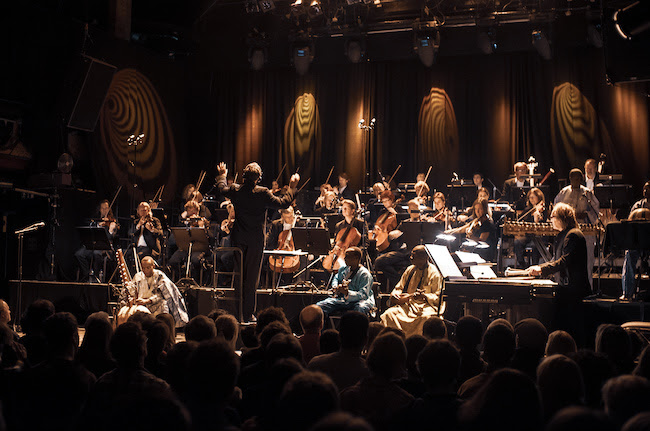
Nicola Benedetti (violin, photo by Martin Shields), Royal Scottish National Orchestra Thomas Søndergård

RSNO Studio, Glasgow
Broadcast Friday 16 April 2021, available online until Friday 30 July 2021

Weinberg Rhapsody on Moldavian Themes Op.47/1 (1949)
Szymanowski Violin Concerto no.1 Op.35 (1922)
Panufnik Sinfonia Sacra (Symphony no.3) (1964)

Written by Ben Hogwood

The first concert of the Royal Scottish National Orchestra’s Polska Scotland season provided a tempting mix of 20th century pieces. The season is exploring connections between the two countries, and watching the accompanying video (at the bottom of this page) reveals a number of interesting and pertinent connections, not least in the orchestra itself.

The choice of repertoire here was refreshing, too. Szymanowski’s Violin Concerto no.1 is more of a regular repertoire piece these days, but the same could certainly not be said of the inclusions from Mieczysław Weinberg, the Polish composer who found his way to Moscow in the 1940s, and Andrzej Panufnik, who fled Warsaw for London ten years later.

Weinberg’s parents moved to Poland from Moldova in 1916, and this concert began with the composer’s Rhapsody on Moldavian Themes, exploring the heritage of his parents through the development of contrasting folk tunes. In this way he was following the lead of folk-based pieces for orchestra from the likes of Kodály, Enescu and Bartók, relishing the chance to project and develop the music of their home countries through the concert hall.

The RSNO strings were appropriately deadpan at the start, their cold and muted contributions expertly controlled and matched by suitable lighting in the hall. The woodwind gave heartfelt, soulful contributions, as did the orchestra leader, violinist Sharon Roffman, and these led to thrills and spills as the RSNO powered through the faster sections, urged on by Thomas Søndergård.

Polska-scotland

Nicola Benedetti was the soloist in Szymanowski’s Violin Concerto no.1, a piece she started to play at the age of 16. Having lived with it for approximately the same length of time, she noted the increased popularity of the piece – and talked through how conductor Sondergaard’s vision of the music was slower than hers, giving her a renewed perspective.

The violin emerged rather magically from the brief but colourful orchestral introduction and dominated almost throughout, rich of tone and with extremely secure intonation. The vivid colours were an overriding feature of this performance, Søndergård achieving a sound balance between soloist and orchestra, but within the ensemble he probed the deeper shades of Szymanowski’s lyrical writing. Benedetti was passionate and driven, the searing high notes carrying easily above the orchestra and then doing their own work in ardent outpouring of the complex cadenza. Søndergård gave the piece more room than it normally receives, but this was to its benefit – and the capricious ending was beautifully weighted.

First violinist Jane Reid then recounted a Polish tour for the orchestra in 1978, which opened with Panufnik’s Sinfonia Sacra, receiving its first performance in the country. It was a daring choice from conductor Sir Alexander Gibson, given the composer’s departure for London in 1954, but Reid’s vivid account spoke of tears in the Warsaw audience. Indeed, it is hard to understand why the piece is not performed more today – given the Weinberg revival of late, the music of Panufnik is just as deserving.

This performance from the RSNO was intensely moving. The powerful opening fanfares of Vision I from the brass were razor sharp, and cut to an equally heartfelt Vision II from the strings, icy cold music of solemn countenance. This was blown apart by Vision III, where driven percussion gave way to onrushing strings the surging brass in music of dissonance and disquiet. The contrast with the final Hymn was even greater, the strings united again in a cold chorale, but gradually the music thawed and grew in power.

Sondergård expertly marshalled this section and its steady build, taking a broad tempo but controlling the unwavering intensity of Panufnik’s writing. The brass fanfares were resolute, but the final statement of the hymn had great resolve, an ultimately triumphant end – even if the dissonances remained, defiant to the finish.

This was a superb start to a season which promises much, with works to come from Lutosławski, Bacewicz and more Szymanowski – Nicola Benedetti will return to play his Violin Concerto no.2. On this evidence, all the online concerts are highly recommended.

You can watch the concert on the Royal Scottish National Orchestra website here

For more information on the Royal Scottish National Orchestra digital season, you can visit their website here
Switched On – Late Night Tales: Jordan Rakei (Late Night Tales)

late-night-rakei

reviewed by Ben Hogwood

What’s the story?

Relaxation lies at the core of the latest addition to the Late Night Tales series from Jordan Rakei. The soulful singer, born in New Zealand but now living in the UK, has reached into his contact book for a selection of tracks from friends and associations who make music to recline to.

What’s the music like?

As the blueprint above implies, this is great music for horizontal listening – and Rakei gets a wonderful variety of styles into his choices.

The nocturnal jazz of Alfa Mist‘s Mulago is a great inclusion, coming as it does after Covering Your Tracks, a typically moody inclusion from singer-songwriter Fink. Jazz is also at the heart of Idiom, a classy collaboration between Joe Armon-Jones, Maxwell Owin and Oscar Jerome, The smoky down tempo soul of Charlotte Day Wilson‘s Mountains is a nice contrast, as is the consoling Count A Heart, where Rakei provides guest vocals for Moreton. Meanwhile frank intimacy lies at the heart of Puma Blue‘s Untitled 2.

Rakei also includes windswept tracks from the consistently strong C. Duncan (He Came From The Sun), the descriptive Seapoet (Eviternity) and a rather special track from Homay Schmitz, Speak Up.

As is traditional in the series there is a contribution from the mixer themselves, but here we have two more from Rakei – a softly glowing cover of Jeff Buckley‘s Lover, You Should’ve Come Over, and a slow burning, piano-led number in Imagination, before the mix ends with the traditional spoken word outro, film director Alejandro González Iñárritu reading Rakei’s own lyrics to Imagination.

Does it all work?

It does. Rakei has put a good deal of thought into this selection and the order in which it unfolds, resulting in a compilation where the skip function will not be needed. As with every good new mix there are some new names alongside the familiar, some new discoveries to be had.

Is it recommended?

Wholeheartedly. This is an extremely listenable set from one of British soul music’s finest young talents, proving that Jordan Rakei has a great awareness of the music around him as well as his own.

Stream

Buy


On Record: Toumani Diabaté & London Symphony Orchestra: Kôrôlén (World Circuit)

diabate-lso

reviewed by Ben Hogwood

What’s the story?

This is the second cross-genre collaboration for the London Symphony Orchestra to be released in as many months, following on from their successful work with Floating Points and Pharoah Sanders, already getting plaudits as an album of the year contender. However this issue of a concert with Malian Toumani Diabaté and his ensemble dates from 2008, another of the kora player’s efforts to bring African music to new audiences.

With arrangements from Nico Muhly and Ian Gardiner, the 21-string kora is set alongside contributions from other Malian musicians and the fulsome presence of the London Symphony Orchestra, bringing forward music that, as Diabaté says, has a tradition stretching back beyond the music of Bach. Ultimately his vision is that we ‘look at African music in a new way’.

What’s the music like?

Rather wonderful. The early exchanges of Haïnamady Town establish the sound world of the kora and orchestra, with an opening solo from Diabaté showing off his fluid and sensitive playing. The serene strings provide colour around the edges, dressing the material rather than dominating it, but as the suite progresses the orchestra takes a more prominent role.

diabate-lso-2

Balafonist Lassana Diabaté comes to the fore for Mama Souraka, a response to the kora that brings fresh, outdoor energy to the music. Attractive woodwind colours are the feature of Elyne Road, which segue to an attractive round that develops. Cantelowes Dream is a longer sequence, where Diabaté takes longer phrases, spinning them above held strings and gently undulating balafon. The music pauses in the middle, giving room for dialogue with the flute.

Moon Kaira has extra propulsion with a recurring bass motif and solos from kora and marimba, and is ultimately taken over by joyful string motifs. Mamadou Kanda Keita provides a fitting climax, beautifully sung by Kasse Mady Diabaté in the first vocal of the album, rapturously received by the Barbican audience.

Does it all work?

In every way. Many collaborations between electronics, jazz and / or symphony orchestra miss the mark because of balance issues, with everything turned up too loud or with too many notes given to too many instruments, or because one or more of the musical parties are not on the same wavelength. This makes Promises all the more remarkable, for even the LSO strings, adding their contribution a year hence, are fully in the moment.

The ‘less is more’ approach of this collaboration pays off in every way. Sure, the music is slow moving, but that is an essential part of its appeal, a meditation for large forces securing the most intimate of responses.

Is it recommended?

Yes, provided the piece is experienced as one. Gardiner and Muhly’s arrangements are nicely weighted, giving the right amount of balance with the African instruments and only occasionally threatening their clarity. The brightness of the wind instruments and softness of the strings complements the studied, picked timbres of the kora. Conductor Clark Rundell gives the music all the room it needs, lending the exchanges an instinctive, almost improvised quality.

Stream

Buy

You can find out more about the release and purchase from the World Circuit website


Switched On – Erik Levander: Jökel (Glacial Movements)

erik-levander

reviewed by Ben Hogwood

What’s the story?

‘Jökel’ is the Swedish word for glacier, with its roots in the Icelandic word ‘Jökull’. It is an entirely appropriate title for Erik Levander’s latest album, borne out of a visit to the Mýrdalsjökull glacier in Iceland (seen below). He crafted a clutch of imaginary field recordings from the visit, inviting the listener to join him on a natural journey around and through this natural phenomenon.

What’s the music like?

Among his plentiful output, this will surely be one of Levander’s more minimal albums to date. Yet that is an entirely valid approach as he looks to capture the slow, incremental progress of the glacier, while also recognising the fact it sits on top of a volcano.

There are no melodies as such here, but the five tracks are compelling as they slowly develop in front of the listener’s ears. Tröskel (Threshold) has an ominous knocking sound that reoccurs as though natural bumps were going on that could lead to something much more substantial down the line. This is a theme developed in the longer Expansion, where the sound widens its perspective and more obvious pitches appear, winding outwards and upwards. This is quite chilling on headphones, before the comfort of the sounds submersed in thick ambience, as though wrapped up in ice.

Myrdalsjökull_01From there we move to Avstånd, where it is possible to discern pieces breaking off the main flow, the ambience still thick behind, before hissing and dripping sounds start to dominate the treble, again a spooky effect on headphones. Yta introduces the most definite pitches we have heard so far, rooted to a single chord initially but then changing to a pitch laden with overtones as the perspective changes. Finally, Massa (Mass) draws back a bit, letting us appreciate the sheer size of the construction, the wind audible over the snow and ice.

The five tracks last just over 50 minutes, and are definitely best heard as a whole in order for the listener to walk with Levander along the edge of this remarkable construction.

Does it all work?

Yes. Levander’s soundscapes are remarkably descriptive, sending a shiver of cold down the spine. This is not comfortable music, and when the listener has the subject matter to hand it is easy to think of the anguish involved with the melting of our glaciers. Levander successfully portrays his subject but with a fair bit of discomfort involved.

Is it recommended?

Yes. Jökel sits comfortably within the spectrum of the Glacial Movements label, and is a compelling document of a visit that clearly had a strong emotional effect on the Swedish artist. 

Stream

Buy


Listening to Beethoven #143 – Neue Liebe, neues Leben WoO 127

Neue Liebe neues LebenPeanuts comic strip, drawn by Charles M. Schulz (c)PNTS

Neue Liebe, neues Leben WoO 127 for voice and piano (1798-99, Beethoven aged 28)

Dedication not known
Text Johann Wolfgang von Goethe

Duration 3′

Listen

Background and Critical Reception

The third of Beethoven’s songs thought to be written in 1799 – and the third different language!

Susan Nouen, in some impressively detailed notes accompanying Signum’s disc of Beethoven Lieder with Ann Murray, recounts the composer’s history with this particular song. ‘The words…were borne of Goethe’s brief betrothal for some months in 1775 to Anne Elisabeth Schönemann’, who he nicknamed ‘Lili’. Their engagement ran into trouble because of her social circle, but her presence stayed with the poet. ‘She was the first woman I truly and deeply loved’, he said. ‘I can also say that she was the last’.

Beethoven identified strongly with this poem, setting it first in sketches in 1792, then this version, and then his final encounter with the text as Op.75/2.

Thoughts

A song of great urgency and concentrated feeling. Most of Beethoven’s writing is for the upper range of the tenor voice, and with quite short notes too – the singer is not allowed to rest at any point. Although in C major the song has no sense of repose, and Goethe’s words are delivered almost breathlessly. It will be interesting to see the music Beethoven finally brings to this text, for this is restless and less than comfortable.

Recordings used and Spotify links

Peter Maus (tenor), Hans Hilsdorf (piano)


You can chart the Arcana Beethoven playlist as it grows, with one recommended version of each piece we listen to. Catch up here!

Also written in 1799 Salieri Falstaff o sia Le tre burle

Next up Piano Sonata no.9 in E major Op.14/1