Listening to Beethoven #32 – Primo amore

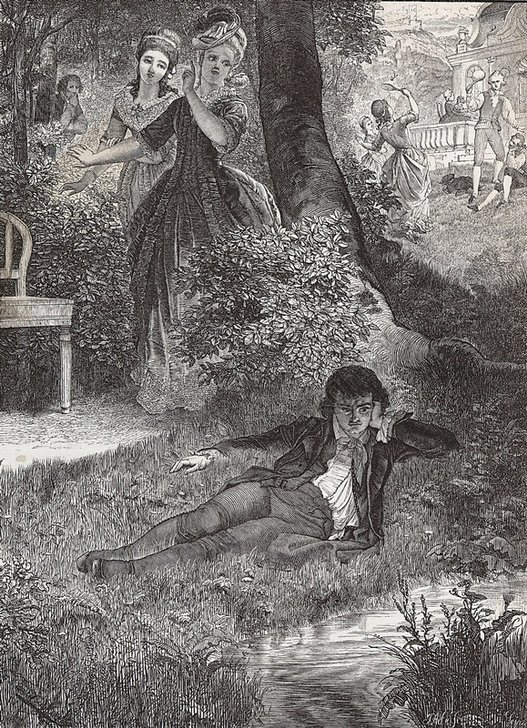
Beethoven and Jeannette d’Honrath (Bonn 1785: the young Beethoven at the house of Hofrätin Helene von Breuning; first love for Jeannette d’Honrath, later Greth by marriage).
Woodcut, 1865, after drawing by Wilhelm Lindenschmit (1829-1895).

Scena ed aria ‘Primo amore’ for soprano voice and orchestra (1790-2, Beethoven aged 21)

Dedication not known
Text Anonymous
Duration 15′

Listen

Background and Critical Reception

Primo amore is a passionate aria for soprano and orchestra, a single unbroken scene of a quarter of an hour. It was not published until 1888 – and initially it was thought to have been written in Vienna while Beethoven was studying with Salieri. However more recent, forensic analysis of the autograph score dates it to 1790-92, late on in his time at Bonn.

The aria sets an anonymous text on the subject of early love, and given its emotion surprisingly little is written about it by scholars of the composer. The focus is thought to have been soprano Magdalena Willmann, a daughter of Beethoven’s neighbour in Bonn, who had an unusually low range – or even Jeanette d’Honrath, described by the Bonn physician Franz Gerhard Wegeler as ‘a beautiful, vivacious blonde, of good upbringing and friendly character’.

Writing about the aria in the booklet notes for her recent disc of Beethoven vocal music, soprano Chen Reiss describes how Primo amore ‘displays a startlingly mature way of looking at love’s complexities, with its disjointed structure, inner turmoil and restlessness. The music – both instrumental and vocal – is strange, almost brutal in comparison with that of his contemporaries’.

Thoughts

The text for Primo amore is matched by Beethoven’s lovelorn music. ‘Primo amore, piacer del ciel! Penetrasti il mio cor’ (‘First love, joy of heaven, you penetrated my heart’). The soprano sings with long notes, often well above the accompaniment of a smallish orchestra. As the aria progresses so the mood becomes more fraught, the orchestra less controlled – and the lasting impact of this first love is laid bare.

Beethoven asks his soprano to cover a lot of ground, with lower notes in the opening pages but much greater heights later on. The writing feels very instinctive, the composer responding keenly to the text with music of broad phrases and great feeling. In the process he echoes some of the soprano writing in the Cantata on the death of Joseph II. Here, as in that piece, the singer is almost completely dominant – and the piece leaves a lasting impression.

Recordings used

Chen Reiss (soprano), Academy of Ancient Music / Richard Egarr (Onyx Classics)
Reetta Haavisto (soprano), Turku Philharmonic Orchestra / Leif Segerstam (Naxos)

Chen Reiss is a fervent devotee of Beethoven’s music for voice and it shows as she completely inhabits the loss and sorrow of the writing. Her beautiful tone soars effortlessly above the well-matched phrasing of the Academy of Ancient Music, who bustle along into the aria’s second section.

Reetta Haavisto, in another new recording for Naxos, sings in a much broader view of Primo amore, complete with expansive introduction from the Turku Philharmonic Orchestra under Leif Segerstam. Her voice has a creamy tone and is beautifully controlled.

Both sopranos hit the highest notes of the aria with some aplomb and manage the demanding range of Beethoven’s vocal writing impressively.

Spotify links

Reetta Haavisto, Turku Philharmonic Orchestra / Leif Segerstam

Chen Reiss, Academy of Ancient Music / Richard Egarr

You can chart the Arcana Beethoven playlist as it grows, with one recommended version of each piece we listen to. Catch up here!

Also written in 1792 Cimarosa – Il Matrimonio Segreto

Next up Trinklied
On record – Aurora Orchestra / Nicholas Collon: Music of the Spheres (DG)

Pekka Kuusisto (violin), Iestyn Davies (countertenor), Sam Swallow (vocalist), Aurora Orchestra / Nicholas Collon

Mozart Symphony no.41 in C major K551 ‘Jupiter’ (1788)
Richter Journey (CP1919) (2019)
Dowland arr. Muhly Time Stands Still (1603)
Adès Violin Concerto ‘Concentric Paths’ (2005)
Bowie arr. John Barber Life on Mars? (1971)

Deutsche Grammophon 4838228 [69′]

Recorded 9 June 2019, Maida Vale Studio 1, London

Written by Ben Hogwood

What’s the story?

Only the Aurora Orchestra could put together an album running from Mozart to David Bowie. Yet as we have seen from their previous themed releases such as Insomnia and Road Trip, there are no gimmicks involved in their musical choices and a clear theme runs through the programming.

Music of the Spheres is no exception, beginning with Mozart’s Jupiter symphony before music from Max Richter (Journey), Dowland via Muhly (Time Stands Still) and the Violin Concerto of Thomas Adès, subtitled Concentric Paths. The soloist here is Pekka Kuusisto, while the Aurora play the Jupiter symphony entirely from memory, as they did in the BBC Proms in 2016.

What’s the music like?

There is something for everyone here. Mozart’s Jupiter symphony is his 41st and final essay in the genre, setting a new bar for the form when it was completed. While the first three movements are particularly fine it is the finale that comes in for the greatest acclamation, for its well-nigh perfect fusion of melody and counterpoint.

Richter’s Journey CP1919, is inspired by and named after the discovery of the first Pulsar star. It fits perfectly onto the tail of the Mozart, running at a slow speed and operating in C minor rather than the earlier piece’s key of C major.

By contrast Adès’ Concentric Paths operates in a wider orbit, the violin soaring at great heights over the compelling orchestral writing, which has in its spiralling strong echoes of the music of Benjamin Britten. As soloist Pekka Kuusisto has described, ‘it’s hyper-emotional music for people in an accelerating world’.

Complementing these instrumental pieces are two songs of identical length but very different form – a serene early 17th century song from Dowland and one of the best-known pop songs of the 20th century. Having heard from Jupiter and CP1919, Sam Swallow asks, to effective arranged accompaniment, is there Life On Mars?

Does it all work?

Pretty much! The Jupiter gets an athletic performance from the Aurora Orchestra – no dallying here, or lingering on expressive notes. That does mean a darkening of the slow movement, and maybe some constricted phrases, but by contrast it means an exciting first movement, a mysterious Menuetto and a lithe finale, busy and brilliantly played.

The Richter is haunting and really effective, its simplicity leaving the orchestra plenty of room to create a remote atmosphere. The songs are great too – Iestyn Davies is the perfect choice for the Dowland, with Nico Muhly’s sensitive orchestration, while Sam Swallow puts his own stamp on Life on Mars? without losing the essence of the original, which is an impressive achievement.

Yet the performance I kept coming back to was Pekka Kuusisto’s white-hot rendering of the Adès. This is terrifically difficult music to play, but he makes it sound easy even at the highest points of the violin range, and the moods range from serenity to power and even anger as the music moves relentlessly forwards. On occasion I have to admit I find Thomas Adès music hard to relate to emotionally, but this is a clear exception and the music digs deep.

Is it recommended?

Yes. The Aurora’s albums are great at bringing music of very different origins together, exposing new elements and old qualities, and it does so again here. Freshly minted Mozart and brilliantly played contemporary works, plus a good deal of imagination. What’s not to love?

Listen

Buy

You can purchase this recording from various digital outlets via the Presto website

Switched On – Bing & Ruth: Species (4AD)

reviewed by Ben Hogwood

What’s the story?

Species is the fourth album from Bing & Ruth, the New York-based project where the ever-present is David Moore. Previous album No Home Of The Mind was largely powered by flowing piano textures, but this time around the outlook is very different. As the cover art implies, the album was made in a hotter, drier climate, and this is reflected in the instrumentation. Moore wrote the music on a Farfisa organ, hooking up with friends playing clarinet (Jeremy Viner) and acoustic bass (Jeff Ratner).

What’s the music like?

This incarnation of Bing & Ruth feels more static than the previous model in terms of its harmonic and melodic movement. Yet it is every bit as compelling, and tracking the development of each track is a little like listening to the earlier Philip Glass of the Dance Pieces.

The colours are immediately appealing as Body in a Room and Badwater Psalm reveal. Time seems suspended in space as compact figures and loops oscillate on the Farfisa, spreading out over long, held pedal notes that support the framework. Moore sets out this deceptively simple material in a way that works really well, bringing out different and intriguing phasing effects from the mellow tones of the organ that prove very pleasing to the ear.

I Had No Dream emits a brighter light as Moore moves to the instrument’s upper register, but in response the short Blood Harmony gives out mellow, sonorous strokes. This prepares the listener for two tracks comprising half the album’s length. Live Forever develops a warm, reassuring loop of consonant harmony, blissfully layered and with beautiful mottled textures. The Pressure of this Water leads straight on with greater movement, its figures dancing in the mind’s eye.

Finally Nearer holds still, its relative lack of moment revealing a heart of greater substance, Moore’s simple bow strokes soft but emotionally penetrating.

Does it all work?

Yes. The longer pieces are the most effective, showing that Moore has really mastered the art of pacing a track that lasts almost a quarter of an hour while keeping it compelling to the listener. It is fascinating tracking the development of the material…but it is equally rewarding to zone out completely and allow the developments to take place in the background and set the mood.

Is it recommended?

Yes. David Moore has opened a fascinating new chapter of Bing & Ruth’s sound by switching to a different keyboard, one that wholly complements the previous piano-based work. Species is both intimate and expansive, so it will prove fascinating to witness it in a live environment – which, COVID-19 permitting, we should be able to do in the UK in December.

Stream

Buy

You can read an interview with David on Arcana in the next few days…and in the meantime enjoy the playlist he put together for us

Listening to Beethoven #31 – Flute Sonata in B flat major


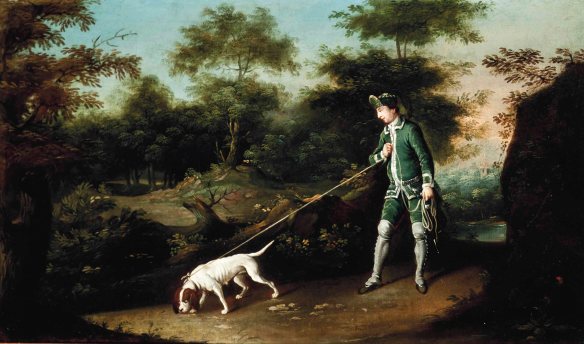
Gentleman walking a hound in a wooded landscape (Unknown, German school, late 18th century

Flute Sonata in B flat major Anh.4 (1790-92, Beethoven aged 21)

Dedication unknown
Duration 25′

Listen

Background and Critical Reception

This substantial four-movement work was found amongst Beethoven’s papers after his death, and was not published until 1906. Despite its location, there are a number of doubts over the authorship of the piece – which appears not to have been in Beethoven’s own handwriting, according to biographer Alexander Thayer.

Barry Cooper, writing in the ‘Rarities’ booklet accompanying DG’s New Complete Edition of Beethoven, makes several useful points. He notes a ‘few awkward moments that could betray inexperience’, and says ‘its authenticity cannot yet be excluded completely, if it is a very early work’. Yet in the other corner there are ‘far fewer articulation markings than in even Beethoven’s earliest known works’, and the scribe ‘was also the composer’, which for Cooper offers the final proof that Beethoven was ultimately not involved.

If it was indeed Beethoven who wrote this work it is thought it would date between 1790 and 1792 – which would plausibly make the dedicatee the flautist son of the Westerholt-Gysenberg family, who Beethoven had included as part of his equally substantial Trio for Flute, Bassoon and Piano a few years earlier.

Thoughts

This substantial piece is quite hyperactive in its first few minutes, when it feels like there are too many notes, but the mood is bright and positive. The music gradually settles, passing through quite an adventurous development section where the dynamic changes, from quite a pastoral mood which then darkens as Beethoven shifts into the minor key.

The second movement, a Polacca, sets out on a strident path, in the same key of B flat major. Both instruments are close together, complementing each other’s melodic movements. The theme is a bit more rustic but the polonaise attributes are not obvious.

The slow movement brings the music to rest, and offers a change of scenery in E flat major. The final movement finds the players close again for a bright theme on which the players then expand with four variations. Even the minor key variation, the third, doesn’t really cloud the sunny exterior too much. By Beethoven’s standards so far it does feel like a relatively standard theme and variations, but they end with a flourish and a relatively restful coda.

Recordings used

Michel Debost (flute), Christian Ivaldi (piano) (Warner Classics)
Emmanuel Pahud (flute), Eric Le Sage (piano) (Auvidis Valois)
Severino Gazzelloni (flute), Bruno Canino (piano) (DG)

A trio of excellent performances here, each of which serves the sonata very well. The top choice by a whisker would be the ever-stylish Emmanuel Pahud and Eric Le Sage, though Severino Gazzelloni and Bruno Canino run them close with their close-knit partnership, which is particularly beautiful in the slow movement.

Spotify links

Michel Debost, Christian Ivaldi

Emmanuel Pahud, Eric Le Sage

Severino Gazzelloni, Bruno Canino

You can chart the Arcana Beethoven playlist as it grows, with one recommended version of each piece we listen to. Catch up here!

Also written in 1792 Haydn Symphony no.98 in B flat major

Next up Primo amore piacer del ciel

Listening to Beethoven #30 – 2 Sonatinas for Piano


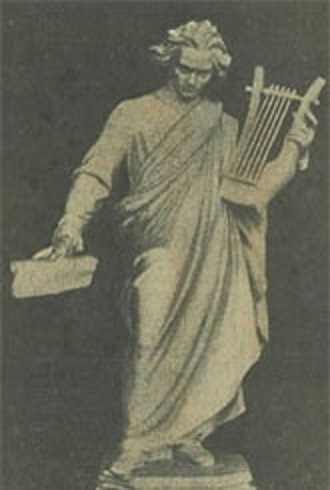
Beethoven with lyre and scroll, alluding to god Apollo (1838-1842)
Reproduction of an old photography of Bläser’s draft, around 1920 (Beethoven-Haus Bonn, photo documentation Stephan Ley, Volume VIII, No. 78)

2 Sonatinas for Piano Anh.5 (1790-92, Beethoven aged 21)

Dedication unknown
Duration 4′ and 5′

Sonatina in G major Anh.5 no.1
1 Moderato
2 Romanze
Sonatina in F major Anh.5 no.2
1 Allegro assai
2 Rondo

Listen

Background and Critical Reception

These two works, of tiny dimensions, are attributed to Beethoven with a suspected year of composition between 1790 and 1792. The unusual numbering of Anh.5 comes from the 1955 catalogue of Beethoven works put together by Georg Kinsky and Hans Halm. ‘Anh’ is an abbreviation for ‘Anhang’, the German word for ‘appendix’, indicating that Beethoven’s authorship remains in doubt.

Were the pieces genuine they would fall towards the end of Beethoven’s time in Bonn. Both works are in two movements, and are mostly suitable for beginners.

Thoughts

Regardless of whether Beethoven wrote these pieces or not, they are a good deal of fun – and one (the F major work) contains a proper earworm.

The G major’s Moderato first movement flows easily on the ear, with a polite theme – and the Romanze, more obviously childlike, is equally easy to listen to.

The F major work appears to be in a bit of a hurry in its first movement, with a few lightly mischievous touches to its phrasing. It is in the second movement, a Rondo, where the earworm appears – and again there are a few mischievous touches round the end. With the emphasis almost entirely on that single tune it is well set in the inner ear by the end!

Recordings used

Tobias Koch (DG)
Ronald Brautigam (BIS)

Brautigam’s fortepiano can sound a little clinical with a harsher edge applied in the Romanze, but he gives charming accounts of both Sonatinas. Tobias Koch is also charming in his versions.

Spotify links

Tobias Koch

Ronald Brautigam

You can chart the Arcana Beethoven playlist as it grows, with one recommended version of each piece we listen to. Catch up here!

Also written in 1792 Haydn 12 Minuets, Hob.IX:11

Next up 2 Sonatinas for Piano Anh.5