Wigmore Mondays – Imogen Cooper plays Brahms & Liszt

Imogen Cooper (piano)

Brahms Intermezzi Op.117 nos.1 & 2 (1892) (1:23 – 11:13)
Liszt Gretchen (Second movement of A Faust Symphony) (1854, arranged 1874) (11:52 – 30:05)
Brahms 7 Fantasien Op.116 (1892) (31:31 – 53:24)

Wigmore Hall, London
Monday 8 July 2019

To hear the BBC broadcast through BBC Sounds, please follow this link

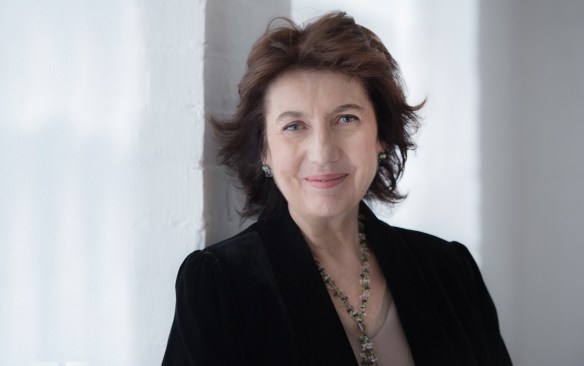
Commentary and Review by Ben Hogwood Photo credit: Sim Canetty-Clarke

Brahms’ late piano music occupies a special place in 19th century repertoire. Rather like late Beethoven he makes use of the piano for some extremely confidential writing that starts to push at the boundaries of tonality and conventional rhythm. While Beethoven complemented his late piano works with a renewed inspiration for the string quartet, Brahms found the clarinet was his ideal ‘other’ vehicle in the early 1890s. Yet in the solo piano writing, here is a level of intimacy rarely found in the music of his time.

Imogen Cooper began her Wigmore Hall recital with two of the three late Brahms Intermezzi Op.117 – an example of where the composer would give a deliberately ambiguous title to a short piece, allowing himself the greatest possible freedom of form and expression. That said, the first – in E flat major – is simplicity itself, a much loved melody that Brahms used as consolation from the recent losses in his life. For this he drew inspiration from the Scottish ballad Lady Anne Bothwell’s Lament, and the piece benefits from Imogen Cooper’s unhurried approach in this performance (from 1:23 on the broadcast). The second piece in B flat minor is more flowing but also more directly troubled as it progresses (from 6:37), finishing in the lower recesses of the piano.

Published adjacently to the Op.117 Intermezzi are seven piano pieces Brahms called Fantasies – separate entities that work best as an overall whole. There are three Capriccio pieces, placed 1, 3 and 7 in the group, complemented with 4 Intermezzi, Brahms again keeping ambiguous labels for artistic freedom. Immediately however there is more heart on sleeve here, the first Capriccio in D minor (31:31) full of power and passion. The second piece, an Intermezzo in A minor, turns inwards, lost in thought (33:54), though there are brief glimpses of light in the central section.

The third piece, a Capriccio in G minor (37:42), has grand designs but still glints with a metallic darkness, using a falling melody whose outline is common to a number of late Brahms piano works, falling in melodic intervals of a third. A solemn central section is more hopeful before this music returns at 40:03. The fourth piece (40:55) is the first of three centred on the pitch of E, which seem to exist between major and minor keys. It is quite ambiguous, with a questioning harmony and uncertain rhythm – but finds calmer acceptance in its brief central section.

The fifth piece – another Intermezzo, now in E minor (45:06) is more mysterious still, its rhythm elusive, as though Brahms is in a dream state. Moving to E major for the sixth piece (47:58) we return towards earth, though the composer – and performer – are still in deep thought. A sudden jolt arrives with the final piece, another Capriccio in D minor (50:59), Brahms suddenly alert and on the front foot, and ending unexpectedly – and exultantly – in the major key. It is an ending hard won, but also slightly false, as it proves difficult to erase the deeply profound thoughts from earlier pieces.

The Liszt piece is a long slow movement taken from the composer’s orchestral / choral epic, A Faust Symphony. This is a portrait of Gretchen that transcribes particularly well for piano, Liszt’s gifts adapting his music and that of others between forms at its very best here. This is after all a composer who thought nothing of transcribing all nine Beethoven symphonies for solo piano.

Gretchen is tender and romantic, unfolding from the very start in a loving and flowing manner as played here by Imogen Cooper. Gradually the music becomes deeply passionate, Liszt building towards a series of weighty climaxes – the first around 19:10 and then again at 23:45. It can be heard as almost one unbroken phrase, and Cooper keeps a very natural feel to her phrasing, until the main theme returns at 24:14, where there is a very natural return to the mood and tenderness of the opening – before more extended dialogue. The period from 27:45 represents the coda, where a settled mood takes hold.

Throughout this concert Imogen Cooper let the music do the talking, as she always has done – not playing to the audience but producing beautifully rendered and carefully thought performances, with very impressive technical command – especially in the big-boned Brahms pieces. Of equal importance was her use of ‘rubato’, which is essentially breathing naturally in a musical sense so the rhythms sound more like phrases of a spoken or sung sentence. Everything came together wonderfully here, as it did in an encore of more Brahms – a beautifully observed account of the Waltz in A flat major Op.39/15, not heard on the broadcast.

Further reading and listening

The music in this concert can be heard below, in leading available versions. Imogen Cooper has yet to record late Brahms, so the playlist includes timeless versions of the pieces from Radu Lupu and Emil Gilels, along with Cooper’s recently recorded Liszt:

Cooper’s Liszt is part of an intriguing disc of piano music by Liszt and his contemporary and close relative Wagner, recorded for Chandos:

Another Imogen Cooper recommendation brings together piano music by Robert and Clara Schumann – a family affair with the former’s stormy Piano Sonata no.1 and Humoreske, nicely complemented with two of Clara’s Pièces caractéristiques:

Wigmore Mondays – Colin Currie Quartet in music by Pereira, Volans, Stockhausen & Reich


Colin Currie Quartet (Colin Currie, Sam Walton, Adrian Spillett, Owen Gunnell (percussion)

Pereira Mallet Quartet (2013 (1:36 – 10:08 on the broadcast link below)
Volans 4 Marimbas (2016) (12:38 – 33:21)
Stockhausen Vibra-Elufa (2003) (35:40 – 41:27)
Reich Drumming Part 1 (1970-71) (44:30 – 59:59)

Wigmore Hall, London
Monday 1 July 2019

To hear the BBC broadcast through BBC Sounds, please follow this link

Commentary and Review by Ben Hogwood

What a refreshing change to have percussion taking centre stage for a Monday lunchtime concert at the Wigmore Hall. Not only that but two of the four pieces had that ‘just off the shelf’ feeling, with the Joseph Pereira and Kevin Volans pieces written for Colin Currie’s ensemble. As an added bonus, South African composer Volans – 70 this year – was in the audience.

Pereira, principal percussionist with the Los Angeles Philharmonic, gave us bright metallic sounds from the start (1:36 on the broadcast). Crisp unison blocks of sound were broken up by quicker figures that gave the Mallet Quartet energy. With a broad range of timbres and pitches, the bursts of activity were often followed by pauses, giving a stop-start feel but ultimately heightening the drama. At 7:30 the quartet converged on a single pitch, D, the high point of the piece at which point the music takes a natural breather. Then the pitches regroup from the depths, returning to a treble pitch from which we tumble down what feels like a waterfall. Pereira’s music pictorial to the close.

Kevin Volans4 Marimbas (from 12:38) exhibited a warmer sound, the players using softer sticks to create a fluid and soothing experience, like running water. As it developed the players negotiated twists and turns skillfully, interpreting the piece an experience of ambient yet positive energy. Around the 19-minute mark the pitch rose, concentrating the mind, but then the sonorous tones of the marimbas’ lower ranges came in again.

Then at 21:45 the performers noticeably reined in the dynamic range, their sticks closer to the instruments as the sound shrunk before our ears. This is a tactic Volans has used on several occasions, working especially well here as percussion is not normally known for quiet performance! The audience subconsciously leant forward in the Wigmore Hall before the reassurance of the full marimba timbre came in again around a minute later. Towards the end it happened again and stayed quiet, proving even more effective second time around.

Stockhausen’s Vibra-Elufa, a short piece (from 35:40), was notable for its intensity and sinuous lines. Performed by Currie alone on marimba, it had moments of tender beauty but also shrill edges, especially when high in the treble range. It left an otherworldly, enchanting impression in the manner of the large-scale stage piece from which it is drawn and arranged, Freitag aus Licht.

Then we were on to Drumming, Steve Reich’s breakthrough masterpiece of 1971 that confirmed minimalism as a community-based musical form (from 44:30). It was a visit to Ghana in 1970 that convinced Reich he was on the right track with what has turned out to be his longest instrumental piece to date. Over time Drumming has evolved, and can even be divided into constituent parts, as here – with Part 1 concentrating on tuned bongos. The technical challenges remain, even over 15 minutes, with improvisational skills and a strong sense of form brought into play. Listen to the broadcast from 44:30 and you will hear how the quartet unite in big strokes of sound but gradually tumble out of phase, picking up kinetic energy as they do so, before aligning again for another commanding statement.

The players were superb, with clear visual communication the secret to a performance notable for its drive, accuracy and flair. Listen to it and lose yourself in the rhythms!
Each of the four pieces in this concert received technically brilliant performances. Currie was the natural leader but Walton, Spillett and Gunnell all stepped forward when required, emphasising the communal approach they have to their music and especially their new commissions. On the way out of the Wigmore Hall I overheard a regular saying it was one of the best lunchtime concerts he had ever been to in the venue, and I am inclined to agree!

Further reading and listening

The music in this concert is not available online, with the exception of Drumming – which exists in a recording made by Steve Reich, Synergy Vocals and the Colin Currie Group. It’s as close to authentic as you could wish for!

Since that recording Currie and Reich have made a live disc from the Foundation Louis Vitton, with a broad range of Reich’s work that includes the classic Clapping Music, the choral piece Proverb, the Mallet Quartet, Pulse and Music for Pieces of Wood. Typically functional titles from the composer there!

There is not a great deal of Kevin Volans’ music on Spotify, but one very good way into his music is via the string quartet – which is where a disc from 1994 from the Balanescu Quartet comes in. Hunting, Gathering, his second string quartet, is particularly evocative:

Wigmore Mondays – Nicolas Altstaedt plays Bach & Dutilleux

Nicolas Altstaedt (cello)

Dutilleux 3 Strophes sur le nom de SACHER (1976) (1:36 on the broadcast link below)
J.S. Bach Cello Suite No 1 in G major BWV1007 (c1717-23) (12:54)
Cello Suite No 5 In C minor BWV1011 (c1717-23) (32:13)

Wigmore Hall, London
Monday 17 June 2019

To hear the BBC broadcast through BBC Sounds, please follow this link

Commentary and Review by Ben Hogwood

The Wigmore Hall is an ideal venue for solo cello, as Nicolas Altstaedt showed in this BBC Radio 3 Lunchtime Concert. Yet before we heard his solo Bach he switched the order of the program slightly, placing the Dutilleux piece first. I must admit I had thought it would be even more effective in between the two Bach suites, but with playing of this insight and quality it soon seemed harsh to quibble.

Along with eleven other composers, Henri Dutilleux wrote a piece to celebrate the 70th birthday of the Swiss conductor and patron Paul Sacher. The brief was to construct a solo cello work using the intials of the conductor’s name (Eb – A – C – B – E – R). Dutilleux was in exalted company – Britten, Boulez, Lutoslawski and Ginastera were some of the other names involved – but he constructed 3 Stophes sur le nom de SACHER, three short but deeply expressive pieces.

Altstaedt played them passionately, immediately enjoying Dutilleux’s ways of exploiting the instrument’s colour through pizzicato, harmonics and a detuned ‘C’ string. The first piece (from 1:36 on the broadcast link) created a heady atmosphere but with plenty of nervous energy, before retreating to a distance. The second piece (4:45) brooded in the cello’s lower register before ascending to a lonely-sounding melody on high. The third (7:20) went at a terrific rate, scurrying figures down the cello punctuated by plucking, then reaching dizzy heights with harmonics that could almost have been from another planet, before swooping down and finishing with aplomb.

Moving to J.S. Bach, the mood eased for a wonderful performance of the Cello Suite no.1. Altstaedt played at a lower ‘baroque pitch’, with very little vibrato and with relatively little flamboyance, happy to let the music do the talking. With an airy Prelude (12:54) followed by a softly voiced Allemande (15:29) and light footed Courante (20:35), notable for its tasteful ornamentation, he was allowing Bach’s dance movements every chance to express their graceful side.

When it came to the slow Sarabande (22:56), he resisted the temptation to do what a lot of cellists do and overplay the double stopped chords, again letting the music speak in quiet, thoughtful tones.

He decided against using the Minuet repeat – a minor shame, as it is such good music! – but the light and shade with the trio section (25:48 and then 26:33) was exquisitely judged, before the Gigue (28:19) danced its way into the distance.

Altstaedt’s choice of suites was very much light and shade, for there is little in Bach with a darker colour than the Solo Cello Suite no.5. The Prelude (32:13) of this suite is austere in the extreme, and again a slightly reserved approach dynamically played to the music’s strengths. The Allemande (37:40) and Courante (43:32) were stern, each dance movement given the appropriate room but very darkly coloured, the rich chords beautifully judged.

The famous Sarabande (45:27), which some have compared to the falling of tears, was suspended in mid-air, time almost stopping as the feather light notes traced their bare outlines. After this a slight pick me up came in the shape of the first Bourrée (49:18), but the second was wispy and elusive (50:48). The concluding Gigue (52:35) gave us more closure but retained the serious air of the suite.

After these performances the lack of an encore was completely understandable, heightening the impact of the music we had heard. It was a very fine concert, and one would hope when he is ready Altstaedt will commit his striking Bach interpretations to disc.

Further reading and listening

You can watch Nicolas Altstaedt play the Dutilleux Strophes here:

The music in this concert can be heard here, in the available versions:

Altstaedt has not yet committed any of the Bach suites to record yet, but he has released a disc of the Sonatas for viola da gamba and harpsichord, with Jonathan Cohen. They can be heard on Spotify here:

The Bach Cello Suites are wide open to interpretation, not just from cellists but from the wider electronic music community. Peter Gregson has a foot in both camps, and last year’s addition to Deutsche Grammophon’s ‘Recomposed’ series was both imaginative and respectful:

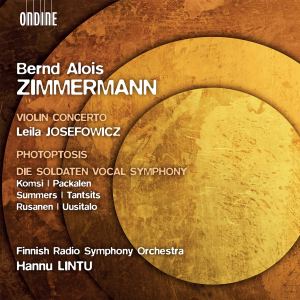
On record: Leila Josefowicz, Soloists, Finnish RSO / Hannu Lintu – Zimmermann: Violin Concerto & Die Soldaten (Ondine)


Leila Josefowicz (violin); Anu Komsi, Jeni Packalen (sopranos), Hilary Summers (contralto), Peter Tantsits (tenor), Ville Rusanen (baritone), Juha Uusitalo (bass), Finnish Radio Symphony Orchestra / Hannu Lintu

Zimmermann
Violin Concerto (1950)
Die Soldaten – Vocal Symphony (1963)
Photoptosis (1968)

Ondine ODE1325-2 [73’45”]

Producer Laura Heikinheimo
Engineers Enno Mäemets, Anna-Kaisa Kamppi (Photoptosis), Jari Rantakaulio (Violin Concerto), Antti Pohjola (Die Soldaten)

Recorded June 2016 (Photoptosis), May 2018 (Violin Concerto), live in September 2018 (Die Soldaten) at Helsinki Music Centre, Helsinki

What’s the story?

A belated though most welcome addition to those releases marking the centenary of the birth of Bernd Alois Zimmermann (1918-70), the Cologne-based composer whose singular music has gradually gained in recognition during the almost half-century since his untimely demise.

What’s the music like?

One of Zimmermann’s earliest successes, the Violin Concerto emerged out of a Violin Sonata from two years earlier. Most distinctive is the central Fantasia, whose rapt intensity (notably in its closing pages) is thrown into relief by the movements either side – a vehement opening Sonata with antecedents in Hindemith and Hartmann, then a final Rondo whose element of rumba duly adds to the heady abandon. Leila Josefowicz (who gave a memorable account of the Sonata at Wigmore Hall – reviewed by Arcana here) touches all the expressive bases for this impressive reading.

It was with his opera Die Soldaten that Zimmermann fully came into his own as a composer. Its gestation (1957-65) was a protracted one, during which the dramatic concept was radically overhauled without diluting the music’s emotive power. Intended to demonstrate the latter’s practicability (along the lines of Berg’s Lulu Symphony a quarter-century before), this Vocal Symphony comprises scenes from the first two of four acts in which the ultimately tragic fate of merchant’s daughter Marie at the hands of a brutal military class is set in motion.

Among the six soloists, Anu Komsi and Hilary Summers stand out for their security in the acrobatic vocal lines, while without eschewing more tangibly human expression. Yet it is in the purely orchestral episodes where Zimmermann’s increasing radicalism comes fully into focus – the Preludio with its melange of competing textures over the remorseless tread of drums; then the Intermezzo during Act Two – the simultaneity of action onstage mirrored by a layering of musical events with Zimmermann’s trait of timbral contrast rendered at its most visceral.

By the time of the ‘prelude for large orchestra’ that is Photoptosis, the composer’s idiom had found even greater power and concentration – evident in the textural stratification of its outer sections as they build from fugitive unease to assaultive violence. Between them, an interlude of half-remembered quotations and allusions ranges from the provocative to the inane – as if to confirm that remorseless ‘closing-in’ of the musical past on that of the present, and thereby denying any purpose for a creative future such as overcame Zimmermann in his final years.

Does it all work?

Yes, and not least when the performances are as perceptive as they are here. Both the Violin Concerto and Photoptosis have been recorded several times, not least by Thomas Zehetmair (ECM) and Karl-Heinz Steffens (Capriccio), though these new accounts would now be first choices. The Soldaten-Symphony has had no previous commercial recording (live readings by Hiroshi Wakasugi in 1978 and Peter Hirsch in 2014 can be heard on YouTube), making this an essential addition to the Zimmermann discography aside from its artistic excellence.

Is it recommended?

Indeed. Hannu Lintu draws a committed response from his Finnish Radio Symphony players, recorded with unstinting clarity and the programme afforded context by a thoughtful booklet note from Mark Berry. An impressive release with which to mark Zimmermann’s centenary.

Further listening

You can listen to this new release on Spotify:

Further reading

You can read more about this release on the Ondine website

On record: BBC Scottish Symphony Orchestra / Martyn Brabbins – Sir Michael Tippett: Symphonies nos. 3 & 4; Symphony in B flat (Hyperion)


Sir Michael Tippett
Symphony no.3 (1970-2)
Symphony no.4 (1976-7)
Symphony in B flat major (1932-3)

Rachel Nicholls (soprano, Symphony no.3), BBC Scottish Symphony Orchestra / Martyn Brabbins

Hyperion CDA68231/2 [two discs, 120’40”]

Producer Andrew Keener
Engineer Simon Eadon
Recorded 3-5 February 2018 at City Halls, Glasgow

Reviewed by Richard Whitehouse

What’s the story?

Martyn Brabbins and the BBC Scottish Symphony Orchestra follow their release of Sir Michael Tippett’s first two symphonies (reviewed here on Arcana) with his succeeding two such pieces, along with a first recording for the Symphony in B flat originally intended to be his ‘Opus 1’.

What’s the music like?

Commenced in the wake of Beethoven’s bicentenary, the Symphony no.3 is Tippett’s most ambitious in concept – its four movements falling into two parts such as interrogate without abandoning the formal archetype. Brabbins emphasizes its initial contrast between stasis and dynamism, in the process highlighting unexpected detail, though without the visceral impact of Sir Colin Davis (Decca) or Richard Hickox (Chandos). The Lento is night-music of profound inwardness tellingly realized here, albeit eschewing the ultimate intensity at the climax of the central string threnody. The scherzo that launches Part Two again predicates clarity ahead of impetus: the ensuing blues numbers – respectively soulful, capricious and plaintive – seem a little low-key, but this is no fault of Rachel Nicholls; her singing more accurate than Heather Harper (Davis) and far more insightful than Faye Robinson (Hickox) here or in that extended scena where Tippett confronts then embraces the Beethovenian tenet of compassion. Brabbins rightly ensures its final antagonism between discord and pathos is left hanging in the balance.

Although yet to regain its former eminence, the Symphony no.4 is still the most frequently heard of this cycle and here brings out the most in Brabbins’s Tippettian instincts. Expansive without becoming sluggish and considered without being turgid, it sustains the expressive arc of this single-movement design with no mean conviction – not least in the eruptive climax at its centre which forms this work’s formal and emotional fulcrum, emphasizing its centrifugal rather than centripetal trajectory (unlike Sibelius Seven, to which the present work is often if erroneously compared). Closer in its unforced momentum to Tippett’s account (NMC) than that by Georg Solti (Decca) who premiered it, Brabbins never undersells the music’s forceful persona for all that its introspective qualities are primary. One aspect of this ostensible ‘birth to death’ piece he realizes more convincingly than any predecessor is the human breathing at key moments in its progress – achieved by the subtle deployment of recent technology so the closing bars, in particular, convey an evanescing of life which the composer surely intended.

It is a fair jolt stylistically to go from here into the Symphony in B flat. This latter had at least three hearings and was several-times revised until being discarded in 1944. Received wisdom suggests a reliance on Sibelius but though its formal processes are overtly Sibelian, its sound is much less so if not yet that of Tippett. The first movement is an eventful yet gauche sonata design – its themes intensified in a fusion of development and reprise then framed by a limpid introduction that returns sombrely at the close. What follows is less a slow movement than an intermezzo in which modal and chromatic elements alternate to ambiguous effect, then a final rondo of pronounced folk inflection that builds toward an apotheosis whose hopeful optimism speaks touchingly of the ‘confidence of youth’. Brabbins finds a committed response in music where lambent harmonies and tricky if untypical rhythms go some way to offsetting any lack of melodic profile. Whatever else, the composer’s trustees were right to sanction revival of a piece that offers fascinating insight into Tippett’s creativity before it began falling into place.

Does it all work?

As on the previous release, Brabbins secures excellent playing from the BBCSSO that does not always render Tippett’s exacting rhythms with quite the clarity or impetus required. Not that this undermines too seriously the idiomatic feel of these readings, abetted by the depth and perspective of the recorded sound. At its best (during parts of the Third and most of the Fourth Symphonies), it would certainly be first choice for those coming to the pieces afresh; still, the door remains open for a Tippett cycle that gets to the heart of this inspiring music.

Is it recommended?

Yes, but for the Third Symphony seek out a live 1976 account by Raymond Leppard and the BBC Symphony, with Josephine Barstow a magisterial soprano (BBC Classics). Notes are by Oliver Soden, whose Tippett biography has recently been published (Weidenfeld & Nicolson).

You can read more about this release on the Hyperion website, while for more on Sir Michael Tippett, visit the Tippett foundation. The BBC Scottish Symphony Orchestra can be found here, while more on Martyn Brabbins can be found here