Stravinsky
Suite italienne (1925) (1:17-16:57 on the broadcast link below)
Three movements from The Firebird (1926-32) (19:18-29:58)
Ballade from The Fairy’s Kiss (1947) (31:58-35:15)
Divertimento from The Fairy’s Kiss (1934) (35:22-55:21)
Wigmore Hall, London
Monday 3 June 2019
To hear the BBC broadcast through BBC Sounds, please follow this link
Commentary and Review by Ben Hogwood
Stravinsky had a chequered relationship with stringed instruments, once describing them as ‘much too evocative’ in tone, but ultimately writing for them with the same level of skill he applied to the rest of the orchestra. Most of his writing for the violin in a solo capacity had Samuel Dushkin in mind.
Dushkin was introduced to Stravinsky by his German publisher in 1930, and Stravinsky wrote a concerto for him, before turning to smaller scale works for the pair to tour together. Many of these are smaller pieces taking stage works as their inspiration – and this BBC Radio 3 Lunchtime Concert from the Wigmore Hall programmed music from three such works.
The Suite italienne actually predates the Dushkin collaborations. To give it its full title, the Suite d’apres des themes, fragments et morceaux de Giambatista Pergolesi, brings together an Introduction and four dance movements from the Pulcinella ballet, retaining their lyricism but adding a certain spikiness in the new format.
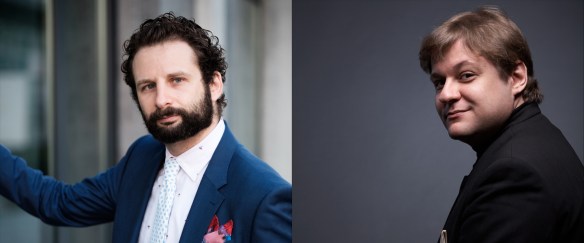
Ilya Gringolts and Peter Laul play them with great character here, from the breezy and catchy Introduzione (1:17), through the Serenata (3:26), to a Tarantella in a hurry (6:16). While the Introduzione sees Gringolts still finding his feet, the Gavotte con due variazioni (8:22) is really nicely done, as are the Scherzino () and Minetto e finale (12:28), where Stravinsky can’t resist the odd sardonic touch.
The three movements from The Firebird are more substantial, beginning with a Préludeet ronde des princesses (19:18) which has a cold shiver in tale. The Berceuse () has a thick, heady atmosphere, while the Scherzo (27:32) feels like it has to be somewhere in a hurry and is a thrilling chase between the two instruments, brilliantly played.
The Divertimento known as The Fairy’s Kiss was Stravinsky’s homage to his biggest Russian inspiration, Tchaikovsky. It is an exciting and winsome orchestral ballet, one of his more romantic creations based as it is on a selection of the senior composer’s songs and piano pieces. The arrangements here work well in the more intimate confines, and again Gringolts and Laul have their measure. The Ballade (31:58) is at times languid but then quite restless, while the Sinfonia (35:22) employs typical Stravinsky textures of bare octaves occasionally audible.
Otherwise the violin writing is perhaps surprisingly ardent, then we progress to a busy section of brusque statements before returning to the slower music. The Danse suisses have some fun figures and exchanges, Stravinsky unable to resist a toe-tapping march with a rustic feel (41:20) before the lively Scherzo (46:01). The searching melodies of the Pas de deux (48:57) lead to a feathery scherzo (52:08) then a brisk Coda, the rustic mood returning (53:19)
BBC Radio 3 went off air before there was a chance for listeners to hear the bracing encore from Gringolts and Laul. Their Danse russe, arranged from Petrushka, was a fitting end to a very well executed recital.
Further reading and listening
Ilya Gringolts and Peter Laul have completed two discs of the complete Stravinsky works for violin and piano. The selection making up this concert and its encore can be heard on this Spotify playlist:
Meanwhile the below collection brings together Stravinsky’s Violin Concerto and also the three ballets from which the music for this concert derives, The Firebird, Pulcinella and The Fairy’s Kiss:
Composer Thomas Larcher (above) talks with Arcana editor Ben Hogwood about his music, and what we can expect from his upcoming residency at the Aldeburgh International Festival
The 72nd Aldeburgh Festival begins this weekend, and there are three artists-in-residence: tenor Mark Padmore, soprano / conductor Barbara Hannigan and the Austrian composer Thomas Larcher.
Larcher’s music has received good coverage in the last decade in particular, with a number of recordings released on the ECM label, but this portrait of his output will make an even wider appraisal possible. With music ranging from solo piano right through to large orchestra, there will also be a chance to catch the second performance – and UK premiere – of his first opera, The Hunting Gun.
We start by talking of Larcher’s memories of the festival – or not, as the case may be! “Let me say I haven’t had any experiences so far!” he says cheerily. “I visited Aldeburgh a year ago at the planning stage for what’s happening now, but I’ve never played a concert there and I don’t think a piece by me has ever been played there. This year’s program all comes through my friendship with Roger Wright, who once commissioned a piece from me for the Proms (the Double Concerto for violin, cello and orchestra, performed by Viktoria Mullova and Matthew Barley). Since then we’ve been in touch, and he has always been very pleasant and friendly. I had the feeling that he is a person who speaks on one level, face to face with a composer, and not from the top down like a big promoter. I felt very much at home at the Proms because of that.”
There is a palpable excitement around the UK premiere of The Hunting Gun, which received very positive reviews from its premiere at the Bregenz Festival in Larcher’s home country Austria. He confirms the approach will be similar. “It will be the same staging as it was in Bregenz, and I know they have been working on the details. I think the main difference will be space. The hall is wonderful with a really good sound, whereas in Bregenz we were in a huge box, more or less. Everyone there said you will need amplification, as there was a lot of noise around from lights and fans. There was the possibility of amplification but we will see how it works out with the full orchestra. For example we didn’t have a pit in Bregenz, so we were all on the same level, but now the orchestra is down in the pit, which should make things feel more free. I hope it will be more intimate in the level of sound.”
Did working on a much larger composition bring out new properties in Larcher’s own writing? He considers the question. “On paper it is not such a big score. There are 19 or something players and a little choir, and the soloists. There are two elements I can mention, however. The first one is coming from the text (the opera is based on a Japanese novella from 1945). I find this little book by Yasushi Inoue (below) highly fascinating. I couldn’t start before I was really sure about how the text would evolve, how we could compress this quite complex novel into quite small pages of text, because I feel that operas – the texts are too long. My girlfriend Friederike Gösweiner, who is the librettist, has found a way to really keep the soul of this novel alive but still reduce it and condense it to something very precise and with very few words. I loved it. So already I could say some of the music had formed before I started.”
And the second element? “Something I had never done before was the integration of the chorus. The chorus is a hybrid thing, staging it as seated with the orchestra. It is a connection between the orchestra and the soloists, it is an amplifier of the soloists and they symbolise the echo room of the persons on stage, the psychological echo room. They have various functions which you can define or not define, but this whole mixture of the ensemble and the chorus proved to be highly interesting for me.”
A sizeable problem facing today’s composers is the difficulty in getting not just first but second performances of their works. To that end it must be very satisfying for Larcher having a sequel on which to rely relatively quickly after the first, and on such a major stage as Aldeburgh? “Yes, it’s really great. I can’t be thankful enough for having as an artist in residence. It’s a great festival and I think Roger has also with other people chosen an excellent solution for the music with Ryan Wigglesworth conducting. It’s all first rate and I’m very curious to hear it. The other day I heard it will also be on stage at Amsterdam as part of the Holland festival. Pierre Audi has invited me to be part of that.”
As a listener it can also be hard to get a second hearing for a new piece that you really want to hear again, so it is satisfying from that point of view also. “I think or I hope that I’m already contributing to changing the situation”, he says, “as I am getting slower and slower at writing! I will leave less pieces so that hopefully they will have half a chance to be played more often! I can’t speak for others but I think the amount of pieces being thrown out is enormous. Of course it is a frustration for composers when their pieces are not played again, and as we know a piece needs some time to grow, to develop and even to be corrected, the mistakes that everyone always makes. These chances don’t come too often. I cannot speak about this because I don’t have this experience, but that is such a lucky situation which is quite unique. I am very thankful to all my players, conductors and orchestras that program existing pieces. It is wonderful for me but should be that way for a lot more composers.”
This year’s Festival will offer a chance for listeners to take in another new Larcher work, the Movement for solo piano which will be played by Paul Lewis. “The Movement was the first piece I could really tackle after having written the opera,” he explains. “In a way I felt as though I was coming out of this huge tunnel, and the Movement was quite a liberation from that. I always have problems writing for piano because I used to be a concert pianist, and would play everything from J.S. Bach to Olga Neuwirth, and I played with so many conductors from Claudio Abbado to Frans Welser-Möst and Paavo Jarvi. Each time I wanted to write something for piano I thought why do I know this – oh no, it’s from Messiaen or Schoenberg, and I was revisiting music I had already played! I prepared the piano so that it became a new instrument for me, and it was more coverable than the well known natural sound. Here again I got myself into a state of going into a new piece and just writing for a ‘normal’ piano was so liberating, a very good experience for me.”
On the festival’s third day Paul Lewis will join Larcher and Mark Padmore for a concert including the Padmore Cycle, a collection of eleven pieces written for the tenor. Their partnership clearly holds a special place for Larcher. “That piece was very important for me and meaningful too. We really embraced the text, and it’s more about going for the text over the quality of the voice, it’s very important. The music meets something in me, but if the text is not right then it does not work. For me, writing for the voice is strongly connected with writing for Mark. For the Padmore Cycle, two friends who wrote the texts for it (Hans Aschenwald and Alois Hotschnig). I deliberately chose texts from these two writers close to me, and so I practically formed my own cycle. By choosing different things you show yourself by what you prefer and what you don’t want to be shown. The unifying force behind all that was Mark, and so it was excellent to write the piece with him. There are three versions of this piece already – the original one that will be heard at the festival, with piano – then there is another one with voice and piano trio and a third with voice and big orchestra.”
Larcher has often spoken of the importance of tonal music, though he shies away from what could be seen as more obvious clichés within his writing. Is that an approach he maintains? “Yes, although it has widened in a sense. If you go through film music it’s always so that the feel is tonal, major or minor, but the horror films have passages that are atonal, with the birds flying – passages that make you think of Hitchcock! In a way that is a shame, but it’s also a cliché with a reason. I think you have to be aware of that, and that you don’t fall into the trap of always over-using those clichés – for example in films they will think of using Arvo Pärt for a solemn scene and Ligeti for a horror trip. I have tried to explore something like multi-tonality and have different threads of tonal music interweaving, or even going on the other hand going to tonal regions when it’s a dramatic scene. I like to juxtapose different tonalities or patterns of chords to make those boundaries more flexible or accessible, and not stand still in those clichés. I think there are so many possibilities still, even though there are only 12 tones, to create new and interesting tonal material. I think we have not reached the end of the road, and I cannot tell how far I will go there but it’s definitely for me! I can’t say I don’t care about tonality or not tonality, but I try to find a way for having complexity in accessible audible forms.
Larcher will be at the Aldeburgh Festival for its duration, taking in the performances of his music all the way through to the Cello Concerto (Ouroboros) on Sunday 23 June with Alisa Weilerstein and the City of Birmingham Symphony Orchestra conducted by Edward Gardner. “By then I will be an Aldeburgh citizen, a resident of Snape!” he jokes.
Yet it seems The Hunting Gun will fit in very well with the festival, for its scale and plot alone. “Absolutely, with the beach as well! Maybe one day it should be staged in front of the atomic power station, which nobody mentions when speaking about Aldeburgh?! I learned about it when I saw pictures by David Lynch of this power plant, so maybe his interest says there should be something done there at that point.”
Sizewell B (n.b. this picture is not by David Lynch!)
Talk turns to music and culture outside of what we might call ‘classical’ music. “I mentioned David Lynch because there are some very powerful photographs of his with power plants on them, they are very dark – and I was amazed how much of the atmosphere he can display in his films, and how it could be transported into a single black and white picture. This I found quite strong. Regarding art, of course I do have a lot of friends. I grew up in Vienna where I studied more at the Art Academy than the Music Academy in my spare time, because it was far more vibrant, far more interesting, and there were nicer girls! I spent a lot of time there and it had some substantial influences. I painted a lot as a child. Even now I am a passionate photographer whenever I can be. Today everyone is a photographer of course but for me taking photos and scribbling things down shows me how I work as a musician also, with methods and writing. How you construct these things has different layers, and I see clearer with a photograph than when I sit in front of my music sheets.
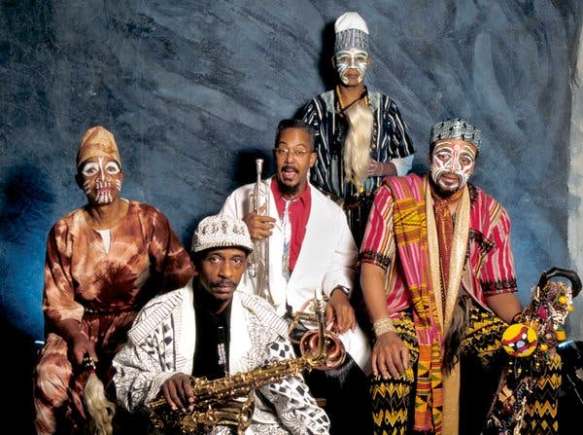
Regarding the music I experienced from 15 there was a jazz club in the town where everyone played, from Pat Metheny to Chick Corea, and from Art Ensemble of Chicago (above) to Dino Saluzzi – all of the jazz greats. This was so liberating for me at the time, it was a way out of this really boring classical scene as I had experienced it in the region. There were a lot of frustrated musicians who were speaking of a big musical world outside of this region, but it didn’t happen here! Sitting frustrated in a teaching job, I couldn’t imagine there would be something like that living in music. When someone like the Art Ensemble comes to your town and delivers their show or Art Pepper and all of those players it was the greatest thing that could happen. A new world opened up to me and showed me this was life and not a prison!
Exposure to these arts surely helps when writing an opera? “Yes, although I obviously trust in the different crafts, so I wouldn’t be a multi-disciplined artist because I am simply not able to, and I am interested in what other people bring into the process. I really like to learn from other disciplines, and be open for what comes into your cosmos as well.”
As artist-in-residence at this year’s Aldeburgh International Festival, Thomas Larcher can look forward to a number of performances of his work, with the UK premiere of The Hunting Gun, the world premiere of Movement, A Padmore Cycle performed with its dedicatee and performances of string quartets and orchestral works. For full details visit the Aldeburgh Festival website. For more information on Thomas Larcher, you can visit his website
The playlist below gives an introduction to his music through available recordings:
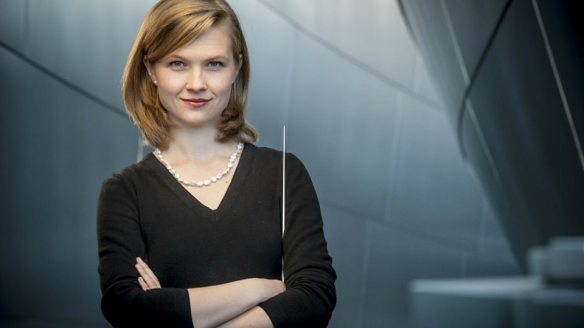
City of Birmingham Symphony Orchestra / Mirga Gražinytė-Tyla (above)
Symphony Hall, Birmingham
Friday 31 May 2019
Honegger Pastorale d’été (1920) Ravel Introduction and Allegro (1905); Le tombeau de Couperin (1919) Brahms Symphony no.2 in D major Op.73 (1877)
Written by Richard Whitehouse
Back from their extensive European tour, the City of Birmingham Symphony Orchestra and their music director Mirga Gražinytė-Tyla returned to home-base with this arresting programme of early 20th-century French music and a classic of the Austro-German symphonic repertoire.
Most understated among curtain-raisers, Honegger’s Pastorale d’été is always a pleasure to encounter and this account had its measure – whether in the evanescent outer sections with their intangible aura, or livelier central episode with its fleeting allusions to Swiss folksong. Gražinytė-Tyla has spoken of her desire to investigate composers ‘off the beaten track’ and Honegger would seem a plausible candidate; such works as the capricious Cello Concerto or anguished Fifth Symphony fairly crying out for reassessment and considered advocacy.
Ravel’s Introduction and Allegro enabled the conductor to take a break while a seven-strong ensemble from the CBSO gave this perfect marriage of formal lucidity and expressive poise; at its most perceptive in the wistful opening music that returns even more hauntingly towards mid-point, with a harp cadenza that Katherine Thomas rendered precisely while delicately. It duly prepared for Le tombeau de Couperin, Ravel’s highly oblique response to the enveloping tragedy of the First World War in an account that defined more fully than usual the character of its middle movements. The astringent irony of the Forlane became more so at Gražinytė-Tyla’s swift tempo, with the Menuet allowed space for its pathos and tenderness to register. If the Prélude and Rigaudon left less of an impression, there was little to fault with either.
After the interval, a performance of Brahms’s Second Symphony that went much of the way towards conveying those passing yet always tangible ambiguities which offset any general equanimity of mood. The opening movement felt not quite the sum of its parts – Gražinytė-Tyla tending to rush headlong into climaxes, and with a curiously indecisive transition into the development as suggested she might still be pondering over that repeat of the exposition. Yet such as the stark transition into the reprise (those granitic harmonies of trombones and tuba really hitting home) then the suffused eloquence of the coda were perfectly achieved, as was the slow movement which here emerged as a more complex amalgam of agitation and resignation than is often the case, not least in those fatalistic intimations towards the close.
Next came a winsome take on the Intermezzo, its pert alternations of elegance and animation deftly while never too knowingly rendered; after which, the finale had energy to spare, if not at the expense of that ambivalence as is made explicit with the mysterious transition into the reprise (a passage of which Mahler could hardly have been unaware). From here Gražinytė-Tyla steered a secure course through to the closing peroration, its exhilaration never risking bombast when emphatic brass chords drove home the prevailing tonality in bracing fashion.
An absorbing performance, then, bolstered by some consistently fine playing from the CBSO. Gražinytė-Tyla returns one final time this season when, in the middle of June, she tackles a piece that has become synonymous with this orchestra – Mahler’s Resurrection Symphony.
Further listening
You can hear a playlist of the pieces heard in this concert on Spotify below – none of which appear to be available in recordings made by the CBSO as yet:
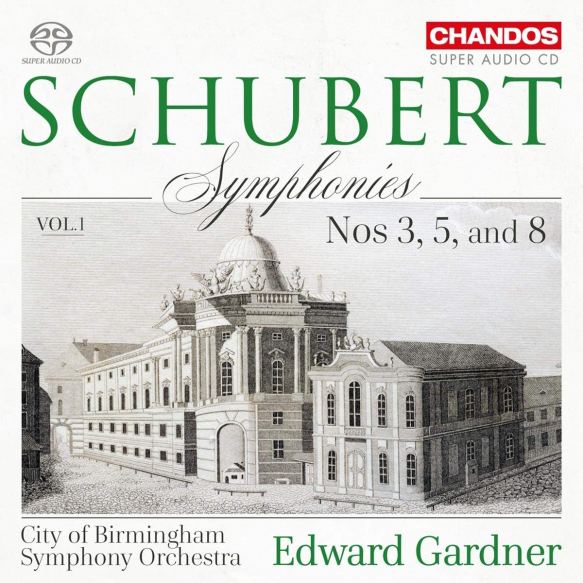
City of Birmingham Symphony Orchestra / Edward Gardner
Schubert
Symphony no.3 in D major D200 (1815)
Symphony no.5 in B flat major D485 (1816)
Symphony no.8 in B minor D759 ‘Unfinished’ (1822)
Chandos CHSA5234 [74’11”]
Producer Brian Pidgeon
Engineers Ralph Couzens, Jonathan Cooper
Recorded 9-10 July 2018 at Town Hall, Birmingham
What’s the story?
Having already tackled the Mendelssohn symphonies (and with a further instalment featuring the overtures imminent), Edward Gardner and the City of Birmingham Symphony now turn to those by Schubert in what promises to be a notable addition to the orchestra’s discography
What’s the music like?
Even with advances made (primarily through the work of Brian Newbould) in recent decades, Schubert’s cycle still tends to fall into two categories – the half-dozen mainly of his teenage years, with overt influences from Haydn, Mozart and earlier Beethoven, then the Unfinished and Great symphonies, in which the composer forges a decisive new path at the outset of the Romantic era. Whether this survey also takes in any of those fragmentary pieces that came in-between, or the drafted ‘Tenth Symphony’ from Schubert’s final weeks, remains to be seen.
This release commences with the Third Symphony, most succinct of the earlier works in its thematic economy and formal concision. Gardner catches well the anticipatory nature of the slow introduction, then steers a secure course through the main Allegro’s alternation of pert woodwind melody with lithe tuttis. More intermezzo than scherzo, the Allegretto is as deftly characterized as the ensuing Menuetto is bracingly despatched. Gardner also minimises that sense of the final Presto as unfolding in ever-decreasing circles prior to its effervescent coda.
The Fifth Symphony is the highpoint of those from Schubert’s formative years – not least in the Mozartian poise of its opening Allegro, with the CBSO woodwind at their most felicitous. Gardner’s relatively swift tempo for the Andante might lessen its inherent charm but enables him to emphasize the searching modulations into its more restive episodes – after which, the Menuetto is more explicit in its G minor incisiveness. Nor is there any lack of impetus as the final Allegro pursues a witty while also suave course through to its almost peremptory close.
From here to the intensely introspective start of the Eighth Symphony (the ‘Unfinished’) is to enter a whole new expressive epoch. The CBSO strings are at their sonorous best in the initial Allegro, here with due emphasis on its ‘moderato’ marking and accruing considerable intensity in its anguished development then fatalistic coda. The Andante complements it in almost every respect, with Gardner ensuring that the hymnal eloquence and anxious musing of its contrasting sections achieve formal and expressive parity ultimately set in relief by the coda’s radiant benediction.
Does it all work?
Yes – thanks not least to some unerringly alert and sensitive playing, together with SACD sound whose clarity and overall perspective admirably reflects that of the refurbished Town Hall acoustic. Interpretively, Gardner occupies a fruitful middle-ground between the tensile rhetoric of Jonathan Nott (Tudor) and agile incisiveness of Thomas Dausgaard (BIS), hitherto the most consistent among recent Schubert traversals and ‘authentic’ through their conveying of this music’s essence without falling prey to merely fatuous notions of stylistic authenticity.
Is it recommended?
Indeed. An additional enhancement is the insights of Bayan Northcott, whose booklet notes will hopefully grace future instalments in a series whose second volume is keenly awaited. Perhaps Gardner and the CBSO might also consider the Berwald symphonies at some point?
Sergey Livitin (violin), BBC Concert Orchestra / Martin Yates
Dorchester Abbey, Dorchester-on-Thames
Friday 24 May 2019
Berners Portsmouth Point (1918) [World premiere] Arnold Serenade Op.26 (1950) Stanford Violin Concerto in D major (1875) [First public performance] Vaughan Williams orch. Yates The Blue Bird (1913) [First public performance] Delius A Song before Sunrise (1918) Milford Symphony no.2 Op.34 (1933) [World premiere]
Written by Richard Whitehouse
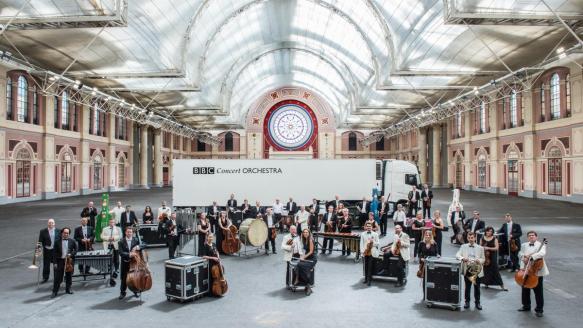
Picture of BBC Concert Orchestra (c) Sim Canetty-Clarke
The 13th English Music Festival got off to an impressive start this evening, with Martin Yates presiding over the BBC Concert Orchestra for a substantial and wide-ranging programme that brought together the hitherto unknown and the relatively familiar in appropriate EMF fashion.
Who else would provide a platform for a first public performance of the Violin Concerto in D major that Stanford wrote at Leipzig in his mid-20s but which, despite the seeming approval of Joachim, remained unheard before being recorded two years ago. Admittedly the first movement rather outstays its welcome, the themes lacking memorability and a solo part not ideally contrasted with the orchestra, but the slow Intermezzo has an appealing poise; its cadenza artfully made an extended transition into the final Rondo (a procedure likely taken over from Wieniawski’s Second Concerto – the model in several respects), its winsome second theme brought back as a lingering coda prior to the closing flourish. Sergey Levitin proved an able and sympathetic soloist in a piece which, whatever its stylistic limitations, was certainly worth rehabilitating.
As too was the incidental music Vaughan Williams devised for Maurice Maeterlinck’s play The Blue Bird, idiomatically orchestrated from the piano score by Yates. This is essentially a ballet (or rather mime) sequence for the end of the first act, its series of thematically related dances striking a fantastical note such as the composer tellingly (if unexpectedly?) conveys. It may well have proved too ambitious in its original context though makes for a lively and imaginative suite, into whose whimsical spirit the BBCCO entered with evident enjoyment.
Malcolm Arnold’s Serenade exemplifies this composer’s early maturity with its pert melodic writing, harmonic ambiguity and rhythmic impetus. A Song before Sunrise is less often heard than other Delius miniatures, but its ruminative mood – barely ruffled by passing shadows, is no less characteristic. It could not have been more different from Lord Berners’s Portsmouth Point, redolent of early Prokofiev in its mechanistic aggression that, if it lacks the ebullience of Walton’s later overture, still packs an uninhibited punch when presented as a curtain-raiser.
The concert ended with its most intriguing item. Long considered a miniaturist (at least in his expressive scope), Robin Milford was not lacking in ambition – as reinforced by his Second Symphony (so designated following the rediscovery of its predecessor from six years earlier), admired by Vaughan Williams but only now receiving its first complete performance. Its four movements ostensibly reflect classical archetypes, but the first of these modulates ever more stealthily as it unfolds, while the scherzo’s latter trio unexpectedly opens-out the expressive range. The highlight is undoubtedly a slow movement of sustained and cumulative emotional depth, closer to Nielsen than Sibelius in tonal follow-through; after which, the (intentionally?) concise finale barely manages to provide a decisive resolution without seeming perfunctory.
Not in doubt was the commitment of the BBCCO and Yates in realizing this dark horse among British inter-war symphonies. A fitting end to an absorbing event: good to hear that orchestra and conductor will be returning for the 14th EMF – scheduled for May 20th–22nd next year.
Further listening
This concert will be broadcast on BBC Radio 3 on a date as yet unknown. Much of the music is not currently available in recorded versions on Spotify. However EM Records, the label who run the festival, made this enterprising release of Stanford‘s Violin Concerto no.2, coupled with Robin Milford‘s Violin Concerto no.2, both with soloist Rupert Marshall-Luck:
For more Robin Milford this album on Toccata Classics provides great insight into his writing for chamber music forces:
Meanwhile the following playlist includes the Malcolm Arnold and Delius works, the more familiar version of Portsmouth Point by Sir William Walton, and Arnold’s Symphony no.1: