On record: Jeremy Dale Roberts – Chamber and Instrumental Music (Toccata Classics)


Peter Sheppard Skaerved (violin), Roderick Chadwick (piano) Kreutzer Quartet (Peter Sheppard Skaerved & Mihailo Trandafilovski (violins), Morgan Goff (viola),  Neil Heyde (cello) with Bridget MacRae (cello)

Jeremy Dale Roberts
Capriccio for violin and piano (1965)
Tombeau for piano (1966-69)
String Quintet (2012/14)

Toccata Classics TOCC0487 [78’24’’]
Producer Peter Sheppard Skaerved
Engineer Jonathan Haskell
Recorded 17-18 December 2014 at St Jude-on-the-Hill, Hampstead (String Quintet), 3 July 2014 (Capriccio) and 22 February 2017 (Tombeau) at St Michael’s, Highgate, London

What’s the story?

Toccata Classics further sets the pace by releasing this disc of music by Jeremy Dale Roberts (1934-2017), whose distinguished academic career (for over three decades at Royal College of Music, latterly as Head of Composition) likely obscured his achievements as a composer.

What’s the music like?

Over more than half a century, Dale Roberts created a catalogue whose diversity is out of all proportion to its modesty (some 40 works). The present disc is the third devoted to his music, following releases on the NMC and Lorelt labels; the latter also featuring Capriccio for violin and piano. This 12-minute piece is dedicated to Howard Ferguson, whose technical finesse it emulates for all that its stylistic profile is appreciably wider – evoking Stravinsky and Bartók as it builds to an assaultive climax before subsiding into the subdued while sombre postlude.

As Roderick Chadwick infers in his booklet note, Tombeau was for Dale Roberts his defining work in terms both of encapsulating where his music had reached at that point and in making possible what came after. Unfolding continuously over 30 minutes, its central elegy is framed by a volatile sequence of studies and variations (Chadwick understandably eschews analysis, even if a diagrammatic outline would have helped in elucidating the intricate overall design). Stylistically, too, the piece ranges widely across the pianistic spectrum from Schumann, via Szymanowski, to Messiaen – with the eventual outcome as personal as it is hard-won. A pity dedicatee Stephen Kovacevich never recorded a piece undoubtedly at the forefront of post-war piano music (British or otherwise), but Chadwick’s identification with the score is total.

The largest work here was also its composer’s swansong. Despite its seemingly abstract title, the String Quintet embodies a densely allusive and multi-layered narrative inspired by Marina Tsvetaeva and Edvard Munch while being given focus by Virginia Woolf, though this is not to suggest the piece is other than an intrinsically musical statement. The viola often assumes an almost concertante role during those three movements which make up the first part, then is largely absent from its successor – a lengthy meditation for violins and cellos whose recall of earlier ideas is riven by silence prior to a culmination capped by the viola’s ghostly offstage re-emergence. A singular experience, then, and a singular work which repays intensive study – from a composer who’s not taking the easy path was never vindicated more fully than here.

Does it all work?

Indeed. To say that Dale Roberts is a connoisseur’s composer should not imply his music is hermetic or obscure; rather it assumes the listener’s commitment and goodwill in the process of assessing the piece at hand. Each of these recordings benefited from the composer’s active participation during the recording sessions. Peter Sheppard Skaerved is at his imperious best, whether in partnership with Chadwick or as part of an augmented Kreutzer Quartet; while his and Chadwick’s booklet notes deftly combine musical discussion with personal recollection.

Is it recommended?

Absolutely. This is now the best point of entry into Dale Roberts’s output, and one hopes for more issues from Toccata. In particular, the Cello Concerto Deathwatch (perhaps coupled with the still-unperformed orchestral cycle Arbor Vitae) cries out for commercial release.

Further listening

You can listen to this new release on Spotify:

Further reading

You can read more about this release on the Toccata Classics website, and about the composer Jeremy Dale Roberts at his website

On record: Acoustic Alchemy: 33 1/3 (Absolute)


Acoustic Alchemy are Greg Carmichael (nylon guitar), Miles Gilderdale (acoustic and electric guitars), Fred White (keyboards), Gary Grainger (electric bass), Greg Grainger (drums)

OnSide Records CDONSIDE03 [40’39”]

Recorded 28-30 April 2016, Potton Hall, Westleton, Suffolk

Produced by Greg Carmichael and Miles Gilderdale

Reviewed by Richard Whitehouse

What’s the story?

Acoustic Alchemy returns with 33 1/3 – the 17th studio album of its 38-year history and the seventh since Miles Gilderdale joined Greg Carmichael to give this band an electrified edge. All the expected ingredients are in place, though with a few tweaks to their familiar sound.

What’s the music like?

Certainly, there could be no better statement of intent than East of Babylon, a hard-hitting fusion of driving rock with Eastern overtones and a dash of funk that already ranks as an AA classic. If later tracks head into more expected territory, this brings no lessening of purpose – hence the equable interplay of Carmen’s Man, then the poetic evocation of The Swallow’s Tale with its pensive acoustic intro from Carmichael and soulful sax break by Jeff Kashiwa. 33 1/3 itself is replete with deft chord changes and a soaring electric solo from Gilderdale.

There is more than a touch of melancholy to the limpid profile of Winter’s End, while the slow-burning vibe of A Little Closer brings the rhythm section of Greg and Gary Grainger elegantly into focus – not to mention nimble piano work from Fred White. Discreet contrast is provided by Blues for Mr. Mu, its swinging gait and nonchalant guitar interplay abetted by cunning syncopation. The Girl With A Plan is a further highlight in its intricate guitar patterns, against a tensile rhythmic backing that AA has made its own over all these years.

The final tracks make an unlikely though welcome detour into the medium of acoustic guitar. The Allemande (from the Lute Suite in E minor BWV996) is a flowing study in two-part counterpoint, while the Prelude in D minor (transposed from that in C minor, BWV999) is typically Bach in its delicately arpeggiated melody and methodical accompaniment. A solo version of The Wind of Change (originally recorded for the AArt album) then provides a limpid showcase for Carmichael as well as an unexpectedly ruminative close to this album.

Does it all work?

Yes – for all that the album is among the shortest of the band’s career, this is undoubtedly a case of quality winning out over quantity. The only proviso is that the acoustic transcriptions feel as though ‘added on’ to the eight tracks preceding them and might have been even more effective were the Bach placed at the centre (they can, of course, easily be reprogrammed).

Not that these latter tracks are at all redundant: indeed, an album of Bach’s Inventions and sundry two-part pieces from Carmichael and Gilderdale would be an enticing proposition.

Is it recommended?

Very much so. Sound has clarity and punch, while the digipack presentation is economical and stylish as befits the CD’s supposed ‘twilight’ era. 33 1/3 might not be a radical departure for Acoustic Alchemy, yet it does confirm this band’s relevance well into the 21st century.

Further listening

You can listen to this new release on Spotify:

Further reading

You can read more about Acoustic Alchemy on their website

On record: Rupert Marshall-Luck, Duncan Honeybourne – Parry: The Wanderer – Complete works for violin and piano


Rupert Marshall-Luck (violin), Duncan Honeybourne (piano)

Parry
Suite no.2 in F major (1907)
Twelve Short Pieces for Violin and Piano: Set 1 (1894)
Violin Sonata no.1 in F major Op.80
Miniatures for Violin and Piano
Sonata in D Minor for violin and piano (1875)
Freundschaftslieder (1872)
Twelve Short Pieces for Violin and Piano: Set 2 (1894)
Partita in D minor (1873)
Miniatures for Violin and Piano
Fantasie-Sonata in Einem Satz für Violine und Clavier (1878)
Suite no.1 in D major for violin and piano (1907)
Twelve Short Pieces for Violin and Piano: Set 3 (1894)
Two Early Pieces (‘Written at Weston for Ernst to play on his Violin’) (1863)
Miniatures for violin and piano
Sonata in D major for piano and violin (1888)

EM Records EMRCD050-52 [three discs, 164’19”]

Recorded 28-30 April 2016, Potton Hall, Westleton, Suffolk

Producer Matthew Bennett
Engineer Dave Rowell

Reviewed by Richard Whitehouse

What’s the story?

EM Records issues one of its most important releases to date, the complete works for violin and piano by Hubert Parry – the centenary of whose death occurred on October 7th last year – in what is a notable addition to the expanding discography of this still-neglected composer.

What’s the music like?

Parry’s output for violin and piano falls into two types. Firstly, shorter pieces equivalent to the French morceau or German album-blatt have been collated as the 10 Miniatures (not the composer’s title). Probably dating from his later years though never published in his lifetime, they present no great difficulties for players or listeners and were likely intended for domestic music-making. Also in this category come the Two Early Pieces, the teenage composer demonstrating an ambition that only just exceeds his technical skill at this juncture.

More advanced are the remaining short pieces, of which the Freundschaftslieder marks his early engagement with the early-Romanticism of Schubert and Mendelssohn. These four surviving (out of five) pieces unfold as a sequence of gradually intensifying expression, set in motion by the wistful poise of ‘The confidence of love’. Collated in 1894, the 12 Short Pieces were published in three sets of four – of which the exquisite ‘Idyll’ (Set 1 No 1), the eloquent ‘Romance’ (2/2) and ingratiating ‘Envoi’ (3/4) ought to find favour as frequent encore items.

The larger works are all direct and substantial engagements with the legacies of Schumann and Brahms. Bach, even, in the Partita in D minor, though these six movements only approximate to Baroque archetypes – with Parry cutting loose in a teasingly ironic Bourées fantastiques then animated Passepied en rondo. If the Sonata in D minoris a little too indebted to its models, for all its technical mastery and purposeful virtuosity, the Sonata in D ranks among his finest achievements in its formal focus and expressive impetus.

Equally engaging is the Fantasie-Sonate in B, not least for the skill with which Parry integrates its four contrasted sections into a single movement whose emotional breadth looks forward to his last orchestral works. Both published in 1907 though originating much earlier, the Suites are more relaxed in manner while being typical of their composer’s maturity; for which sample either fourth movement – the Suite in D’s tonally questing Dialogue, or the Suite in F’s harmonically subtle Retrospective with its evocative recalling of earlier ideas.

Does it all work?

Yes, not least because of the performers – Rupert Marshall-Luck endowing violin lines with real flexibility and Duncan Honeybourne ensuring some densely chorded piano parts never feel overbearing; both players overcoming any tendency to registral or rhythmic uniformity. Not all this music was unrecorded: Erich Gruenberg tackled the Sonata in D, Fantasie-Sonate and 12 Short Pieces in 1985 (Hyperion), while Marshall-Luck set down the three sonatas only a decade ago (Radegund), but the present accounts set new standards for these works overall.

Is it recommended?

Indeed. The sound offers a realistic perspective on this difficult medium, with detailed notes about each piece (by Jeremy Dibble?). Along with the string quartets (MPR) and piano trios (Hyperion), almost all of Parry’s chamber output is now available in authoritative recordings.

Further listening

You can listen to this new release on Spotify:

Further reading

You can read more about the release on the EM Recordings website, and for more information on the two performers, visit the websites of Rupert Marshall-Luck and Duncan Honeybourne respectively.

Live review – CBSO & Ilan Volkov: Mahler Symphony no.9, Krása & Klein

City of Birmingham Symphony Orchestra / Ilan Volkov (above)

Symphony Hall, Birmingham
Thursday 25 April 2019

Krása Overture for small orchestra (1944)
Klein arr. Saudek Partita for strings (1944)
Mahler Symphony no.9 (1909)

Written by Richard Whitehouse

Photo of Ilan Volkov (c) Astrid Ackermann

Pursuing one of the more eventful conducting careers of his generation, Ilan Volkov returned to Birmingham for this pertinent juxtaposition of music by composers who numbered among countless Nazi atrocities next to what is arguably Mahler’s greatest symphonic achievement.

Mahler has long been central Volkov’s programming (performances of the Sixth and Seventh Symphonies when principal conductor of the BBC Scottish Symphony Orchestra resonate in the memory), and this evening’s account of the Symphony no.9 exuded conviction borne of long familiarity.

Even now, it is uncommon to hear a reading of the expansive first movement which unfolded with such unforced inevitability; those extremes of anguish and introspection finding seamless accord within the composer’s most elaborate formal design. Nor was there any lack of contrast with what follows – the ‘fantasia’ on ländler rhythms whose symmetrical elegance is constantly undercut by that glancing irony at its most acute during the final pages, when the texture appears to disintegrate out of weariness then from any more rational intent.

Excellent as was the City of Birmingham Symphony’s playing thus far, it raised its game for the third movement – the Rondo-Burleske whose contrapuntal intricacy can become turgid at too stolid a tempo and lose definition at too rapid a pace. Not that this fazed Volkov, who duly steered a secure course across what is tonally and emotionally Mahler’s most fractious statement – the soulful strains of its trio section allowing for precious little repose before the initial music returns in an explosive denouement. After this, the closing Adagio emerged as long-breathed yet never flaccid as it accumulated gravitas through to a fervent climax, then subsided into a coda shorn of false emoting or affectation – the CBSO strings all the while maintaining focus as Mahler’s silence-riven gestures seemingly attained the desired closure.

The brief though worthwhile first half had featured a brace of works by Czech composer who both flourished in the Nazi transit camp at Terezin before being murdered at Auschwitz. Not that there is any sense of encroaching dread in the Overture by Hans Krása – its purposeful elision of traits drawn from Stravinsky and Hindemith abetted by scoring as economical as it is characterful. Volkov secured an incisive rendering, only easing up for the final bars whose sense of suddenly opening-out onto new and unforeseen vistas was palpably conveyed here.

Even more engaging was the Partita by Gideon Klein. An arrangement – by Vojtěch Saudek (1951-2003) – of the String Trio that proved to be Klein’s last completed work, it features at its centre a sequence of variations on a Moravian folksong in which elements derived from Janáček take on a distinctive and undeniably personal guise at the hands of one who would have surely found a defining role in post-war Czech music. If the vigorous outer movements seem less individual, they are none the less effective within the context of this piece overall.

In both these works, Volkov secured a spirited response from the CBSO strings (perhaps a little too dogged in the Klein). Hopefully he will return to this orchestra during the 2019/20 season, and hopefully include further pieces by the ‘Terezin generation’ in his programmes.

For further information on the City of Birmingham Symphony Orchestra’s 2018-19 season click here

Further listening

This concert will be broadcast as part of ‘Radio 3 in Concert’ on Friday 3rd May. To access that concert click on this link

Ilan Volkov is yet to record a Mahler symphony, but for a leading version of the Symphony no.9 from the Berliner Philharmoniker and Herbert von Karajan you can listen on Spotify below:

Wigmore Mondays – Adam Walker, Tabea Zimmermann & Agnès Clément: Music for flute, viola and harp by Bax, Debussy & Gubaidulina

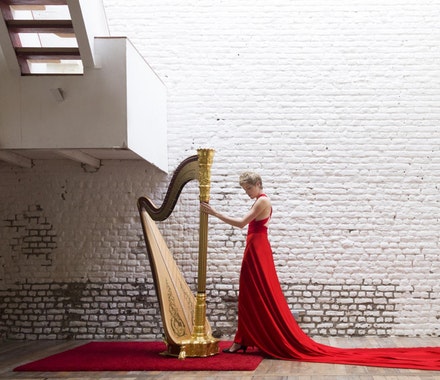
Adam Walker (flute, above), Tabea Zimmermann (viola) & Agnès Clément (harp) (both below)

Bax Elegiac Trio (1916) (1:40 – 11:15 on the broadcast link below)
Debussy Syrinx (1913) (12:47-14:28; Sonata for flute, viola and harp (1915) (17:34 – 35:44)
Stravinsky Elégie for viola (1944) (37:21-43:24)
Gubaidulina Garten Von Freuden Und Traurigkeiten (Garden of Joy and Sorrow) (1980) (45:38-1:02:34)

Wigmore Hall, London
Monday 15 April 2019

To hear the BBC broadcast through BBC Sounds, please follow this link

Photo credits: Adam Walker (c) Marco Borggreve, Agnès Clément (c) Tysje Severens

Commentary and Review by Ben Hogwood

The combination of flute, viola and harp is relatively unusual but has inspired some extremely forward-looking music since the second decade of the 20th century. Within two years of each other Bax and Debussy wrote independently for the combination, responding very differently to the potential of new and open textures.

Sir Arnold Bax was in fact the first to publish, and his Elegiac Trio immediately casts its spell through the rippling adagios of Agnès Clément’s harp (from 1:40 on the broadcast). Above this the flute of Adam Walker and viola of Tabea Zimmermann exchange airy thoughts, introspective but also free of constraint. The watery sound is beautiful and weightless, but Bax’s thoughts become more substantial. The music comes to rest in the major key, having started in the minor, with the feeling of troubles put to rest.

Of all the pieces written for solo flute, Debussy‘s Syrinx (12:47) is both the most magical and the most innovative. And yet when you listen to it there is no effort at all required, the languid lines instinctive but leading to an impressive climax. Adam Walker plays superbly here, ending in the lower register lost in thought.


Debussy’s Sonata for flute, viola and harp (from 17:34) is also a piece deserving of its description as magical, and is regarded as one of the signposts to modern 20th century music for its innovations in sound, harmony and melody. It is ideal when heard after Syrinx, as the flute begins – then the viola. As the programme booklet writer Paul Griffiths vividly observes, this first movement, marked Pastorale, takes time to pause in reflection, while demonstrating Paul Klee’s idea of ‘taking a line for a walk’. It’s elusive yet captivating.

The second movement Interlude (24:50) is graceful and a little dance like. Again the textures are beautifully open, helped by the tone quality of the three soloists, who bring to Debussy’s music that wonderful hazy warmth we associate with the composer at times. Then from 27:38 we hear a joyous tune from flute and viola together, over flowing harp, before the movement subsides to a soft end.

The Finale (31:08) is often singled out for its striking sonorities. The harp tremolo gives a rich backing for the very separate thoughts of flute and harp, one enchanting and the other relatively scratchy with the bow towards the bridge. At all times Debussy is keenly aware of the colours he wants to portray and the three players here respond superbly, bringing their close attention to sonic detail with a convincing unison.

Tabea Zimmermann then goes alone for the understated but striking Elégie of Stravinsky – striking because it is scored for solo, muted viola and sounds as though it has been imported from another civilization. It is also in two parts, so the initial idea (37:21) gives way to an austere dialogue between different ‘voices’ on the same instrument. The end recaps the mournful opening before dying away.

A world very far from the Wigmore Hall is also the destination for the unusual colours (for classical audiences at least) conjured up by Sofia Gubaidulina. East frequently meets West in her compositions, and in Garten Von Freuden Und Traurigkeiten (Garden of Joy and Sorrow) the East is most obviously present in the harp, plucking its responses to the flute’s decorations with slides of pitch. It is eerie but also compelling.

Then from around 50:15 the viola explores its harmonics – the fingers resting very lightly on the string to get a glassy sound that appears to be far-off, but which Gubaidulina uses cleverly. The flute is still the most prominent instrument, but increasingly the viola’s ‘voices of the night’ and the harp’s insistent plucking make themselves known. The music gets more animated, taking the harp right down to its lowest range – from where the flute starts a solo ‘cadenza’ (54:00)

The garden then seems to fall under its own spell, with night noises from all three instruments, until the viola plays a powerful line rising to a height. After this the music of the opening returns, with the striking harp slides again in evidence, before fading to the middle distance.

A superb performance of this piece from three friends, for whom this was their first ever concert as a trio. That would explain the wonderful spontaneity on show, for you would never have known!

Further reading and listening

The music in this concert can be heard here, including a live recording of the Gubaidulina and a legendary recording of the Debussy from the Melos Ensemble:

If Gubaidulina is a new name to your ears, then the strongest possible recommendation can be made for this recording of her Offertorium for violin and orchestra from Gidon Kremer, coupled with the Hommage à T.S. Eliot – a cycle for soprano and an octet featuring today’s viola player Tabea Zimmermann:

For more chamber music featuring the harp, this lovely collection from the Academy of St. Martin-in-the-Fields Chamber Ensemble is a treat. It includes two works by Debussy, the beautiful Introduction and Allegro by Ravel and the delightful Serenade for flute, harp and string trio by this year’s centenary composer Roussel: