
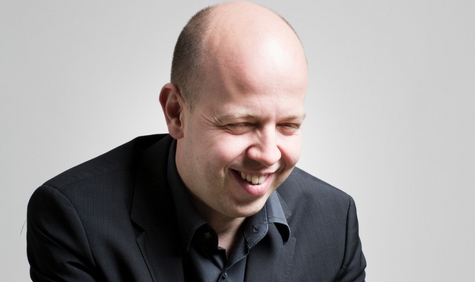
Talking Heads: Huw Watkins

It may not yet feel like it (in the UK at least!) but Spring is just around the corner. With a timely intervention, Huw Watkins (above) has not long had the first performance of a piece with that very title, given by the orchestra of which he is Composer-in-Association, the BBC National Orchestra of Wales. When Arcana catches up with him, however, his thoughts are with a boyhood favourite, the Britten Piano Concerto – centrepiece of a concert he has curated for the orchestra.

Immediately Watkins is enthusiastic about the Britten performance, and the orchestra’s prowess. “I have to say the orchestral parts are sounding brilliant, and touch wood it’s gone pretty well. It’s a really fun piece to play, and I don’t think the orchestra have ever played this piece before. They are so quick to learn though, and the rehearsal we have just done was done in two hours rather than three!”

The Britten brings its own particular challenges. “I do play concertos but I’m a composer and chamber musician really, so I’m not on the regular circuit. It is always a bit nerve wracking playing with an orchestra again, but this is a work that I am familiar with and have known since university. I did it with the orchestra there, so got to know it very well. It’s a lovely, youthful piece, and the conductor Martyn Brabbins, who I’ve been working with, has done it a lot and knows it very well. He was really excited about this performance, and it was lovely to work with him. I play a lot of chamber music so you have to listen in a different way with the orchestra, leading rather than following.”

Watkins recalls for Arcana his first ever encounters with classical music. “It’s difficult to remember exactly, because music was always around. Paul was already playing the cello and piano, my dad was an amateur viola player, and mum was teaching in school. Before my teenage years I loved playing the piano but I had become a bit bored with it. Then I listened to Stravinsky’s Petrushka and it blew me away when I first heard it – and so did the Britten that I’m about to play! It’s so immediately likeable and fun.”

He then recalls the first meeting he had with the BBC National Orchestra of Wales. “I remember that I’d written a piece in 2000, a Sinfonietta-type piece that they did with Grant Llewellyn. I’ve withdrawn it from publication now but it was a great learning piece. As a composer it’s hard to get access to an orchestra regularly so that was a really big thing. Shortly after I wrote my Piano Concerto, which I played myself with tonight’s conductor Martyn Brabbins. We go back a long way!”

How would he describe Spring in the form of a program note? “I didn’t really want to do what was just an aural picture, but the opening felt like that moment just before spring starts. A lot of pieces of music do that but it had a pregnant feel to it. Giving a title to a piece of music is really hard, because if you think of something poetic you become chained to it, but it’s nice to have something to think about in the audience. With this piece I think there is a sense of something blooming and broadening out. That was in my mind, and the idea of looking forward to spring.”

You can listen to Spring here

What are his own personal reflections on the season? “When spring comes you notice it getting lighter, and getting energy back. It would be nice to be able to have a break but the trouble with composing is that the deadlines come through thick and fast. I do need to plan a bit of a break, you can’t just keep churning it out. I do want to find time to listen to other pieces, it can be distracting to hear other people’s work when you’re writing so I generally choose not to. I’m lucky with the demand there is at the moment, the BBC NoW is a source of three commissions and writing for the orchestra is very enjoyable, if time consuming!”

Watkins divides his time between composition and the piano, and over recent years has shown himself to be an extremely quick learner. This has enabled him to record several discs of lesser-known British repertoire for cello and piano for Chandos. In partnership with cellist brother Paul Watkins, this was an experience he clearly enjoyed. “A lot of that repertoire was new to us, and I think the John Foulds Cello Sonata in particular is an absolute masterpiece. The York Bowen Cello Sonata was good too. We were lucky to do those discs. I find I’ve always been a quick sight reader but I can’t always rely on that as I get older! I want to spend more time on new pieces, but I want to concentrate on doing pieces more than once, to really get to know them.”

The challenge with such a busy schedule on both fronts is achieving balance between work as a performer and a composer. “My piano playing feeds into my creativity and my compositional life”, he says. “I think you lose a perspective if you’re not involved in live performance as a musician, and with how audiences respond.”

Some opportunities are just too good to pass though, including last year’s commission for a carol for the Service of Nine Lessons and Carols at King’s College, Cambridge. “It was an incredibly inspiring thing to be asked to do. I wanted to write something simple, to write something pure and plain. The atmosphere in that service on Christmas Eve is amazing, and that’s probably my only chance to go to the service as well!”

You can discover more about Huw’s contribution to the service here

Later in the year Watkins the pianist will step forward as soloist in the Piano Concerto by Philip Cashian, an eagerly awaited world premiere at the Aldeburgh Festival. “Yes, that’s something we were preparing to do this time last year with the BBC Symphony Orchestra,” Watkins recalls. “We had three days rehearsing it with Oliver Knussen and he sadly became ill on the morning of the concert, and it had to be rescheduled. It’s a really good piece, energetic and athletic. Philip is great at writing fast and rhythmically lithe music.”

Knussen is a conductor Watkins has worked with before, and who has had a considerable influence on his life as a performer and composer to date. “I find him completely inspiring”, he gushes. “I’ve been lucky to do a couple of concertos with him, the Tansy Davies and Helen Grime (Huw’s wife). He’s brilliant to hang out with too, he knows and knew so many people. I hope he writes it all down! It would be great to read a book by him eventually, especially as he’s also hilarious and very good company. He wrote a piece for the violinists Tamsin Waley-Cohen and I recently. It was the first new piece he had written since 2010, so that was really special. I think this has started him back to regular writing, and it is a truly gorgeous piece. It was a real honour. We were getting e-mails with a page a day of this amazing, handwritten score.”

Watkins counts Knussen as a lasting inspiration. “He really is one of the towering figures of the last 50 years in the music of this country, a composer with such a brilliant ear. With him it’s really important that you play the right notes, because he has thought out the harmony so thoroughly. It is so beautiful to listen to. He is definitely very high up my list, and I’ve been very lucky to work with a lot of contemporary composers. Gerald Barry is another I have really enjoyed working with, and I played in his opera The Importance of Being Earnest. I admire it greatly, although it is hugely difficult to play!”

There is plenty for Watkins to explore on the instrumental front, and for now he has plenty to get his teeth into with this relatively ‘traditional’ approach. “I don’t think instruments are ‘tired out’ yet, there is still so much you can get out of it. There was a Thomas Adès piece Seven Days, a kind of video ballet, and I thought that was absolutely brilliant. I wouldn’t rule it out in my own writing but there is still so much to do!”

His own music has a tonal base, with melodic points of reference, but continues to look forward int is approach, drawing a little on the past in form and function but introducing new melodic and harmonic thoughts. “That’s a nice way of putting it”, he says approvingly. “I don’t want to go back to something safe and cosy, I want to write fresh things. I’ve immersed myself in some out there music but I am now writing the music I really want to write. I get some writers who say it’s conventional but I don’t care to be honest! I think someone like Britten still did things with tonality that still make it new and fresh. If everything is self-consciously new it can be fake! It’s no good denying the tonal audacity and the hierarchy of the intervals with Britten – and shows that there are still things you can do. That’s not to say the other developments are not valid, but I wouldn’t dismiss it.”

We move on to discuss the BBC National Orchestra of Wales, now 90 years old. Watkins is hugely appreciative of their achievements and function. “I think the part I know is since the 1980s, when they became a fully fledged Symphony Orchestra. I can only speak from my own experience in the St David’s Hall, which was new then. It has become an incredibly good orchestra, but they also make an effort to go around Wales which I think is extremely important. Places like Abergavenny and Bangor would not always have a symphony orchestra near them, so it’s very important. They don’t have to worry quite so much about full houses so they can do stuff that’s off the beaten track, and it’ll also be on the radio.”

“That’s a very healthy thing. It’s good for composers to think a little bit commercially when writing, but also good that people like the BBC NoW commission these pieces. At the end of February I’m doing a workshop with young composers, and Martyn Brabbins is doing conductor masterclasses. That’s a real services because it’s hard for people to learn their craft. The orchestra does get better and better, we were so impressed with the Britten and I know that tomorrow it will be better still. Cardiff’s lucky to have the Welsh National Opera too, it improves the life of a city. I feel very lucky to be Composer in Association here, it’s been a very nice experience for me.”

Watkins will perform Philip Cashian’s Piano Concerto at the Aldeburgh Festival, part of a concert with the BBC Symphony Orchestra and Oliver Knussen that will include Copland’s Appalachian Spring and Music For A Great City. For more details you can go to the Snape Maltings website

Wigmore Mondays: Golda Schultz & Jonathan Ware – Mozart, Schubert, Amy Beach & John Carter

Golda Schultz (soprano, above) and Jonathan Ware (piano, below – credit Kaupo Kikkas)

Mozart An Chloe, K524; Das Lied der Trennung, K519 (both 1787)
Schubert Heimliches Lieben, D922 (1827); Romanze (Rosamunde, D797 No 3b) (1823); Suleika I, D720; Suleika II, D717 (both 1821)
Amy Beach Three Browning Songs, Op 44 (1900)
John Carter Cantata (1964) (40:33-53:30)

Wigmore Hall, London; Monday 5 February 2018

You can listen to the BBC Radio 3 broadcast by clicking here

Written by Ben Hogwood

It is always welcome to see a singer make their debut at a venue like the Wigmore Hall with a less than usual recital programme in tow. South African soprano Golda Schultz did just that, giving with pianist Jonathan Ware a concert ranging some 200 years and crossing from Europe to North America as it progressed.

Europe first, and two songs from Mozart. While known as a vocal composer, Mozart’s songs are relatively rarely heard in the concert hall, and it was nice to hear two substantial, more mature examples, from around the time of Le Nozze di Figaro. An Chloe made a relatively graceful start, Schultz exhibiting a full voice with a lovely bright top end to the soprano voice, but the more substantial Das Lied der Trennung (6:49-11:30) told a story of greater angst.

The Schubert selection (from 19:32-29:28) was a quartet of the composer’s settings of women poets, beginning with the late (for him, anyway!) song Heimliches Lieben. Written when the composer was still only 29, it is a deeply passionate affair, and Schultz involved herself completely. Then we heard the lovely Romanze (16:20), with its deep longing, persuasively phrased in accompaniment by Ware.

Both Suleika songs followed, often wrongly attributed to Goethe but with words by Marianne von Willemer. The first, initially an edgy affair (19:32), was described by Brahms as ‘the loveliest song ever written’, and here benefited from Schultz’s poise and Ware’s telling shifts from major to minor key before evening out for a radiant coda. The second (25:16) included the same shifts, but danced lightly on its feet.

Amy Beach was one of the first women composers to really make a lasting impression in classical music, terrible as that sentence sounds. Some of her songs are well known, in particular these three short settings of poetry by Robert Browning (31:02-33:50 on the broadcast). The first, The Year’s at the Spring! (31:02), was a rapturous picture postcard with which to throw open the doors, while Ah, Love, but a Day! (32:13) grew gradually higher in range, Schultz making the most of this with an exquisitely floated delivery. Finally I Send My Heart Up To Thee (33:50) was a joyful ray of light.

Ending the program was a real curiosity, the Cantata by little-known Afro-American composer John Carter (1932-c1981). Written for and premiered by Leontyne Price in 1964, it is based on settings of Negro spirituals, but adds some particularly vivid descriptions in the piano part, heroically played here by Jonathan Ware. His Prelude (40:33) set out an impressive stature for the piece, which Schultz built on with Peter, Go Ring Dem Bells (41:23). This developed into a tour de force, increasingly fervent with peals of bells in the right hand and a soaring top B flat from Schultz, brilliantly delivered.

After this a step backwards was needed – and found – in Sometimes I Feel Like A Motherless Child (45:12), a solemn utterance, before the contemplative Let Us Break Bread Together On Our Knees (48:02). From the silence came a tumultuous final movement (51:22), the Toccata Ride On King Jesus. Both performers gave it everything, capturing the mysterious power of Carter’s music.

There were two encores – an affectionate account of Somewhere Over The Rainbow (54:48), vibrato beautifully controlled, and then, closer to home for Schultz, an Afrikaan song entitled Homesickness (1:00:28).

Further listening

You can watch an intriguing interview with Golda Schutz below, in which she candidly discusses her own stage fright – which certainly was not on show at the Wigmore Hall!

Meanwhile to hear recordings of the music from this concert you can use the Spotify playlist below:

Listening to the John Carter Cantata I was reminded of Copland’s Old American Songs – and you can hear them in their choral versions below, conducted by Michael Tilson Thomas:

Under The Surface – Havergal Brian: Symphonies 8, 21 & 26 (Naxos)

Havergal Brian: Symphonies Nos. 8, 21 & 26 – New Russia State Symphony Orchestra / Alexander Walker

Reviewed by Richard Whitehouse

What’s the story?

Naxos’s Havergal Brian cycle, begun a quarter-century ago on the Marco Polo label, reaches an important milestone with a disc that features the composer’s only previously unrecorded symphony, alongside notable such works from his middle- and late- periods.

What’s the music like?

The premiere recording is that of the Twenty-Sixth Symphony, written as Brian approached his 90th birthday and among his most concentrated – for all that the overall mood is one of relative good humour. Of its three allegros, the first is a boisterous sonata design that cannily elides development and reprise, while its successor is a lively intermezzo with unexpectedly aggressive trios then a pointedly understated ending which leads directly into the finale – an off-kilter rondo whose more ambivalent episodes make possible a coda whose decisiveness is more than a little fractious. Unheard since two performances in its composer’s centenary year, the piece yields unexpected subtleties – Alexander Walker drawing a tensile response from his New Russia State Orchestra forces in this lesser while not unappealing addition to the Brian canon.

The significance of the Eighth Symphony has never been in doubt. If not the first of Brian’s one-movement such works, it is the first in which this composer grappled with the potential of symphonic continuity in earnest. Compared to Sir Charles Groves’s 1977 recording (EMI/ Warner), Walker opts for less strongly characterized individual sections in favour of greater underlying cohesion – the piece thus emerging as more than the sum of its already fascinating parts. A further plus is the definition accorded harp and piano, their contribution being crucial to the motivic evolution of music whose mystical qualities are offset by elements of sardonic humour and fraught eloquence. Nor are the enigmatic final bars undersold, though the quiet concluding dissonance as horn and trombones collide might have evinced greater presence.

By comparison, the Twenty-First Symphony tended to be heard as Brian’s marking time prior to embarking on a new and more challenging phase. This, at least, was always the feeling of Eric Pinkett’s pioneering 1972 account with the Leicestershire Schools Symphony Orchestra (Unicorn/Heritage), though such equable classicism has little place in Walker’s conception – the charged opening Allegro, its gawky introduction transformed into a surging coda, being a case in point. The Adagio emerges as one of its composer’s most searching, its increasingly wracked expression barely held in check, then the Vivace’s nimble scherzo with two livelier trios makes way for a finale whose muscular variations build inexorably toward an apotheosis the more powerful for its relative succinctness in what is an unequivocal statement of intent.

Does it all work?

Indeed. This is a major appraisal of three contrasting Brian symphonies, grippingly conveyed by an orchestra which now sounds audibly at ease with this composer’s recalcitrant idiom.

Is it recommended?

Yes, not least when the recorded sound is arguably the best yet secured from this source, and John Pickard’s booklet notes offer a wealth of informed observation. Incidentally, the Eighth Symphony has not been performed since a 1971 broadcast and never given in concert. Maybe Alexander Walker would like to take the plunge as this piece approaches its 70th anniversary?

For more information on this release, you can visit the Naxos website. For more information on the New Russia State Symphony Orchestra click here, and for the conductor Alexander Walker’s website click here

Wigmore Mondays: Apollon Musagète Quartet play Grieg, Puccini & Sibelius

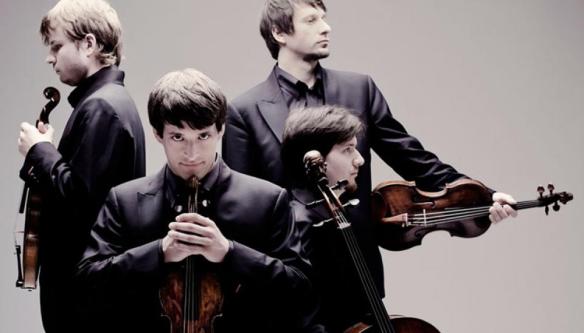
Apollon Musagète Quartet [Paweł Zalejski, Bartosz Zachłod (violins), Piotr Szumieł (viola), Piotr Skweres (cello)]

Sibelius Andante Festivo (1922) (1:55 – 6:00 on the broadcast link below)
Puccini I Crisantemi (1890) (6:25 – 13:45)
Grieg String Quartet in G minor Op.27 (1877) (16:00 – 52:46)

Wigmore Hall, London; Monday 29 January 2018

You can listen to the BBC Radio 3 broadcast by clicking here

Written by Ben Hogwood

This was a well thought out and brilliantly played concert from the Apollon Musagète Quartet, bringing together three composers not normally associated with the idiom of the string quartet, and making a very strong case for their efforts.

The Andante Festivo dates from a period when Sibelius was struggling, inspiration arriving at the Finnish composer’s house only fitfully. This piece was written on one such day, with the same luminous scoring that would characterise the Sixth Symphony. Here it was given an appropriate, ceremonial air – apt given that it was written for the 25th anniversary of the Säynätsalo sawmills. The full chords were deeply resonant here, hinting at a suitability realised by the composer’s later arrangement for string orchestra.

Puccini‘s I crisantemi is if anything more familiar in the composer’s arrangement for larger forces, but it was also very affecting here. The recurring harmonies have a strong, nostalgic tug at the heart strings, and again the Apollon Musagète were as one, skilfully putting deep feeling over sentimentality.

Grieg’s String Quartet in G minor is, in my opinion, a neglected masterpiece. That is a phrase you will of course read all too often in reviews, but in my defence I have no less a figure than the composer Franz Liszt to back me up!

“It is a long time since I have encountered a new composition, especially a string quartet, which has intrigued me as greatly as this distinctive and admirable work by Grieg.”

In this performance (from 16:00) on the broadcast link) the bold, solemn introduction quickly yielded to a fast movement that meant business and was already digging deep. Frequently the string writing is beefed up, and the impressive volume of this performance was balanced by a cleanliness of ensemble and attack. At 23:44, a brief pause between a big, sweeping statement and a very small response felt like the start of a new movement, so pronounced were the four players in their response.

From 28:56 the charming second movement Romanze made great appeal, with a lovely warm solo from cellist Piotr Skweres. The third movement Intermezzo (36:45) returned to the bold, assertive outlines of the first movement, resolutely sticking to a minor key – until, that is, its rustic second theme gave a jaunty alternative. This introduced a tension to the performance, as though Grieg himself was flitting between the two moods and unable to settle.

This battle of wills continued into the finale (from 43:59), the twisting lines of its brief introduction led by first violinist Paweł Zalejski until a nervy fast theme took hold. The quartet made much of Grieg’s daring harmonies, with some surprisingly bold dissonances, until finally the refuge of a major key was reached (from 51:46) Now the struggle – for performers as well as composer! – was more emphatically won, putting the seal on a really fine account of a piece that should be heard far more often.

As an encore the Apollon Musagète gave us a string quartet arrangement of Osvaldo Fresedo’s Vida mía (from 54:39), one of the Argentinian composer’s best-loved tangos.

Further listening

You can listen to recordings of the music from this concert on the Spotify playlist below:

Grieg’s String Quartet had a profound influence on Debussy, when he came to write his only work in the form sixteen years later. It is paired in a playlist here with Sibelius’ best known work in the form, his quartet known as Voces intimae:

BCMG – Celebrating Carter

Pierre-Laurent Aimard (piano), Birmingham Contemporary Music Group / Mirga Gražinytė-Tyla

Elliott Carter (above)
Mosaic (2004)
Bariolage (1992)
Two Controversies and a Conversation (2010/11)
Two Thoughts about the Piano (2007)
Double Trio (2011)
Epigrams (2012)

Town Hall, Birmingham; Sunday 28 January 2018

Written by Richard Whitehouse

Little of Elliott Carter’s music was heard in Birmingham during his lifetime, but an account of the then recent song-cycle In Sleep, In Thunder remains vivid in the memory 35 years on. That was directed by Oliver Knussen, who was latterly assiduous in the scheduling and even commissioning of the composer with Birmingham Contemporary Music Group, which this afternoon devoted a whole programme to Carter and was conducted for the first time by the City of Birmingham Symphony Orchestra’s current music director Mirga Gražinytė-Tyla.

A composer who not only lived to a great age but continued writing up until his death meant that BCMG had a sizable number of pieces from which to choose. It was an astute move to open with Mosaic, as this eventful piece is a paradigm for that ‘late late style’ Carter evolved in his 90s. Harp is the first among equals here, Carter having spoken of his desire to explore techniques developed by inter-war virtuoso Carlos Salzedo. Not that these are deployed for effect; indeed, this piece evinces an almost continuous ‘through line’ from which emerges a discourse as inventive as it is diverting – with an incitement to disciplined virtuosity that the musicians, not least Céline Saout, seized on with assurance. The harpist took centre stage for Bariolage, taking its cue from Rilke in what is a scintillating exploration of those techniques.

Nor is humour at a premium in this music. Two Controversies and a Conversation finds the piano at first mediating precariously between ensemble and percussion (first marimba, then woodblocks), before more balanced and equable discourse is made possible.

Carter’s earliest musical mentor, Charles Ives, would have been impressed by this refracted recollection of a concept he himself pursued in his Second String Quartet and while he might have been less convinced by the abstraction of Carter’s writing for piano, there can be little doubting the effectiveness of the latter’s Two Thoughts about the Piano. Complementary pieces too – the preoccupied and silence-riven progress of Intermittences countered by the linear velocity of Caténaires; Pierre-Laurent Aimard tackling both these pieces with his customary poise and precision.

Back in the early 1980s, Triple Duo was one of Carter’s most effervescent and entertaining works – its stealthy ingenuity posited in far more gnomic ways by Double Trio with its often impulsive if ultimately resigned interplay between violin, trombone and percussion as heard against trumpet, cello and piano.

Gražinytė-Tyla’s direction was at its most perceptive here, though it was left for Aimard, Alexandra Wood and Ulrich Heinen to take the platform for what was Carter’s final work. Epigrams consists of 12 refractory miniatures for piano trio (designed by the composer so that their cohesion would be assured however many were completed) – their salient gestures constantly though unpredictably recurring such that their diversity is never achieved at the expense of their unity, however hard-won this may seem.

If there was anything predictable here, it was the conviction and technical finesse of tonight’s performance, rounding off a programme as compact and absorbing as the music itself. Those yet to do so should investigate BCMG’s disc of Carter’s ‘late music’ as a matter of urgency.

For more information about Birmingham Contemporary Music Group, visit the ensemble’s website

Further listening

You can listen to the BCMG’s disc of Carter that Richard refers to on Spotify below: