In concert – Kleio Quartet @ Wigmore Hall: Elgar, Webern & Haydn

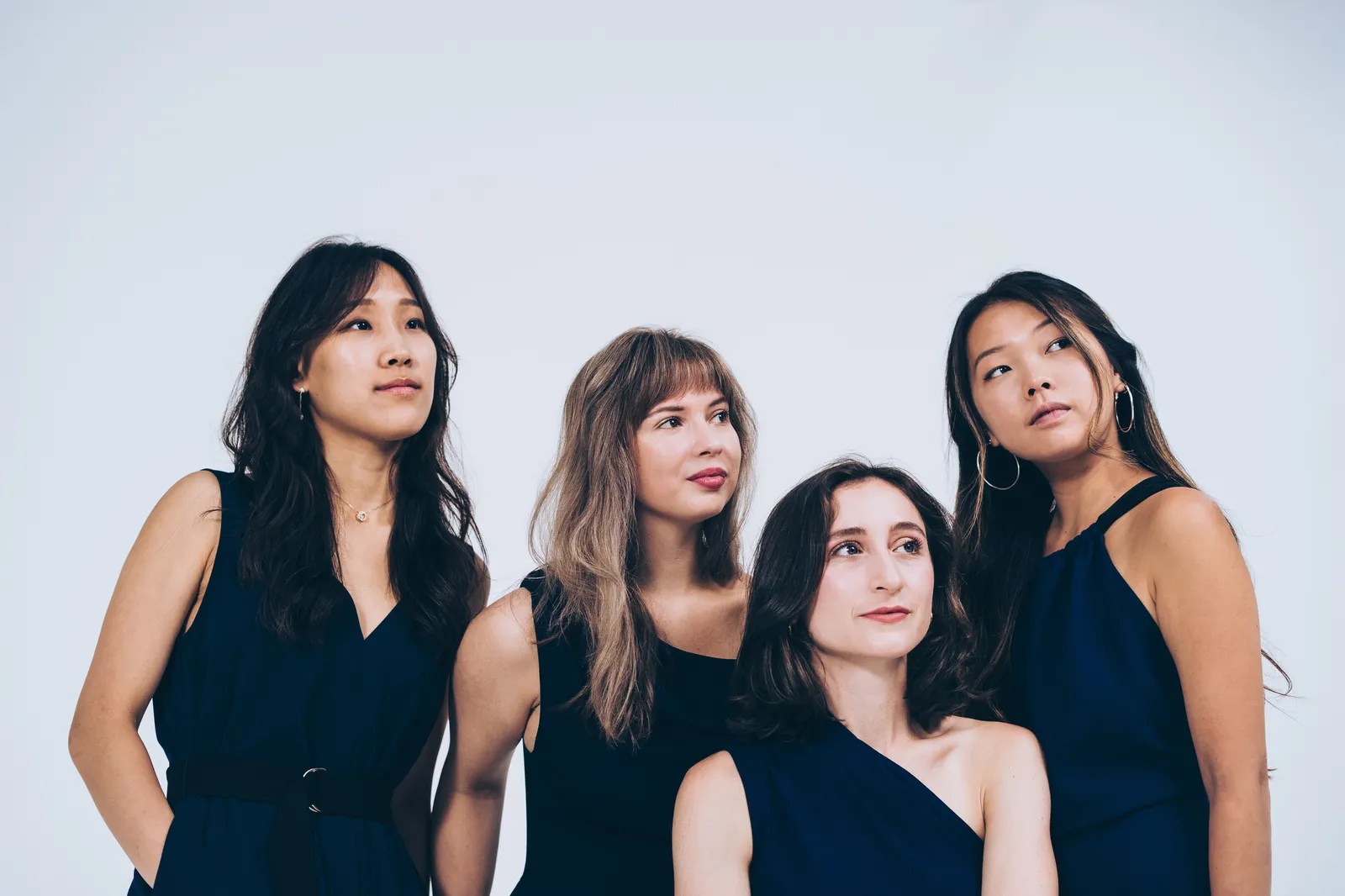
Kleio Quartet [Juliette Roos, Katherine Yoon (violins), Yume Fujise (viola), Eliza Millett (cello)]

Elgar String Quartet in E minor Op.83 (1918)
Webern 5 Movements for String Quartet Op.5 (1909)
Haydn String Quartet in D major Op.50/6 ‘Frog’ (1787)

Wigmore Hall, London
Monday 6 October 2025 (1pm)

On the evidence of this BBC Radio 3 Lunchtime Concert, the Kleio Quartet – members of the station’s New Generation Artists scheme – are ones to watch. Not least for their programming, for it was refreshing to see a Haydn string quartet given top billing at a concert rather than making up the numbers.

The concert began with an account of Sir Edward Elgar’s sole String Quartet notable for its poise, elegance and understated emotion. Elgar’s ‘late’ works are best experienced in concert at this autumnal time of year, though the dappled sunlight evoked here was compromised by a subtle yet lasting foreboding. For the youthful Kleio Quartet to capture the thoughts of a man in his early 60s with such clarity was impressive indeed. They did so through a first movement taking the ‘moderato’ of Elgar’s tempo marking to hand – deliberate but never plodding. The dense, Brahmsian counterpoint was deftly unpicked, while the nostalgic elements of the second movement gave the feeling of an ensemble performing in an adjacent room, the listener asked to imagine an elegant salon setting. The purposeful finale snapped us out of this reverie with vigorous exchanges, though there was time for affection in its second theme. Ultimately the music revelled in the Sussex outdoors enjoyed by Elgar and wife Alice, though the Autumnal chill remained present.

Memories of a very different kind coursed through Webern’s 5 Movements for String Quartet, written in the wake of his mother’s death. These remarkable compositions illustrate an unparalleled gift for intense, compressed expression. None of the movements last longer than two minutes, yet so much concentrated feeling is loaded into their short phrases, pushing against tonality with oblique melodies and rich yet desolate harmonies.

The Kleio Quartet found those qualities and more in a deeply impressive account, with the alternate moods of the first movement, argumentative and then delicate, and the forthright third. Countering these moods were the soul searching second and the sparse, eerie fourth, where the ticking motif of Yume Fujise’s viola suggested a period of insomnia. The bare bones of Webern’s anguish were made clear in the final movement, in the high, inconsolable violin of Juliette Roos and the empty closing chords.

Following this with one of Haydn’s most amiable quartets was an inspired move, the Wigmore Hall audience smiling feely as the composer’s humour was repeatedly revealed. The so-called ‘Frog’ quartet, named for the croaking repeated notes of the finale’s main theme, shows Haydn completing his Op.50 set of six quartets with a panache that would surely have delighted their beneficiary, Frederick William II of Prussia.

The Kleio had fun with the unpredictable first movement, spirited yet restless, and the harmonic twists and turns of the Poco adagio, led by expressive flourishes from Roos. The quirky Menuetto revelled in melodic inflections and cheeky asides, with the pregnant pauses of the trio section adding to the irregular rhythms within the triple time meter. All of which set up the fun and frolics of the finale, where the occasional slip of ensemble tuning could be easily forgiven in the spirit of the Kleio’s performance, Haydn charming his audience to the very end.

Listen

You can listen to this concert as the first hour of BBC Radio 3’s Classical Live, which can be found on BBC Sounds until Tuesday 4 November.

Published post no.2,680 – Tuesday 7 October 2025
In concert – Cleveland Orchestra / Franz Welser-Möst @ Carnegie Hall: Prokofiev & Webern symphonies

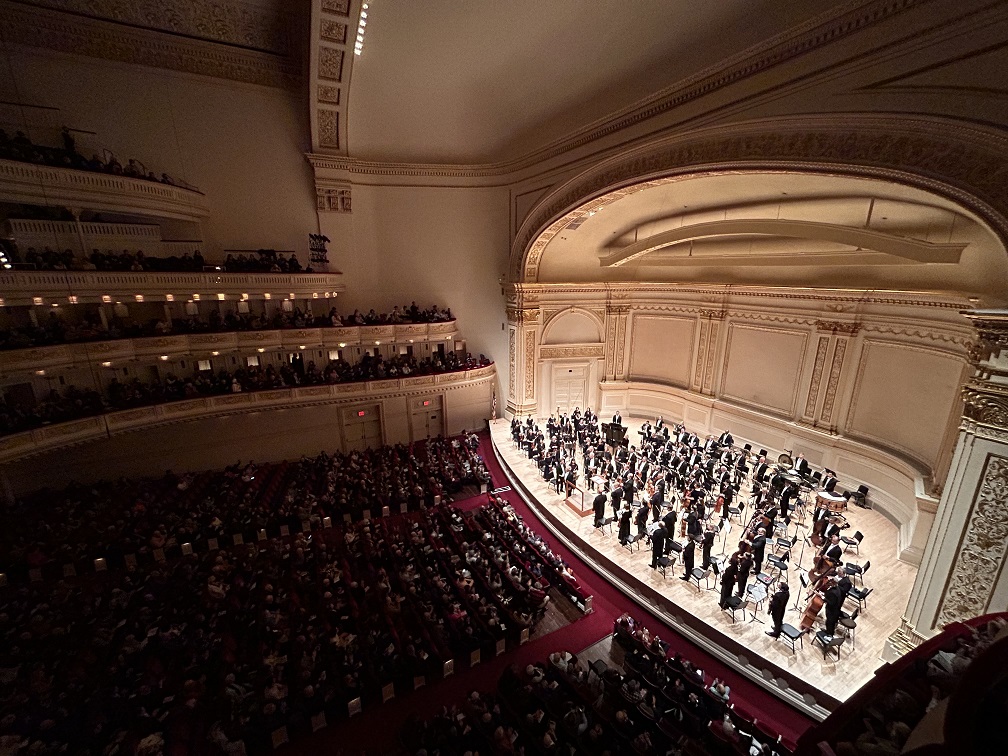
Prokofiev’s trademark technicolour orchestration contrasted with Webern’s sparse score for his Symphony Op.21 performed by the Cleveland Orchestra with Franz Welser-Möst.

Cleveland Orchestra / Franz Welser-Möst

Prokofiev Symphony No. 2 in D Minor Op. 40 (1924-1925)
Webern Symphony, Op. 21 (1927-1928)
Prokofiev Symphony No. 5 in B-flat Major, Op. 100 (1944)

Carnegie Hall, United States
Sunday 21 January 2024

Reviewed by Jon Jacob. Photo (c) Jon Jacob

Most concerts start with some kind of concert opener. An overture, for example, gives the band on stage the opportunity to get accustomed to the acoustic with an audience in it, while giving the audience a chance to settle down before the main event. That the Cleveland Orchestra got underway so deftly with the epic industrial landscape of Prokofiev’s Second Symphony immediately hinted at the kind of concert this would turn out to be. 

Conducted by their music director, Austrian conductor Franz Welser-Most, the Cleveland Orchestra presented three works as part of Carnegie Hall’s ongoing series examining the fall of the Weimar Republic: two symphonies by Russian composer Prokofiev, contrasted with Webern’s Symphony for chamber ensemble. 

Prokofiev’s Second Symphony, written in 1924 and premiered in Paris in 1925, is an epic work brimming with fiendish detail and tantalising textures. The first movement’s brutal industrial landscape is depicted with a gargantuan, lumbering brass section, piercing brass top lines, and occasionally shrill woodwind. The combination did at times cause the person sat next to me at Carnegie Hall to put her fingers in her ears. This was contrasted by a tender oboe solo at the beginning of the short second movement theme, followed by a series of short variations which saw a remarkable range of colours and textures from the strings and woodwind. This was a polished, confident and assertive performance throughout, right from the start.  

In contrast, the material in the Prokofiev’s Fifth Symphony, written in 1944 when the composer had returned to the Soviet Union, is lighter and the treatment of it far more playful, energetic and in places vigorous. In the performance, the orchestra sometimes sounded underpowered meaning things felt overly romantic. The second movement Allegro had spirit and bounce, moving through multiple personalities and moods, cheerful, cheeky and, from to time, just a hint of macabre too, though, like the final movement, it did feel like it lacked a bit of grit. After Franz Welser-Most paused for a police siren to disappear out of earshot down 7th Avenue, the third movement opened with tantalizingly papery strings over which the solo was passed effortlessly between different combinations of woodwind instruments whilst still making everything feel whole. Later we heard rich, warm, heart-tugging string sounds (the leaps in the upper strings got me every single time).

Webern’s ‘miniature’ ten-minute, two-movement Symphony, written three years after Prokofiev’s Second Symphony, could have sounded like an academic curiosity in comparison to the Russian composer’s technicolour orchestration. Yet in this concert, Webern’s Op. 21 acted as a palette cleanser, pivoting us from the epic Second to the more box-office appealing Fifth of Prokofiev’s symphonies.

Special praise to Cleveland’s principal clarinet Afendi Yusuf, whose rounded burgundy tone was simply to die for. A gorgeous sound throughout. Excitable applause also for some fruity queues from bass clarinetist Amy Zoloto and contrabasoonist Jonathan Sherwin.

Further listening

Some recommended recordings to listen to are based simply on the final movement allegro which in the case of Herbert von Karajan’s Berlin Philharmonic recording is a tour-de-force. On the other hand, in Valery Gergiev and the London Symphony’s performance, there’s a crazed sense of menace. In concert, Franz Welser-Most seemed to pull out a more playful character in the final movement and this is also reflected in the Cleveland’s 2023 recording under his direction. I’m always going to prefer the unhinged characterisation, but that probably says more about my character than it does about the performance.

Meanwhile the Cleveland Orchestra recorded Webern’s Symphony as part of an album devoted to the composer’s orchestral music, under their former music director Christoph von Dohnányi in 1998.

Jon Jacob is a writer, digital content producer and strategist, authors the Thoroughly Good Classical Music Blog, and produces the Thoroughly Good Podcast.

Published post no.2,064 – Monday 22 January 2024

Alexander von Zemlinsky at 150

Today marks 150 years since the birth in Vienna of composer, conductor and teacher Alexander von Zemlinsky.

Zemlinsky is a figure of great historical importance in classical music, with a marked impact behind the scenes on the direction it was to take in the 20th century. In his early twenties, he caught the attention of Brahms, who was impressed with the Clarinet Trio published as a composer’s Op.3 in 1896. Around this time Zemlinsky also met Schoenberg, and then Alma Schindler, with whom he had an intense relationship. Their union was unexpectedly and suddenly broken in 1902, however, when Alma married Gustav Mahler.

Zemlinsky’s musical family tree is an intriguing one. As a teacher he mentored and encouraged Berg, Webern and Korngold. As a conductor he received unreserved praise from Schoenberg, Stravinsky and Weill. Stravinsky declared in 1964, “I do believe that of all the conductors I have heard, I would choose Alexander Zemlinsky as the most outstanding, and this is a mature verdict.” Schoenberg admired his “natural, unforced and obvious greatness”.

It is as a composer that we remember him here, however, for Zemlinsky’s music has not yet reached the audience it deserves. One of his greatest works, the Lyric Symphony made a strong impression at the Proms in 2016, and the Clarinet Trio was performed at the same festival this year. Those are just two of many fine compositions, however. Brahms was also impressed with Zemlinsky’s symphonic writing, and as an orchestral composer both his tone poem Die Seejungfrau and the Sinfonietta are fine works. The magical opening bars of the former, as heard in a new recording from the Royal Liverpool Philharmonic Orchestra and Vasily Petrenko for Onyx Classics, are to be treasured:

The four string quartets are also highly regarded, as is the output for solo piano, while another strong area for Zemlinsky was Lieder. Here there are many fine settings, perhaps the best of which are his 6 Songs after Poems by Maeterlinck of 1910-13.

The Spotify playlist below brings a number of these pieces together – while you can visit the Alexander Zemlinsky website to learn more about his life and work. Meanwhile a biography by Antony Beaumont, published in 2000 by Cornell University Press, is also highly recommended.

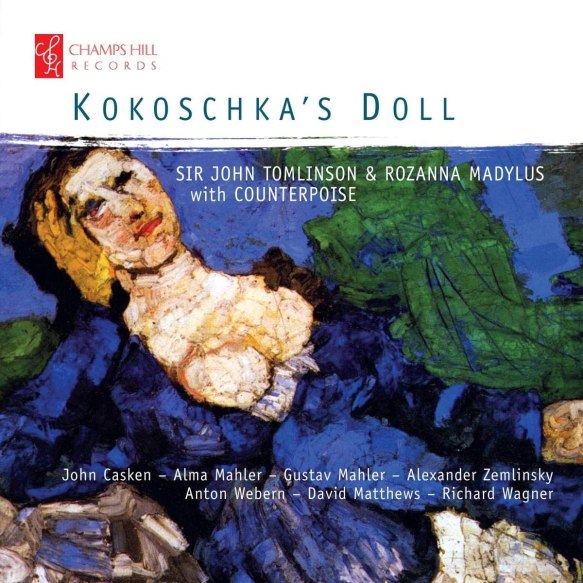
On record – Sir John Tomlinson, Rozanna Madylus & Counterpoise: Kokoschka’s Doll (Champs Hill Records))

Rozanna Madylus (mezzo-soprano), Sir John Tomlinson (bass), Counterpoise [Kyle Horch (saxophone/clarinet), Deborah Calland (trumpet), Fenella Humphreys (violin), Iain Farrington (piano)]

Music by John Casken, Alma Mahler, Gustav Mahler, David Matthews, Richard Wagner, Anton Webern and Alexander Zemlinsky

Champs Hill Records CHRCD150 [81’54”]

Producer Matthew Bennett
Engineer Dave Rowell

Recorded 21-22 May 2018 & 17 January 2019, Music Room, Champs Hill, Sussex

Written by Richard Whitehouse

What’s the story?

The enterprising ensemble Counterpoise returns with its second release – an ambitious and wide-ranging selection centred upon that redoubtable femme fatale who was Alma Mahler and with a major new piece of music-theatre featuring Sir John Tomlinson from John Casken.

What’s the music like?

The generous programme effectively divides into two parts. The Art of Love opens with four songs by Alma – her setting of Julius Bierbaum’s Mild Summer Night and A Nocturnal Light followed by that of Gustav Falke’s Harvest Song, all of them accorded a fresh perspective in resourceful arrangements by David Matthews. Much the finest is the recently located setting of Leo Greiner’s Lonely Walk, but even this must yield to the radiance of Paul Wertheimer’s Blissful Hour by Zemlinsky, Alma’s lover before Mahler and an underrated Lieder composer.

Matthews’s subtle arrangement of Mahler’s rapturous Rückert setting If You Love for Beauty, followed by his ominous Wunderhorn setting Where the Splendid Trumpet Sounds, proceed Iain Farrington’s violin-and-piano transcription of the start of the Adagietto from Mahler’s Fifth Symphony (it would be worth hearing the rest). Webern’s glinting Trio Movement for clarinet, trumpet and piano is intriguingly countered by Matthews’s hardly longer yet more equable Transformation (with addition of piano); after which, his arrangement of Wagner’s Dreams (last of five settings after Mathilde Wesendonck) underlines its rapt introspection. Rounding off this first part with Liszt’s take on Isolde’s Liebestod might almost be thought rather predictable, but Farrington’s pointedly unshowy rendering is an undoubted pleasure.

The second half of this programme is devoted to Kokoschka’s Doll – a melodrama for bass-baritone and ensemble by John Casken, who has also devised the text in collaboration with Barry Millington. Drawing on the artist’s letters and autobiography, this almost 40-minute piece focusses on Kokoschka’s fractious liaison with a recently widowed Alma Mahler, his near-death experience as a soldier on the Eastern front, then his ill-fated attempt to recreate Alma as a doll to his idealized specifications. Unfolding between past and present, the text provides plenty of leeway for Sir John Tomlinson to convey the tortured while not a little self-seeking protagonist through an adept interplay of speech and parlando – dispatched with his inimitable blend of fiery rhetoric and soulful rumination. Instrumentally the music is rich in timbral and textural nuance, following the emotional ebb and flow of Kokoschka’s musings as they spill over into the irrational. An engrossing concept, skilfully realized, which would certainly be worth presenting in a scenic version at some of the UK’s many studio-theatres.

Does it all work?

As an overall sequence, certainly. Counterpoise is an object-lesson of unity within diversity, whether in the range of music this ensemble brings together or in the arresting nature of the arrangements it favours. Added to which, the singing of Rozanna Madylus is a treat in store.

Is it recommended?

Indeed. Performances and recording leave nothing to be desired, while the booklet features a succinct introduction by Millington along with reproductions from Kokoschka’s drawings of his ‘Alma Doll’ – more appealing visually than it becomes at the denouement of the scenario!

Listen and Buy

You can read more about this release, listen to clips and purchase from the Champs Hill website

Wigmore Mondays – Daniel Müller-Schott & Annika Treutler: Dvořák, Webern & Franck

Daniel Müller-Schott (cello, above), Annika Treutler (piano, below)

Wigmore Hall, Monday 17 February 2020 (lunchtime)

You can listen to this concert on the BBC Sounds app here (opens in a new window)

Review and guide by Ben Hogwood

There is so much original music for cello and piano dating from the 19th century that there is a danger of feeling short changed in a concert when presented with music arranged from a different instrument. Yet such was the conviction with which Daniel Müller-Schott and Annike Treutler played these pieces that it was possible to forget those thoughts and enjoy the music, pure and simple.

It also showed just how flexible some of the original music is. Dvořák’s 4 Romantic Pieces began as works for string quartet but their songful nature gives them just as much expression in their better known arrangement for violin and piano, and then in Müller-Schott’s own arrangement here. The first piece, a Cavatina, is a lyrical treat (2:36), while the second has a comparatively stern expression (5:44), ending with imaginative use of harmonics from the cellist. The third and most lyrical of the four pieces (8:28) returns to the same key as the first, and is ideally suited to the cello’s range, while the fourth and longest piece (10:51) is more thoughtful and affecting.

It usually takes longer to write about Webern’s music than it does to perform – which is again the case here. Yet such is the compressed intensity of his writing that the Drei Kleine Stücke will have stuck in people’s memories, despite lasting less than 5 minutes. Webern wrote the three pieces at a particularly fraught time in 1914, and Daniel Müller-Schott’s probing tone communicates their strength of feeling. As did Annika Treutler’s timely interventions, lingering on the mysterious chords of the first (from 19:06) signing off the second piece abruptly (20:15) and then the two savouring the ghostly sonorities of the slow, stretched out notes of the third piece (20:42).

The Violin Sonata in A major is one of César Franck’s most enduring works. Brimming with good tunes, it has an air of spring about it, and its abundance of good feeling makes it a very popular concert piece – as it surely was in its first performance, at the wedding of legendary Belgian violinist and composer Ysaÿe. Although originally written for violin and piano Franck was fully aware of the potential of a version for cello, and specified it could be played as such. This was eventually realised with the help of French cellist Jules Delsart.

Because most of the melodies are an octave lower in pitch it means the sonata does not have quite such a sunny outlook in its cello arrangement – but it does bring out the red blooded Romanticism of the stormy second movement.

Before that, Müller-Schott and Treutler delight in the dreamy first movement, threading Franck’s thematic ideas together beautifully (from 24:11). The second movement, the most effective in the arrangement, powers forward with impressive momentum (30:15), the music flowing freely as Müller-Schott’s probing tone and intonation shine through. At the same time Treutler proves the ideal anchor, the two judging the tempo just right.

The third movement is a freeform recitative for cello with subtly voiced thoughts for the piano (38:22), and the pair’s instinctive feel for the music gives it just the right amount of room to breathe. The finale (46:17) is a masterful bit of writing, a canon where the cello part shadows the piano at a close distance almost constantly. There is little more to say here than simply to enjoy the music and Franck’s powers of invention in an ideal performance!

Repertoire

This concert contained the following music (with timings on the BBC Sounds broadcast in brackets):

Dvořák, arr Müller-Schott 4 Romantic Pieces Op.75 (1887) (2:36)
Webern Drei Kleine Stücke Op.11 (1914) (19:06)
Franck, arr. Desart Sonata in A major (1886) (24:11)

As an encore we had a nicely chosen Schumann treat, the first of 3 Fantasiestücke Op.73 (54:04). Like the Dvořák and Franck before it, this is a piece whose songful nature means it can be arranged for any number of instruments. The cello does just fine here though!

Further listening & viewing

The music from this concert can be heard in the playlist below, most of it recorded by Müller-Schott himself:

Beyond the Violin Sonata and Piano Quintet, very little of César Franck’s chamber music gets a regular airing. This playlist adds the String Quartet and Trio Concertant no.1, two substantial and major works that show off once again Franck’s talent for recycling and developing melodies:

On a very different tip are Webern’s works for chamber forces. Never one to overstay his welcome, he did nonetheless contribute some remarkable works in the smaller form, among them the Concerto for 9 instruments and four distilled pieces for violin and piano. They are included here as part of a disc that begins with the famous Symphony:

As well as writing large scale chamber works, Dvořák was able to put together much shorter pieces for the salon and light entertainment. The Cypresses for string quartet fall into this category, essentially working as songs without words: