by Ben Hogwood Picture by Kauppo Kikkas, used from the ECM Records website
Today marks the birthday of one of our most important and best-loved composers, the Estonian Arvo Pärt.
Pärt is best known as a composer with the ability to write music with a deep, spiritual connection, that often has a haunting and meditative quality. Yet a listen to a range of his works confirms that he is – and has been – so much more than that, with an early body of work that is uncompromising and challenging, to be heard alongside the deceptively simple, child-like pieces that make such an easy transition to relaxing playlists.
Pärt is most definitely a ‘playlist composer’, as short pieces such as Fur alina, Fratres and Cantus in memoriam Benjamin Britten confirm…but the playlist below brings these together with some of the earlier pieces, where a rebellious, pre-punk approach brought startling and compelling results. Try listening without skipping, so that you include the fascinating Symphony no.2 and the Credo. In context, the remarkable qualities of the shorter pieces take on new meaning.
Annika Lõhmus, Yena Choi (sopranos), Toomas Tohert (tenor), Geir Luht (bass), Estonian Philharmonic Chamber Choir, Kadri Toomoja (organ) / Tõnu Kaljuste
Arvo Pärt Da pacem Domine (2004/6); Veni creator (2006); Magnificat (1989); The Deer’s Cry (2007); Für Jan van Eyck (2020) (UK premiere) Galina Grigorjeva Svyatki – ‘Spring is Coming’ (2004) Rachmaninov All Night Vigil (Vespers) Op.37 (1915): Slava v vyshnikh Bogu; Bogoroditse Devo J.S. Bach Motet: Ich lasse dich nicht, BWV Anh.159 (1713) Arvo Pärt Peace upon you, Jerusalem (2002); De profundis (1980) Tormis Curse upon Iron (1972, rev. 1991) Arvo Pärt Vater unser (2005/11); encore: Estonian Lullaby (2002)
Royal Albert Hall, London Thursday 31 July 2025 (late night)
Reviewed by Ben Hogwood Photos (c) BBC / Chris Christodoulou
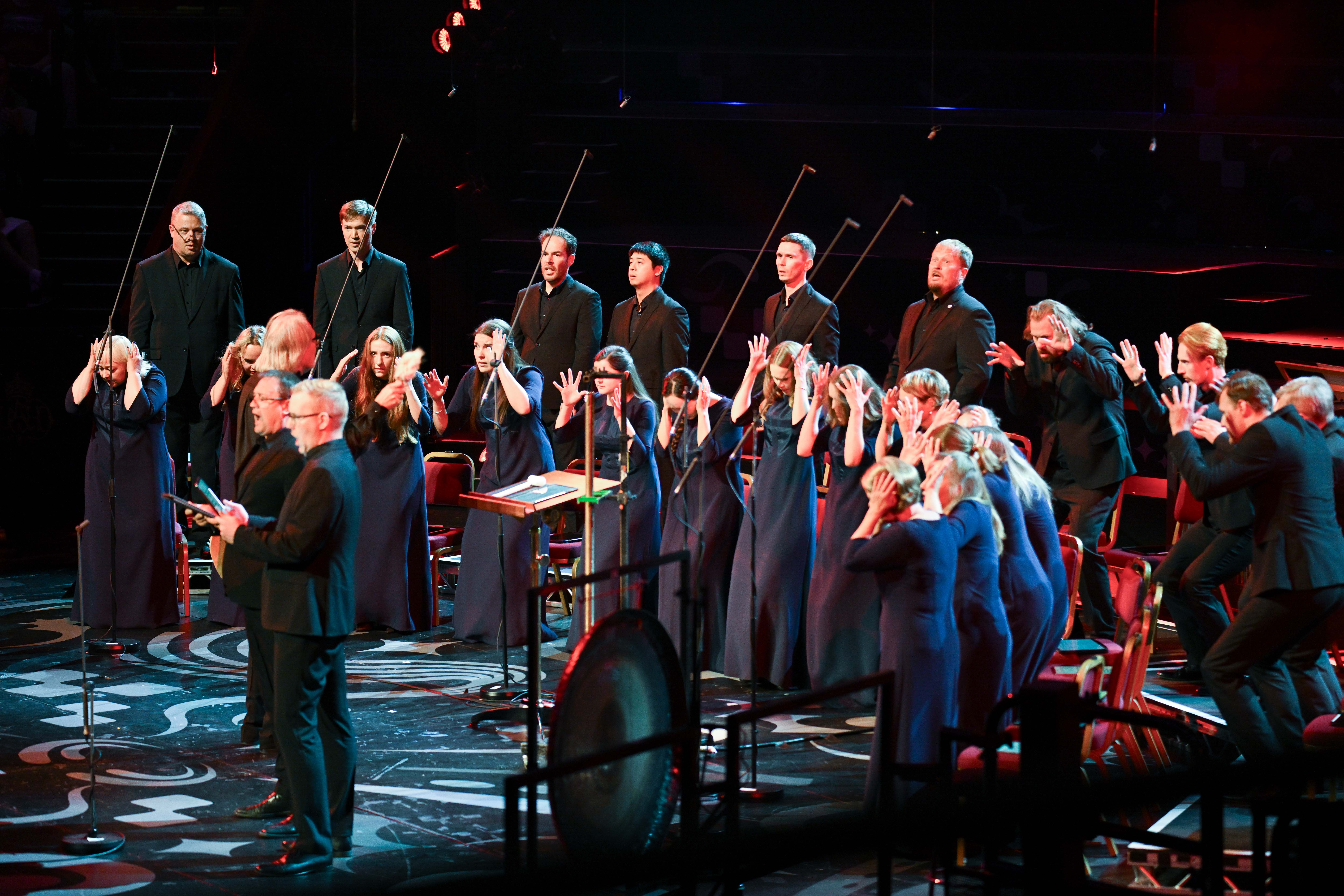
The music of Arvo Pärt is ideal for the special atmosphere of a late-night Prom. Yet this was no ordinary concert, being a celebration of the Estonian composer’s forthcoming 90th birthday in September, given by his close friend and collaborator Tõnu Kaljuste, conducting the Estonian Philharmonic Chamber Choir.
This combination of performers have been mainstays of the Pärt discography, forming a celebrated partnership with the ECM label that began with the landmark Tabula Rasa album of 1984, a cornerstone for Pärt’s critical and commercial success.
Pärt is often referred to as a ‘holy minimalist’, to which the response should be that his music is not ‘wholly minimal’. The substantial orchestral works attest to that, though here we heard much slighter but equally meaningful pieces for choir, most given unaccompanied by the 25-strong Estonian ensemble. The Proms audience were commendably quiet, leaning in to appreciate both the delicacy and crystal purity of the voices. The program was well-thought, realising the expressive potential of Pärt’s music alongside that of Bach, Rachmaninov and fellow Estonians, Veljo Tormis and Galina Grigorjeva.
The solemn Da pacem Domine and open-air Veni creator made an ideal opening couplet, the choir projecting with striking clarity rather than volume. For silence, too, plays a critical role in Pärt’s music, and Kaljuste ensured the spaces between the notes were every bit as expressive.
The Magnificat revealed its hidden power, while The Deer’s Cry was perfectly phrased, Pärt’s lilting cadences casting a spell. Für Jan Van Eyck, setting the text of the Agnus Dei, found the ideal balance between the reduced choir and Royal Albert Hall organ, where Kadri Toomoja had the ideal registration. Peace Upon You, Jerusalem, for female voices, contrasted silence with brightly voiced choral statements, while the solemn De profundis, for male voices, began from a small cell, maintaining rapt concentration while punctuated by organ and percussion.
Galina Grigorjeva’s Svyatki was a beautiful meditation, led by the heavenly voice of soprano Yena Choi, her voice with a remarkable bell-like clarity. Bach’s motet, previously attributed to his son Johann Christian, was impeccably voiced and phrased, but while the two excerpts from Rachmaninov’s All-Night Vigil were arguably less successful, they reflected a familiarity with listening to big choirs perform this music, rather than the subtleties of a chamber choir. Purity proved ample compensation for volume here.
This was emphatically not the case in Curse upon Iron, a remarkable setting from Veljo Tormis, of words from the Finnish national epic, the Kalevala, translated into Estonian. Describing the horrors of war, it sends a chill down the spine right from the primal call to arms of the shaman drum, struck by Kaljuste himself, then from the restrained urgency of the choir, like a coiled spring. While listening it was impossible not to think of the current plight of Ukraine and by extension in fear for the Baltic states, especially as Tormis’ writing was brought to a horrific climax. This was realised through the elemental power of tenor Toomas Tohert, bass Geir Luht and the choir, turning from side to side with watchful dread but then erupting in barely concealed anger. It was a remarkable performance, which will live long in the memory.
After this emotionally shattering encounter, the balm of Vater unser, Pärt’s German setting of The Lord’s Prayer for Pope Benedict, was just what was needed, its simplicity all the more affecting for what went before. As an encore, Kaljuste found just the right complement in the choir and piano version of Estonian Lullaby, its pauses near the end the musical equivalent of drooping eyelids. It was a most effective end to a special concert, Arvo Pärt’s musical essence distilled for a most appreciative audience.
You can listen back to this Prom concert on BBC Sounds until Sunday 12 October.
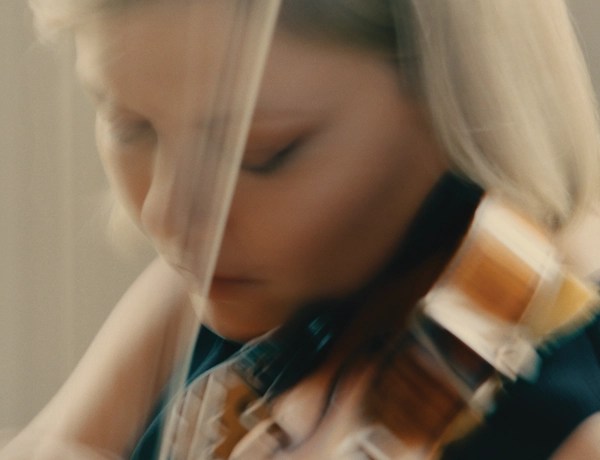
Alina Ibragimova (violin, above), City of Birmingham Symphony Orchestra / Dinis Sousa (below)
Pärt Our Garden (1959, rev. 2003) Sibelius Violin Concerto in D minor Op.47 (1903-04, rev. 1905) Dvořák Symphony no.8 in G major Op.88/B163 (1889)
Symphony Hall, Birmingham Thursday 3 April 2025
Reviewed by Richard Whitehouse Picture of Alina Ibragimova (c) Joss McKinley; Dinis Sousa (c)
In what was an auspicious first appearance with the City of Birmingham Symphony Orchestra, Dinis Sousa presided over an appealing programme that featured repertoire staples by Sibelius and Dvořák alongside welcome revival of an uncharacteristic early choral piece by Arvo Pärt.
Uncharacteristic but highly enjoyable, Our Garden seems relatively untypical of the Estonian composer even in his mid-twenties – its winning an award at a Soviet-sponsored competition in 1962 bringing plaudits at a time when Pärt’s was very much an ‘unofficial’ presence on the new-music scene. Six decades on this can be enjoyed simply for what it is – an unpretentious celebration of youthful endeavour whose unaffected setting of four not overly polemical texts is as cohesive as it is sincere. Certainly, the CBSO Youth Chorus did justice to writing whose rhythmic unison was offset with some deft harmonic twists and enhanced by the resourceful contribution of a sizable orchestra. An obvious candidate for inclusion in music quizzes, Our Garden is never less than effective on its own terms and made for an attractive curtain-raiser.
Geographical proximity aside, there was little connection between Pärt’s cantata or Sibelius’s Violin Concerto, and while a performance of the latter rarely fails to impress it rarely catches fire as it did here. Alina Ibragimova has given some memorable performances in Birmingham over recent seasons, but this account got to the heart of a piece that, for all its indebtedness to Romantic-era virtuosity, is no less original in form or content than its composer’s symphonies and tone poems of this period. Most notable were Ibragimova’s fusing of the first movement’s central cadenza with developmental impetus, her building of cumulative momentum over the course of the Adagio or a final Allegro which, though this may all but have eschewed the ‘ma non tanto’ marking, exuded a drive and panache maintained through to the scintillating close.
A first-rate accompanist, Sousa (above) brought out much of interest from the orchestral texture – not least its writing for low woodwind and horns which frequently underpins the soloist in a way that could only be Sibelius. Such attention to detail was equally evident in his performance of Dvořák’s Eighth Symphony – music easy to take for granted in its warmth and affability, yet whose opening Allegro is a masterclass in formal innovation as benefitted from the incisive if never overdriven energy Sousa brought to this movement as a whole and its coda in particular.
Even finer was the Adagio, its pathos shot through with an ominous import which came to the surface at its brief if forceful climaxes and so confirmed this as music of rare eloquence. The intermezzo’s twin themes unfolded with an ideal lilt that made its boisterous pay-off the more fitting, while the finale made the most of Dvořák’s putting his trenchant folk-dance through a set of variations whose rapidly growing excitement could always be sensed even as the music subsided towards virtual stasis, from where the peroration made for a truly uproarious QED.
Those expecting Finlandia at the start of the second half (as indicated in this season’s guide) were disappointed, but Sousa did offer the second (in G) of Dvořák’s Legends as an apposite encore – its fluid interplay of poise and humour the ideal way to end this memorable concert.
Adès O Albion (1994, arr. 2019) Pärt Fratres (1977, arr. 1991) Purcell (arr. Britten) Chacony in G minor Z730 (c1680, arr. 1948) Barber Adagio in B flat minor Op.11 (1935, arr. 1936) interspersed with poetry readings by Casey Bailey Fauré Requiem in D minor Op.48 (1887-90, rev. 1893)
James Platt (bass), Casey Bailey (poet), CBSO Children’s Chorus, CBSO Youth Chorus, CBSO Chorus, City of Birmingham Symphony Orchestra / Tomo Keller (violin/director), Mirga Gražinytė-Tyla (conductor)
Symphony Hall, Birmingham Saturday 6 November 2021
Written by Richard Whitehouse
Even if live music-making has gradually been returning to how it was, the (ongoing) legacy of Coronavirus could hardly be overlooked, thus a concert such as that given this evening by the City of Birmingham Symphony Orchestra was a necessary act of remembrance for all the many concertgoers to have been affected by the pandemic. As befitted such an occasion, no speeches or prefatory remarks were needed, with the darkening of the auditorium during the performance a simple but effective gesture which helped focus musicians and listeners alike.
Strings only were onstage in the first half – Tomo Keller directing a sequence as began with O Albion, Thomas Adès’s arrangement of the sixth movement from his quartet Arcadiana, whose gentle pathos made for the ideal entrée. Arvo Pärt has written numerous memorials and while Cantus might have been more appropriate in this context than Fratres, the latter’s sparing deployment of percussion as to underline its ritualistic emergence then withdrawal conveyed no mean eloquence. Surprising, perhaps, that Britten’s arrangement of Purcell’s Chacony is not heard more frequently on such occasions, its expressive intensification here informed by an acute rhythmic clarity. Barber’s Adagio is, of course, a staple at these times – the visceral emotion of its climax and subdued fatalism that ensues audibly conveyed here.
Interspersed between these pieces were poems by Casey Bailey, currently Birmingham Poet Laureate and whose readings were undeniably affecting in their sincerity – whether the heady reportage of 23.03.21 (a date no-one in the UK could hope to forget), the intimate evocation of Weight or graphic remembrance of Once. His appearances on stage were precisely judged as to segue into then out of the music either side and it was a pity when he did not take a call at the end of this first half, alongside the CBSO strings, given his contribution to proceedings.
Tomo Keller remained for the second half – adding ethereal counter-melodies to two of the sections in Fauré’s Requiem, whose 1893 version is without violins but with divided violas and cellos along with reduced woodwind and brass to make for a reading closer to the initial conception and certainly more apposite tonight. Her credentials in the choral repertoire well established, Mirga Gražinytė-Tyla conducted with a real sense of this work’s essential poise but without neglecting any deeper emotions. James Platt brought a ruminative warmth to the Hostias and Libera me, and it was an inspired touch to have the Pie Jesu sung in unison by the Children’s Chorus; its plaintiveness offsetting those richer tones of the Youth Chorus and CBSO Chorus, while opening-out the music’s textural and expressive range accordingly.
In one sense it would have been better had this concert not had to take place, given the legacy it commemorated (as was witnessed by the personal recollections occupying five pages of the programme) and yet, as those ethereal strains of the In Paradisum receded beyond earshot, a feeling of the Covid crisis having been recognized then overcome was palpable on the part of those present. Moreover, the CBSO’s next event is a performance of Janáček’s The Cunning Little Vixen – surely as transcendent and life-affirming an experience as could be hoped for.
Further information on the CBSO’s current season can be found at the orchestra’swebsite. For more on Casey Bailey, clickhere, for James Platt click here, and for Tomo Kellner here
It gives us great pleasure to welcome composer and instrumentalist Danielle Schwob – aka DELANILA – to Arcana’s playlist section:
Danielle’s selection is a fascinating Transatlantic exchange, mixing the best of America, Estonia, Iceland and the UK amongst others.
The heady violin of Canadian Angèle Dubeau is the first instrument we hear, leading La Pietà in the first movement of Arvo Pärt‘s Tabula Rasa. This leads to a fascinating exploration of American work from Bryce Dessner, Harry Partch and John Corigliano. Partch’s Two Studies on Ancient Greek Scales, for harp and guitar, are especially fascinating – short but perfectly formed and shimmering attractively.
Later we have a spacious excerpt from Adam Schoenberg‘s Finding Rothko, and a track from Thom Yorke‘s music for Suspiria, led by mottled piano. The music of Justin Dello Joio creates fascinating colours, reinventing the piano trio, while violin pieces by David Lang, Anna Clyne, Giya Kancheli and Jakub Ciupinski are inspiring for their open and ethereal air.
Ben Frost‘s Super Dark Times and a movement from John Adams‘ The Dharma at Big Sur explore expansive viewpoints, while PUBLIQuartet‘s reinterpretation of Hildegard von Bingen‘s O ignee Spiritus is a thoughtful and moving response.
Elsewhere we have two encounters with the music of Jóhann Jóhannsson, with whom Danielle worked – his Krókódíll and then the crowning glory of the mix, the fifth and final part from IBM 1401 A User’s Manual – The Sun’s Gone Dim And The Sky’s Turned Black, which sums up how we still miss the composer and also the current lockdown situation.
That’s not to say this selection is maudlin though – far from it. You will I’m sure discover something new as well as enjoy the chance to revel in some beautiful and powerful music, shifting shapes and perspectives. Take the next 90 minutes out and enjoy it.
DELANILA’s album Overloaded is out now via Zyg Zyg.




 It gives us great pleasure to welcome composer and instrumentalist Danielle Schwob – aka DELANILA – to Arcana’s playlist section:
 Arcana.fm