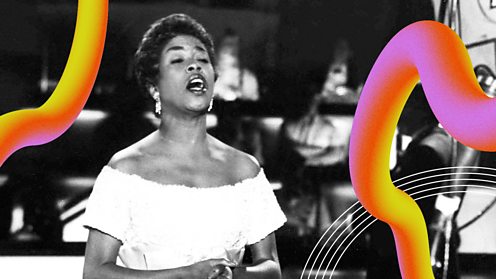
Arcana at the Proms – Prom 13: Sarah Vaughan – If You Could See Me Now

CHERISE, Lucy-Anne Daniels, Marisha Wallace, Lizz Wright, Clarke Peters, BBC Concert Orchestra / Guy Barker

Royal Albert Hall, London
Sunday 28 July 2024

reviewed by Richard Whitehouse Pictures (c) Andy Paradise

It has been customary in Proms seasons across the past decade to celebrate figures from those interconnected worlds of jazz, blues and soul. In this context, Sarah Vaughan (1924-90) was a natural choice as, though she rarely featured as a songwriter, her versatility across the musical spectrum meant she had few (if any) equals among her peers and even fewer successors. That tonight’s programme, and its four main singers, could do little more than touch on the relevant stylistic bases was itself tribute to one whose insisting ‘‘I am a singer’’ was not to be gainsaid.
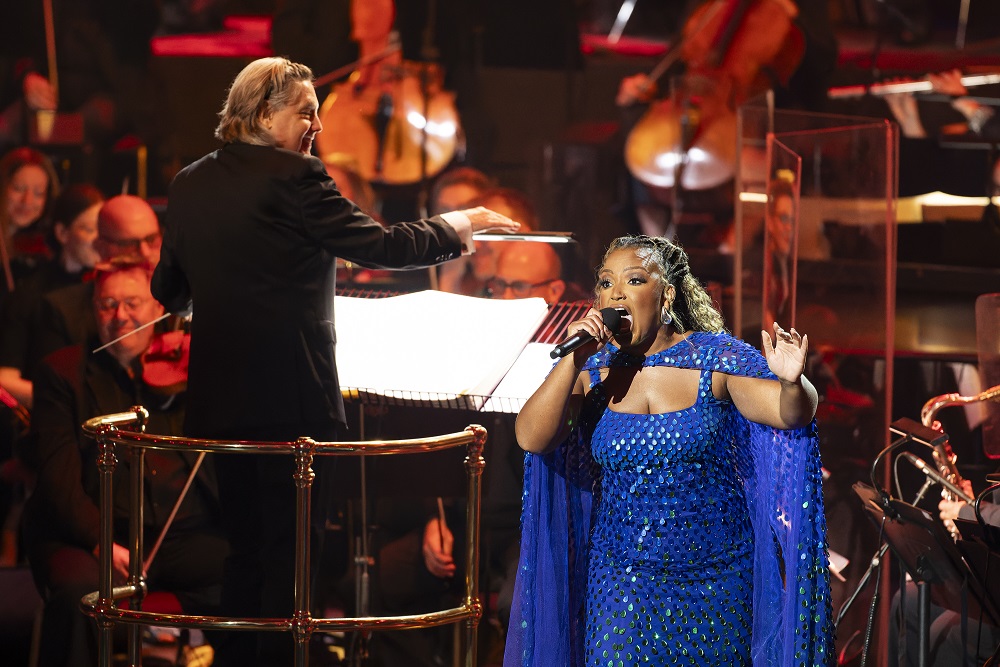
Marisha Wallace (above) pitched straight in with her no-holed-barred reading on I’m Gonna Live Till I Die, complemented by Lucy-Anne Daniels with an appropriately ‘sassy’ Nobody Else but Me then a soulful rendering of A Night in Tunisia (aka Interlude and surprisingly little heard as a vocal item). CHERISE (below) brought no mean pathos to I’ll Wait and Pray then no little wit to the catchy Mean to Me, while Clarke Peters made the most of his spotlight with a dextrous take on I Love the Rhythm in a Riff. Lizz Wright was eloquence itself in Tenderly, and despatched I Hadn’t Anyone Till You with a deft touch, then CHERISE gave a melting rendition of Misty (more affecting for the absence of affectation), but Daniels’s rather ‘by numbers’ scat rather undersold Sassy’s Blues – a pity given this was a rare Vaughan co-write. Wallace returned to round off the first half with a contrasting brace in which My Man, encompassing the wistful and dramatic in equal measure, proved a perfect foil to Great Day whose sheer vocal agility made for an undoubted showstopper with the BBC Concert Orchestra firing on all cylinders.
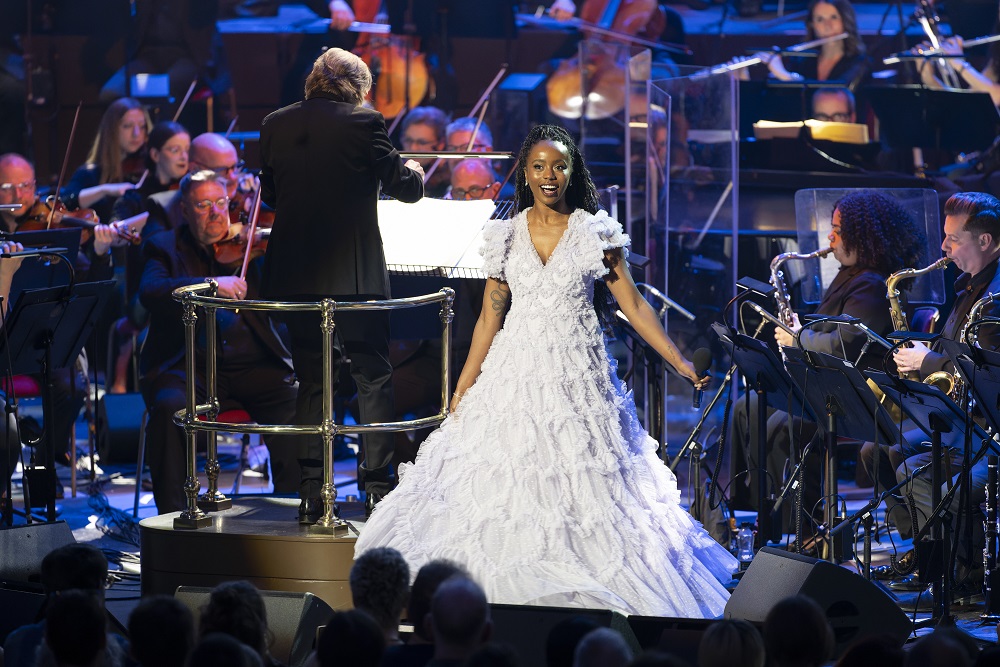
The orchestra came into its own at the start of the second half, its Bebop Instrumental Medley of standards by Thelonious Monk (‘Round Midnight, Little Rootie Tootie and Pannonica) and Dizzy Gillespie (A Night in Tunisia and Manteca) engaging reminder of the musical environs out of which Vaughan emerged. Daniels then sounded a plaintive tone in Body and Soul, with CHERISE’s insinuating take on Double Rainbow (whistling done to perfection) a reminder of Vaughan’s attraction to Brazilian music in later years. Wallace and Peters were a characterful double-act in Passing Strangers (without banishing memories of Kiki Dee and Scott Walker in their 1968 reading) while CHERISE was raunchiness incarnate in Don’t Be on the Outside, before Wright took the stage for a sequence comprising a moody Black Coffee, sultry Lullaby of Birdland then a confiding If You Could See Me Now which underlined just why this should have become a signature-tune for Vaughan.
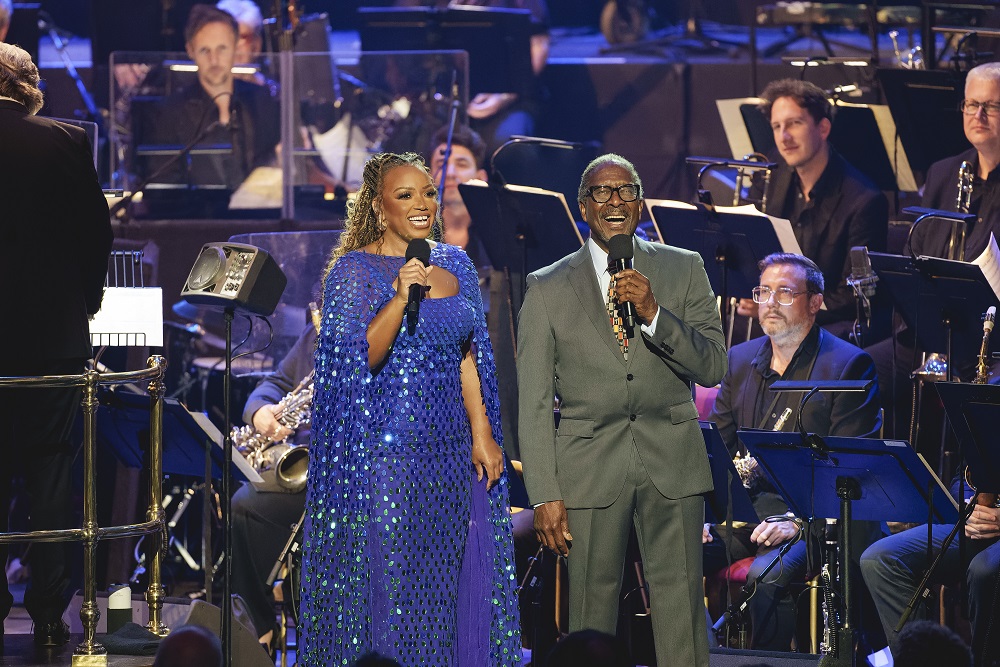
Daniels consequently upped the ante with a blithe I Cried for You, ideally complemented by Wallace with her genial take on Just a Little Lovin’. Although tonight was very much a showcase for vocal prowess, most of the items found space for at least one instrumental solo and rightly so, given the roster of ‘names’ in the BBCCO (a pity that woodwind and reeds were omitted from the personnel in the programme). As conductor (and arranger?), Guy Barker set his inimitable seal on proceedings which hopefully brought Sarah Vaughan a younger generation of admirers. All four vocalists (and Peters) returned for a send-off in the guise of an effervescent take on Perdido that assuredly brought the house down.
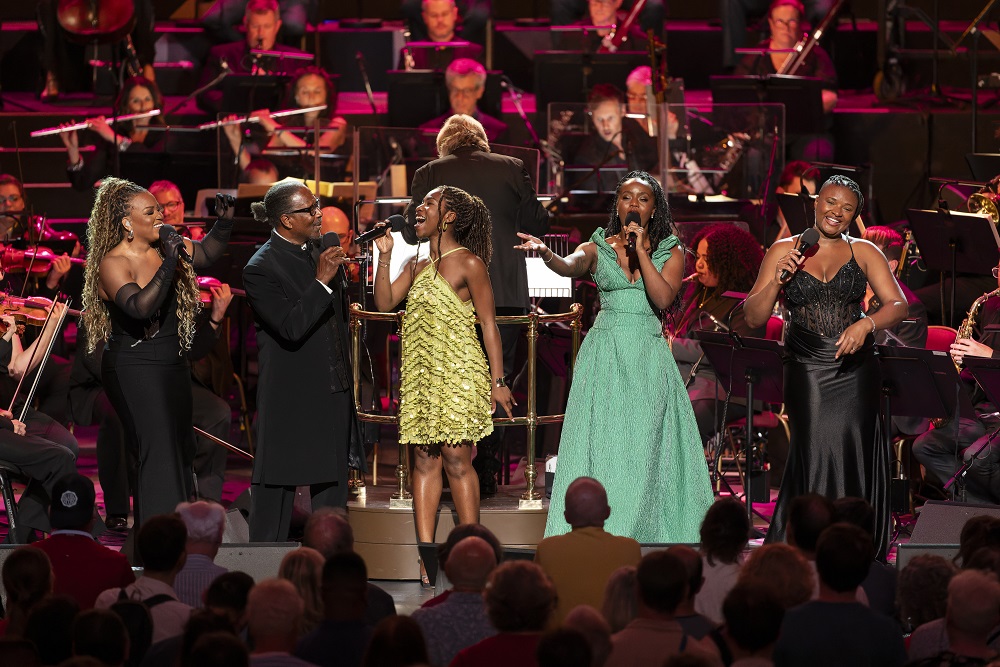
Prom 13: Sarah Vaughan – If You Could See Me Now. CHERISE Lucy-Anne Daniels Marisha Wallace Lizz Wright Clarke Peters presenter BBC Concert Orchestra Guy Barker conductor

The night’s program was as follows:

Curtis/Hoffman/Kent: I’m Gonna Till I Die
Kern: Nobody Else but Me
Gillespie: Interlude (A Night in Tunisia)
Treadwell/Valentine: I’ll Wait and Pray
Ahlert: Men to Me
Eckstine: I Love the Rhythm in a Riff
Gross: Tenderly
Noble: I hadn’t Anyone Till You
Garner: Misty
Vaughan/Jones: Sassy’s Blues
Yvain: My Man
Youmans: Great Day
Monk/Gillespie: Bebop Instrumental Medley
Green: Body and Soul
Jobim: Double Rainbow
Mitchell/Applebaum/Mann: Passing Strangers
Kelly/Watts/Wyche: Don’t Be on the Outside
Burke: Black Coffee
Shearing: Lullaby of Birdland
Dameron: If You See Me Now
Arnhelm/Lyman: I Cried for You
Mann/Weil: Just a Little Lovin’
Martínez: Perdido

You can watch this concert on the BBC iPlayer. For more on the 2024 BBC Proms, visit the festival’s website at the BBC. Click on the names for more information on Sarah Vaughan, and on the artists – CHERISE, Lucy-Anne Daniels, Marisha Wallace, Lizz Wright, Clarke Peters, the BBC Concert Orchestra and Guy Barker

Published post no.2,255 – Tuesday 30 July 2024

In concert – Michael Collins, BBC Concert Orchestra / Martin Yates – The 17th English Music Festival @ Dorchester Abbey

Michael Collins (clarinet), BBC Concert Orchestra / Martin Yates

Carwithen Suffolk Suite (1964)
Delius Idyll de Printemps, RTVI/5 (1889)
Stanford Clarinet Concerto in A minor Op.80 (1902)
Vaughan Williams Richard II: A Concert Fantasy (1944) [World Premiere Performance]
Holst Symphony in F major H47 ‘The Cotswolds’ (1899-1900)

The Abbey, Dorchester-on-Thames
Friday 25 May 2024

Reviewed by Richard Whitehouse

This latest edition of the English Music Festival, also the first to take place entirely within the spacious ambience of the Abbey at Dorchester-on-Thames, began with the customary concert from the BBC Concert Orchestra and Martin Yates. As conceived for amateur players, Suffolk Suite by Doreen Carwithen feels nothing if not resourceful – whether in the regal opulence of Prelude, evocative poise of Orford Ness then the alternately rumbustious or genial humour of Suffolk Morris; the martial tread of Framlingham Castle bringing about a resolute close.

Recent years have seen renewed interest in Delius’ early orchestral work, Idylle de Primtemps an appealing instance of the composer harnessing Nordic influences to the impressionist style then emerging in his adopted home of Paris – resulting in this short yet atmospheric tone poem.

It was enticingly given by the BBCCO, which then partnered Michael Collins (above) for a revival of the Clarinet Concerto by Stanford. As with numerous concertante works from the period, this is a three-movements-in-one design. The preludial Allegro introduces two main themes, their development continued (albeit understatedly) in a central Andante that unfolds with mounting eloquence, before the final Allegro brings a transformed reprise of the initial themes on route to its decisive ending. As with the First Cello Concerto of Saint-Saëns or the Violin Concerto of Glazunov, this is a piece the accessibility of whose idiom belies the ingenuity of its formal thinking or appeal of its ideas, and Collins (who evidently last played the piece four decades ago) brought subtlety and insight to music which ultimately delivers more than it promises.

These EMF opening concerts regularly feature first performances, and this evening brought that of the ‘Concert Fantasy’ as adapted by Yates (above) from Vaughan Williams’ incidental music to a production of Richard II for a BBC radio production and subsequently shelved. As might be expected, this abounds in allusions to earlier VW works from the period (notably Job and the Fifth Symphony), but the skill by which the composer reflects salient events in Shakespeare’s play and ease with which these fuse into a relatively continuous whole is its own justification.

It made sense to feature a major work by Holst in this, the 150th anniversary-year of his birth as well as the 90th of his death, with his Cotswolds Symphony certainly a welcome inclusion. If the weight and intensity of its second movement, Elegy (In Memoriam William Morris), rather dwarfs those other three, this is less an issue when the overall sequence was as astutely balanced as here. Yates secured a keen response in the opening Allegro, the personality of its ideas here outweighing any short-windedness, while there was no lack of verve and grace in the Scherzo or of animation in the Finale. That Elegy, though, is the real highpoint and the BBCCO did not disappoint with the sustained plangency of its playing. Numerous of Holst’s early pieces qualify as his primary achievement pre-Planets and this is arguably the greatest.

It duly rounded-off a fine opening to this year’s EMF. Maybe a future such occasion could see the revival of Stanford’s once popular Third ‘Irish’ Symphony or, even more pressingly, the first hearing for over a century of Holst’s doubtless unfairly derided suite Phantastes?

Click to read more about the English Music Festival 2024 – and on the names for more on the artists Michael Collins, Martin Yates and the BBC Concert Orchestra. For more detail on the composers, click on the names to read more about Carwithen, Delius, Stanford, Vaughan Williams and Holst

Published post no.2,186 – Wednesday 22 May 2024

On Record – Roderick Williams, Rupert Marshall-Luck, BBC Concert Orchestra / John Andrews – La Belle Dame (EM Records)

Roderick Williams (baritone) (Holst, O’Neil, Quilter & Scott), Rupert Marshall-Luck (violin, Brian), BBC Concert Orchestra / John Andrews

Brian orch. Marshall-Luck Legend B144 (c1919)
Delius Petite Suite d’Orchestre no.1 RTVI/6 (1889-90)
Holst Ornulf’s Drapa H34 (1898, rev. 1900)
Mackenzie Colomba Op.28 – Prelude (1883)
O’Neill La Belle Dame sans Merci Op.31 (1908)
Quilter orch. anonymous The Faithless Shepherdess Op.12/4 (1908)
Scott The Ballad of Fair Helen of Kirkconnel Op.8 (1900)

EM Records EMRCD085 [61’21’’] English texts included
Producer Neil Varley Engineers Andrew Rushton, Robbie Hayward
Recorded 5-7 January 2023 at Battersea Arts Centre, London

Reviewed by Richard Whitehouse

What’s the story?

EM Records continues its enterprising schedule with this collection of mainly vocal settings from the early twentieth century – heard alongside early orchestral pieces by Mackenzie and Delius, plus a recent orchestration of what is Havergal Brian’s only surviving chamber work.

What’s the music like?

This album’s title is also that of the 1819 poem by John Keats, its tale of ecstasy recollected in despair tangibly conveyed by Norman O’Neill in a setting which surely ranks among his finest concert works before music for theatre productions became his focus. Only marginally less compelling, Cyril Scott’s take on a typically over-elaborate ballad by Walter Scott has a keen sense of atmosphere – not least as rendered by Roderick Williams with an appropriate Lowland burr. Less involving emotionally, Holst’s setting of verse from an early Ibsen play is rather forced in its rhetoric – though the passages of emotional impulsiveness, allied to an acute feeling for orchestral textures, does presage those masterpieces of his maturity. Roger Quilter’s setting of a favourite Elizabethan lyric launches the collection with brusque charm.

Of the orchestral pieces, Delius’s early Première Petite Suite is here heard in full for the first time. Influences are easy to discern – Bizet in its whimsical Marche, Grieg in its winsome Berceuse, Massenet in its vivacious Scherzo then Fauré in its plaintive Duo – but never to the detriment of this music’s appeal, while the final variations on a sternly unison theme with ecclesiastical overtones will keep even seasoned Delians guessing as to its provenance. The likelihood of Alexander Mackenzie’s lyrical drama Colomba being revived is slim, but the Prelude to its first act has an evocative ardency which concludes this album in fine style.

John Andrews has the measure of these contrasting idioms and gets committed playing from the BBC Concert Orchestra. Roderick Williams is on fine form, as is Rupert Marshall-Luck in the Legend by Havergal Brian he himself has orchestrated. Ranging widely in expressive profile, while building considerable fervour during its relatively brief span prior to a calmly eloquent close, it is a stylish adaptation of the violin-and-piano original which has enjoyed increasing exposure this past decade. Marshall-Luck speculates whether Brian intended his own orchestral realization yet, given the composer had evidently written an orchestral piece with this title around 1915, it seems not impossible that the duo version is itself a reduction.

Does it all work?

Yes, in that the whole proves greater than the sum of its parts. Certainly, the works by Scott and O’Neill find these contemporaneous while otherwise very different figures at something near their best, while the Delius makes for an attractive sequence which deserves more than occasional revival. As, too, does the Brian given that comparable shorter concertante pieces by figures such as Saint-Saëns are being taken up by a younger generation of violinists. The spacious sound and extensive annotations are both up to EMR’s customary high standards.

Is it recommended?

Indeed. Hearing the Holst prompts the thought that, with the 150th and 90th anniversaries of his respective birth and death falling this year, now would be the ideal time for revival of his orchestral suite Phantastes – which has seemingly remained unheard since its 1912 premiere.

Listen & Buy

La Belle Dame is due for release on 19 April, but you can hear excerpts and look at purchase options on the EM Records website. For more information on the artists click on the names of conductor John Andrews, baritone Roderick Williams, violinist Rupert Marshall-Luck and the BBC Concert Orchestra

Published post no.2,126 – Saturday 23 March 2024

Online review – BBC Radio 2’s Piano Room: Pet Shop Boys

by Ben Hogwood

If you’ve been keeping an eye on Arcana lately you will know that we in turn have been keeping a close eye on the month of largely superb music we’ve enjoyed from the BBC Radio 2 Piano Room.

Having watched Bruce Hornsby, and recommended a further five ‘best’ songs from the month, I finally got round to watching the Pet Shop Boys‘ trio of tracks from the Maida Vale studios and the BBC Concert Orchestra. Neil Tennant and Chris Lowe are no strangers to the orchestra, with a Proms performance and a ballet score under their belts – so this was an obvious and welcome choice to close a season that has shown – again – how pop and orchestral music can complement each other so well in the right environment.

They started with the most obvious candidate – Left To My Own Devices, probably the most orchestral of their hits to date. Now fully realised with the BBC forces, it sounded wonderful, and I always wish someone would make a remix based around the chord they reach where Neil sings about setting “Che Guavara and Debussy to a disco beat”. This was a joyous performance.

The next was a likely candidate too, the most recent single Loneliness, transposed down a tone but still sounding mighty fine to these ears. Neil Tennant’s voice still has the purity it had in the 1980s but on a song like Loneliness the aching emotion in the song felt clearer, with excellent support from the backing singers and the exquisitely voiced BBC Concert Orchestra, piquant woodwind to the fore.

The big surprise was saved until last. Mott The Hoople‘s All The Young Dudes was completely reinvented in this performance. I have to be honest and say I’m still not sure about the final version – but that’s on me, not Tennant or Lowe! The reason for my lack of wholesome praise at this point is because the original is so well known, and this cover is a more or less complete reinvention – making you hear the song in a whole new light. Tennant obviously loves the track and his vocal was powerful and on point, while the electronic / acoustic balance was thick and fuzzy but in a way that looks set to suit the chromatic harmony. An effective cover version for sure…and hopefully one to grow into!

You can watch the whole Pet Shop Boys piano room session on the BBC iPlayer

Published post no.2,100 – Monday 26 February 2024

Online review – BBC Radio 2’s Piano Room: Five of the best

by Ben Hogwood

Today (23 February) saw the conclusion of BBC Radio 2’s Piano Room month, which has been taking place every weekday for the last month.

For anyone new to the concept, it consists of a well-known pop artist delivering three songs in the company of a piano and the BBC Concert Orchestra. Generally they follow the format of something old, something new and something borrowed (which may of course be blue!) in the form of a cover version. We began with Bruce Hornsby on Monday 31 January (a performance already appraised by Arcana) and ended today with Pet Shop Boys.

The Piano Room has proved to be an enormously uplifting spectacle over the last few years, and a fascinating one too – the equivalent of watching a famous actor appearing on the West End stage. There are two things that often shine through in the course of a session. One is obvious, being the artistry of the main act in question, and their ability to breathe new life into their songs or well-chosen covers. The other is not so immediate, being the quality of the orchestral arrangements and the sheer ability of the BBC Concert Orchestra, who deliver their lines with incredible poise and great expression.

Here, then, are five top performances Arcana has had the pleasure to hear this month, in addition to the Bruce Hornsby already reviewed…bearing in mind that as I type this I haven’t yet heard Pet Shop Boys doing Left To My Own Devices!

Rick Astley – Never Gonna Give You Up

The sign of a song with ultimate staying power is its versatility – and when it can be sung like this, in a version that bears very little resemblance to the original, you realise again just what a brilliant song this is. Somehow the arrangers and Rick have worked in a pizzicato part for the violins that comes from Ed Sheeran’s Shape Of You – a very different love song, but one that fits this template hand in glove.

It also shows how Rick Astley has grown as a vocalist, making music that matches his experience but also his youthful approach:

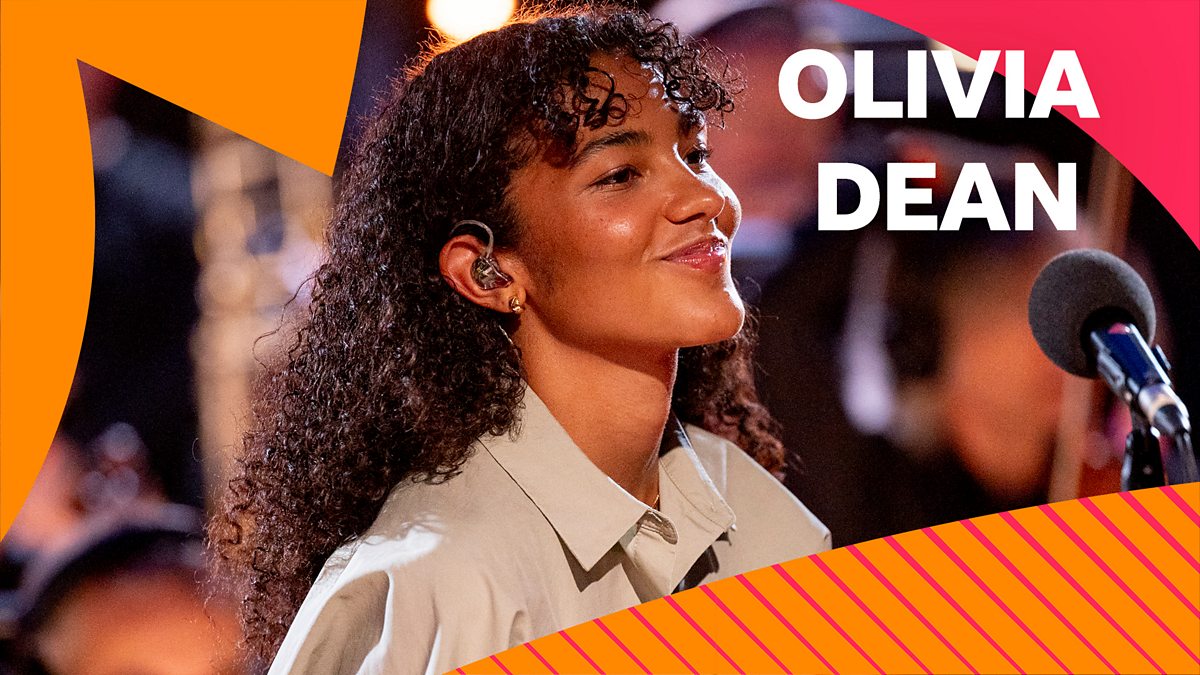
Olivia Dean – Suzanne (Leonard Cohen cover)

This is an extraordinary cover version from Olivia Dean. Sumptuous strings begin and end the arrangement (made by Sam Gale) and Dean sings in a way that recognizes Leonard Cohen’s ability to wring great emotion from relative simplicity. She intones the verse and brings a swell to the chorus, giving the song a deep resonance. This is capped by the fragility of the closing violin solo, a moment of pure but devastating clarity (played – I am almost sure – by Charles Mutter). I haven’t been able to keep a dry eye watching it yet!

Jess Glynne – Everywhere (Fleetwood Mac cover)

This was a very pleasant surprise. I find I respect Jess Glynne rather than connecting directly with her music, though her Rather Be collaboration with Clean Bandit and her own Don’t Be So Hard On Yourself have shown their staying course, and Hold My Hand is on a TV advert several times a day. I wasn’t prepared for how much I would warm to this cover – sensitively done, a lovely ‘less is more’ vocal sung with evident affection, and some great work from the band (especially bass player Dishan Abrahams). Casting aside a well played but rather unnecessary reference to David Bowie’s Under Pressure towards the end, this is a beautifully made cover, which you can view from 16’50” on this link

Crowded House – Four Seasons In One Day

This short song gains an unexpectedly emotive orchestral prelude, made possible through a broad cello solo to set the scene before the song comes in. Neil and Tim Finn’s evocative songwriting makes an effortless leap from intimate voice and guitar to band and orchestra, telling the story in just as much detail as before – yet boosted by a beautiful string arrangement. You can view from the start of this link

Gabrielle – A Place In Your Heart

How does Gabrielle do it?! For 30 years now she has held the keys to an increasing array of radio friendly songs, and under the guise of an orchestra they blossom into even fuller colours. This, her most recent single, is a beauty – and touchingly sung, too, in an arrangement that adds a great deal of depth to the song. You can view from 7’23” on this link

And finally…what a lovely tribute the orchestra gave to Radio 2 DJ Steve Wright, playing his Big Show jingle in tribute to the DJ who died unexpectedly on 13 February:

You can watch the full set of Bruce Hornsby in the Radio 2 Piano Room by clicking here

Published post no.2,097 – Friday 23 February 2024