Proms at … Cadogan Hall 7: Wojciech Świtała & the Silesian String Quartet play Weinberg & Bacewicz

Silesian String Quartet [(Szymon Krzeszowiec, Arkadiusz Kubica (violins), Łukasz Syrnicki (viola), Piotr Janosik (cello) (above)], Wojciech Świtała (piano, below)

Weinberg String Quartet no.7 (1959) (2:47 – 26:49 on the broadcast link below)

Bacewicz Piano Quintet no.1 (1952) (30:36 – 53:10)

Cadogan Hall, Monday 2 September 2019

Reviewed by Ben Hogwood

Photo credit Magdalena Jodłowska (Silesian String Quartet)

You can listen to this Prom on BBC Sounds here

For this listener at least, it has taken a while for the Proms At…Cadogan Hall theme to catch on this season. However the BBC’s traversal of 800 years of musical history has turned out to be both original and interesting, touching on areas of music not often heard or given top billing. By grouping these two anniversary composers together a cogent and thought provoking program was the result; a concert subdued in delivery but high on musical and emotional substance.

Both Polish composers featured are not thought of as front rank examples of their country’s classical music tradition, but on this evidence both should be brought forward. There are past reasons for that relative neglect, in the relative unavailability of Weinberg’s music to western ears, and the effective suppression of his and Grażyna Bacewicz’s music, but as classical music looks to remove boundaries and stereotypes, these are exactly the type of musical figures that should benefit from such a move.

We heard Weinberg first, and the seventh of his impressive output of seventeen string quartets (from 2:47 on the broadcast link above). It is perhaps the one that sails closest to the style of his friend and protector Shostakovich, especially in the second movement where it quotes from his String Quartet no.3. As the Adagio first movement (2:47 on the broadcast) shows, the two composers have much in common in mood if not execution. Weinberg’s bittersweet lyricism is to the fore here, the radiance of pure C major at the very beginning reminiscent of Shostakovich’s own first string quartet in the same key from 20 years later.

As the music progresses however there are more troubled offshoots and episodes, the players digging deeper and the music lost in thought. Weinberg does still keep his audience in mind of the brighter sound of the opening material, which returns at 8:18.

The second movement (marked Allegretto, 9:24) has shadowy outlines from the cello, the music again wary but prone to quick and nimble outbursts from second violin (the excellent Arkadiusz Kubica) – very much in the vein of a Shostakovich scherzo, but with less bite to its execution.

The third and final movement (15:24), a substantial set of 23 variations on a theme, feels like the emotional crux of the work, and was performed as such here by the Silesians. Passionate solos from first violinist Szymon Krzeszowiec and viola player Łukasz Syrnicki (an extended dialogue from 24:20) took place in the Adagio sections, and were complemented by some really concentrated and increasingly fraught quartet episodes in the Allegro, the melodies compressed and tense. In keeping with the movement’s arch structure this tension built towards the viola solo, which marked the passionate final section and a resolution in C major. The feeling was that of a battle won, but at a cost.

Bacewicz contributed two piano quintets to her sizeable chamber music output, and both are works of originality and style. While many piano-led works such as these go for volume and bluster in the keyboard part there is more poise and reserve here, the piano and strings complementing each other on an equal footing.

There is a light touch to the music too, especially in the dance music of the second movement. Before then the first movement (initially marked Moderato by the composer) sets a relatively austere scene, though the string glints at the edges. A faster central section hints at a dance and certainly gains more energy before falling back to the slower approach, albeit with more depth this time, certainly as performed here.

The second movement (marked Presto, 37:47) takes the Polish oberek dance as its inspiration, the forthright piano melody supported by lilting, syncopated strings before summoning itself for a dramatic finish. The slow movement (Grave, 42:09) is every bit as powerful, though here the steps are very slow and steady to a stern, full-bodied climax.

The finale (48:35) had great purpose and originality of texture, the quartet busying their musical arguments against an increasingly outspoken piano part. A set of quick fire exchanges and bustling figures among the strings were harnessed for a full bodied closing statement.

Both pieces were superbly played in this concert, the commitment of the Silesian String Quartet beyond contention – as was also the case for pianist Wojciech Świtała. If the music itself was a little straight faced, it was a timely reminder that only 80 years ago (to the week) the Second World War had begun. The music therefore served as a warning for lessons that appear not to have been heeded!

Listen

The music in this concert can be heard on Spotify below:

The Silesian String Quartet have also recorded a good deal of Weinberg’s chamber output. Here is a disc of the composer’s String Quartets nos. 9 & 10:

They have also recorded all seven string quartets by Bacewicz, in an award winning double album for Chandos which you can hear below:

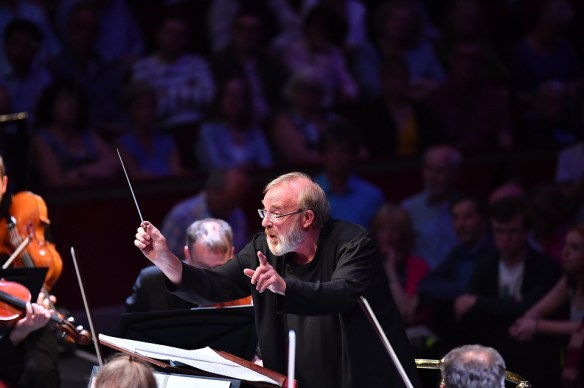
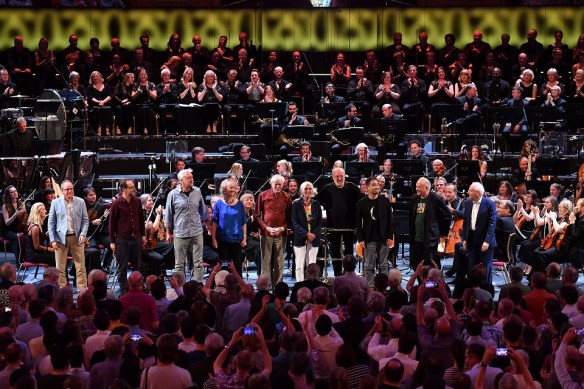
Arcana at the Proms – Prom 53: Sir Andrew Davis conducts Vaughan Williams, Hugh Wood and Elgar’s The Music Makers & Huw Watkins

Prom 53: Stacey Tappan (soprano) Dame Sarah Connolly (mezzo-soprano), Anthony Gregory (tenor), BBC Symphony Chorus, BBC Symphony Orchestra / Sir Andrew Davis

Vaughan Williams Fantasia on a Theme of Thomas Tallis (1910)
Hugh Wood Scenes from Comus (1965)
Elgar The Music Makers Op.69 (1912)

Royal Albert Hall, Thursday 29 August 2019

Reviewed by Ben Hogwood
Photo credits Chris Christodoulou

You can listen to this Prom on BBC Sounds here

A knight of the realm and a dame performing Elgar. It doesn’t get much more English than that! Yet on this humid night in the Royal Albert Hall the continental aspects of the music chosen were just as evident, Sir Andrew Davis securing a trio of very fine performances from the assembled forces.

To begin, the solemn but radiant strains of Vaughan Williams’ Fantasia on a Theme of Thomas Tallis, written in the wake of his studies with Ravel in France. That opening chord never fails to transport the listener to another place, and Davis has more experience with it than most. The BBC Symphony Orchestra strings responded as one, their unity as evident in the swelling of the music as it was when the parts were divided. The four soloists at the front – violinists Igor Yuzefovich and Dawn Beazley, viola player Norbert Blume and cellist Susan Monks played beautifully, as did the group of nine instruments on a raised platform at the back of the stage. With these judicious placements Davis ensured the balance of the music – both audibly and emotionally – was firmly aligned.

Hugh Wood’s Scenes from Comus approach Englishness from a very different perspective – that of the Second Viennese School, headed by Schoenberg. Notorious for its rejection of tonality, the school was an incredibly innovative part of 20th century classical music, and Wood was one of several English composers to fall under its spell. Often the accusation is that music without tonality lacks emotion, but Wood refutes that emphatically.

Scenes from Comus may not have an obvious key centre but it treats its story in a powerfully expressive way. The orchestra told the story with strongly rendered colours, with particularly fine playing from principal horn Martin Owen with the opening theme. Soloists Stacey Tappan and Anthony Gregory (both above) found an ideal balance with the orchestra, and the story – where an Attendant Lady, lost in a ‘wilde wood’, is kidnapped by Comus – came to life. The 87 year-old Wood was present in the audience, waving cheerily at Sir Andrew Davis in acknowledgement of an excellent performance of his piece, performed for the first time at the Proms in 1965.

Elgar’s The Music Makers, a setting of Arthur O’Shaughnessy’s Ode, has tended to fall short of critical acclaim, which is unfortunate as it contains some very fine music. In it the composer recycles some of his greatest melodies, quoting and redressing them in the manner of a greatest hits compilation. If anything that approach, when complemented by new musical ideas, makes the piece even more personal, speaking to us of his own favourite moments in music while wrought with worry about the onset of later life and the prospect of war.

The memorable opening line, ‘We are the music makers and we are the dreamers of dreams’, was magical in the hands of the BBC Symphony Chorus, subdued but wonderfully clear as they are in a recent recording made with Sir Andrew Davis for Chandos.

Also on the recording is Dame Sarah Connolly, and her first notes in this particular concert (‘they had no vision amazing of the goodly house they are raising’) sent a shiver down the spine, sung with raw emotion and urgency. She was a dominant figure from her on, passionate yet fully in control of her phrasing, responding forcefully to O’Shaughnessy’s text.

Elgar’s liberal quotations enhanced the music, none of the melodies present for the sake of it, and each reimagined with O’Shaughnessy’s text. The melodies from the Enigma Variations, the Symphony no.1, the Violin Concerto and, most tellingly, The Dream of Gerontius, all contributed to a reading of really impressive gravity and poise. The BBC Symphony Chorus sang with great unity of purpose, aided by sensitive accompaniment from the orchestra and their heartfelt account of the winsome melodies. Sir Andrew Davis is a master Elgarian, and here his credentials were handsomely reinforced.

You can listen to the new recording by these forces of The Music Makers on Spotify below:

Arcana at the Proms – Prom 35: Martyn Brabbins – Enigma Variations

Idunnu Münch (mezzo-soprano), William Morgan (tenor), Nadine Benjamin (soprano), David Ireland (bass-baritone), English National Opera Chorus, BBC Singers, BBC Scottish Symphony Orchestra / Martyn Brabbins (above)

Various composers Pictured Within: Birthday Variations for M. C. B. (2019, BBC commission: world premiere)
Vaughan Williams Serenade to Music (1938)
Brahms Schicksalslied (Song of Destiny) Op.54 (1871)
Elgar Enigma Variations Op.36 (1899)

Royal Albert Hall, Tuesday 13 August 2019

Reviewed by Richard Whitehouse
Photo credits Chris Christodoulou

You can listen to this Prom on BBC Sounds here

It was clearly a great idea that the BBC commission a piece to mark Martyn Brabbins’s 60th birthday, this concert also being his 36th appearance at these concerts, as well as featuring 14 composers with whom this most stylistically wide-ranging of conductors has been associated.

The result was Pictured Within: Birthday Variations for M.C.B, each composer contributing a variation on an anonymous theme in what is an inverse take on Elgar’s procedure in his own Variations on an Original Theme – whose ground-plan also furnished the formal framework. Space precludes more detailed discussion, though it is worth noting the degree to which these composers (the full list is here) were inhibited or liberated by their placing in the overall scheme. And as this theme yielded its potential more from a harmonic then melodic or rhythmic angle, the most successful made a virtue of such constraints – not least Judith Weir in her engaging 10th variation and John Pickard in a finale, The Art of Beginning, whose deft mingling of portentousness with humour might yet become the springboard for an entirely new venture.

Vaughan Williams’s Serenade to Music (premiered in this venue – but not at these concerts – 81 years ago) was conceived for 16 solo singers and the choral alternative inevitably loses some of the original’s intimacy, though not the distinctiveness in its setting of lines drawn from Shakespeare’s The Merchant of Venice. Joining the BBC Singers and members of the ENO Chorus were participants on the Harwood Young Artists programme, of whom Nadine Benjamin brought a wide-eyed wonder to the soprano solos which motivate the latter stages.

Less often heard in the UK, Brahms’s Song of Destiny is among his most ruminative choral works. Its setting of the eponymous poem by Friedrich Hölderlin might be seen as continuing from A German Requiem in its subdued fatalism, albeit with a more animated central section as hints at that starker resignation which overcame the composer in his later years. Brabbins presided over an unforced yet insightful account of a piece that, for its relative unfamiliarity, has garnered numerous distinguished admirers – among them the composer William Walton.

Closing this concert with Elgar’s Enigma Variations made for an effective symmetry as well as bringing the programme full circle. Brabbins is no stranger to the work and duly galvanized the BBC Scottish Symphony Orchestra in a performance which gave full rein to these widely contrasted portraits (never caricatures!) of the composer’s friends while also ensuring an overall unity to the greater design – with the only lengthy pause coming after a luminous account of the ninth Nimrod variation – that carried through to a finale whose elation was shorn of any bombast. There were various delights on the way, not least a winsome take on the fifth variation, with the numerous instrumental solos eloquently taken. Hard to believe Elgar extended that final variation only at the urging of others, so inevitably does this build to its resplendent ending.

Some might have wondered whether building a full Prom around the birthday of its conductor was excessive but, given the regard in which Brabbins is held and the conviction he invested into each of these pieces, that decision was manifestly justified. Many Happy Returns M.C.B!

Martyn Brabbins has recorded Elgar’s Enigma Variations with the BBC Scottish Symphony Orchestra for Hyperion. More details can be found on their website, or on the YouTube clip below:

Proms at … Cadogan Hall 4: Aris Quartet play Schubert, Sirmen & Haydn

Aris Quartet [Anna Katharina Wildermuth, Noémi Zipperling (violins), Caspar Vinzens (viola), Lukas Sieber (cello)]

Schubert String Quartet no.1 in G minor / B flat major D18 (1810/11) (2:03 – 18:14 on the broadcast link below)
Maddalena Laura Sirmen String Quartet No. 5 in F minor (publ. 1769) (20:20 – 31:43)
Haydn String Quartet in B flat major Op.76/4 ‘Sunrise’ (1796-7) (33:04 – 54:33)

Cadogan Hall, Monday 12 August 2019

Reviewed by Ben Hogwood

You can listen to this Prom on BBC Sounds here

The BBC Proms are charting 800 years of history in their Proms At…Cadogan Hall concerts this season, and the fourth instalment brought an examination of the string quartet towards the start of its existence. It was great to see Haydn – the acknowledged father of the form – given top billing for once, with one of the six masterpieces published as his Op.76, the mature peak of his chamber music output.

Before that, the youthful Aris Quartet brought us music by an even younger composer. Schubert was only just into his teens when he delivered the first of fifteen published string quartets, and even at this point – with a work given its first performance by the family quartet in their home – he was finding a distinctive and adventurous voice. Schubert played viola in his own piece – and it was published when he turned 15.

The String Quartet no.1 inhabits two keys, G minor and its major key ‘relative’, B flat. The first movement (from 2:03 on the broadcast link above) has a tender slow introduction but becomes surprisingly stern as its main theme kicks in (3:47), with brisk tremolo figurations. This is complemented by a less stern, major key theme later on (5:24). The Aris Quartet gave it the appropriate depth, before moving on to the silvery elegance of the Menuetto (7:56), where the quartet are instructed to use mutes. This had a nice rise and fall to its dance steps in the Aris performance. A warm Andante followed (11:30), now in the sunnier climbs of B flat major, before a bright and breezy finale (14:31) in the same key confirmed the young composer’s progress not just with writing for strings, but in his already enviable grasp of form.

Very little has been heard to date of Maddalena Laura Sirmen, but thanks to the BBC Proms we had confirmation that women composers were indeed alive and well in the 18th century. Thankfully performances of their work are starting to break through, and to hear Sirmen’s String Quartet no.5, published alongside Mozart’s early works, was to hear a voice rooted in Venetian Baroque traditions but very much looking forward.
Sirmen’s work opens with a short but quite austere Largo (20:20), which the quartet played with a bit less vibrato, gradually using more as the music became warmer. Then at 21:30 they gave a nice, full sound to the first Allegro, an attractive movement and a busy affair where the parts are closely intertwined. Sirmen’s style is free of padding and the players enjoyed its conversational style. The Largo returned at 26:26, casting a shadow before the Minuetto (27:40) drew us back to music of optimism and charm.

Haydn wrote a great many string quartets – thought to be 68 in all – but the six published as Op.76 are among his finest achievements in the field. He somehow manages to find a fresh approach with each of his works, and in the case of the ‘Sunrise’ it is through a musical portrayal of the very beginning of the day (from 33:04). He had already successfully tried this approach in a symphony (the introduction of Symphony no.6 (Le Matin) the best example) but this is a more intimate affair.
The performance here was beautifully shaded to catch the first light, with a sensitive and beautiful solo from Anna Katharina Wildermuth, but the ensuing busy passages – the players following the composer’s directions – were much more forceful, as though the sun had woken a gale force wind too.

This was a very fine performance, enjoying Haydn’s invention and wit, but giving each return to the ‘Sunrise’ material the magic of the first hearing. The second movement, marked Adagio, was expansive but also softly voiced (41:18), an example of one of the composer’s later, radiant slow movements. There was still plenty of room given to the first violin part, and Wildermuth took full advantage with excellent intonation.

A typically lively Minuet followed, with a smile and the odd knowing glance through its chromatic melodies (45:59). With it came a contrasting Trio section which had something of the march about it (57:35), over a steady drone from cellist Lukas Sieber, with the Minuet repeated at 49:01. The fourth movement (50:02) was elegant, light on its feet and with fine ensemble playing, the quartet enjoying Haydn’s presentation of the theme and its variations right up to the brisk finish.

Once off air the quartet gave an encore of the last movement of Dvořák’s American string quartet, disrupting the progression through 800 years for the live audience rather, but again playing with plenty of energy and virtuosity.

Listen

The music in this concert can be heard on Spotify below:

The six Surmen quartets can be heard on Spotify in this collection from the Allegri Quartet:

Meanwhile Haydn’s collection of Op.76 quartets can be heard here in a fine set of recordings from the Takacs Quartet:

Arcana at the Proms – Prom 28: Tadaaki Otaka conducts the BBC National Orchestra of Wales in Rachmaninov & Huw Watkins

Prom 28: Iurii Samoilov (baritone), Natalya Romaniw (soprano, below), Oleg Dolgov (tenor), BBC National Chorus of Wales, Philharmonia Chorus, BBC National Orchestra of Wales / Tadaaki Otaka (above)

Takemitsu Twill by Twilight (1988)
Huw Watkins The Moon (2018-19) (BBC commission: world premiere)
Rachmaninov The Bells (1912-13)
Borodin Prince Igor – Polovtsian Dances (1869-87)

Royal Albert Hall, Thursday 8 August 2019

Reviewed by Ben Hogwood
Photo credit (Tadaaki Otaka) Chris Christodoulou

You can watch this Prom on the BBC iPlayer here

Given his commission brief, to write a choral piece celebrating the 50th anniversary of the first Moon landing, Huw Watkins must have been tempted to set Neil Armstrong’s immortal ‘one giant leap’ quote to music. Instead however he opted to ‘capture our experience of viewing the moon from Earth’. In doing so he set four intriguing texts pre-dating the first manned visit to our original satellite – two from Percy Bysshe Shelley, and one each from Philip Larkin and Wilfred Owen.

The four were stitched together like phases of the moon in a continuously running 20 minutes, with plenty of opportunity for the orchestra to have their say in between. Watkins has an interesting musical language, always rooted in tonality but using evocative colours and harmonies hinted at in works for chorus and orchestra by Holst, Vaughan Williams or even Hugh Wood.

The Moon had a very satisfactory flow to it, and was passionately delivered by the 130-strong BBC National Chorus of Wales, who clearly enjoyed the experience. Given its length it makes a tricky piece to programme or to appraise on one listen, but it is to be hoped in this anniversary year we get more chances to acquaint ourselves with a composer who writes in a very human voice, and found the ‘definite and bright’ description of Larkin’s verse. That may sound like an obvious statement to make, but surprisingly few composers form a connection with their audience as pronounced as Watkins did here, and even less make the words as clear as he did.

He was of course helped by his ‘home’ orchestra, conducted by a returning prodigal in Conductor Laureate Tadaaki Otaka. Making his first visit to the Proms since 2015. Otaka opened with a piece by his dear friend Toru Takemitsu. Twill By Twilight, in memory of Morton Feldman, was in clear thrall to the Debussy of Nocturnes, creating a dreamy atmosphere. The piece is typical of Takemitsu’s compositions in its dealing with orchestral colour, melody and harmony on equal standing, and it runs slowly if inevitably. In this performance it panned out beautifully, the expansive orchestral sound guided by Otaka’s steady yet relaxed direction.

Otaka has a special place for the works of Rachmaninov, having recorded the symphonies and piano concertos for Nimbus back in the early 1990s. Yet the Russian composer’s choral symphony The Bells was absent from this project, and it was great to hear it in such full-bodied form here. The BBC National Chorus of Wales were boosted still further by the 100-strong Philharmonia Chorus, making a terrific bank of sound that carried all before it – and yet which, thanks to Otaka’s careful balancing, was complemented by the orchestra.


Loud Alarm Bells, the third movement, was suitably terrifying especially at the end, Otaka driving at a quick tempo, and this balanced out the relative joy felt in the first movement, Silver Sleigh Bells, where tenor Oleg Dolgov was a fulsome presence. Soprano Natalya Romaniw sang beautifully in Mellow Wedding Bells, the second movement, her voice effortlessly soaring up to a top B flat without a hint of effort, while baritone Iurii Samoilov offered a darker hue for the depths of Mournful Iron Bells, whose late shift from darkness to light was beautifully done. Rachmaninov’s choral epic has been well served by the Proms in recent years – I remember a terrific outing directed by Vladimir Jurowski – and this was another fine advocacy.

Finishing with Borodin’s Polovtsian Dances was a masterstroke, sending the audience home with several tunes in the locker that simply refused to leave for the rest of the evening! What a gifted melodist Borodin was, and how frustrating that because of his day job – a chemist – he did not leave more for us to enjoy. What he did leave still gives much pleasure, however, and the Polovtsian Dances benefited from such a big choir at their disposal.

The women floated the tune of the Young Girls’ Dance beautifully, while the men – while not quite hitting the passion of Russian voices in this music – were still fulsome and bold. Several orchestral solos stood out, not least from clarinetist Robert Plane, while Otaka’s pacing and linking of the sections was ideal. At 71 the conductor still looks in fine fettle, and his ‘sleep’ gesture at the end was borne more of mischief than genuine fatigue. It seems he, like the rest of us, was fired anew by the passionate Russian music of the concert’s second half.