
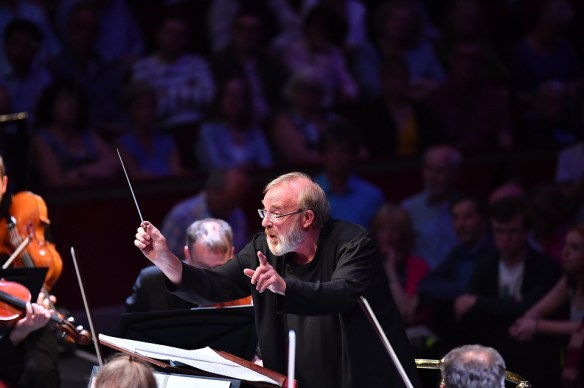
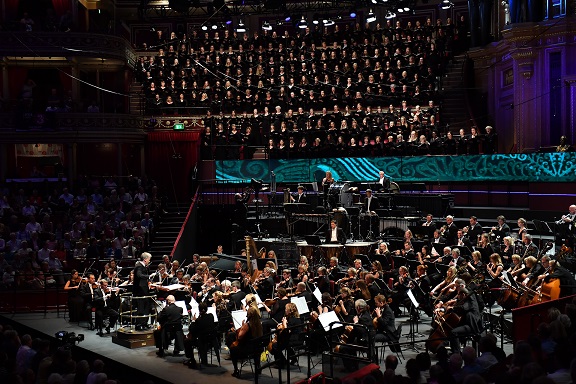
Idunnu Münch (mezzo-soprano), William Morgan (tenor), Nadine Benjamin (soprano), David Ireland (bass-baritone), English National Opera Chorus, BBC Singers, BBC Scottish Symphony Orchestra / Martyn Brabbins (above)
Various composers Pictured Within: Birthday Variations for M. C. B. (2019, BBC commission: world premiere)
Vaughan Williams Serenade to Music (1938)
Brahms Schicksalslied (Song of Destiny) Op.54 (1871)
Elgar Enigma Variations Op.36 (1899)
Royal Albert Hall, Tuesday 13 August 2019
Reviewed by Richard Whitehouse
Photo credits Chris Christodoulou
You can listen to this Prom on BBC Sounds here
It was clearly a great idea that the BBC commission a piece to mark Martyn Brabbins’s 60th birthday, this concert also being his 36th appearance at these concerts, as well as featuring 14 composers with whom this most stylistically wide-ranging of conductors has been associated.
The result was Pictured Within: Birthday Variations for M.C.B, each composer contributing a variation on an anonymous theme in what is an inverse take on Elgar’s procedure in his own Variations on an Original Theme – whose ground-plan also furnished the formal framework. Space precludes more detailed discussion, though it is worth noting the degree to which these composers (the full list is here) were inhibited or liberated by their placing in the overall scheme. And as this theme yielded its potential more from a harmonic then melodic or rhythmic angle, the most successful made a virtue of such constraints – not least Judith Weir in her engaging 10th variation and John Pickard in a finale, The Art of Beginning, whose deft mingling of portentousness with humour might yet become the springboard for an entirely new venture.
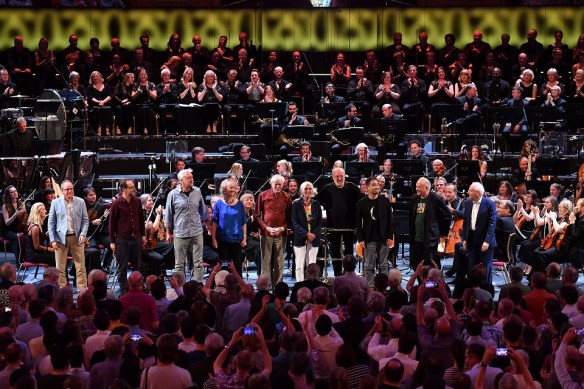
Vaughan Williams’s Serenade to Music (premiered in this venue – but not at these concerts – 81 years ago) was conceived for 16 solo singers and the choral alternative inevitably loses some of the original’s intimacy, though not the distinctiveness in its setting of lines drawn from Shakespeare’s The Merchant of Venice. Joining the BBC Singers and members of the ENO Chorus were participants on the Harwood Young Artists programme, of whom Nadine Benjamin brought a wide-eyed wonder to the soprano solos which motivate the latter stages.
Less often heard in the UK, Brahms’s Song of Destiny is among his most ruminative choral works. Its setting of the eponymous poem by Friedrich Hölderlin might be seen as continuing from A German Requiem in its subdued fatalism, albeit with a more animated central section as hints at that starker resignation which overcame the composer in his later years. Brabbins presided over an unforced yet insightful account of a piece that, for its relative unfamiliarity, has garnered numerous distinguished admirers – among them the composer William Walton.

Closing this concert with Elgar’s Enigma Variations made for an effective symmetry as well as bringing the programme full circle. Brabbins is no stranger to the work and duly galvanized the BBC Scottish Symphony Orchestra in a performance which gave full rein to these widely contrasted portraits (never caricatures!) of the composer’s friends while also ensuring an overall unity to the greater design – with the only lengthy pause coming after a luminous account of the ninth Nimrod variation – that carried through to a finale whose elation was shorn of any bombast. There were various delights on the way, not least a winsome take on the fifth variation, with the numerous instrumental solos eloquently taken. Hard to believe Elgar extended that final variation only at the urging of others, so inevitably does this build to its resplendent ending.
Some might have wondered whether building a full Prom around the birthday of its conductor was excessive but, given the regard in which Brabbins is held and the conviction he invested into each of these pieces, that decision was manifestly justified. Many Happy Returns M.C.B!
Martyn Brabbins has recorded Elgar’s Enigma Variations with the BBC Scottish Symphony Orchestra for Hyperion. More details can be found on their website, or on the YouTube clip below:

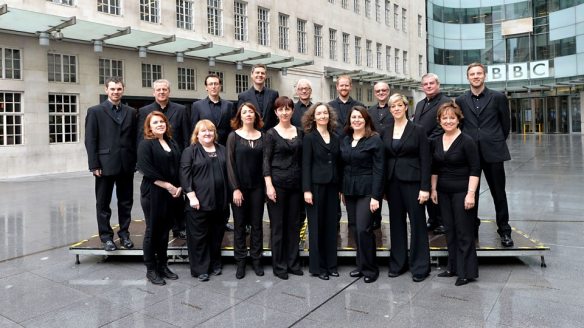 Proms at the Cadogan Hall: BBC Singers (above) / Sakari Oramo (below)
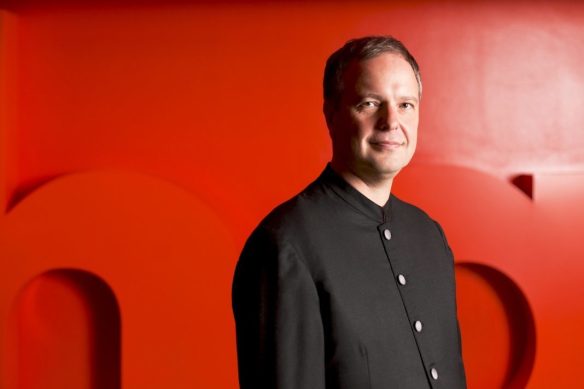 Sakari Oramo has experience as a choral conductor but this was his first outing with the BBC Singers. He led them in a direct, unfussy manner, shaping the phrases while recognising this experienced group already have the tools at their disposal to make a beautiful sound.
 The first night of the BBC Proms is a watershed moment in the summer of a classical music lover. Yet increasingly the festival is working on being more inclusive, and some of this year’s BBC Proms Youth Choir (seen above the BBC Symphony Orchestra and conductor Edward Gardner) had not even sung in public before, let alone attended the festival.
 Levit (above, at the piano) also had quiet asides, but his were absolutely spellbinding – the first movement cadenza and slow movement introduction in Beethoven‘s Piano Concerto no.3 both cases in point. Here we could easily have been back at the Wigmore Hall, witnessing a solo sonata performed to a select few, such was the intensity of his communication at a quiet dynamic. When he was with the orchestra the intensity subsided a little, not least because the balance favoured a coarse timpani sound. That said, the playing of the BBC Symphony Orchestra woodwind was particularly beautiful under Edward Gardner’s watchful eye.

 Arcana.fm