Yesterday we heard the sad news of the death of the British conductor Sir Andrew Davis, at the age of 80.
The warmth of the tributes made on social media to Sir Andrew are an indication of his standing as a highly respected conductor who was for many a friend as well as a fellow musician. As a live performer he excelled at the BBC Proms, becoming the festival’s musical figurehead in the 1990s as chief conductor of the BBC Symphony Orchestra, a post he held from 1989 until 2000. Yet he also made his mark overseas, through posts held with the Toronto Symphony Orchestra (from 1975 until 1988) and the Melbourne Symphony Orchestra (from 2013).
The playlist below attempts to summarise his considerable contribution to recorded music – and in particular his many outstanding discs of British music. The reader is particularly directed towards an extensive and hugely rewarding series of Elgar for Chandos, but the list below includes early Berlioz, Delius, Elgar, a recent highlight of Stravinsky‘s Violin Concerto recorded with James Ehnes and the BBC Philharmonic Orchestra, and an outstanding version of Vaughan Williams‘ Symphony no.6, capturing a side of the composer seldom heard at the time of recording.
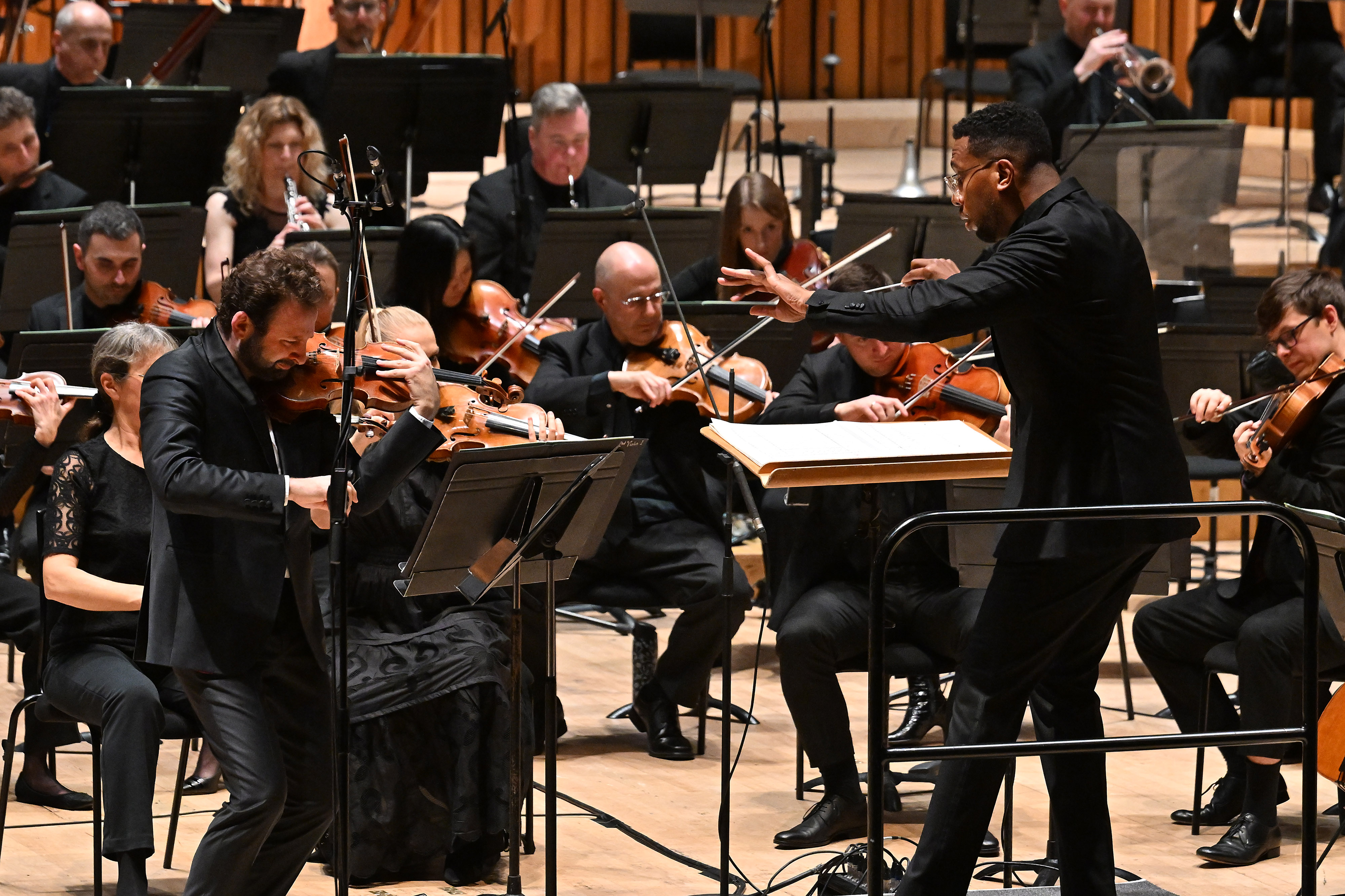
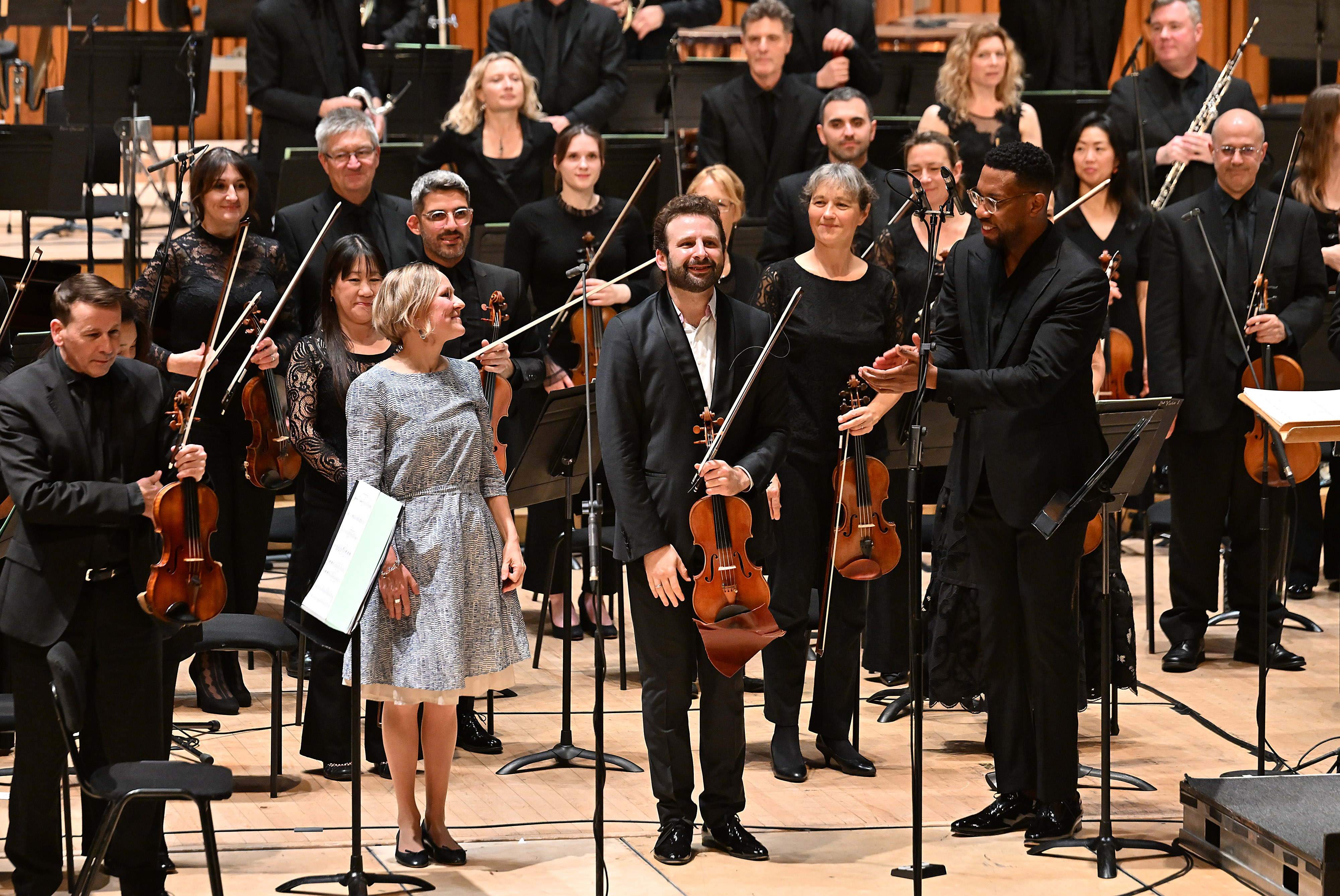
Ilya Gringolts (violin), BBC Symphony Orchestra / Roderick Cox
Debussy Prélude à l’après-midi d’un faune (1891-4) Wennäkoski Prosoidia (BBC co-commission: world premiere) Lyatoshinsky Grazhyna Stravinsky The Firebird – suite (1919)
Barbican Hall, London Friday 3 November 2023
Reviewed by Ben Hogwood. Pictures courtesy of BBC/Mark Allan
If the number of concertgoers whistling the Finale of Stravinsky’s Firebird down Silk Street to the tube was anything to go by, this typically creative BBC Symphony Orchestra program had made its mark.
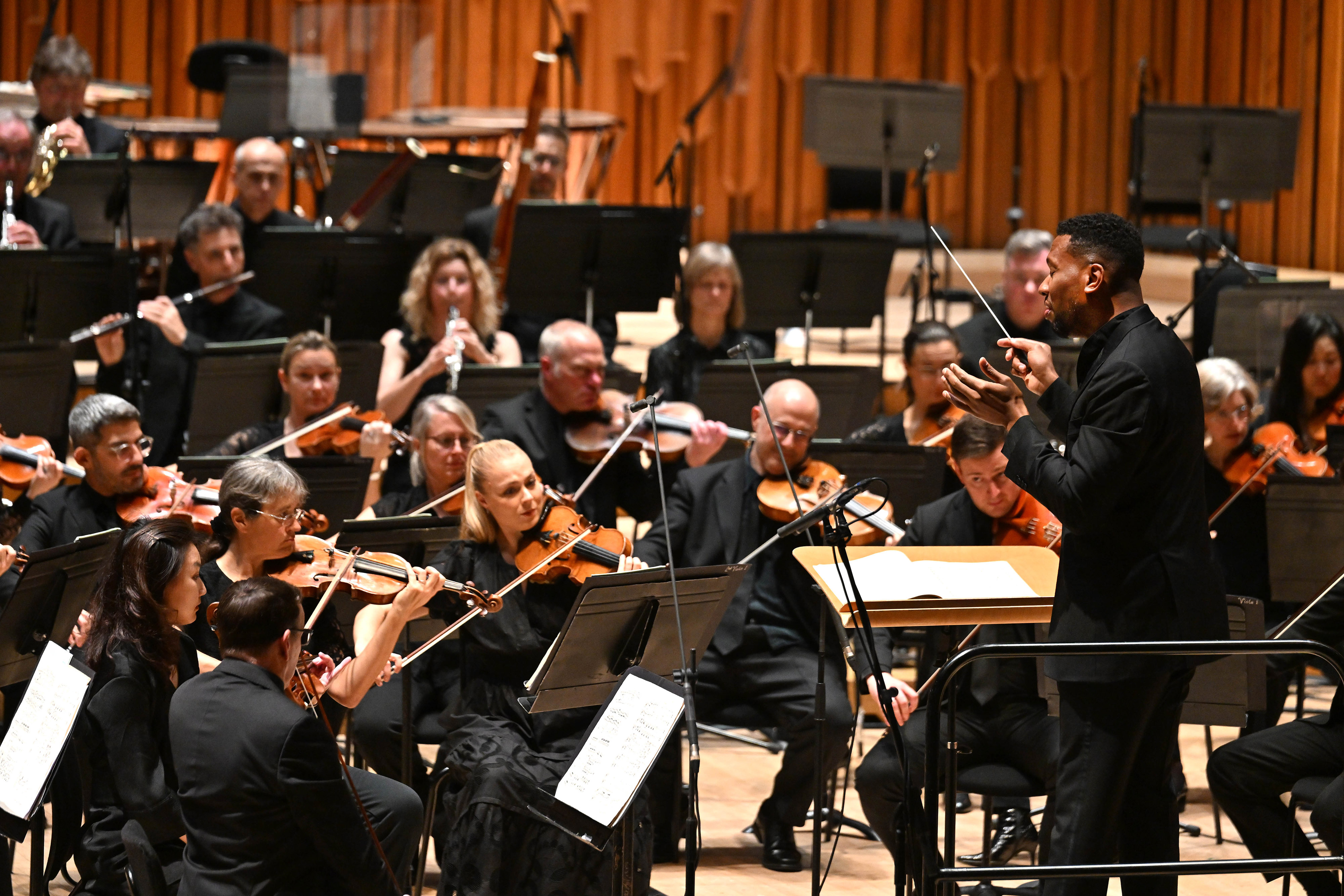
This was in spite of a late change of conductor, Roderick Cox replacing the indisposed Eva Ollikainen – yet the transition was seamless, Cox an alert and subtly commanding presence who clearly enjoyed making music with his new charges. All those qualities were evident in a hazy, sensuous account of Debussy’s Prélude à l’après-midi d’un faune, the temperature raised in spite of the autumnal weather outside. This is, as Paul Griffiths observed in the booklet notes, where Debussy’s ‘music begins here afresh. So does modern music generally.’ Daniel Pailthorpe’s flute solo set the tone, the BBC Symphony Orchestra revelling in alluring wind melodies and hazy, soft-focus strings. The sense of the new – even 120 years after completion – was tangible throughout.
Lotta Wennäkoski’s Prosoidia was also new – still drying on the page in fact, as this was the world premiere of a co-commission from the BBC SO, Lahti SO and Norrlands Opera for violin and orchestra. Though not billed in the title as a violin concerto it assumed that function, though Ilya Gringolts (above) moved between his own solo statements and conversations as part of the orchestra. Throughout he showed impeccable technique and great expression. The orchestra’s role was headed by percussion and harp, with some exquisite shading especially in the quiet music. How refreshing to hear a composer confidently writing music that the audience strained to hear, the resultant effect all the more powerful for this restraint. Here Wennäkoski was reflecting linguistic instructions inspired by ‘prosody’ – the word referring to the musical properties of speech: rhythm, pitch, stress and pauses. Her focus gave the work a moving humanity, a concerto where wordless instrumental voices spoke with great intensity.
The second movement, Word Stress, had a primal savagery, the orchestral voices clamouring to be heard and on occasion drowning the violin. Here the influence of Bartók was palpable, Wennäkoski drawing perhaps on her studies in Budapest. A moving third movement followed, inspired by Ingmar Bergman’s film Cries and Whispers – and in particular a scene where the voices are replaced by the Sarabande from Bach’s Cello Suite no.5. Written in memory of the recently departed Kaija Saariaho, Wennäkoski’s teacher, it was an intimate discourse, recalling the equivalent passage in Berg’s Violin Concerto where the composer also quotes from Bach. Here the approach was less explicit but formed an engaging tableau, where the dynamic dimmed and textures became spare at the thoughtful close. A concerto with an appealing economy and frank musical language, Prosoidia deserves a regular place in the repertoire.
After the interval we heard music from Boris Lyatoshinsky, described in Martin Anderson’s composer profile as ‘the first explicitly Ukrainian composer of the modern age’. Grazhyna, a symphonic poem about a fictitious 15th century female Lithuanian chieftain, cast its eyes back to Liszt and Saint-Saëns in its orchestral narrative, but the modern harmonic language of 1955 spoke more of Myaskovsky and Shostakovich’s music for the stage, not to mention the lasting influence of Lyatoshinsky’s teacher Glière. Roderick Cox presided over a convincing interpretation, impressively grasping the piece in spite of what was surely limited preparation. From the brooding violas portraying the River Neman, we heard a plangent cor anglais lament from Max Spiers, then a high voltage tutti as the battle scene raged. Though short on distinctive melodies, Grazhyna was dramatic to the last as the river music returned, capping an atmospheric and compelling account.
This was also the case for Stravinsky’s 1919 suite from The Firebird, fashioned by the composer into a crowd-pleasing five movements, and creeping in stealthily on the lowest strings. This was an assured interpretation, Cox cajoling the well-drilled BBC SO through a thrilling Infernal Dance, having enjoyed the vivid colours of The Princesses’ Round Dance. The bassoon of Andrea de Flammineis excelled in the Berceuse, where Stravinsky’s ‘sweet and sour’ melodies were in evidence, before the bold as brass Finale that sent the audience home whistling. This was an impressive concert all round, showing the strength in depth the BBC Symphony Orchestra possess these days. Their ensemble, a winning combination of experience and raw talent, is enjoying a purple patch.
Bruckner Symphony no.8 in C minor WAB108 (1884-7, rev. 1889-90 [ed. Nowak])
Royal Albert Hall, London Monday 4 September 2023
by Richard Whitehouse photos by Chris Christodoulou / BBC
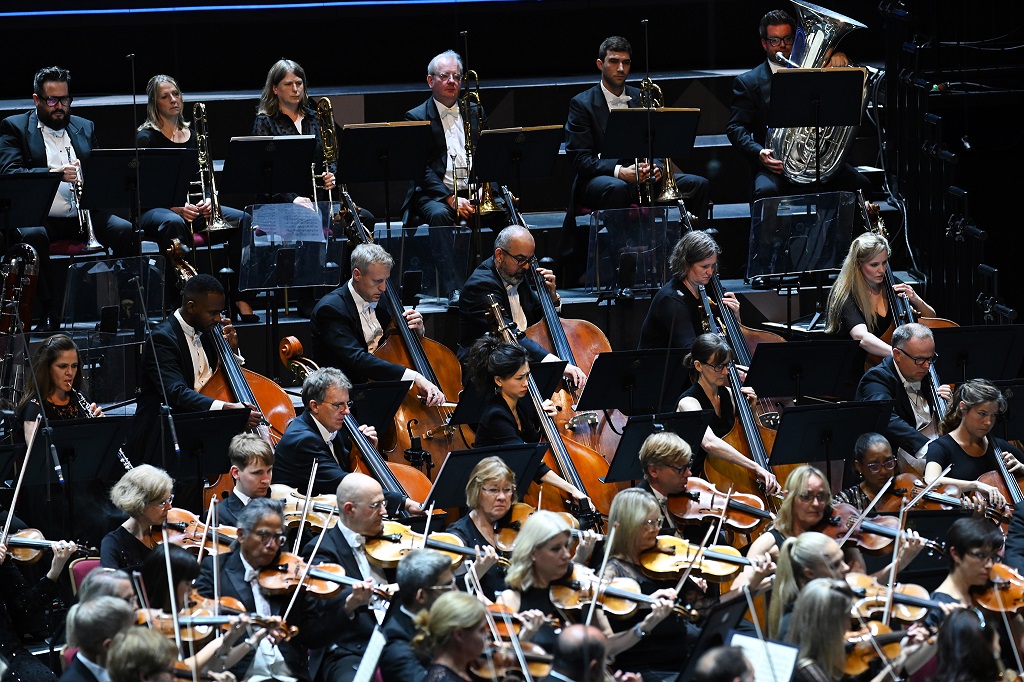
It may have taken 70 years for its Proms premiere but the Eighth has since become the second most often played of Bruckner’s symphonies (this being its 21st hearing), and a near capacity house greeted tonight’s performance by the BBC Symphony Orchestra with Semyon Bychkov.
At home across a broad repertoire, Bychkov has of yet directed relatively little Bruckner, and the first movement took its time to settle. Fugitive rather than speculative in their emotional import, those distinct motivic elements lacked a final degree of definition and only began to take on greater cumulative focus during a development whose unfolding drama was matched but not exceeded by the climax of the coda – after which, that inexorable winding down into silence was precisely controlled while curiously unevocative in its sense of time running out.
With the outer sections taken at a swift but never headlong tempo that enabled its underlying ostinato pattern to be perceived throughout, the Scherzo exuded energy while also mystery in what remains Bruckner’s most powerful instance of a genre he made his own. The brass was at its most assured, and Bychkov duly avoided any temptation to make the lengthy trio a self-contained episode. Its unforced progress brought winsome contributions from woodwind and harps, the reprise then having audibly greater impetus as it surged towards its decisive close.
As so often in this symphony, the Adagio found the interpretation and its realization in most potent accord. Mindful to draw its continual thematic restatements into a consistent process of developing variation, Bychkov conveyed the music’s expressive but also spatial grandeur with an assurance hardly less evident in its unfolding tonal trajectory. Nor did the excising of material in revision impede its course, even if the sudden appearance of cymbals and triangle at its climax sounded more than usually redundant. A pity, moreover, that momentary failings of intonation among Wagner tubas affected what was otherwise his near perfect rendering of the coda – Bruckner’s distilling of main motifs, underpinned by the halting accompaniment, finding closure only at that point where everything stops as the movement comes full circle.
From here the Finale set out with due purposefulness, even though the occasional rhythmic hesitancy gave notice of an approach in which the whole did not quite match the sum of its admittedly impressive parts. Strategically coinciding with those divisions of the movement overall, the chorale-like main theme brought a resplendent response as left its eloquent then ominous successors sounding incidental within the ongoing formal scheme, and though the extensive development did not lack for variety of content, its discursiveness made for a less than perfect unity. Any remaining tentativeness was none the less dispelled in a coda whose gradual emergence made for an apotheosis of unusual clarity – the superimposing of themes not just ingenious in its technical skill but cathartic in its conveying of a journey completed.
The illustrious rollcall of conductors who have tackled this work at the Proms speaks for itself, and while Bychkov might not yet have joined the ranks of Wand, Haitink and Mehta et al, his belief in and commitment to Bruckner’s Eighth was amply communicated to all those present.
Hopkins ATHOS (arr. Jules Buckley) (BBC Commission, world premiere) Feel First Life (arr. Peter Riley & Leo Abrahams) The Wider Sun (arr. Sam Gale) Singularity (arr. Simon Dobson) Music for Psychedelic Therapy – excerpt (arr. Peter Riley) Form by Firelight (arr. Peter Riley) Luna Moth (arr. Sam Gale) Collider (arr. Simon Dobson) Abandon Window (arr. Tom Trapp) Recovery
Jon Hopkins (piano, programming), Leo Abrahams (guitar), BBC Singers, BBC Symphony Chorus (chorus master David Young), BBC Symphony Orchestra / Jules Buckley
Royal Albert Hall, London Tuesday 29 August 2023
by Ben Hogwood photos by Mark Allan / BBC
Electronic and orchestral music are more closely related than you might think, with Jon Hopkins a classic case in point. For 15 years, the pianist and producer has been carefully sculpting his music either as a contributor for other artists (King Creosote, Coldplay and Brian Eno to name just three) or making his own, weather-beaten albums. Starting with Opalescent and Insides, these have developed into immersive meditations (Singularity and the most recent long player Music for Psychedelic Therapy) by way of more full-bodied rave music (2013’s Immunity). How, then, does this music hold up in a packed and expectant Royal Albert Hall?
Extremely well as it turns out. In order to achieve what he described beforehand as ‘a meditation for 5,000 people’, Hopkins has to temporarily turn his back on beat-driven, post-rave landmarks such as Collider or Form By Firelight. When such material appears, its percussive impact is modified so that the main job is done by the timeless, meditative chorale echoing around the hall.
Hopkins’ music is repetitive, but as with the best exponents of minimalism – Steve Reich, Philip Glass and John Adams, for instance – the material under repetition rewards the investment made. The mind is eased, enjoying the upfront melodies but also taking up the option of picking out new threads beneath the surface, like examining a tartan pattern under a magnifying glass.
The tartan analogy is purposeful, for Hopkins’ earlier music has a distinctive Celtic edge furthered by his work with King Creosote. The Wider Sun, from 2009 album Insides, has an authentic left of centre tuning, is slow but packs emotional heft, beautifully arranged by Sam Gale and masterfully weighted by Jules Buckley and the BBC Symphony Orchestra strings.
Before that we hear a new piece, the 25-minute ATHOS demonstrating Hopkins’ control of larger structures. This is a natural direction for his music to be taking after Music for Psychedelic Therapy, for it is effectively an album ‘A’ side of several interwoven tracks. The profile and material of ATHOS sits closely to composers such as Arvo Pärt, and in particular his Credo, but Hopkins has up his sleeve a number of heart-shifting modulations. Accentuated by the Royal Albert Hall organ, these are once heard, never forgotten moments.
So, too, are the choral passages, thanks to pinpoint interpretations from the BBC Singers and BBC Symphony Chorus, whose lines float effortlessly above the orchestral forces. Their vocal control is masterful and effortless, ensuring the sustained notes keep their emotional impact without wavering. Lesser singers would have tailed off long before these ones even think of blinking!
The sequence of music, running for approximately 75 minutes, is well chosen. Only on occasion does the source material become oversimplified, and as it turns out these moments serve as natural pauses for breath in the musical tapestry.
Guitarist Leo Abrahams, appearing for the last two numbers, makes a critical contribution (above). A good friend and established collaborator with Hopkins and Eno, he brings a sharper timbre to the shredded distortion of Recovery, which is – as throughout – complemented by imaginative and sympathetic lighting.
This was a multisensory Prom, containing a different sort of symphony to which the Royal Albert Hall is normally accustomed. Hopkins has proved his credentials in mastering larger structures, and his development in this field will be worth watching for sure. For now, the afterglow remains.
by Richard Whitehouse photos by Chris Christodoulou / BBC
The late indisposition of Sir Andrew Davis saw Sakari Oramo at the helm for this programme of Berg and Mahler, an effective coupling even allowing for the replacement of the latter’s Tenth Symphony with his Seventh. Hopefully it will be ‘third time lucky’ for Davis and Mahler 10.
It might have received almost 20 hearings at these concerts, but Berg’s Violin Concerto is not easy to bring off in so resonant an acoustic as the Albert Hall’s. As elegantly as she delineated the initial Andante’s arch-like trajectory, Leila Josefowicz did struggle to make herself heard against a restrained though dense orchestral backdrop. Balance righted itself with the ensuing Allegretto – the soloist’s ingratiating response ideal for its alluring, even coy expression with a bittersweet folksong inflections then its ominous foreshadowing of the work’s second part.
It was in that latter half’s Allegro the performance really took flight, Josefowicz as attuned to its fractious opening pages as to the plangent searching of its cadenza-like central span. Both the seismic start of the movement’s culmination and its convulsive wind-down were assuredly handled – the emergence of Bach’s Es ist genug chorale setting the course for a final Adagio where pensive inwardness and heartfelt supplication were palpably conveyed through to the fervent climax, then a close bringing matters full circle with its mood of beatific resignation.
Unheard at the Proms until 1969, Mahler’s Seventh was also the last of his symphonies to win wider acceptance and is still a tough challenge to make cohere. Oramo (above) had its measure though not consistently in an opening movement, the effortfulness of whose introduction pervades its main Allegro yet without impeding its onward and increasingly cumulative course. For all the wonderment of its central interlude then emotional heft of the lead-in to the reprise, there was yet a sense of this music being coerced into shape rather than unfolding with due inevitability. Not so the ‘First Night Music’, its intertwining of the speculative and crepuscular rendered to bewitching effect – Oramo balancing those intricate yet translucent textures with a sure sense of where this movement was headed, namely a resolution not so much tentative as intangible.
Equally elusive, the central Scherzo can seem an exercise in flitting gestures as fail to add up to anything more substantial but here exuded darkly ironic humour as it wended its unsettling way. The ‘shadowy’ duly found its ideal complement in the ‘amorous’ manner of the ‘Second Night Music’ – its underlying affability all too easy to make bland or faceless, yet which here unfolded with a precise feel for its function within Mahler’s teasingly oblique formal scheme. As was almost equally true of the Rondo-Finale – its ordinario marking easy to misinterpret, but in which Oramo’s sure and steadfast if never turgid course made the most of its engaging progress. Hardly alone in not quite making the reappearance of first-movement material feel other than contrived, he nevertheless headed through those final pages with irresistible verve.
This performance would not have been as successful overall without its sterling contribution by the BBC Symphony Orchestra, both in soloistic passages or those tuttis as give the outer movements their impact. Ten years on, the rapport between orchestra and conductor remains undimmed.






 Arcana.fm