BBC Proms 2023 – María Dueñas, BBC Symphony Orchestra / Josep Pons – Falla, Lalo, Debussy & Ravel

Prom 8 – María Dueñas (violin), BBC Symphony Orchestra / Josep Pons

De Falla La vida breve (1904-05) – Interlude and Dance
Lalo Symphonie espagnole, Op. 21 (1874)
Debussy Ibéria (1905-08)
Ravel Boléro (1928)

Royal Albert Hall, London
Thursday 20 July 2023

by Richard Whitehouse photos by Chris Christodoulou / BBC

The Proms went to town on Spanish music just over two decades ago, and if tonight’s concert featured only one piece by a Spanish composer, an aura of ‘Spanish-ness’ fairly pervaded this programme which likewise found the BBC Symphony Orchestra in excellent form throughout.

The piece in question was Interlude and Dance from de Falla’s opera La vida breve, once a regular fixture at these concerts and one which makes for an ideal encore or (as here) curtain-raiser according to context. Josep Pons duly brought out the drama of its initial pages, before heading into a rendition of the main section such as (rightly) predicated suavity over rhetoric, while not lacking for impetus as this music reached its effervescent close. Lasting little more than an hour, the opera ought to enjoy more frequent revival as part of a judicious double-bill.

Édouard Lalo is himself a composer worth revival, his Symphonie espagnole having regained something of its familiarity from half a century ago. Her tonal warmth and incisiveness made María Dueñas an ideal exponent, while her rapport with the orchestra accordingly underlined its concertante-like ingenuity. There was no lack of energy or pathos in the opening Allegro, the capering elegance of the Scherzando duly complementing the forcefulness of the ensuing Intermezzo before the Andante brought a finespun eloquence, itself offset by the final Rondo with its indelible main theme and never wanton virtuosity. Evidently a first-rate accompanist, Pons drew as subtle a response from the BBCSO here as in a rapt arrangement for violin and strings of Fauré’s song Après un Rêve which Dueñas offered as the entirely apposite encore.

Debussy allegedly spent just one day over the Spanish border, but his feel for that country’s musical essence in Ibéria could not be gainsaid. The unwieldly trilogy that is the orchestral Images often makes performance of this in itself a stand-alone triptych preferable, and Pons had its measure from the outset of Along the Streets and Pathways, with its characteristic alternation of decisiveness and hesitancy. Nor was there any lack of ecstatic languor in The Perfumes of the Night whose soulfulness only gradually became apparent – Pons making a rhythmically seamless transition into The Morning of a Festive Day with its vivid evoking of castanets and guitars, along with a folk-inflected élan as carried through to the headlong closing bars. Highlighting of detail never risked cohesiveness in this scintillating account.

Ravel’s Rhapsodie espagnole would have been an ideal work to conclude this concert, though few in the audience would surely have begrudged hearing Boléro in its place and Pons did not disappoint. At just over 15 minutes it was appreciably faster than the inexorable unfolding its composer most likely envisaged, but the combination of textural definition and astute placing of detail ensured this traversal enticed over the short term as keenly as it compelled across the whole. In what is a ‘concerto for orchestra’ without equal, it would seem invidious to single out individual contributions, but Alex Neal was unerring in his articulation of the side-drum ostinato, while Antoine Bedewi’s timpani steered those climactic stages through to a forceful but not overbearing denouement. If not the ultimate Boléro, this was certainly one to savour.

For more on the 2023 BBC Proms, visit the festival’s website at the BBC. Click on the names for more information on the BBC Symphony Orchestra, Josep Pons and María Dueñas

New music – Public Service Broadcasting

Here is a bookmark for your diary – the next release from celebrated ‘archive band’ Public Service Broadcasting will be an official vehicle for their centenary tribute to the BBC, first heard at the 2022 BBC Proms.

This New Noise will be released on 8 September, a celebration of the power of radio led by the band but with a key role for the corporation’s flagship ensemble, the BBC Symphony Orchestra. They appear under the guise of arranger and conductor Jules Buckley, their Creative Artist in Association. He has an impeccable record for bringing orchestras into contact with other genres in a totally natural way, as seen in the Pete Tong Ibiza Proms and a number of excellent soul collaborations.

Here is a taster for the release, the elegant and rather moving Broadcasting House:

BBC Proms 2023 – we’re underway…

Yesterday saw the start of the biggest festival in British classical music, the BBC Proms – broadcast live from the Royal Albert Hall.

Dalia Stasevska, guest conductor of the BBC Symphony Orchestra, led passionate Nordic music from Sibelius (the choral version of Finlandia with the BBC Singers and BBC Symphony Chorus, and a new arrangement of Snöfrid, narrated by actress Lesley Manville) and Grieg, whose evergreen Piano Concerto was given a new lick of paint by a wonderful interpretation from Paul Lewis.

Also featured was a Sibelian new work, Let There Be Light, from Ukrainian composer Bohdana Frolyak – a composer definitely worth seeking out in this evidence – and the concert closed with Britten‘s Young Person’s Guide To The Orchestra, with its triumphant fugal finale.

You can watch the Prom here on the BBC iPlayer:

https://www.bbc.co.uk/iplayer/episode/m001nr5b/bbc-proms-2023-first-night-of-the-proms

Arcana will be covering a good number of concerts as the season progresses, so check back through July and August to read more!

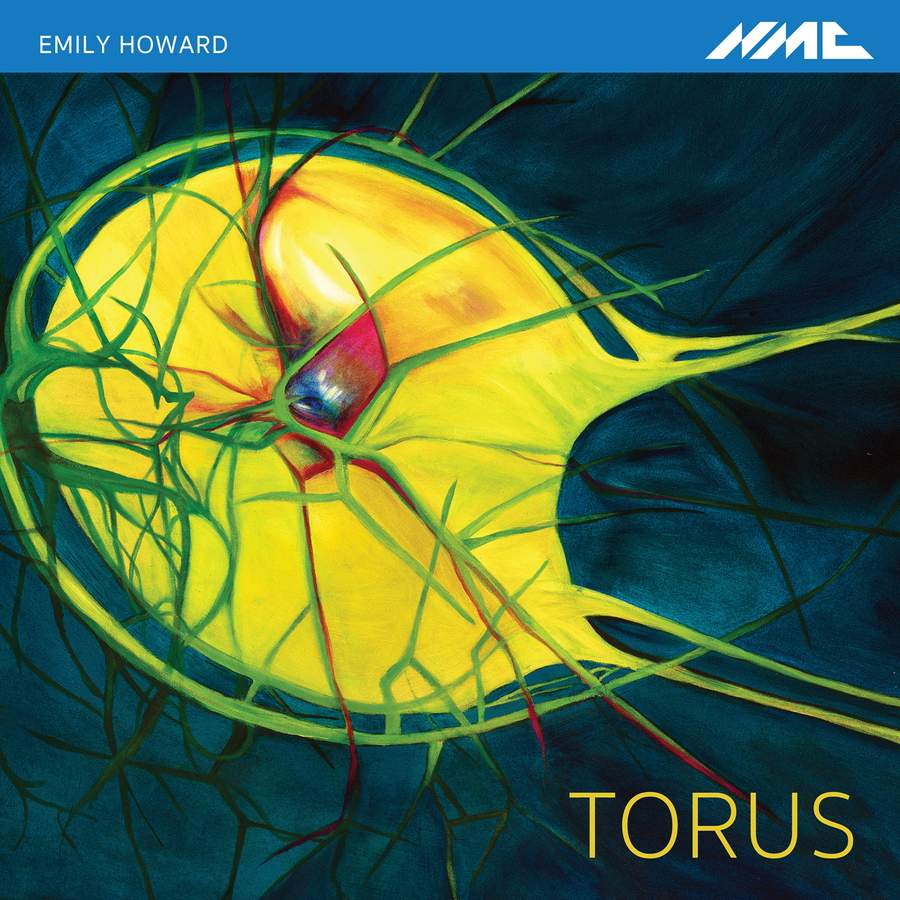
On Record: Emily Howard: Torus (NMC Recordings)

Emily Howard

Antisphere (BBC Philharmonic Orchestra / Vimbayi Kaziboni)
Producer Matthew Bennett, Engineer Stephen Rinker
Recorded 29 November 2022, Bridgewater Hall, Manchester

sphere (BBC National Orchestra of Wales / Mark Wigglesworth)
Producer Dean Craven, Engineer Stephen Rinker
Recorded at the Aldeburgh Festival, 23 June 2018, The Maltings, Snape

Compass (Julian Warburton (percussion), Birmingham Contemporary Music Group / Gabrielle Taychenné)
Producer & Engineer David Lefeber
Recorded 4 December 2022, Royal Northern College of Music, Manchester

Torus (BBC Symphony Orchestra / Martyn Brabbins)
Producer Ann McKay, Engineer Christopher Rouse
Recorded 11 November 2019, Barbican Hall, London

NMC Recordings D274 [68’58″]

Reviewed by Richard Whitehouse

What’s the story?

NMC releases a second collection of music by Emily Howard – now in her early forties and established among the most distinctive while forward-looking composers of her generation, heard in scrupulous performances by a notable line-up of British orchestras and ensembles.

What’s the music like?

Few world premieres from recent years have left an impression comparable to that of Taurus at the Proms in 2016. Its appearance, moreover, marked a further stage in an evolution which had commenced just over a decade earlier and has continued apace, with major commissions from British and European organizations. This has been paralleled by Howard’s commitment into researching the intrinsic properties of sound, most recently via the Centre for Practice & Research in Science and Music (PRiSM) at Manchester’s Royal Northern College of Music.

As it now stands, Torus is the first part in an informal trilogy of pieces collectively entitled Orchestral Geometries. It evolves along the perceived trajectory of a doughnut-shaped ball whose central void is crucial to music evoking absence as much as presence. Not that a work subtitled Concerto for Orchestra could be found lacking in either immediacy of content or virtuosity of gesture, which qualities come demonstrably to the fore as it unfolds and make for a composition involving in its expressive profile and fascinating in its formal process.

By contrast, Sphere is a succinct yet eventful journey through and around the global shape in question and which, in this context, might reasonably be thought an extra-terrestrial interlude – its ideas pithy while exuding enough potential for their development in subsequent pieces.

This is what happens in Antisphere which forms its conceptual opposite though also its aural continuation, the piece gradually encompassing the ‘sound-space’ through an engrossing and imaginative demonstration of orchestral prowess. Evident too is an increased focus upon the visceral nature of the musical content, likely reflecting a form which can precisely be defined in mathematical terms but remains all but intangible as regards human perception. Fortunate, then, that Howard has been able to render this concept as an emotional and affective whole.

Hardly less absorbing is Compass, the most recent of these pieces. This takes the spatial and nautical connotations of its title as the basis for music which unfolds as a cohesive dialogue between string septet and percussion that complements it and offers contrasts at every turn.

Does it all work?

It does, not least for providing an arresting take on that interplay of ‘heart and brain’ that has been a mainstay of Western music. The cerebral basis of all these pieces may be undeniable, though equally so is the precision of their forms and, above all, the allure of their expression judged intrinsically as sound. Much the same could be said of the music of Iannis Xenakis, the centenary of whose birth was commemorated last year, and whose thinking is continued by Howard from a vantage that is inherently personal while being decisively of the present.

Is it recommended?

It is, not least for its excellent performances by three of the BBC orchestras and Birmingham Contemporary Music Group, with booklet notes by Paul Griffiths and mathematician Marcus du Sautoy. This impressive release reinforces Howard’s significance in no uncertain terms.

Listen & Buy

Torus is released on Friday 28 April. You can explore buying options at the NMC Recordings website, and listen to clips from the album at the Presto Music site. You can read Arcana’s interview with Emily Howard by clicking on the link, and click on the names for more on the composer Emily Howard, plus performers Vimbayi Kaziboni, Mark Wigglesworth, Julian Warburton, Gabrielle Teychenné and Martyn Brabbins

BBC Proms #44 – Soloists, BBC Symphony Chorus & Orchestra / Sakari Oramo: Ethel Smyth ‘Mass’ & Debussy ‘Nocturnes’

Prom 44 – Nardus Williams (soprano), Bethan Langford (mezzo-soprano), Robert Murray (tenor), Božidar Smiljanić (bass), BBC Symphony Chorus, BBC Symphony Orchestra / Sakari Oramo

Debussy Nocturnes (1897-9)
Smyth Mass in D (1891, rev. 1924) [Proms premiere]

Royal Albert Hall, London

Saturday 20 August 2022

Reviewed by Richard Whitehouse Photos (c) Chris Christodoulou

His third Prom this season found Sakari Oramo conducting the BBC Symphony Orchestra in an unlikely yet, in the event, thought provoking double-bill of pieces composed at either end of the same decade and which duly played to the strengths of all those who were taking part.

The music of Ethel Smyth has been a prominent feature of this season and while her Mass in D comes too early in her career to be considered ‘mature’, it does evince many of those traits as defined the operas that followed. Written during a brief flush of adherence to Anglicanism, this is demonstrably a concert rather than liturgical setting (which makes its apparent status as the first Mass heard publicly in England for almost 300 years the more ironic) and, moreover, one of a ‘symphonic’ rather than ‘solemn’ conception despite the audible debt to Beethoven.

Smyth reinforces this aspect by placing the Gloria at the close – thereby making it the finale of a sequence in which the Kyrie, building gradually to a baleful climax before returning to its initial sombreness, becomes an extended introduction to the Credo whose numerous sub-sections facilitate a sonata-form design of no mean formal cohesion and expressive breadth. For their part, the Sanctus, Benedictus and Agnus Dei function as extended slow movement whose (for the most part) emotional restraint enables the soloists to come to the fore – after which, the Gloria takes its place as a finale not least in terms of drawing on previous themes and motifs through to the forceful though never merely bathetic culmination. That Smythe did not essay a symphony given her evident structural command seems the more surprising.

Tonight’s performance was no less assured than that which Oramo gave at the Barbican (and subsequently recorded, albeit with different soloists) three seasons ago. The soloists made the most of their contributions – Nardus Williams bringing a plaintiveness and elegance that was ideally complemented with Bethan Langford’s warmth and understated fervency, and though Robert Murray’s ardency showed signs of strain, he was no less ‘inside’ his part than Božidar Smiljanić, whose solo was more affecting for its burnished eloquence. The BBC Symphony Chorus responded as one to the full-on contrapuntal writing of those main movements, while Richard Pearce ensured the (too?) extensive organ part did not muddy the orchestral textures. Oramo directed with clear enjoyment a work that, for the most part, justified its 62 minutes.

In the first half, Oramo presided over a searching account of Debussy’s Nocturnes – its three movements still sometimes encountered separately but far more effective heard as a complete entity. Not its least impressive aspect was the ease with which these followed on from each other with a cumulative inevitability – the fugitive shading of Nuages (melting cor anglais playing by Helen Vigurs) leading to the half-lit activity of Fêtes, with its darting gestures and a central march-past of vivid understatement, then on to the sensuous allure of Sirènes.

As enticing as the women’s voices of the BBCSC sounded in this closing movement, it was the fervency with which Oramo infused its recalcitrant content such as made it the natural culmination of the sequence – the final bars dying away with a tangible sense of fulfillment.

Click on the artist names for more information on Nardus Williams, Bethan Langford, Robert Murray, Božidar Smiljanić and Sakari Oramo and for more information on the BBC Symphony Orchestra head to their website. For more on composer Dame Ethel Smyth, click here