Arcana at the Proms – Prom 25: Sol Gabetta, BBC Symphony Orchestra / Dalia Stasevska – Tchaikovsky, Weinberg & Sibelius

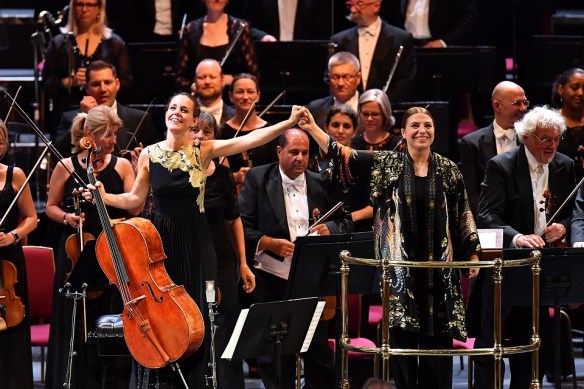
Prom 25: Sol Gabetta (cello), BBC Symphony Orchestra / Dalia Stasevska (above)

Sibelius Karelia Suite Op.11 (1893)
Weinberg Cello Concerto in D minor Op.43 (1948, rev 1956) [Proms premiere]
Tchaikovsky Symphony no.6 in B minor, Op.74 ‘Pathétique’ (1893)

Royal Albert Hall, Tuesday 6 August 2019

Reviewed by Richard Whitehouse
Photo credits Chris Christodoulou

You can listen to this Prom on the BBC iPlayer here

This Prom was notable for its being the BBC Symphony Orchestra’s first public concert with principal guest conductor Dalia Stasevska and the first appearance in this (or any previous) season of music by Polish-born Russian composer Mieczysław Weinberg, whose centenary is later this year.

Conceived as a Concertino then expanded eight year later, the Cello Concerto is not untypical of Weinberg’s earlier works in its discrepancy between completion and premiere (by Mstislav Rostropovich in Moscow during 1957). Even more striking is its absence from the repertoire, given its formal clarity and direct melodic appeal. Myaskovsky’s own concerto is an indirect model, notably in the ruminative opening Adagio with a folk-tinged main theme that returns to heightened effect at the close, but Weinberg’s approach is more oblique and eventful. The first movement leads to a wistful intermezzo with Jewish and even Spanish inflections, then an animated scherzo capped by an extensive cadenza. This segues into a finale whose lively main theme is revealed as a variant of the initial melody during an increasingly inward coda.

The piece clearly has a devoted advocate in Sol Gabetta, whose perceptive account can only enhance its popularity. The BBCSO evinced passing technical fallibilities, likely caused by a slightly amorphous balance between soloist and orchestra in this acoustic; though that did not affect Gabetta as she drew evident soulfulness and intensity from the music. No-one hearing this concerto for the first time was likely to have been left unmoved – nor by Pablo Casals’s arrangement of the Catalan folk-song Song of the Birds, which made for a winsome encore.
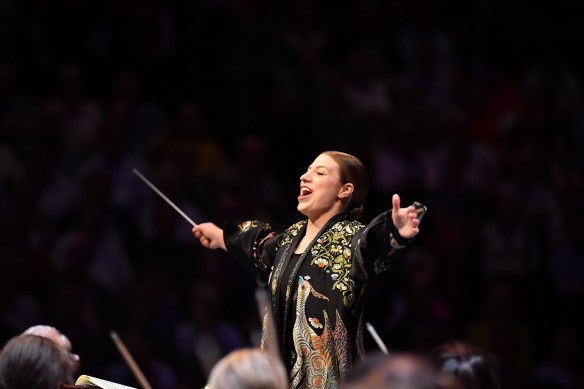
Framing the Weinberg were two repertoire items composed during the same year. Sibelius’s Karelia Suite was never less then enjoyable, though Stasevska slightly misjudged the balance between reflection and animation in the Intermezzo, while the speculative modal contrasts of the inward Ballade might have been more firmly integrated. Best was the closing Alla marcia’ – its bracingly populist overtones allowed free rein without ever becoming blatant, though quite what determined that cymbal clash on the very final note is anybody’s guess.

After the interval came Tchaikovsky’s Sixth Symphony – tonight receiving its 124th hearing at these concerts (so equating to one performance per season), and a reading which gained in stature as it unfolded. Stasevska had the measure of the opening movement, though a certain impassiveness was only banished in the development’s driving fugato as it carried over into the fateful denouement. The ensuing Intermezzo was deftly paced with no hint of stolidity in its trio, then the Scherzo had a propulsion as fairly erupted in its latter stages – the premature applause for once sounding spontaneous. There was no undue emoting in the finale as this conductor heard it, with the music’s fraught eloquence maintained through two impassioned climaxes and on to a coda whose enveloping darkness did not preclude fatalistic acceptance.

If not an overly memorable performance, this was certainly an assured one that suggested the rapport between conductor and orchestra is already taking shape. Stasevska has two concerts with the BBCSO in the coming season which, on tonight’s evidence, will be worth attending.

Arcana at the Proms – Prom 18: Edward Gardner conducts the BBC Symphony Orchestra in Mahler and Britten

Prom 18: Stuart Skelton (tenor, above), Claudia Mahnke (mezzo-soprano), Leif Ove Andsnes (piano), BBC Symphony Orchestra / Edward Gardner (above)

Britten Piano Concerto Op.13 (1938)
Mahler Das Lied von der Erde (1908-1909)

Royal Albert Hall, Thursday 1 August 2019

Reviewed by Ben Hogwood
Photo credits Chris Christodoulou

You can watch this Prom on the BBC iPlayer here

Mahler’s Das Lied von der Erde (The Song of the Earth) received its Proms premiere in the year 1914, long before the huge upturn his music experienced in the 1960s. It is an example of Sir Henry Wood’s instinct for new music that it reached the Proms so soon, though the programme labelling of the piece as a ‘Henry Wood novelty’ does the work a massive disservice. A certain Benjamin Britten was on to it too, describing in 1937 the impact of its final set of poems, Der Abschied, and how it ‘passes over me like a tidal wave’.

Mahler was one of Britten’s foremost influences, specifically the Fourth Symphony, which you can hear at the Proms later in the season on Sunday 11 August. There is not much Britten this year, but what there was in this concert was brilliantly performed. The Piano Concerto has a youthful spring in its step, treating the instrument equally as a creator of percussion and melody, following in the traditions of Prokofiev and Shostakovich as it does so.

This performance showed it off in full. Leif Ove Andsnes (above), who has lived with the work for 25 years and performed it on his Proms debut in 1992, had its measure. Technically he was superb, leading from the front with an account of targeted bravura, never showing off for the sake of it and always keeping a melodic shape to even the most percussive of chord sequences. Edward Gardner and the BBC Symphony Orchestra offered solid support, if very occasionally falling behind the piano rhythmically – though that could also have been the Royal Albert Hall acoustic playing tricks. The strings were beautifully shaded in the quieter moments of the Impromptu, whose emotional depths hinted at a darker presence behind the technical feats – perhaps the presence of the Second World War, only a few years away.

Andsnes delivered an unexpected encore in the first movement of Mompou’s Suburbis, stylistically close to Ravel and Falla but still evoking its own individual nocturnal scene.

The Mahler followed the interval, lasting just over an hour – but given the quality of the performance the time passed in a flash. To date Edward Gardner’s encounters with Mahler have been relatively minimal, but the natural gravitas he gave to the orchestral writing in Das Lied von der Erde, not to mention the room made for the chamber-like instrumental solos, showed his instincts are ideally suited to the composer. The BBC Symphony Orchestra wind – fully deserving of their curtain call at the end – were on top form, as were the strings, their quiet thoughts during the final song in particular staying rooted in the memory.

Fine as the orchestral playing was, the two singers rightly shared the limelight. Stuart Skelton’s tenor was a thing of wonder, called into high register action at a daringly early stage in proceedings but delivering wholeheartedly from the off. His characterisation of the two drinking songs was spot on, the gestures and body language wholly at one with the words, giving him the creative licence to exaggerate a note or two. Here he had support from BBC Symphony Orchestra leader Igor Yuzefovich, and a suitably inebriated violin solo during Der Trunkene im Frühling (The Drunkard in Spring). Meanwhile in Von der Jugend (Of Youth) some nimble negotiation by Skelton of Mahler’s score gave the song an invigorating freshness. That he was able to project these natural and very human elements of phrasing without ever sounding contrived spoke volumes for the degree to which he has clearly inhabited this piece, as evidenced in his contribution to the Proms Twitter feed a few hours before.


Mezzo-soprano Claudia Mahnke (above) was equally assured in her delivery, the voice and its phrasing again completely comfortable with Mahler’s demands in Der Einsame im Herbst (The Lonely Soul in Autumn) and Von der Schönheit (Of Beauty) before, in the celebrated Der Abschied (The Farewell), time stood still and the music became a thing of wonder. These otherworldly contemplations felt as though they extended from the Arena floor of the Royal Albert Hall right up to the stars, far beyond the dome, and Mahnke’s rapt expression spoke of how she too was experiencing the same transporting effect. Gardner’s operatic instincts stood him in good stead, particularly in the recitative-like sections, where orchestral players held notes like baroque continuo staples, but the overall effect was in aid of the contemplation of life itself.

The rude interjection of a mobile phone did nothing to break the spell, for these two singers, and the 80 or so instrumental singers behind them, had created something very special together.

Prom 1 – BBC Singers, Symphony Chorus and Orchestra / Karina Canellakis – Janáček Glagolitic Mass, Dvořák & Zosha Di Castri


Prom 1: Asmik Grigorian (soprano), Jennifer Johnson (mezzo-soprano), Ladislav Elgr (tenor), Jan Martiník (bass), Peter Holder (organ), BBC Singers, BBC Symphony Chorus, BBC Symphony Orchestra / Karina Canellakis (above)

Di Castri Long Is the Journey, Short Is the Memory (2019) (BBC commission: World premiere)
Dvořák The Golden Spinning Wheel Op.109 (1896)
Janáček Glagolitic Mass (Final version, 1928)

Royal Albert Hall, Friday 19 July 2019

Reviewed by Richard Whitehouse

You can listen to this Prom on the BBC Sounds app here

In its including of a female conductor, a premiere alluding to the 50th anniversary of the first moon-landing and a Henry Wood ‘novelty’, the First Night of this year’s Proms encapsulated the season in almost all essentials while making for an engaging programme in its own right.

The premiere was that of Long Is the Journey, Short Is the Memory from Canadian composer Zosha Di Castri. Now in her early thirties, Di Castri has achieved recognition for the arresting timbres and textures of her music and there was no doubt as to the scintillating sonorities she drew from the orchestra in what, loosely defined, was a cantata where changing conceptions of the Moon were articulated through a text drawn centred on the musings of Chinese-British writer Xiaolu Guo alongside fragments by Sappho and Giacomo Leopardi. A pity, then, that the composer’s rather moribund word-setting and vagaries of the Albert Hall acoustic meant the emotional affect of this text went for relatively little, for all the orchestral component was often spellbinding in its evoking the immensity yet also intimacy of space above and beyond.

Certainly the BBC Singers projected its contribution with audible assurance, while the BBC Symphony Orchestra responded ably to the astute direction of Karina Canellakis both here and in a rare revival of Dvořák‘s symphonic poem The Golden Spinning Wheel. Third of his four late such pieces drawing on the folk-ballads of Jaromir Erben, this is usually heard in the abbreviated version prepared by Josef Suk but tonight brought the full-length original with Erben’s poem set line by line in an uncanny musical embodiment of the text. That said, its sheer repetition of motifs and themes can prove excessive and while Canellakis had the measure of the work’s evocative aspect, she was less successful when trying to infuse the sprawling structure with any cumulative impetus such that the rousing final peroration seemed all too long in arriving.

There could not be a piece less given to longeurs than Janáček‘s Glagolitic Mass, first heard in the UK almost nine decades ago but not at these concerts until 1972. Recent hearings have opted for the conjectural urtext whose sometimes reckless audacity its composer toned down before the premiere, but this evening reinstated the final version that Canellakis directed with verve and sensitivity, if lacking a degree of fervency which turns a fine performance into an indelible embodiment of that pantheist spirituality central to the music of Janáček’s maturity.

Not that there was much to fault in the singing, with Asmik Grigorian more than equal to the demanding tessitura of the soprano part and Ladislav Elgr hardly less attuned to the stentorian tenor role. Jennifer Johnson was a mezzo of no mean eloquence, while bass Jan Martiník was only marginally too impassive. Peter Holder duly put the Albert Hall organ through its paces in an incisive and ultimately thunderous organ solo – after which, it was hardly the BBCSO’s fault if the final Intrada sounded a little underwhelming as its rhythmic elan was undoubted.

Throughout this account, the contributions of both orchestra and BBC Symphony Chorus left little to be desired. Hard to believe the intricacies of Janacek’s writing were once put down to technical inadequacy. In that respect, as with space exploration, progress has been absolute.

On record: BBC Symphony Orchestra / Martyn Brabbins – Vaughan Williams: A Sea Symphony (Hyperion)

Elizabeth Llewellyn (soprano), Marcus Farnsworth (baritone), BBC Symphony Chorus and Orchestra / Martyn Brabbins

Vaughan Williams
A Sea Symphony (Symphony no.1 in B flat minor) (1903-09)
Darest thou now, O soul (1925)

Reviewed by Richard Whitehouse

What’s the story?

Following his impressive take on A London Symphony (given in the 1918 version), Martyn Brabbins here continues his Vaughan Williams cycle with its predecessor A Sea Symphony, coupled with a choral setting which reinforces the composer’s adherence to Walt Whitman.

What’s the music like?

Now that most of the numerous orchestral pieces Vaughan Williams wrote at the turn of the 20th century have been recorded, the context for the present work is far clearer than hitherto. Yet it still took six years before A Sea Symphony was completed; during which time, both its actual concept and his musical aesthetic underwent radical change. The premiere in Leeds on 12th October 1910 may have overshadowed by that of the Tallis Fantasia just a month before, but the larger work likewise confirmed VW’s arrival as a leading composer of his generation.

While not an overly long work (lasting around 67 minutes), A Sea Symphony feels expansive as compared to Vaughan Williams’s later such works and benefits from a formally focussed approach. This it receives from Brabbins, who controls the first movement securely from its magisterial opening, through its eventful if prolix ‘development’ then on to a rapt conclusion. The ensuing nocturne is less problematic and Brabbins duly points up the contrast between its fervent climax and pensive introspection on either side. He secures a rousing response in the scherzo, with its unabashed echoes of Elgar and Parry, then steers a convincing course across the expansive finale – whether in its cumulative earlier stages, its eloquent central vocal duet or the closing stages with their stark juxtaposing of bracing peroration and ethereal postlude.

Throughout this recording, the playing of the BBC Symphony Orchestra is responsive and committed, while the singing of the BBC Symphony Chorus leaves nothing to be desired in terms of tonal finesse and rhythmic articulation. The two soloists are less consistent. Marcus Farnsworth lacks presence during the combative baritone contribution to the first movement, though his stoic musing in its successor is far more persuasive. A soprano with the requisite mezzo range, Elisabeth Llewellyn yet evinces a vibrato in her higher register that can prove distracting, but this is less of a problem in the finale – she and Farnsworth exuding warmth and ardency in its lyrical central duet, while bringing poise without indulgence towards its close as vocal phrases stretch out in parallel to the expanse of that ‘journey’ being evoked.

Does it all work?

Yes, notwithstanding those reservations noted above. Brabbins adopts a firm though flexible approach which is demonstrably in the lineage of Sir Adrian Boult and Vernon Handley. Both orchestral playing and choral singing are first rate (in advance of that for Andrew Davis in the BBC’s first VW cycle a quarter-century ago), and there is once again an enterprising coupling. Darest though now, O soul finds Vaughan Williams briefly revisiting a Whitman text he set 18 years before in Toward the Unknown Region, reduced to a hymnal setting for unison chorus and strings.

Is it recommended?

Indeed. The sound finds an ideal balance between spaciousness and definition, with probing notes by Robert Matthew-Walker. If Brabbins’s Sea Symphony is slightly less fine than his London Symphony, it is a consistent follow-up in what looks set to be impressive VW cycle.

For further information on this release, visit the Hyperion website, or the BBC Symphony Orchestra. You can also read more about Martyn Brabbins here

Vilde Frang, BBC Symphony Orchestra / Sakari Oramo: Anna Clyne, Britten & Beethoven ‘Pastoral’

Vilde Frang (violin), BBC Symphony Orchestra / Sakari Oramo (above)

Clyne This Midnight Hour (2015) [London premiere]

Britten Violin Concerto, Op.15 (1939)

Beethoven Symphony No.6 in F, Op.68, ‘Pastoral’ (1808)

Barbican Hall, London; Wednesday 21 March 2018

Written by Richard Whitehouse

You can listen to the broadcast of this concert here, available until 20 April 2018

Most concerts by the BBC Symphony still feature either a world or national premiere, and tonight’s concert began with a first London outing for Anna Clyne’s This Midnight Hour. Drawing inspiration from poems by Juan Ramon Jiménez and Charles Baudelaire, this 12-minute piece duly alternates between energetic and more ruminative music in a ‘stretto’ of accumulating impetus. A pity the climactic stage loses focus in an amalgam of waltz-like flaccidness and folk-inflected jejunity – suggesting this as not one of Clyne’s better pieces.

Britten’s Violin Concerto has certainly come in from the cold over recent years. Vilde Frang was a little tentative in the initial Moderato, with its interplay of wistful lyricism and driving impetus, but the central scherzo was finely judged through to a seismic climax then dextrous cadenza leading into the finale. The earliest among Britten’s passacaglias, it makes plain his feelings over the demise of the Spanish republican movement, and Frang (below) had the measure of its sombre inwardness and high-flown rhetoric prior to a recessional of haunting eloquence.

As so often, Sakari Oramo was an astute and attentive accompanist – thereafter putting the BBCSO through its paces in a fluent and often searching account of the Pastoral Symphony. In this, as in Beethoven’s music overall, Oramo was his own man – omitting the exposition repeat in what was an incisive but never headlong reading of the first movement, followed by an Andante whose rhapsodic unfolding was accorded focus by the flexible underlying tempo and fastidious shading of string textures as has long been a hallmark of Oramo’s conducting.

The last three movements proceed continuously and if the scherzo was a little too streamlined for its verve and humour fully to register, the ‘Thunderstorm’ made for a powerful interlude before (and climactic upbeat to) the finale. As disarming melodically as it is difficult in terms of pacing, this unfolded with a sure sense of its developing variation; allied to a lilting motion which evokes a cosmic dance offered as thanks for peace in time of crisis. Maybe the closing cadence was just a touch over-emphatic, but the sense of a journey fulfilled was undeniable.

You can watch Vilde Frang talk about the Britten Violin Concerto in a BBC video here For more information on the BBC Symphony Orchestra, head to the orchestra’s homepage – and for more on their chief conductor Sakari Oramo, click here

Meanwhile you can listen to Vilde Frang’s disc of the Britten and Korngold Violin Concertos, recorded for Warner Classics, on Spotify: