Wigmore Mondays – English Songs with Marcus Farnsworth & Joseph Middleton

farnsworth-middleton

Marcus Farnsworth (baritone), Joseph Middleton (piano)

Wigmore Hall, London, 28 March 2016

written by Ben Hogwood

Audio (open in a new window)

http://www.bbc.co.uk/programmes/b074zd45

Available until 27 April

What’s the music?

Purcell, arr. Britten – Music for a while; Fairest Isle (1945); Not all my torments (1943); Evening Hymn (1945) (13 minutes)

Ireland: Sea Fever; If there were dreams to sell; When I am dead my dearest; The bells of San Marie (9 minutes)

Finzi: Let us Garlands Bring (1929-1942) (15 minutes)

Trad, arr. Britten: The Salley Gardens (1940); Sally in our Alley (1959); The Plough Boy (1945) (9 minutes)

Spotify

Unfortunately not all the music performed is available on Spotify. There is however a playlist containing as many of the English songs performed as I could find:

About the music

A far-reaching program of English song, with old and new united through the thread of arrangements by Benjamin Britten – and in the middle some of the best early 20th century vocal writing from England.

Britten ‘realized’ a total of 42 vocal works by Purcell for voice and piano. That effectively means he gave them a new set of clothes, providing a new piano part for concert performance. This was done to give his recitals with Peter Pears more options, to remind their audience of Purcell’s standing, and for Britten to express his sheer admiration of the composer in musical form. These four examples illustrate how he was able to do this while keeping the essential mood of the Purcell originals.

Meanwhile in the 1930s Britten had already set out his position on folksongs. He was averse to Vaughan Williams’ treatment of them – in accordance with his teacher Frank Bridge – but aligned himself more readily with figures like Moeran, with whom he spent some time playing folksong arrangements, and Percy Grainger, who he and Peter Pears greatly admired. These three selections represent some of his best-loved arrangements.

The 400th anniversary of William Shakespeare’s death is marked by Gerald Finzi’s song cycle Let us Garlands Bring, a cycle of five songs the composer dedicated to Vaughan Williams. Finzi eventually arranged them for baritone and string orchestra, but this is the original version.

John Ireland, meanwhile, was a restless composer prominent in the early decades of the 20th century. His songs are an important part of his output, as well as chamber music, bittersweet orchestral music and a wonderful piano output containing some delectable miniatures. The vocal selection here includes arguably his best-loved song, Sea Fever.

Performance verdict

Marcus Farnsworth stepped in at the last minute to give this concert, and it seems to have been a winner. Arcana was not in the hall but his ability to stick with the original program was impressive, and the selection of English song is a clever and logical one.

Of this selection it is perhaps the Finzi that stands out as the most rewarding, a satisfying and extremely enjoyable cycle, but the Ireland songs – as always – leave a haunting impression.

Britten’s mining of his country’s musical archive for his own performing means is also very interesting to hear, and Farnsworth sings his arrangements with great clarity and poise. Joseph Middleton is a most able pianist alongside.

What should I listen out for?

Purcell, realized Britten

1:43 – Music for a While (words by John Dryden) It can take a little while to adjust to the idea of hearing Purcell’s music through Britten’s eyes. While his piano accompaniments are unobtrusive they are still recognisably his in the way the chords are spread. The piano often shadows the vocal line. There is then a real vocal emphasis on the way ‘the snakes drop from her head’ and ‘the whip from out her hands’

5:30 – Fairest Isle (Dryden) A grander setting, this, and the piano takes more of a back seat to the grand vocal line – though it does still offer complementary melodies.

7:45 – If all my torments (Anon) The piano and singer take a noticeably darker colour for this recitative, and the vocal line is almost completely free, the piano supplying just the basic outline of the harmonies. Farnsworth uses very little vibrato to enhance the despair of the song.

10:51 – Evening Hymn (Bishop William Fuller) After the despair of the previous song comes the consoling Evening Hymn, a period of repose at the end of the day. Again the piano is complementary rather than obtrusive, Britten making sure the voice projects very easily. The song ends with an expansive ‘Alleluia’

Ireland

16:44 Sea Fever (John Masefield) – one of Ireland’s most celebrated songs. It is ideal for the baritone, with a rich, resonant beginning and a vivid description of the ‘grey mist on the sea’s face’, at which point the piano goes quiet.

19:00 If there were dreams to sell (Thomas Lovell Beddoes) – Ireland’s music frequently explores the darker side, but this song is one of his most positive. The baritone has a yearning tone for much of the song, though reaches a fervent peak half way through.

20:59 When I am dead my dearest (Christina Rosetti) – despite its title the theme here is one of resignation rather than anything particularly morbid. The upper part of the baritone register is used.

22:54 The bells of San Marie (Masefield) – a slightly wistful but generally positive song, with a lilt to the piano part that gives it a folksy edge.

Finzi

26:37 – Come Away, Come Away, Death (from Twelfth Night) Finzi’s craft as a word setter is immediately evident in this song, which has a distinctive melody and is also laced with romance.

29:48 – Who is Silvia? (from The Two Gentlemen of Verona) – Who is Silvia, what is she? asks the baritone with a full voice. Finzi gives the piano a wandering counterpoint to the vocal melody. It is a celebratory song, especially when the words ‘to her let us garlands bring’ are sung.

31:20 – Fear No More The Heat o’ the Sun (from Cymbeline) – a flatter and lower beginning for the singer here, though this slower song grows gradually. There is a particularly heady piano interlude in the middle, where the harmonies are spicy and chromatic, before the final stanza, where the composer’s musings on death are fully revealed in power and emotion.

36:40 – O Mistress Mine (from Twelfth Night) – a much lighter outlook after Finzi’s contemplation of death, this is a perky song more preoccupied with youthful love.

38:33 – It Was a Lover and His Lass (from As You Like It) – another more energetic, ‘outdoor’ song, where Finzi celebrates the spring along with Shakespeare, in the company of his two lovers.

Trad, arr Britten

42:21 – The Salley Gardens (W.B. Yeats) – this is sung by Marcus Farnsworth at a lower pitch (D) than the one Britten arranged it in (F#) It is a plaintive and rather sad song.

45:01 – Sally in our Alley (Henry Carey) – one of Britten’s earliest folksong arrangements, this is a charming rendition of a romantic song. Farnsworth sings in A major rather than Britten’s arranged D.

49:13 – The Plough Boy (Anon) – the charming and rather quirky setting is an immediate winner thanks to the piano introduction, but the baritone’s clipped delivery is also a winner!

Encore

52:18 – the encore is Britten’s setting of I wonder as I wander (John Jacob Niles) which is an extremely moving experience when heard live. The piano does not play with the vocalist but is alongside, allowing the melody to be heard on its own.

Further listening

English song is a maligned but very enjoyable musical area – and arguably the best people to take us through it are the tenor Ian Bostridge and pianist Julius Drake. Here is their album The English Songbook:
Wigmore Mondays – Brentano String Quartet play Haydn and Britten

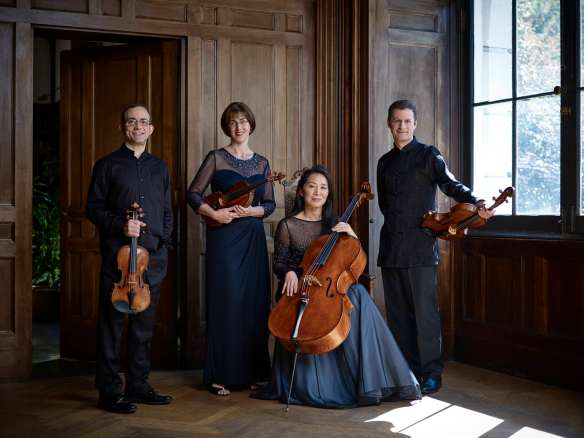
BRENTANO QUARTET - Misha Amory/ viola, Serena Canin/violin (glasses), Nina Lee/cello, Mark Steinberg/violin (glasses) www.http://brentanoquartet.com/

BRENTANO QUARTET – Misha Amory/ viola, Serena Canin/violin (glasses), Nina Lee/cello, Mark Steinberg/violin (glasses) www.http://brentanoquartet.com/

Wigmore Hall, London, 7 March 2016

written by Ben Hogwood

Audio (open in a new window)

http://www.bbc.co.uk/programmes/b072hw4q

Available until 6 April

What’s the music?

Haydn – String Quartet in F sharp minor, Op.50/4 (1787) (20 minutes)

Britten – String Quartet no.3, Op.94 (1975) (27 minutes)

Spotify

The Brentano String Quartet have not yet recorded this music, but other versions can be accessed via the playlist below, in case you can’t get to the broadcast:

About the music

Haydn wrote nearly 70 string quartets, but he was one of those composers incapable of writing the same thing twice. He also had a bit of a penchant for exploring relatively rare keys, and so this quartet, the only one he wrote in F sharp minor, occupies a special place.

It was part of a present for King Frederick William II of Prussia, to whom he had already sent his ‘Paris’ symphonies (nos.82-87) – receiving a ring in return. Haydn decided to send six string quartets, known as the ‘Prussian’ quartets – which continue to show his development as a composer in this relatively new form. The F sharp minor example is not as dark as some of the works in this key, though it does have some idiosyncratic moments described below.

Britten’s third numbered string quartet – his fifth and last to be published in the medium – is a direct product of the composer’s ailing health in 1975. With his capacity for work dwindling but not unbowed, it was suggested to him – in all seriousness by his friend Hans Keller – that if he wrote for less staves on the manuscript score he would be able to write more music.

He therefore completed a dedication for his friend, but as Keller recounts in his recent book, Britten: Essays, Letters and Opera Guides, the thought had been in his mind for some while. After a protracted discussion on form and sonata structure, Britten said to his friend, ‘One day, I’ll write a string quartet for you’. What he completed is something of a Divertimento – a wide ranging term that can apply from a short multi-movement piece to something as substantial as Mozart’s Divertimento for string trio, K563. The implication is that Britten wanted the freedom the form gave him.

With the Amadeus Quartet already enthusiastic exponents of his work, Britten took up the challenge with the help of the group and his assistant, composer Colin Matthews, who helped write much of the music from the piano. Although the Amadeus and Britten ran through the piece in private, he did not live to hear the public’s thoughts on the piece, for the premiere took place just over two weeks after his death.

The last movement of the quartet was written in its entirety in Venice, where Britten was still well enough to go on holiday, and perhaps inevitably it takes its lead from Death in Venice for its musical material. These are thought to be a present in musical form for Peter Pears. The final chord was a matter of some conjecture, and Britten changed it – for in the words of Colin Matthews, he wanted the work to ‘end on a question’.

For more thoughts on Britten’s last full work, visit the Good Morning Britten blog entry

Performance verdict

The Brentano Quartet were notable for their accuracy of tuning and ensemble in this concert but at times some of the raw emotional elements of the music were not necessarily close at hand.

The Haydn was extremely well played but did not have a freshness or spontaneity of the best Haydn performances. It was however impressive for the way they found the inherent darkness in the music, especially the finale, which had a grim determination. The slow theme and variations that make up the second movement could perhaps have enjoyed more variety between each one.

The Britten reached further emotionally, and the beautifully played last movement was a fitting finale. The Brentano were also very effective in the two faster movements, finding the right level of aggression. The rippling textures of the outer movements were beautiful too, recognising the very unusual colours Britten achieves in this music. Britten’s quartets travel internationally now – they were very much confined to this country for a while – and it is intriguing to hear them played from afar. This performance did the Third Quartet justice.

What should I listen out for?

Haydn

1:21 – the first four notes are key in the first movement of this quartet, for they form the basis of everything that follows – a bit like the repeated note motif in Beethoven’s Symphony no.5 but in a very different mood. Here the outlook is quite sombre, though the violin is positive. The first section is repeated (2:55), then at 4:25 the four note theme moves into development mode, before Haydn brings it back in original form at 5:37. Then he shifts the key to F sharp major at 6:22, and there is a notable upturn in mood.

7:31 – after the relative strife of the first movement the second begins in a pure and rather lovely form. A simple theme is presented before Haydn subjects it to several variations, but the peace doesn’t last and things take a darker turn at 9:30, the cello moving into its lowest register. At 10:55 the sunshine returns but is still affected by the music prior to it, and sure enough the minor key returns (12:34) – before Haydn moves once again to the major key for the next variation (13:16). The movement ends in a sudden full stop.

15:14 – the third movement, as is tradition, is a Minuet­ – but this one is a bit different as Haydn sets it in F sharp major, the most difficult of all keys for string players. It has a strange air about it, and some sudden loud bits do not help the mood of anxiety. At 16:45 a trio section starts, slipping into the minor key and feeling more vulnerable as a result. The Minuet music returns at 18:06, but doesn’t fully ease the tension.

19:10 – the mood of the quartet gets even darker for its finale, an austere fugue – which is where each part comes in at regular intervals playing slightly altered versions of the same tune. It makes a busy sounding texture, which Haydn works ingeniously until a sudden end, the finale only two minutes long.

Britten

23:54 – immediately in this work there is a sense of otherworldly mystery. In the third quartet Britten picks up where Death in Venice left off, the first violin using the same conversational style that Britten assigned to Aschenbach,(e.g. 25:14) the other instruments painting pictures of the undulating waters of the city’s canals. There is an intense period of contemplation that runs through this movement, subtitled Duets – because Britten tends to divide the quartet equally as the music unfolds

30:34 – the second movement (Ostinato) arrives with a jolt, and though its statements often end on a chord built on C – one of Britten’s favourite tonalities – it often sounds dissonant and unfeeling. There is a central section where brief respite is found, but it does not last long.

33:56 – when the violin takes the lead in this movement, marked Solo, it does so as a leader in prayer and meditation, and the other three instruments stand considerately in the sidelines. As the movement closes Britten reaches a radiant calm.

38:40 – either side of this moving section are two gruff, defiant scherzos, Britten writing closer to the style of Shostakovich but seeming also to shake his fist at the approach of Death. This second scherzo emphatically bursts the bubble created by the violin in the middle movement.

41:09 – the final movement – subtitled Recitative and Passacaglia – has perhaps the strongest sense of inevitability in late Britten. It begins with thoughts from the solo instruments, using the conversational style of the first movement. Then the Passacaglia takes hold (44:05). It is both sure footed and sublime, every repetition of the gently rising phrase feeling like a slow but sure step towards another world. That it ends on a question is something of a masterstroke, for after the serenity of the E major chord is realised in harmonics (50:33), Britten still has questions in his life and beliefs that remain unanswered. Ending on the ambiguous chord speaks volumes.

Encore

53:03 – a difficult call to make, doing an encore – but the Brentano chose nicely, opting for the first fugue from J.S.Bach’s The Art of Fugue (3 minutes). This is also reproduced on the Spotify playlist.

Further listening

Where to go after Britten’s final thoughts? It’s a very tricky question to answer, so how about some late or final thoughts from other composers? Included at the bottom of the playlist are Beethoven’s Piano Sonata no.32, Schubert’s last String Quartet and the Adagio from Mahler’s Symphony no.10:

In concert – Ryan Wigglesworth and the BBC Symphony Chorus and Orchestra at the Barbican

ryan-wigglesworth

Picture (c) Benjamin Ealovega

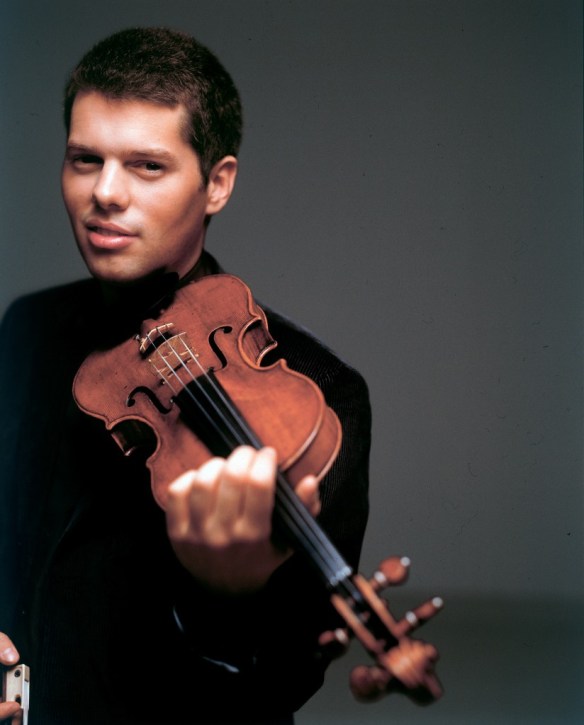
Barnabás Kelemen (violin), BBC Symphony Orchestra / Ryan Wigglesworth (above)

Barbican Hall, London / Wednesday 2 March

This typically well-planned BBC Symphony Orchestra concert had a surprise or two in store. Bookending the quartet of works on display were two pieces by Stravinsky – the Agon ballet from 1957 and the Symphony of Psalms.

They provided a good illustration of how Stravinsky changed styles as a composer, and how in spite of that he retained a fascination with older polyphonic styles. Some of the sound worlds in Agon, a set of twelve tableaux for twelve dancers, frequently alighted on melodic figures or chords that felt ‘old’, holding dissonances and deliberately leaving chords unresolved.

Agon is viewed as the work where Stravinsky starts to take his leave from a more obviously tonal approach to composition. In this performance it was lean yet colourful, with excellent solos from leader Stephanie Gonley, mandolin player Nigel Woodhouse, harpist Sioned Williams and Christian Geldsetzer and Richard Alsop, the two BBC SO lead double bass players, who nailed their otherworldly harmonics on each appearance.

The Symphony of Psalms was more obviously outgoing but saved its greatest emotional impact for the quieter music, the closing pages of ‘Omnis spiritus laudet Dominum’ (‘Let everything that hath breath praise the Lord’) from the BBC Symphony Chorus given out with softly oscillating orchestral figures.

Stravinsky uses the lower end of the orchestra in this piece, with no violins or violas, adding extra percussive punch from two pianos – all aspects that Wigglesworth brought forward in a taut performance. Great credit should however go to chorus master Hilary Campbell, who was unfortunately not mentioned in the concert programme. She is clearly popular with the singers, and helped secure that extra degree of accuracy and emotional involvement. One of Stravinsky’s most cinematic scores, it was in this performance a powerful statement of affirmation.

Wigglesworth positioned his own Violin Concerto modestly after the interval – I say modestly as in its five years of existence the piece has already ramped up an impressive number of performances. On this evidence its status is well-deserved, for it is a tightly structured unit of no little tension, the soloist searching for his ultimate melody while the reduced, ‘classical’ orchestra try and find their ultimate tonality.

barnabas-kelemen

Soloist Barnabás Kelemen (above) was a macho presence, with a little too much testosterone at times when the violin was surging forward, but he balanced that with some incredibly sensitive playing at the quietest moments of the piece, where the audience strained on his every note. Both melody and tonality were resolved in moments that confirmed Wigglesworth as a composer of impressive style and instinct.

The one dud in the program was Britten’s Four Sea Interludes and Passacaglia from the opera Peter Grimes, seen through the visual projections of Tal Rosner. This was a commission from four American orchestras in Britten’s centenary year 2013, with each interlude was set to the images of the city from which the commission came. For its UK premiere Rosner added a portrait of London to go with the other orchestral excerpt from the opera, the Passacaglia. This was centrally placed, keeping the order in which the scenes appear in the opera.

Although well played by the orchestra, the idea sadly fell flat on several levels. Although Britten spent time in America – and indeed began Peter Grimes there – the work’s roots are so entrenched in Suffolk that to suggest anything other than the Aldeburgh coastline through the music feels completely wrong. Rosner’s constructions were skilled, and had a few fine moments where close-up images of the Golden Gate Bridge rotated in technicolour.

Sunday Morning, with its bright building blocks of orchestral colour, was revealed to be a minimalist precursor of the music of John Adams through the clever constructions of its visuals. However despite Britten’s more universal appeal as a composer these days, Peter Grimes surely belongs wholeheartedly in Suffolk – and any suggestion to the contrary, however well intended, feels wrong.


In concert – Benjamin Baker and Daniel Lebhardt @ St James’s Piccadilly, London

benjamin-baker

Benjamin Baker (violin, above), Daniel Lebhardt (piano), St James’s Church, Piccadilly, 18 January 2016

Reviewed by Ben Hogwood

Britten – Suite for violin and piano, Op.6 (1934-35)

Elgar – Sonata for violin and piano in E minor, Op.82 (1918)

Violinist Benjamin Baker and pianist Daniel Lebhardt are both promising musicians in their twenties, and here they performed an attractive pairing of the young Britten and the ageing Elgar. This was part of the Richard Carne Trust Series, a lunchtime concert given in the generously lit, spacious surrounds of St James’s Piccadilly, a fine Christopher Wren church.

Britten was a relatively serious child, and although the Suite for violin and piano is an early work, completed in his early twenties, it has the mark of a composer already sure of himself in form, melody and writing for the violin. Britten still has fun through a number of dance forms, though, and after a bold as brass introduction Baker and Lebhardt strode confidently through a March, well balanced and intuitively finding the flexibility in Britten’s rhythms.

This togetherness was even more apparent in a dramatic Moto perpetuo, a nervy piece of writing, but this fraught mood dissipated in the bell-like chords with which Lebhardt began the Lullaby. Finally the Waltz, a brazen but very enjoyable affair where the performers could perhaps have been more exuberant, but where they took some very tasteful liberties with the rhythm, as Britten instructs in the score.

Elgar’s Violin Sonata was a different story, darkly passionate in the intial outpouring of feeling in its first movement but contrasted with a ghostly quieter section that even on a cold January lunchtime sent a shiver down the spine. Elgar is fiercely lyrical in the outer movements of this work, and Baker did well to project this over an equally active piano part. The two found the grace of the Romance, where it felt as though they were dancers in hold, charming with slow steps but occasionally drifting apart.

Elgar’s determination returned in the finale, the tune consistently putting its head above that of the piano and achieving a well-won victory by the end. The two showed great understanding of the older man’s music, a fine interpretation that reminded me this piece was one of Nigel Kennedy’s earliest recordings. Baker and Lebhardt, then, have followed in illustrious footsteps!

Wigmore Mondays – Alexei Ogrintchouk and friends play music for oboe and string trio

Picalexei-ogrintchouk

Picture used courtesy of the BBC

Alexei Ogrintchouk (oboe), Boris Brovtsyn (violin), Maxim Rysanov (viola) and Kristina Blaumane (cello) – Wigmore Hall, London, live on BBC Radio 3, 12 October 2015

Listening link (open in a new window):

http://www.bbc.co.uk/programmes/b06hjxlv

on the iPlayer until 18 November

Spotify

In case you cannot hear the broadcast, here is a Spotify playlist of the music in this concert, from available versions on Spotify. Alexei Ogrintchouk has recorded the Mozart, while available versions of the Haydn, Britten and Schubert pieces are also included.

What’s the music?

Attributed to Haydn: Divertissement in B flat, HII:B4 (not known) (10 minutes)

Britten: Phantasy Quartet, Op 2 (1932) (13 minutes)

Schubert: String Trio in B flat, D471 (1816) (8 minutes)

Mozart: Oboe Quartet in F, K370 (1781) (14 minutes)

What about the music?

Often in chamber music the strings get a lot of the glory, so it is good to report on a concert where the oboe is invited to take centre stage. The instrument is on occasion associated with sad music (Midsomer Murders use it a lot!) and it is perfect for autumnal listening, but it should be remembered that the oboe is also responsible for a lot of happy music too, as Mozart’s Oboe Quartet testifies.

This piece is a beauty, seemingly free of any constraints in its outer fast movements, while the inner slow movement is short yet poignant, set in the minor key. Mozart wrote it for the virtuoso Friedrich Ramm, and composed the oboe line to sit above that of the violin, thus using the higher register of the instrument a lot.

Britten uses a wider range of colour in his Phantasy, written as a competition piece when he was at the Royal College of Music. Thanks partly to the advocacy of the legendary oboist Leon Goossens, but also to his musical craft, the piece won its competition in Paris. Set over nearly 15 minutes, it has a dramatic profile, beginning as a march that seems to process in from nothing – started by the cello – until the sweep of lyrical oboe and punchy strings together is striking.

The first piece in the concert is a two movement Divertissement attributed to Haydn but, it is not wholly certain who actually wrote it. To my slightly untrained ears it sounds like it could be earlier than Haydn, but regardless of who the composer is the music is polite and attractive, the four instruments set in close dialogue.

Schubert’s single movement for String Trio is in the same key – B flat major – and has a similar profile, though does make the most of a striking descending motif throughout. Originally Schubert wanted this to be the first movement of a bigger piece, but after sketching some bars of the slow movement he stopped writing.

Performance verdict

Over the last few years Alexei Ogrintchouk has developed from a very promising musician to an oboist right at the top of his game – and that was evident throughout a highly enjoyable concert.

The peak was undoubtedly reached in the Mozart, where he met the virtuosic demands of the piece head on but without losing the airy, lyrical approach that makes the Oboe Quartet such a charmer. The performance of the Britten dug in much more firmly, the strings encouraged to project outwards, and this they did with impressive power when the march took hold. Britten’s genius in working with small forms was evident even at this point, and not a note was wasted in the performance.

Both the Haydn and Schubert performances charmed, the Schubert nicely placed so that the strings had a brief moment in the sun – which they enjoyed, with lightness and dexterity, clearly listening to each other.

What should I listen out for?

Attrib.Haydn

2:01 – this light hearted piece begins with an oboe-led melody, while the cello supplies a chugging pulse. The music is polite and attractive. At 5:13 a central section begins, based on the melody from the start.

7:50 – a slightly slower second movement, a courtly dance – in the form of a rondo, which essentially means the same theme recurs at regular intervals. The violin and viola assume greater importance in this movement. The theme itself makes a final appearance at 11:02.

Britten

14:25 – the beginning is almost imperceptible, a little phrase from the cello which is gradually joined by the other two stringed instruments. When the oboe joins at 15:07 the tone is songful, though the spiky accompaniment continues, leaving some tension until a firm statement of the main tune at 16:12. Then a different section takes over, with heavier string writing.

20:25 – the writing now has a softer, hazy hue, as the strings enjoy a slower and more obviously lyrical section. At 22:30 a higher melody from the oboe floats above the texture.

24:52 – the main march idea makes a reappearance, striding forward purposefully – until the music fades, as though it were walking over the horizon and out of earshot.

You can read more about the Britten Phantasy on a blog entry I made two years ago here

Schubert

29:52 – the Schubert String Trio, set in one movement, begins with an attractive melody led by the violin. There is a distinctive downward sweep that is heard from 30:40, and which becomes an important part of the piece. The three instruments stay closely aligned throughout. After developing his main tune, Schubert restates it at 35:22.

Mozart

40:04 – the oboe is already high in its register when the distinctive tune of the first movement is heard, top of an extremely light texture. The strings are busy in their accompaniment. Mozart then proceeds to manipulate his memorable tune through different methods of presentation, until a slight lull at 43:53 – and the return of the main tune at 44:57.

46:44 – A slight shadow falls over the music for the second movement Adagio, where the strings are softer and the oboe a little mournful if still beautiful in its first melody. At around 48:57 the oboe is left exposed in a kind of cadenza, leading up to the thoughtful end.

49:57 – once again the brightness in this music is evident as a light hearted theme sways between oboe and strings. The oboe enjoys the recurrences of its tune, with Mozart subtly varying the accompaniment each time before finishing on the high ‘F’ of the oboe at 54:00.

Further listening

If you enjoyed the sound of the oboe, then a logical next step is a couple of orchestral pieces, added to the bottom of the playlist, that use the instrument to its fullest capabilities:

First of all is Ravel’s subtle but gorgeous Le tombeau de Couperin, the oboe taking up the first theme in the Prélude and also enjoying prominence in the slow Menuet.

Then we have Vaughan Williams’ beautiful, autumnal Oboe Concerto, heard here in a new recording from the oboist Nicholas Daniel. The wistful quality perhaps gives away the fact this piece was written in the Second World War. Daniel’s disc is reviewed on Arcana here