Jean-Guihen Queyras plays works for solo cello by J.S. Bach and Benjamin Britten at the Wigmore Hall
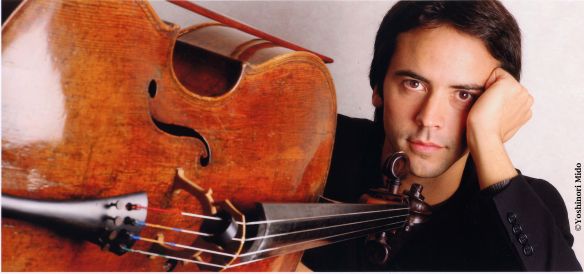
Jean-Guihen Queyras (cello) – Wigmore Hall, London, live on BBC Radio 3, 6 July 2015
Listening link (opens in a new window):
http://www.bbc.co.uk/programmes/b060zmjg
on the iPlayer until 5 August
Spotify
In case you cannot hear the broadcast, here is a Spotify playlist of the music in this concert, in recordings made by Queyras for Harmonia Mundi:
What’s the music?
Britten: Solo Cello Suite no.1 (1964) (20 minutes)
J.S. Bach: Solo Cello Suite no.6 (c1724) (30 minutes)
What about the music?
The idea of a cello playing on its own was only fully cultivated in the twentieth century – when Pablo Casals recorded the six Bach suites in the 1930s and they became part of the repertoire once again. Until then, unbelievably, they had lain dormant – but now they stand as arguably the most-played body of works for cello in existence. They are wonderfully flexible pieces, because the easiest parts of the suites can be played by budding amateurs. Generally, the higher the number of the suite, the more technically demanding they are.
Hence the Sixth and last suite in the set is extremely virtuosic. It is thought to have been written for a five-string instrument known as the violoncello piccolo, like the one in the picture below:
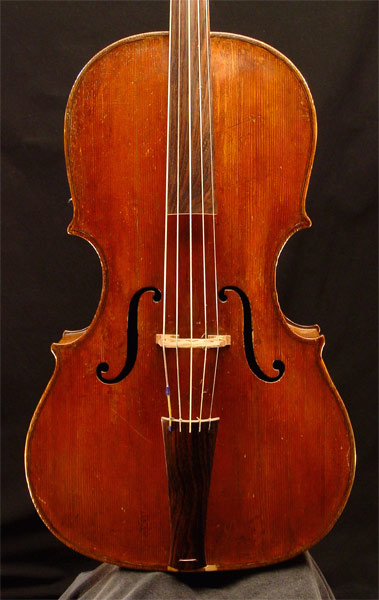
The Sixth is the longest of the suites, and often features multiple stopping – i.e. more than one note played at once. Because the fifth string of the violoncello piccolo would have been a higher one (an ‘E’ above the highest cello string of ‘A’) the suite is unusual for its treble-rich sound.
Britten stole into the world of the solo cello by way of his dear friend Mstislav Rostropovich, who threw down the gauntlet to him to write a number of compositions for the instrument. In taking on writing for the solo cello he was one of the first since Bach to take it on in a solo capacity – Zoltán Kodály and Max Reger being the others.
Britten made an explicit homage to Bach’s works in the use of different dance forms, and like the elder composer he often wrote out multiple stopping, using the confines of the instrument to somehow write independent parts for it. These can be heard especially as the second movement Fuga takes shape.
Britten was to write another two suites for solo cello, for it was clearly an instrument that pricked his compositional interest.
Performance verdict
If ever proof were needed that Bach can make you happy, Jean-Guihen Queyras supplied it handsomely in this wonderful hour of music. Each of the six movements making up the Sixth Cello Suite danced persuasively, although in the slower Allemande and Sarabande dances Queyras achieved a wonderful, all-encompassing peace. Technically he was superb – this is far from easy music to play in public – with rock solid intonation and an easy way that endeared him to his audience.
The Britten made a good contrast, for this is a very serious piece, with inner strife that Queyras built perceptibly as the final flurry of notes grew closer. Here he was careful to bring out Britten’s part writing for the instrument, so that on occasion it felt as though there were many more instruments than just one in the room. The cello’s probing tone still brought each melody to the front, while the technical effects Britten uses to enhance the impact of the piece were brilliantly executed.
What should I listen out for?
Britten
1:41 – the Canto primo, where the cello proclaims the theme majestically. Immediately you can hear Britten’s use of multiple stopping, which is where the cello plays chords from several strings at once. This moves into…
3:39 – the Fuga begins. It seems very unlikely that a fugue could work on a cello but it somehow does – when at 3:52 the next entry of the tune comes in, meaning several parts can exist simultaneously. The ear is led this way and that, as though two or even three cellos are playing. From hear the mood darkens to…
7:42 – the Lamento, which starts with a broad intonation, like a solo singer. Britten wrote so many of his instrumental pieces as though they are vocal.
10:07 – the Canto Secondo. In response to the Lamento the cello gives a subdued account of the Canto theme, appearing lost in thought.
11:07 – Serenata. Marked Allegretto pizzicato (quite fast but with the strings plucked) this is a more playful homage to the second movement of Debussy’s Cello Sonata, which Britten and Rostropovich recorded together in 1961.
13:33 – a movement marked as Marcia – where Britten achieves ghostly sounds firstly through the use of harmonics, where the left hand rests very lightly on the string, and then through the wood of the bow banging on the string (14:14). The mood is now agitated.
16:40 – from the murky depths of the cello we hear the solemn Canto terzo, another variant of the tune from the start. The music becomes gradually more forceful, moving into…
18:29 – the Bordone begins – an unusually titled movement that features a drone on the note ‘D’ – mostly from the open string. Around it a cluster of notes can be heard, while the left hand plucks the string absently. Again it sounds like there are two or three instruments playing, such is the density of Britten’s music.
21:39 – the final section, marked Moto perpetuo – and now the cello sounds like a group of excited insects, the melody fluttering around restlessly. At 23:02 the main tune returns but sounds breathless in this company, as it does until the end – which is deliberately distorted and angry.
J.S. Bach
27:08 – the expansive Prelude, rooted in D major by frequent sounding of the open ‘D’ string, before gradually opening out. Bach’s main tune returns at a lower pitch (‘G’) at 29:33 – but then the music climbs to a peak at 30:28.
32:16 – the slow Allemande dance begins. This is the longest single movement in all of Bach’s music for solo cello, and it resembles a religious contemplation. Time really does seem to stand still as the cello’s music unwinds with a great inevitability. When he repeats the first section (from 33:57) Queyras plays much quieter.
40:34 – the triple-time Courante dance, a lively affair that finds the cello jumping around its range.
44:31 – the slow, serene Sarabande – which inhabits a similar world to the earlier Allemande. It requires clarity on the part of the cellist, who is playing high chords for much of the sequence, but when played well it is very beautiful, as here.
49:46 – a lightness of touch runs through the two Gavottes. The first of these uses a lot of multiple stopping, while the second (beginning at 51:25) is more purposeful and works its way into a bit of a frenzy over a drone. The first Gavotte is repeated at 52:34.
53:25 – the last of the dances, a Gigue – again in triple time. This has a rustic feel and keeps the wide open sound Bach has used throughout the suite, which reaches a thoroughly uplifting finish at 57:33.
Further listening
If the sound of the cello on its own appeals, the rest of the Bach and Britten suites are wholeheartedly recommended. In the Britten, one of many fine recordings comes from Norwegian cellist Truls Mørk, made for Virgin Classics. It can be heard on Spotify here:
In the Bach works interpretations are many and varied, so it is advisable to try a number of different sources. One of the earlier classic recordings that is always rewarding comes from the French cellist Pierre Fournier, made for Deutsche Grammophon’s side label Archiv Produktion in 1960. Here it is on Spotify:
For more concerts click here