
In concert – Thomas Trotter, CBSO / Pierre Bleuse: Saint-Saëns ‘Organ’ Symphony; Ravel, Poulenc & Holmès

Thomas Trotter (organ, above), City of Birmingham Symphony Orchestra / Pierre Bleuse

Ravel Le Tombeau de Couperin (1914-17, orch. 1919)
Poulenc Organ Concerto in G minor FP93 (1934-8)
Holmès La Nuit et l’Amour (1888)
Saint-Saëns Symphony no.3 in C minor Op.78 ‘Organ’ (1885-6)

Symphony Hall, Birmingham
Wednesday 20 September 2023 (2.15pm)

Reviewed by Richard Whitehouse

It hardly seems 40 years since Thomas Trotter took on the post of Birmingham City Organist in succession to the venerable George Thalben-Ball, and it was good to see his local orchestra marking the occasion with a programme which featured two staples from the organ repertoire.

Some 85 years on and it might be hard to imagine just how radical (or, better still, subversive) Poulenc’s Organ Concerto was through its juxtaposing elements both serious and populist in a continuous sequence that comes together precisely because of this stylistic incongruity. Not that Trotter betrayed any such doubts in what proved a tautly cumulative reading; aspects of the Baroque and Classical colliding with a sombre if never wantonly earnest Romanticism in which strings melded seamlessly with the soloist while timpani underpinned climactic points. Pierre Bleuse ensured a steady gathering of tension over the lengthy central span of slow(ish) music, with the final stages making the most of that music-hall element as makes the fateful ensuing recessional then baleful closing cadence more decisive in its stark emotional impact.

Organ transcription of Ravel’s Le Tombeau de Couperin is not unknown, but this afternoon’s performance was of the composer’s familiar orchestral version. Bleuse (below) conveyed the reticent elation of the Prélude, and while his expressive emphases made the Forlane overly studied in its knowingness, the wistful elegance of the Minuet sounded as disarming as was Yurie Aramaki’s oboe playing. Nor was any lack of poise in the central sections of the Rigaudon, even if Bleuse’s slightly stolid tempo in those either side sacrificed some of the music’s elan.

Composer, artist and feminist Augusta Holmès left a substantial output whose ambition may outstrip its attainment but includes such gems as La Nuit et l’Amour. Originally an interlude in her symphonic ode Ludus pro patria, it had established itself as an autonomous item well before becoming a staple of late-night music programmes – its canny amalgam of sensuous harmonies and heady lyricism recalling such contemporaries as Massenet and Godard, albeit with her engagingly personal twist which communicated itself readily in this performance.

Saint-Saëns was guarded with his assessment of Holmès, but his remark on her ‘flamboyant orchestration’ feels no less applicable to the Organ Symphony such as constitutes his greatest orchestral achievement and of which the City of Birmingham Symphony has given numerous memorable outings. While not among these, this account still left little to be desired – Bleuse launching the first part with keen expectancy before steering a purposeful if slightly dogged course through the ensuing Allegro. Seated up high at the organ console (rather than adjacent to the orchestra as with the Poulenc), Trotter made the most of the Adagio’s luminous timbral registrations which complemented the similarly burnished orchestration, while there was no lack of vigour or vivacity in the ‘scherzo’ section that bursts in at the start of the second part.

It is easy to make the ‘finale’ overbearing in its grandiloquence, but Trotter resisted any such temptation – he and Bleuse conveying the impetus and excitement of this music as it headed through passages of chorale and fugue toward a peroration as satisfying as it was irresistible.

You can read all about the 2023/24 season and book tickets at the CBSO website. Click on the artist names for more information on organist Thomas Trotter and conductor Pierre Bleuse
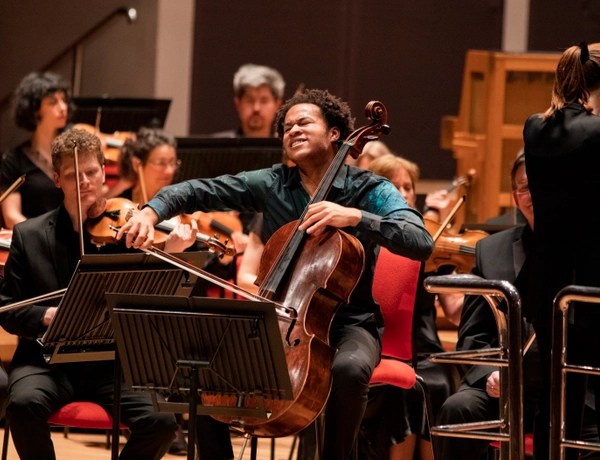
In concert – Sheku Kanneh-Mason, CBSO / Kazuki Yamada: Beethoven, Shostakovich, Walton

Sheku Kanneh-Mason (cello), City of Birmingham Symphony Orchestra / Kazuki Yamada

Beethoven Leonore Overture no.1 Op. 138 (1807)
Shostakovich Cello Concerto no.1 in E flat major Op.107 (1959)
Walton Symphony no.1 in B flat minor (1932-5)

Symphony Hall, Birmingham
Saturday 16 September 2023

Reviewed by Richard Whitehouse

Having opened the City of Birmingham Symphony Orchestra’s season two days earlier with Verdi’s Requiem, Kazuki Yamada returned for a judicious programme comprising three ‘No. 1’s’ – two mid-20th century masterpieces and an overlooked gem from the previous century.

Beethoven’s First Leonore Overture is in fact the third such piece written in conjunction with his eponymous opera, being intended for a Prague production that never materialized. Shorter in duration and simpler in design than its two ‘successors’, it sets the scene without attempting an overview of Leonore’s dramatic essence. Yamada duly made the most of an introduction as speculative as it was searching, then steered a lively course over the main Allegro – not least a surging crescendo into the coda such as Rossini had taken to heart before the decade was out.

It was with Shostakovich’s First Cello Concerto that Sheku Kanneh-Mason won BBC Young Musician of the Year in 2016 and thus launched a career that shows no signs of stalling. In the meantime, his take on this piece has deepened and at times darkened – the opening Allegretto exuding keen irony abetted by the incisive response from an orchestra whose single horn and double woodwind are thrown into sharp relief against modest strings. If the ensuing Moderato seemed a little measured, its stark intimacy was eloquently sustained to a yearning climax then mesmeric interplay of cello harmonics with celesta in the coda. The third-movement Cadenza emerged with real cumulative impetus, and not even the hiatus while Kanneh-Mason replaced a broken string could stem the final Allegro’s sardonic course to its decisive closing flourish.

A work that has latterly regained (at least in the UK) the reputation it enjoyed decades earlier, Walton’s First Symphony has had regular performances from the CBSO (and a recording with Simon Rattle), and this reading did not lack for commitment. Not least an opening movement such as built methodically and remorsefully from initial expectancy, through a central span of brooding stasis, to a pulverizing culmination; the only proviso being the frequent inaudibility of its underlying pulse in lower strings during the climactic stages. The scherzo seemed even finer in its tense amalgam of spite and barbed humour, its treacherous syncopation dextrously handled, while the slow movement unfolded from a wistful flute melody (affectingly rendered by Marie-Christine Zupancic) to its climax of baleful intensity subsiding into numbed regret.

The finale still tends to be seen as surrender to well-tried symphonic precedent yet, as Yamada presented it, did not eschew formal or emotional obligations. The resolute introduction, agile fugal writing and irresistible build-up to the timely appearance of extra percussion all became part of a conception vindicated by the elegiac trumpet theme (ably conveyed by Jason Lewis); leading to a peroration in which Yamada’s urging his players onward briefly risked unanimity of response while still resulting in the sheer affirmation of those thunderous closing chords.

Overall, an engrossing performance which augurs well for the CBSO’s first full season with Yamada. Next week places the spotlight on Thomas Trotter who, having done forty years as City Organist in Birmingham, takes the loft for repertoire staples by Poulenc and Saint-Saëns.

You can read all about the 2023/24 season and book tickets at the CBSO website. Click on the artist names for more information on cellist Sheku Kanneh-Mason and conductor Kazuki Yamada

In concert – CBSO Centre Stage: Bobbie-Jane Gardner & Tchaikovsky

Eugene Tzikindelean, Kirsty Lovie (violins), Adam Römer, aDavid BaMaung (violas), Eduardo Vassallo, aArthur Boutillier (cellos)

Gardner True Self (2023) [CBSO Centenary Commission: World Premiere]
Tchaikovsky String Sextet in D minor, Op. 70, ‘Souvenir de Florence’ (1890)a

CBSO Centre, Birmingham
Thursday 8 June 2023 (2pm)

Reviewed by Richard Whitehouse

This last of the City of Birmingham Symphony Orchestra’s Centre Stage programmes for this season brought together the most heard work for the relatively limited medium of string sextet with a Centenary Commission for string quartet by a composer born and based in Birmingham.

Best known for her diverse arrangements of African-American classics taking in Odetta and Alicia Keys, Bobbie-Jane Gardner has also written extensively for classical ensembles; most recently Up on the Toes (the slippery stair dance) for brass quintet (recorded by Onyx Brass), and now True Self. Taking its cue from the Buddhist virtue of absolute happiness, this latter unfolds along an ‘innocence to experience’ trajectory prior to a new awakening – the whole piece founded on a motif whose ‘childlike’ innocence is pervaded by its own vulnerability.

Harmonically subtle and rhythmically agile, True Self received what sounded a committed reading from the CBSO players – notably in the opening section when the music stirs gently but insistently into life, and towards the close when it touches on a resolution not so much tentative as anticipatory. Maybe these nine minutes could yet prove the first stage of a large-scale work or series of pieces? At any rate, it left a thoughtful and affecting impression, and will hopefully be taken up by other quartets seeking a worthwhile addition to the repertoire.

Souvenir de Florence has never been out of its respective repertoire, and this performance gave it its due – not least an impetuous opening Allegro as made the most of Tchaikovsky’s frequently dense part-writing, with a thrillingly climactic lead-back to the reprise, followed by an Adagio whose emotional build-ups were never indulged or overbearing. Even so, the speculative central interlude (with its edgy sul ponticello exchanges) might have benefitted from a touch more ambivalence to set the expansive sections either side into greater relief.

There was no doubting the trenchancy of the Allegretto, outwardly an intermezzo but with a scherzo-like capriciousness across its trio, while the unabashed rhetoric of the final Allegro was finely controlled as this movement reached a close of suitably breathless exhilaration.

You can read all about the 2023/24 season for Centre Stage at the CBSO website. Click on the composer name for more information on Bobbie-Jane Gardner, or visit her Soundcloud page

In concert – Benjamin Grosvenor, CBSO / Riccardo Minasi: Schubert, Chopin & Mozart

Benjamin Grosvenor (piano), City of Birmingham Symphony Orchestra / Riccardo Minasi

Schubert Overture in C major ‘In the Italian style’ D591 (1817)
Chopin Piano Concerto no.2 in F minor Op.21 (1830)
Mozart Symphony no.41 in C major K551 ‘Jupiter’ (1788)

Symphony Hall, Birmingham
Thursday 1 June 2023 (2.15pm)

Reviewed by Richard Whitehouse

It is not often these days to have a whole concert of music from the late Classical and early Romantic eras, but that was just what the City of Birmingham Symphony Orchestra provided this afternoon under the disciplined as well as immensely assured direction of Riccardo Minasi.

There was no mistaking the inherent classicism of Chopin’s Second (sic) Piano Concerto – not least the simmering impetus in its opening Maestoso where, after a forthright tutti, Benjamin Grosvenor rendered those main melodies with requisite poise, and the emotional eddying of its development in direct contrast to the terseness of its coda. Most memorable was a Larghetto of melting eloquence but also, in its central episode, a volatility only gradually dispelled. Here, and in the final Allegro, the almost concertante role allotted to bassoon was characterfully taken by Nikolaj Henriques – as were those brass fanfares and col legno writing for strings (was this really Chopin’s idea?) which see the latter movement on its way to a spirited close. A limpid take on Chopin’s Nocturne in C sharp minor from the same year made for an appropriate encore.

Mozart symphonies rarely conclude a programme nowadays, yet the last four are ideal for this purpose and none more than the Forty-First – by some distance the weightiest and the most physical such work prior to Beethoven’s Eroica. This was the highlight of Minasi’s recording of the final triptych (Harmonia Mundi), with the opening Allegro likewise a statement of intent in its rhythmic tensility and general bravura, though its more ambivalent asides were never downplayed. Less distinctive melodically than its two predecessors, the Andante is memorable for its expressive understatement and a subtlety – with wind and strings enfolded into a textural continuity – that accentuates its pathos. Nor was there any lack of suavity in the Menuetto, its outer sections finding ideal contrast with a trio whose pert expectancy was delectably pointed.

The final Allegro crowns this work in every respect and, here again, Minasi did not disappoint. Not that there any sense of merely ‘going through the motions’ with his inclusion of first- and second-half repeats, each of which brought added intensity to what had gone before as well as enabling the wealth of contrapuntal detail to come through as it too rarely does. For its part the CBSO more than rose to the challenge, not least in a coda whose methodical combining of this movement’s themes makes possible an apotheosis such as felt truly visceral in its affirmation.

Schubert evidently had other preoccupations when essaying his two overtures ‘in the Italian style’, both of which have fallen out of the repertoire this past half-century but which make for attractive and appealing curtain-raisers. Especially that in C major with its teasingly portentous introduction, jocular and lilting main themes, then coda which sees it through to an effervescent close. The CBSO players (woodwind in particular) audibly enjoyed making its acquaintance, and it would be a real pity were such pieces relegated to the lower reaches of today’s playlists.

Hopefully a performance such as that by Minasi will make this just a little less likely. One looks forward to his future collaboration with this orchestra, which returns next Wednesday with its chief conductor Kazuki Yamada in a programme featuring Holst, Beethoven and Rachmaninoff.

You can read all about the 2022/23 season and book tickets at the CBSO website. Click on the artist names for more information on Riccardo Minasi and Benjamin Grosvenor

In concert – CBSO / Robert Treviño – Mahler’s 10th symphony

City of Birmingham Symphony Orchestra / Robert Treviño

Mahler, ed. Cooke Symphony no.10 in F sharp major (1910)

Symphony Hall, Birmingham
Thursday 18 May 2023

Reviewed by Richard Whitehouse

The City of Birmingham Symphony Orchestra has a notable association with Mahler’s Tenth Symphony – realized by Deryck Cooke – having given memorable performances with Simon Rattle and more recently with Sakari Oramo. This evening’s account was to have been taken by Mirga Gražinytė-Tyla, but her indisposition brought American conductor Robert Treviño to the helm for what was a memorable performance that vindicated (if such were needed) this ‘performing edition’ and hinted at what might develop into a notable partnership in the future.

The quality of string playing these days means the initial viola melody no longer poses quite the risks it once did. Treviño went on to shape this opening Adagio with a sure sense of how its contrasting themes are drawn into an evolution whose unpredictability is informed by an emotional candour, heard at its most explicit in the climactic dissonance (evidently added at a late stage) such as makes the beatific coda the more affecting. Nor did he fail to tease out the underlying continuity of music shot through with the knowledge of its own dissolution.

Such an issue is more graphically present in the first Scherzo, its contrapuntal texture fitfully realized in the score but here achieved with a deftness making the trade-off between its polka- and ländler-like ideas the more potent. Not least during the later stages of a movement where these themes alternate with ever increasing frequency, as if in a stretto of activity, on the way to the most decisive and even affirmative conclusion found in Mahler’s late music. Treviño’s opting not to tone down those more unlikely percussive touches proved its own justification.

Almost Mahler’s shortest symphonic movement, the Purgatorio is yet crucial to the overall design – the ‘treadmill’ motion of its outer sections exuding acute irony, with the histrionics at its centre firmly held in check so their implications were made more than usually evident.

Performances of this work most often founder in the second Scherzo, but not here – Treviño launching it with anguished intent, while maintaining a persuasive balance between this and the more consoling element which informs its progress. The brief central interlude conveyed exquisite pathos, tension barely receding as the expression gradually and inevitably subsides into crepuscular activity with its fleeting intimations of what went before and what is still to come. Just one bass-drum stroke, surely, is needed to separate this movement from the finale.

That said, the unfolding of this latter left nothing to chance – whether in the sepulchral gloom of its initial bars, the poise of its indelible melody for flute, or a central phase of activity that here emerged as the natural consequence of what went before. Treviño (rightly) retained the additional percussion necessary to make the return of the first movement’s climax the more shattering – the sheer eloquence of what followed building to a rapturous culmination which, as with the closing emotional wrench, drew an unfaltering response from the CBSO strings.

A memorable performance, and one that met with an enthusiastic response. Treviño brought the soloists and sections to their feet, but might have started with trumpeter Jason Lewis and flautist Marie-Christine Zupancic – their contributions typifying the excellence of the whole.

You can read all about the 2022/23 season and book tickets at the CBSO website. For more on Robert Trevino, visit his website