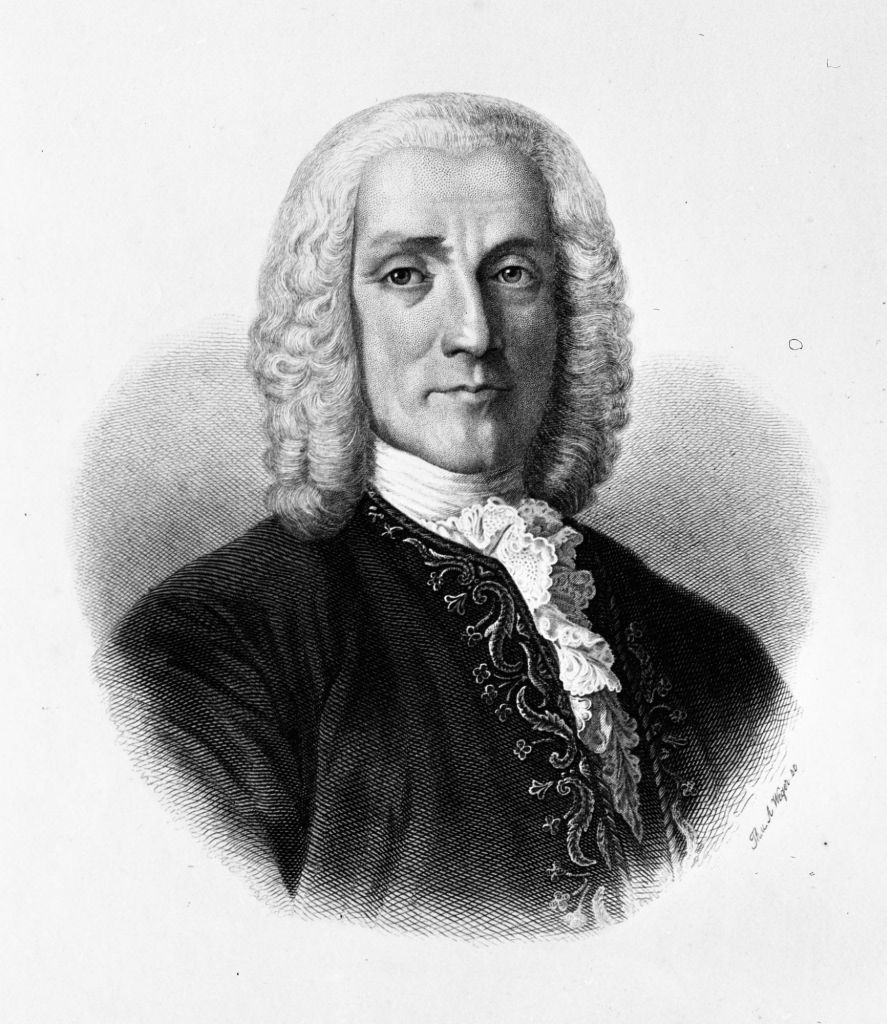
Earlier in the week we marked 300 years since the birth of Alessandro Scarlatti..and now we switch attention to his son Domenico, born 340 years ago today.
Domenico was a prodigious composer of keyboard sonatas, a form he helped revolutionise. Here are some in excellent versions from Anne Quéffelec:
On this day in 1757, the composer Domenico Scarlatti died in Madrid.
Taking the baton from his father Alessandro Scarlatti, Domenico was a prolific composer wrote no fewer than 550 keyboard sonatas, an unparalleled output that has a fascinating variety, looking forward to Beethoven and even beyond. Here is a great example with which to end the day, from a very fine album devoted to the composer by French-Canadian pianist Anne Quéffelec
Geneva Lewis (violin, above) and Georgijs Osokins (piano, below)
Brahms Violin Sonata no.2 in A major Op.100 (1886) Domenico Scarlatti Sonata in D minor Kk213 Elgar Violin Sonata in E minor Op.82 (1918)
Wigmore Hall, London Monday 20 May 2024 (1pm)
by Ben Hogwood
The Violin Sonata no.2 is one of Brahms‘s chamber music perennials, a popular recital fixture – but in this recital from BBC New Generation Artist Geneva Lewis and Latvian pianist Georgijs Osokins it was as though the work had received a fresh coat of paint.
The tempo marking Brahms applied to the first movement, Allegro amabile, is seldom found in classical music – ‘amabile’ meaning ‘lovely’. That was certainly the case in this performance, though Lewis and Osokins took a much slower tempo than is the norm. Their daring approach succeeded, however, for the melodic phrasing blossomed, the spring-like main tune given plenty of room to shine. The second theme was laid bare, but again the slow tempo allowed for greater insight, followed attentively by the Wigmore Hall audience.
The dynamic range of both players was also notable, Lewis very much aware of her surroundings in the quiet passages, the audience subconsciously leaning in to the music. At points the music was so quiet that Osokins’ pedalling could be heard…but conversely the pair were not afraid to put the pedal down and play out, as they did in the finale. In between came a tender and affectionate middle movement, its dreamy opening certainly tranquillo, before a most appealing central vivace section.
Elgar’s Violin Sonata was completed when the composer had just turned 60 – and although he would live for another 16 years, very few major works followed. To hear the sonata played by performers in their twenties was eye-opening indeed, with more youthful elements of the piece revealed and a different light shed on a work that often has autumnal reflections to cast.
The first movement was notable for its commanding first paragraph, Lewis setting the tone for the movement as she became immersed in Elgar’s broad phrasing. Osokins, for his part, mastered the full piano textures most impressively, before both performers drew back for a thoughtful second theme. The second movement became a fascinating mini-ballet between the two instruments, its shadowy colours a clue to the composer’s darker thoughts, though the bittersweet melodies were given extra charm by the dance-inflected rhythms.
The finale took flight immediately, the violin surging forward with penetrating melodies that led to a sense of sunlight breaking through the clouds in the closing phrases, Elgar allowing his thoughts to brighten as the music turned to the major key. The imaginatively chosen encore capitalised on this, Lewis and Osokins giving us the rustic finale of Busoni’s Violin Sonata no.2 in E minor, music which might have passed for one of Brahms’s Hungarian-influenced works were it not for some particularly scrunchy harmonies.
In between the two big sonatas, Osokins (above) had the chance to shine alone, one he took with a profound account of one of Domenico Scarlatti‘s many keyboard sonatas. The Sonata in D minor Kk213 is a bittersweet piece, a reminder of how forward looking this composer’s music can. Rooted in the 18th century it may be, but in reality we could have been listening to a Satie Gnossienne, especially with Osokins’ poetic licence drawing out the final harmonic resolution.
All of this was book-ended by two concerts of sacred music broadcast on BBC Radio 3 for Holy Week, both demonstrating what a unique and valuable choir they are.
On 17th March they gave their first concert following the BBC’s shameful axing announcement at St Giles’ Cripplegate in London. It was inevitably a special and emotional occasion. The programme of choral and cello music went under the bitterly ironic title of All Will Be Well (after Roxanna Panufnik’s piece of the same name which concluded the programme). “I’m still the producer of the BBC Singers” said Jonathan Manners in his introduction to much applause.
The concert was a fitting example of the range and depth of the choir’s repertoire in terms of time (it opened with Hildegard von Bingen’s O cruor sanguinis from the 12th Century) and style. It displayed impressively their ability to convey a sense of comfort and balm such as in Lesia Dychko’s short piece Blessed be the name (Emma Tring a beautiful solo soprano) as well something more unsettling like Fac me tecum pie flere by Sven-David Sandström.
But this was a programme of choral and cello music and cellist Benjamin Hughes was individually expressive as well as combining powerfully with the choir, both in evidence in Knut Nystedt’s Stabat Mater.
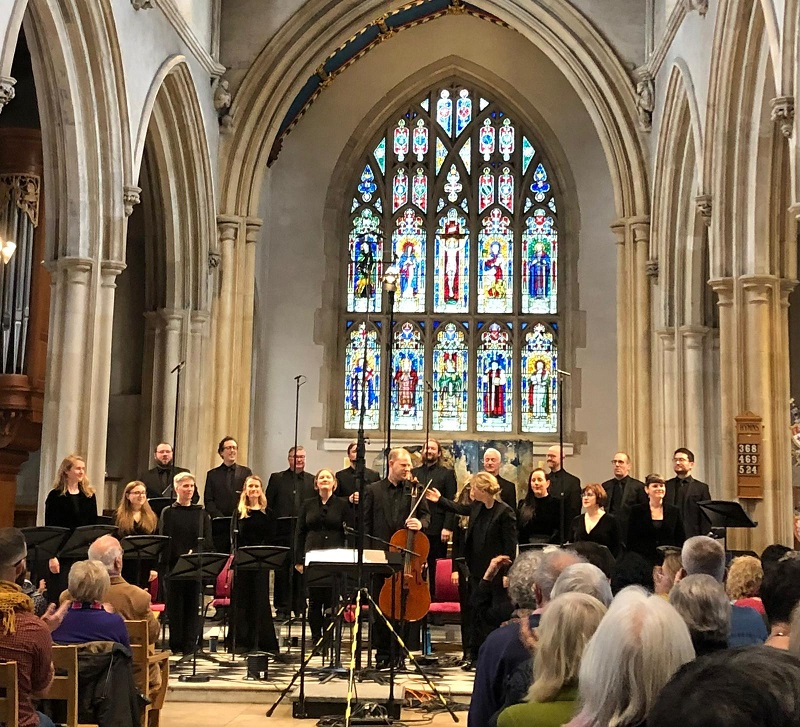
A magnificent encore of Maurice Duruflé’s motet Ubi Caritas was followed by a rapturous and moving ovation (below)
Today, we were joined by cellist @benhughescello and Chief Conductor @sjeannin in a programme for choir and solo cello 🎶
Thank you to all who joined us at a packed out @stgilesc 👏
The concert was recorded for future broadcast, stay tuned for more information 📻 pic.twitter.com/JJcJDh2dX6
Less than three weeks later, and following the BBC statement announcing a suspension of the closure, the group performed a Music for Maundy Thursday concert of sacred pieces on the theme of ‘contemplation, sorrow and reflection’ for live broadcast on BBC Radio 3 at St Paul’s Church, Knightsbridge, London (above).
Yet again the programme highlighted the sweep of their repertoire opening with a meditative motet from the 1590s, Vittoria Aleotti’s Miserere mei, Deus (from the first published book of sacred music by a woman) and also featuring sacred pieces from the 21st Century (Karin Rehnqvist’s I raise my hands and Judith Bingham’s Watch with Me), as well as William Byrd’s 14th Century The Lamentations of Jeremiah.
But there were two pieces where the group really shone to spectacular effect. Domenico Scarlatti’s Stabat Mater à 10, with Richard Pearce on chamber organ, was stunning and utterly compelling in its detailed delivery. Francis Poulenc’s Quatre motets pour un temps de penitence made a glorious finale.
One must also acknowledge the key role of Chief Conductor, Sofi Jeannin, always assured yet empathetic. To watch her conduct is a mesmerising experience in itself.
The extent to which the BBC Singers and Jeannin develop and promote a diverse repertoire (they have a 50:50 gender policy for composers whose music they perform), engage in learning and community work, regularly perform commissions and broadcast on Radio 3 (making their phenomenal output available to such a wide audience) is all part of what makes them so unique.
I have seen them many times over many years and they never fail to move me. These two concerts only served to prove just why they are irreplaceable.
John Earls is Director of Research at Unite the Union and tweets at @john_earls
Martin Fröst (clarinet), Roland Pöntinen (piano), Sébastien Dubé (double bass)
Debussy Première rhapsodie (1909-10) Chausson Andante and Allegro (1881) Poulenc Sonata for clarinet and piano (1962) Night Passages – A musical mosaic (with arrangements by the performers) Domenico Scarlatti Sonata in D minor Kk32 Chick Corea Children’s Song no.15 (1978) Rameau Les Indes galantes: Air pour les Sauvages (1735-6) Purcell Incidental music for Oedipus, King of Thebes Z583: Music for a while (1692) J.S. Bach Sinfonia no15 in B minor BWV801 (c1720) Chick Corea Armando’s Rumba (1976) Purcell Hornpipe in E minor Z685 Handel Menuet in G minor (1733) Traditional Polska från Dorotea Göran Fröst Klezmer Dance no.2 (2011)
Wigmore Hall, London Wednesday 21 December 2022
Reviewed by Ben Hogwood
In 2019, Arcana was at the Wigmore Hall to see Martin Fröst and Roland Pöntinen give a concert of largely French music for clarinet and piano. Their encore hinted at an intriguing sequence of arrangements exploring connections between classical music and jazz. Three years on, that sequence has grown in stature, realised in recorded form as the Sony Classical album Night Passages, and given meaningful content by personal and world events.
Through lockdown, Fröst experienced intense bouts of Ménière’s disease, whose symptoms include unexpectedly severe bouts of vertigo and tinnitus. The clarinettist experienced one such bout while driving his car, which he thankfully negotiated without injury, but which bred a number of accompanying fever dreams. Expressed in the program notes, they lent a vivid written complement to the music.
Since 2019 the double bass of Sébastien Dubé has been added to the instrumental thinking, an essential musical component taking the arrangement style towards Jacques Loussier without ever resorting to parody. Unexpectedly, the group’s colourful arrangements did not always include the piano, allowing Fröst and Dubé the chance to explore the rewarding combination of clarinet and double bass through imaginative techniques and compelling improvisation.
The course of Night Passages led from a solemn sonata by Domenico Scarlatti to a Klezmer dance from Fröst’s brother Göran, by way of arrangements exploring the versatility of Baroque music. These were matched by jazz-inflected work from Chick Corea, with Armando’s Rumba presenting some vibrant syncopations, along with a celebration of the Swedish polska.
Frost’s artistry was almost beyond criticism, the clarinettist able to make even the most demanding technical passages appear nothing more than a walk in the park, airily improvising or running through sharply edged cadenzas. Dubé was no less impressive, and a remarkably wide range of colours issued from the double bass, whether bowed or plucked. His chemistry with Fröst was compelling, and the occasional use of vocals added to the mix. Roland Pöntinen also made the most of his chances to shine, providing the rhythmic verve to the dances but also a welcome, cleansing clarity which ran through the Baroque arrangements, tastefully and affectionately realised.
Prior to the interval we heard three short pieces by French composers for clarinet and piano. Debussy’s Première rhapsodie tells its story through a set of contrasting thoughts, initially set out in a humid atmosphere but becoming more outward facing as it gains in confidence. Fröst and Pöntinen had its many twists and turns instinctively under their fingers, finishing each other’s sentences as they did in the romantic, lyrical writing of Chausson’s Andante and Allegro, played with evident affection.
Yet it was Poulenc’s Sonata for clarinet and piano, completed in the year before his death, that made the most lasting impression. What a profound work this is, paying tribute to his friend and fellow composer Arthur Honegger. The slow movement holds the emotional centre of the work, with melancholy on occasion spilling over into outright sadness. Fröst’s quieter asides encouraged the audience to lean closer to the music, but these intimate thoughts were swept away by the exuberant finale, throwing caution to the winds. Fröst and Pöntinen played with great feeling throughout, typifying the approach of a concert that may not have been generous in length but which amply compensated through musical quality.





 Arcana.fm