In concert – Soloists, Danish National Concert Choir & Symphony Orchestra / Fabio Luisi @ BBC Proms: Beethoven 9th Symphony, Bent Sørensen & Anna Clyne

Clara Cecile Thomsen (soprano), Jasmin White (contralto), Issachah Savage (tenor), Adam Palka (bass), Danish National Concert Choir, Danish National Symphony Orchestra / Fabio Luisi

Bent Sørensen Evening Land (2017)
Anna Clyne The Years (2021)
Beethoven Symphony no.9 in D minor Op.125 ‘Choral’ (1811-24)

Royal Albert Hall, London
Thursday 21 August 2025

Reviewed by Ben Hogwood Photos (c) BBC / Chris Christodoulou, Ben Hogwood (soloists)

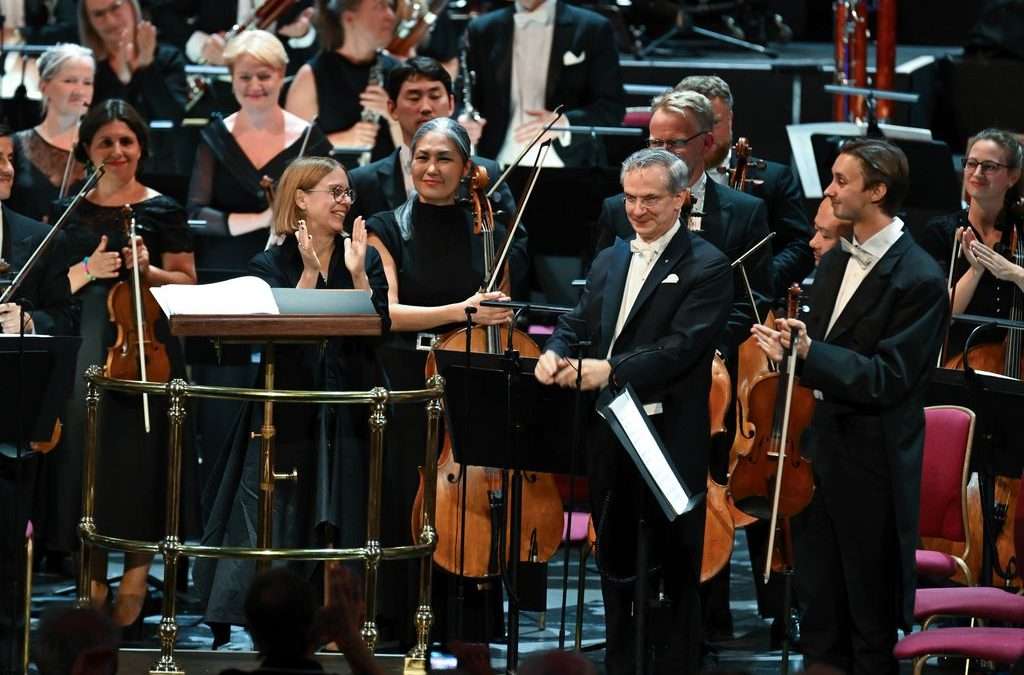
Celebrating their centenary this year, the Danish National Symphony Orchestra and chief conductor Fabio Luisi led us from the quiet of evening to the blazing light of a sunny morning in the course of this concert.

The challenge facing any concert programmer containing Beethoven’s Choral Symphony is how to lead up to it. This Prom approached from a contemporary angle, beginning in near silence with Bent Sørensen’s contemplative Evening Land. The Danish composer’s imaginative orchestration was key to the success of his picture painting, beautifully rendered by Luisi, as was the threadbare violin solo with which leader Christina Åstrand began. Childhood reminiscences of the Danish island Zealand took place in the half-light, contrasting with visions of nocturnal Manhattan that came through in bursts of technicolour, honouring Leonard Bernstein. Making a lasting impression, however, was the beautiful oboe solo from Kristine Vestergaard that marked the illness and subsequent passing of Sørensen’s father.

Having eavesdropped on this intimate opening piece, the Danish National Concert Choir rose for Anna Clyne’s musical account of the Covid pandemic – already consigned to history, it seems. Few people would like to revisit those days in a concert experience, but Clyne’s message – channelling the text of Stephanie Fleischmann – was one of underlying resilience. The choir began in stasis, occupying an added note chord which somehow drew parallels with the Björk song Possibly Maybe for this correspondent, before the piece flourished. A dreamlike mood was enhanced by a pure, almost complete lack of vibrato from both choir and orchestra, while the harmonic language drew strong parallels with the latter stages of Holst’s suite The PlanetsSaturn and Neptune in particular. An autumnal chill was evident in spite of increasingly frenetic activity in the orchestra, and the piece ended in an uneasy acceptance of events passed, rather like our own emergence from lockdown.
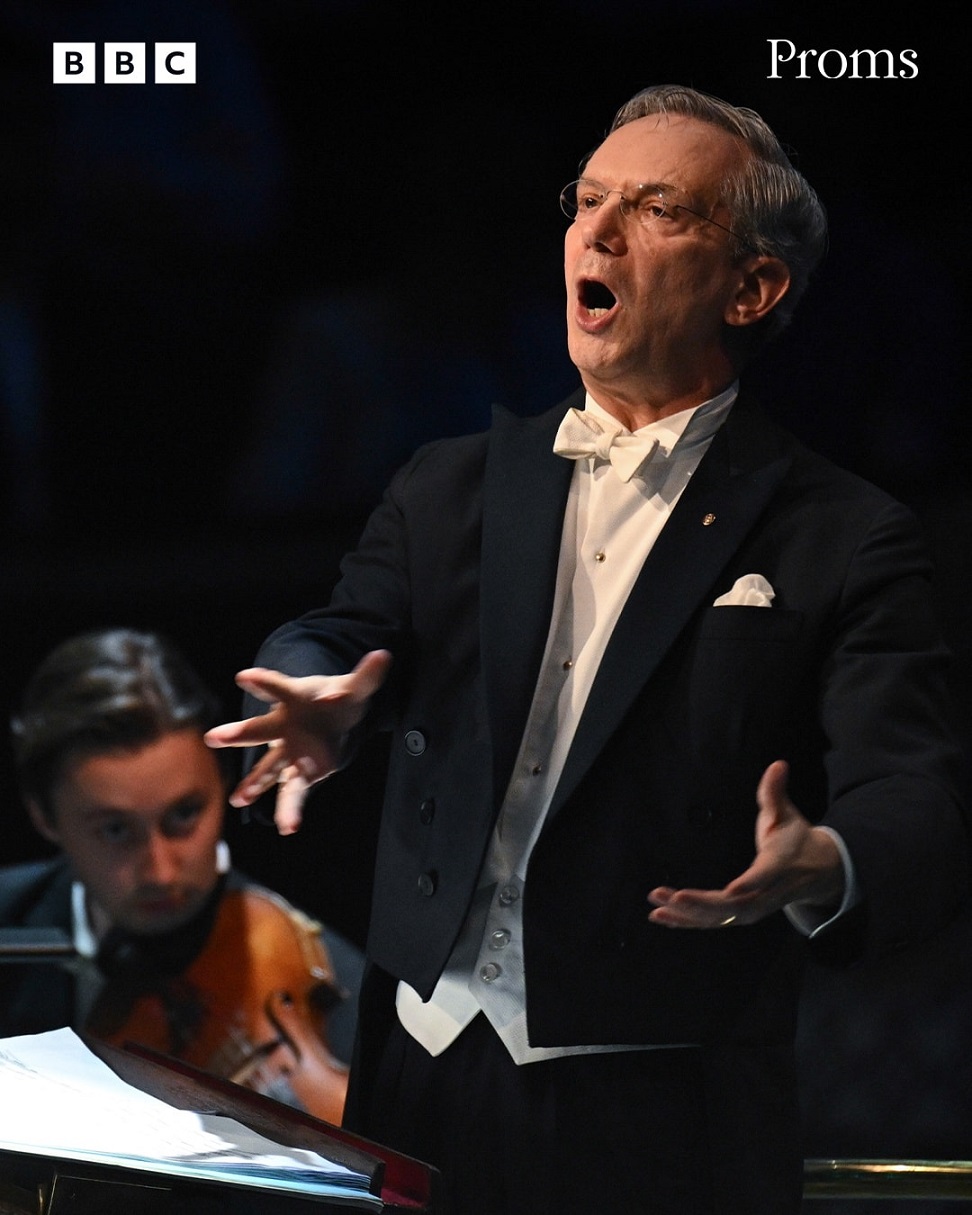
Beethoven’s Ninth Symphony is the ultimate hymn to freedom, though it does of course go through a titanic struggle before that release, in the form of Schiller’s Ode To Joy, can be attained. Luisi led us through the dark, pre-twilight moments in an account notable for its poise and guile. Using relatively fast speeds, the first movement took a little while to light the touch paper, but once ignited the music powered forward with increasing determination. The scherzo was quick, quite matter of fact with its timpani interventions, and balanced by a bucolic trio where the wind kept pace heroically with Luisi’s quick baton. Their attractive textures and warm melodic phrasing were a key feature of both this and the Adagio, again on the quick side, but managing its fanfare interventions impeccably.
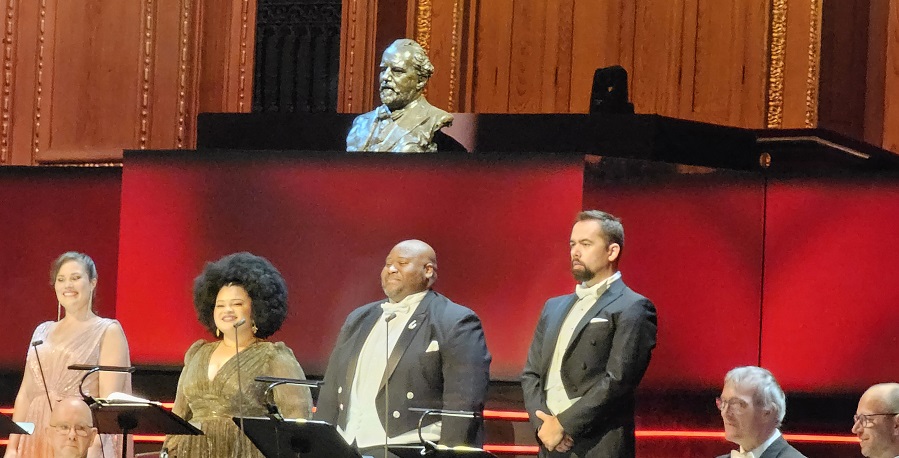
Left to right: Clara Cecile Thomsen (soprano), Jasmin White (contralto), Issachah Savage (tenor), Adam Palka (bass), beneath the bust of Sir Henry Wood @ BBC Proms

And so to the finale, with a memorable exposition for the Ode to Joy theme from sotto voce cellos and basses, the Royal Albert Hall hushed in anticipation. The choral passages were suitably exultant, the 75-strong choir drilled to perfection if cooler in temperature than the orchestra. The four soloists (above) were led by impressive bass Adam Palka, whose authoritative recitative “O Freunde, nicht diese Töne!” was a highlight, and while the quartet’s ensemble pieces wavered a little in tuning the sense of release and elation was keenly felt and clearly relished. The smile on the face of the music spread to the audience in the exhilarating closing bars as the orchestra took flight, completing an impeccably controlled interpretation on the part of Luisi that came to the boil at just the right time.

You can listen back to this Prom concert on BBC Sounds until Sunday 12 October.

Click to read more about the BBC Proms

Published post no.2,634 – Friday 22 August 2025

Award winner – Nielsen Symphonies conducted by Fabio Luisi

Yesterday we marvelled in the wonder of John Cage’s writing for choir, as highlighted in the Gramophone Awards on Wednesday. At the ceremony the magazine also named its Recording Of The Year, choosing Nielsen’s Symphony no.4 (the Inextinguishable) and no.5, as played by the Danish National Symphony Orchestra conducted by Fabio Luisi.

The choice is further evidence that Nielsen’s symphony cycle is acknowledged as one of the finest of the 20th century, having perhaps taken longer to reach its standing than other more immediate successes. You can listen to the recording below – while reading Richard Whitehouse’s verdict on all six symphonies, recorded by the same forces and reviewed on these pages.

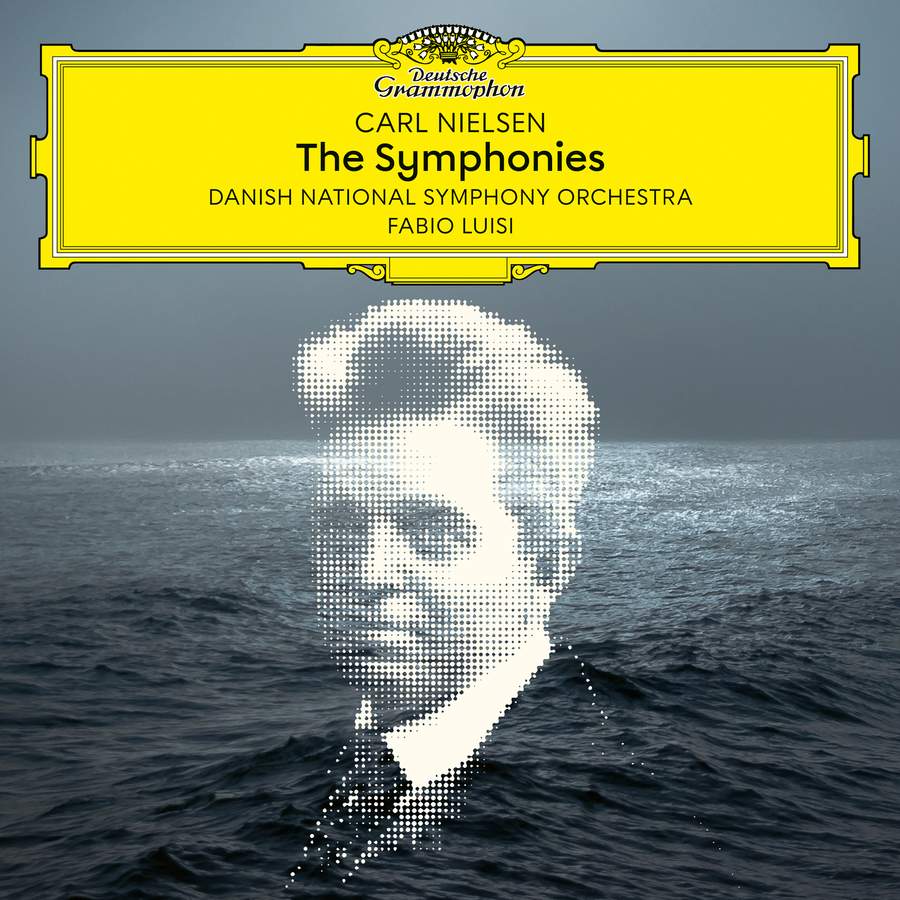
On record – Danish National Symphony Orchestra / Fabio Luisi – Nielsen: The Symphonies (Deutsche Grammophon)

Danish National Symphony Orchestra / Fabio Luisi with Fatma Said (soprano), Palle Knudsen (baritone) (Symphony no.3)

Nielsen
Symphonies: no.1 in G minor FS16a; no.2 FS29 ‘The Four Temperaments’b
no.3 FS60 ‘Sinfonia espansiva’c; no.4 FS76 ‘The Inextinguishable’d; no.5 FS97e; no.6 FS116 ‘Sinfonia semplice’f

Deutsche Grammophon 4863471 [3 hours 36 minutes]
Producer Bernhard Güttler; Engineers Mikkel Nymand, Christoph Stickel

Recorded in live performances at Koncertsalen, DR Koncerthuset, Copenhagen: 1 February (no.4), 3 February (no.2), 3 June (no.6), 17 June (no.1), 26 November (no.3), 28 November (no.5)

Written by Richard Whitehouse

What’s the story?

Deutsche Grammophon continues its latest generation of symphonic cycles (following those first-time traversals of Franz Schmidt and Charles Ives) with that from Carl Nielsen, performed by the Danish National Symphony Orchestra and its incumbent principal conductor Fabio Luisi.

Almost 50 years after the first integral recording of these symphonies (Ole Schmidt with the London Symphony Orchestra on Unicorn/Alto), there are at least 20 such cycles available so that any newcomer needs to bring a fresh perspective on Nielsen’s always distinctive though increasingly unpredictable fusion of innovation with tradition. This pairing of orchestra and conductor is intriguing insofar that the DNSO has been associated with these works from the outset, while Luisi is a musician of broad sympathies with cycles of symphonies by Schmidt (Querstand) and Schumann (Orfeo) plus an incomplete one of tone poems by Strauss (Sony). The result is a Nielsen cycle at times impressive in its conviction if at others dismaying in its inconsistency, and not always in those works or for those reasons one might have expected.

What’s the music like?

Luisi makes his intentions plain at the start of the First Symphony, its initial Allegro launched via an emphatic C major whose impetus is sustained through an impetuous development, with a remorseless acceleration into the implacable coda. Even finer is an Andante by turns elegant and eloquent, strings coming into their own, while only a marginal hesitancy as to the elision between scherzo and intermezzo affects its successor’s stealthy progress. Taut if not inflexible, the final Allegro has innate buoyancy capped with the uninhibited verve generated at its close.

If the Second Symphony is less successful, this is because Luisi does not transcend its status as a symphonic suite. The ‘choleric’ element of the opening Allegro verges on the histrionic, with the humour of the following intermezzo deadpan rather than ‘phlegmatic’. The Andante, though, is superbly sustained over its airily pastoral interlude towards an intensified recall of its ‘melancholic’ opening and coda of fatalistic poise. The ‘sanguine’ trait of the final Allegro is deftly undercut by musing uncertainty, but this yields a slightly tepid resolution in its coda.

Nothing comparable affects the Third Symphony, the ‘expansiveness’ of its opening Allegro abetted by visceral drive in its outer paragraphs and nuanced subtlety in its more speculative passages. The Andante’s interplay of the pastoral and emotional sees a rapturous apotheosis, soprano and baritone vocalises beguilingly intertwined, then the scherzo generates no mean energy prior to its restive ending. Luisi’s steady overall tempo for the final Allegro avoids sluggishness, and not least a coda the more conclusive for its eschewal of wanton triumph.

Despite a properly blazing start to the Fourth Symphony, its opening Allegro emerges as no more than the sum of some admittedly fine parts, with the charm of the ensuing intermezzo just a little too ‘knowing’. The highlight here is a slow movement of real fervency, its dense textures clearly articulated and a transition of simmering intensity into the finale’s headlong fugato on strings. Tension here is ably maintained, but Luisi’s holding back in its peroration replaces that striving onwards Nielsen surely intended with a more generalized affirmation.

This take on the Fifth Symphony is very much a tale of two parts. Luisi audibly locates the ‘tempo giusto’ for the first movement’s opening half – its increasingly ominous expectancy fulfilled in an Adagio of great pathos, albeit with a side-drum cadenza overly reined-in both texturally and emotionally. Too stolid a tempo for the second movement’s initial Allegro is exacerbated by its inhibited Presto, and though Luisi renders its Andante with compassion, his broadening towards the close of the final Allegro is too self-conscious to be convincing.

Is it surprising that the Sixth Symphony rounds off this cycle so perceptively? The complex array of emotions found in its opening movement yields the right ‘innocence to experience’ trajectory, with both the sardonic humour of its Humoreske and the fractured eloquence of its Proposta seria palpably conveyed. Above all, the finale’s outwardly fractious variations unfold with a seamlessness and an inevitability that makes of the coda a culmination whose outcome is held in check until the last bar. A still disputed masterpiece is hereby vindicated.

Does it all work?

Swings and roundabouts. There could be no doubt as to the seriousness with which Luisi has taken on this project, nor of the overall excellence of the DNSO’s playing. Where this cycle falls down is in a lack of focus across the whole, to the extent that there could have been two or even three conductors involved here. Moreover the orchestral sound, warm and immediate but often lacking definition or a consistent balance, feels appreciably different from what this ensemble produces in its home venue – leading one to suspect a modicum of post-production.

For CD adherents the fold-out triple pack is eminently stylish and straightforward, while Jens Cornelius’ note sets the scene adequately enough. The cycle is also available as three separate couplings of Nos. 4 and 5, Nos. 2 and 6 then Nos. 1 and 3 – with the three concertos to follow.

Is it recommended?

Yes, with qualifications. Prospective purchasers are advised to sample the cycle via streaming then proceed accordingly. Certainly, the Third and Sixth Symphonies rank with the finest now available, and listeners should form their own judgement as to the merits of this cycle overall.

Listen

Purchase

To explore purchasing options and hear clips from the recordings, visit the Deutsche Grammophon website. For more on the artists, click on the links to read more about Fatma Said, Palle Knudsen, the Danish National Symphony Orchestra and conductor Fabio Luisi

Under the Surface at the Proms – Nielsen and The Four Temperaments

Prom 38, 13 August 2015 – London Symphony Chorus Womens’ Voices, BBC Philharmonic Orchestra / Juanjo Mena at the Royal Albert Hall


Fabio Luisi conducts the Danish National Symphony Orchestra in Nielsen at the Royal Albert Hall. Photo (c) Chris Christodoulou

Helios Overture
http://www.bbc.co.uk/events/e4nrzc#b065xhdn

3 Motets, Hymnus Amoris and Symphony no.2, ‘The Four Temperaments’
http://www.bbc.co.uk/events/e4nrzc#b065xhds

The Proms and one of this year’s anniversary composers, the Dane Carl Nielsen, are still relatively new friends.

This is because Henry Wood and subsequent directors of the festival did not consider his music worthy of inclusion until very recently – and indeed the Second Symphony, heard in this Prom, was only receiving its second ever Proms performance.

It was the culmination of a thoroughly enjoyable evening that showed Nielsen in several forms. We experienced religious contemplation towards the end of his life in the 3 Motets of 1931, the flowering of spring and love in the Hymnus Amoris of 1897 and then entered the symphonic boxing ring – or so it felt – for the taut arguments of the symphony, modelled on The Four Temperaments. These performances were all authentic, given by the Danish National Vocal Ensemble, Symphony Chorus and Symphony Orchestra.

The evening began with a sunrise – a magical evocation conjured from almost total stillness by conductor Fabio Luisi. As the Helios Overture took shape he kept a close ear to the orchestral colour, and the shafts of sunlight grew ever stronger thanks to wonderful horn playing.

The 3 Motets were cooler, partly because the choir singing them was relatively small, but if anything this enhanced their purity. In this late trio of works Nielsen pays homage to the Renaissance composer Palestrina in a series of carefully woven lines, though there is room for instinctive joy too – as there was in the final motet, Benedictus Dominus. Yet it was the words of an old man that stuck in the memory from the first motet, Afflictus sum, with its translated text “I am feeble and sore broken”.

We then heard Hymnus Amoris, an early work begun by the brightly voiced Boy and Girl Choristers of Winchester Cathedral before blooming through two additional choirs, soprano and baritone soloists (David Danholt and Anna Lucia Richter) and orchestra. Essentially a journey through life, the 25-minute cantata has a healthy glow and pulse, its treble rich sounds bringing forward the promise of new life and love, despite the onset of old age towards the end. Ultimately triumphant, the work finished in a blaze of colour, following excellent solos from Richter in particular.

If the musical language here carried the enthusiasm of youth, the mood darkened appreciably for the symphony – and Luisi noticeably stepped up a gear in his conducting. Using a subject that has often appealed to classical composers, the Four Temperaments, Nielsen takes us on a voyage of very differing emotions, and Luisi ensured these were clearly signposted but also keenly felt.

The turbulent first movement (the Choleric temperament) has a lot going on, moving restlessly from one cadence to another, but it packs a punch and is ultimately a tale of resolve. The middle two movements (Phlegmatic and Melancholic) reveal more obviously vulnerable sides, and in the third there are dark clouds over the soul as the music spends much of its time brooding in a minor key.

There are tunes to be enjoyed, though, especially a winsome number in the second movement, and Nielsen’s development of his material is notable for its speed of thought. Several listens to each movement are recommended to get a feel for his style, but in the Second Symphony Nielsen really convinces with his emotional arguments. The final movement, Sanguine, is the culmination, telling the tale of struggles won and demons vanquished. In a performance as convincing as this it was easy to be won around, a task made even simpler by a charming encore, the Dance of the Cockerels from Nielsen’s opera Maskarade.

Want to hear more?

The obvious next port of call for Nielsen is his Fourth Symphony, the Inextinguishable – a powerful and hugely affirmative piece. It can be heard on Spotify here, with the San Francisco Symphony conducted by Herbert Blomstedt:

For the charming, rustic side to Nielsen’s character, the Wind Quintet is a charming place to start. Here it is as part of an all-Nielsen album from the Athena Ensemble:


The concert also included Nikolaj Znaider playing BrahmsViolin Concerto. More of that in a future post!

There will be more Under the Surface features as the Proms progress, exploring lesser known pieces and composers at the festival