In concert – Benjamin Grosvenor, CBSO / Marta Gardolińska: Mozart, Beethoven, Fanny Mendelssohn & Felix Mendelssohn

marta-gardolinska

Mozart Die Zauberflöte K620: Overture (1791)
Beethoven
Piano Concerto no.1 in C major Op.15 (1795, rev. 1800)
Fanny Mendelssohn
Overture in C major (1832)
Mendelssohn
Symphony no.4 in A major Op.90 ‘Italian’ (1833)

Benjamin Grosvenor (piano), City of Birmingham Symphony Orchestra / Marta Gardolińska

Symphony Hall, Birmingham
Wednesday 3 November 2021 (2.15pm)

Written by Richard Whitehouse. Picture of Benjamin Grosvenor (c) Andrej Grilc

Those having heard Gustavo Dudamel’s recent Ives cycle will know of Marta Gardolińska’s role in the success of the Fourth Symphony, with her similarly methodical attention to detail being evident in this afternoon’s concert with the City of Birmingham Symphony Orchestra.

An avowedly Classical concert it may have been, but an artfully programmed one. Certainly, it was refreshing these days to hear the introduction of Mozart’s Overture to The Magic Flute given with this degree of gravitas, followed by a purposeful take on the main allegro such as brought out the music’s verve along with an onward striving apposite given its indebtedness to the ideals of the Enlightenment. The CBSO itself sounded wholly enthused in what was as purposeful and as immediate an account of this piece as it can have given in recent seasons.

It also prepared admirably for Beethoven’s First Piano Concerto with Benjamin Grosvenor (above). The latter has often sounded unduly self-effacing in the concerto repertoire, but this work fits his temperament to a tee – not least its initial Allegro, whose alternating of bravura with more equivocal expression included an electrifying transition to the reprise then nonchalant take on what is the second (c1805), shortest and contextually most satisfying of the composer’s three cadenzas. Neither was there any lack of eloquence in a Largo such as ranks among the most affecting of Beethoven’s earlier slow movements, while a headlong if never hectic tempo for the final Rondo enabled Grosvenor to instil his last entry with a poise as made the orchestral payoff the more conclusive. A fine performance which inevitably brought the house down.

Grosvenor returned for an affecting encore of Danza de la Moza Donosa – second of three Danzas Argentinas by Alberto Ginastera (maybe Grosvenor will investigate one or other of his piano concertos one day?). There was further unfamiliar fare after the interval, with an Overture by Fanny Mendelssohn. Her only completed orchestral work, its formal cohesion and technical finesse indicate what might have been possible under different circumstances, not least when Gardolińska drew such committed and characterful playing from the CBSO.

There cannot have been a time when Felix Mendelssohn’s Italian Symphony was unpopular in Birmingham and so it proved here. As has become customary, Gardolińska (rightly) observed the first movement’s exposition repeat, with its substantial lead-in, in what was otherwise an unexceptionally fine account of this opening Allegro. More individuality came through in the Andante, not least with its quirkily understated interplay between pedantry and pathos, while the intermezzo was more than usually arresting for the distinction made between its elegant outer sections and a trenchant, often combative trio. The ensuing Saltarello rounded off this performance in bracing fashion – those rhythmic contrasts between its main and second ‘tarantella’ themes vividly brought out on the way to a conclusion of no-nonsense finality.

This appealing programme was enthusiastically received by the fullest house the CBSO had enjoyed since live music-making resumed. Symphony Hall will hopefully be as well attended this Saturday, when Mirga Gražinytė-Tyla returns for the commemorative A Covid Requiem.

Further information on the CBSO’s current season can be found at the orchestra’s website. For more on Marta Gardolińska, click here – and for more on Benjamin Grosvenor, head to the pianist’s website

CBSO players perform the Allegretto from Fanny Mendelssohn’s String Quartet in E flat here:
In concert – Alexander Sitkovetsky, English Symphony Orchestra / Kenneth Woods: Beethoven in Hereford

alexander-sitkovetsky

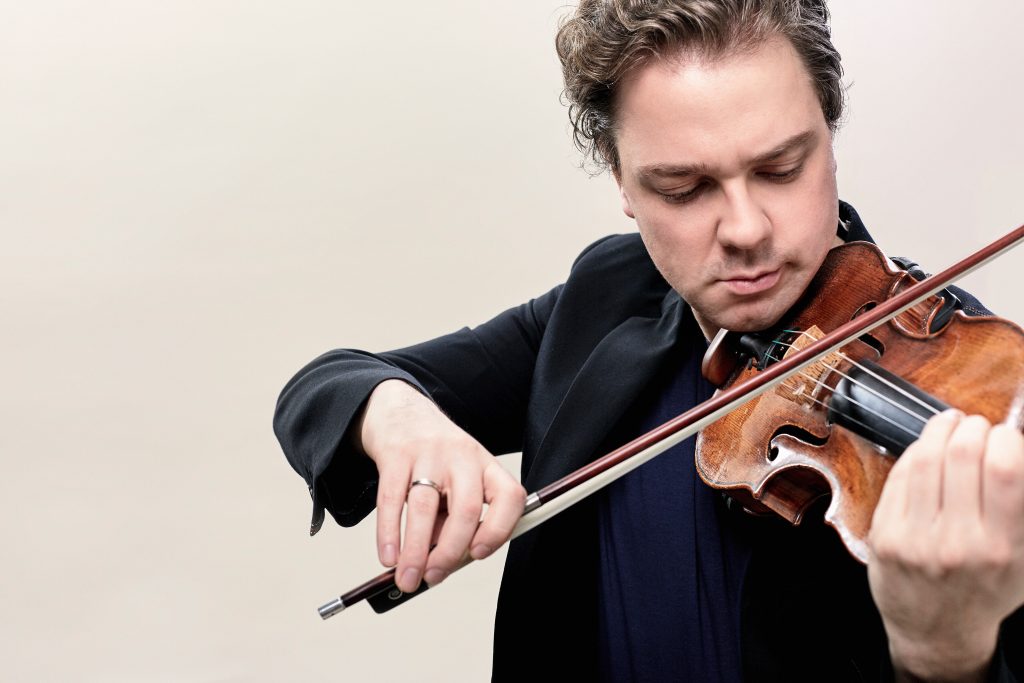
Alexander Sitkovetsky (violin, above), English Symphony Orchestra / Kenneth Woods

Mendelssohn Symphony no.4 in A major Op.90 ‘Italian’ (1833 rev.1834)
Carwithen arr. Woods
: Lento for Strings (1945 arr. 2020)
Beethoven
Violin Concerto in D major Op.61 (1806)

St. Peter’s Church, Hereford
Sunday 26 July 2021 (3.30pm) (Concert reviewed online via ESO Digital)

Written by Richard Whitehouse

For this first concert in its 2021/22 season, the English Symphony Orchestra was heard at St. Peter’s Church, Hereford in a concert combining familiar classics with an arrangement of the kind that has been a hallmark of its programming under principal conductor Kenneth Woods.

The piece in question was a Lento for Strings that began as the slow movement of the First Quartet by Doreen Carwithen. Although she left a notable output of concert and film music, Carwithen (1922-2003) is remembered mainly through her association with William Alwyn – being his amanuensis from 1961 and second wife from 1975 for the final decade of his life. At the time of this quartet, she was a promising composer in her own right, as confirmed by Woods’s adaptation of the slow movement so that its prevailing intimacy and introspection lose none of their acuity. The ESO played it with requisite poise and finesse, not least those plangent solos for viola and violin that were eloquently rendered here by Matt Maguire and Kate Suthers, thereby resulting in an atmospheric miniature which warrants frequent revival.

Mendelssohn was just a year older when he completed his Italian symphony, long among his most popular works even if heard a mere handful of times then withheld from publication in his lifetime. Maybe the touristic nature of its conception or its unlikely tonal trajectory (A to A minor) created issues he was unable to resolve, but in creating this symphonic suite he had unconsciously set a precedent. Woods undoubtedly had its measure – whether in an Allegro (exposition repeat included) whose joyousness did not exclude more combative energy from its development and coda, an Andante whose journeying pilgrims were evoked with no little pathos, an intermezzo deftly revisiting the wide-eyed enchantment of the composer’s youth, or a finale whose interplay of saltarello and tarantella rhythms surged on to a decisive close.

Beethoven’s Violin Concerto is one of a select few in its genre whose weight and substance justifies its occupying the whole second half. Alexander Sitkovetsky responded accordingly – the opening movement long-breathed but sustaining itself at least until the latter stages of the development, when a sense of expectancy rather failed to materialize. Momentum picked up thereafter, not least during a finely projected account of the (Kreisler) cadenza whose tensile rhetoric subsequently made the orchestra’s heartfelt re-entry in the coda seem more telling.

The highlight of this performance came with the Larghetto, slower than is often now the case but its sequence of variations melding into each other with seamless elegance, with a rapport between soloist and conductor at its most tangible in the theme’s hushed reiteration prior to a spirited transition into the Rondo. This did not lack for impetus, and if Sitkovetsky was most perceptive in the intervening episodes, the anticipation generated as the main theme steals in on the approach to the final tutti carried through to the nonchalant pay-off of the closing bars. An appealing and enjoyable concert in which, moreover, the ESO sounded not at all fazed by the vagaries of the acoustic. It continues its current schedule on October 10th with music by Mendelssohn, Mozart and Schubert – plus a mystery piece ‘‘to be announced on the night’’!

Further information on the ESO’s next concert can be found at their website. For more on Doreen Carwithen, visit the MusicWeb International page here

On record – Villa-Lobos: Choral Transcriptions (São Paulo Symphony Choir / Valentina Peleggi) (Naxos)

villa-lobos

Villa-Lobos transcriptions of:

Bach Prelude and Fugue no.8 in E flat minor / D sharp minor BWV853, Prelude no.14 in F sharp minor BWV883; Fugues – no.1 in C major, BWV846; no.5 in D major, BWV874; no.21 in B flat major, BWV866; no. 22 in B flat minor BWV867
Beethoven Adagio cantabile Op.13/2
Chopin Waltz no.7 in C sharp minor Op.64/2
Massenet Élégie Op.10/5
Mendelssohn Lieder ohne Worte in E major Op.30/3
Rachmaninov Prelude in C sharp minor Op.3/2
Schubert Ständchen D957/3
Schumann Träumerei Op.15/7
Villa-Lobos Bachianas Brasileiras no.9 W449

São Paulo Symphony Choir / Valentina Peleggi

Naxos 8.574286 [58’32”] English and Portuguese translations included

Producer Ulrich Schneider
Engineers Marcio Jesus Torres, Camilla Braga Marciano, Fabio Myiahara

Recorded: 5-10 August 2019 at Sala São Paulo, Brazil

Written by Richard Whitehouse

What’s the story?

Naxos’s coverage of the music of Heitor Villa-Lobos (part of this label’s series The Music of Brazil) continues with a selection of mainly transcriptions from the piano repertoire that the composer undertook during the mid-1930s as part of his extensive educational commitments.

What’s the music like?

Almost all these arrangements emerged in the period 1932-5, when Villa-Lobos took on the challenge of overhauling music education in the public school system of Rio de Janeiro. This involved the creation, virtually from scratch, of a choral pedagogy that he drew from across the spectrum of Baroque, Classical and Romantic music. It is a measure of his prowess that such transformation from mostly piano sources was accomplished with unfailing rigour and an idiomatic quality, so the fame of the originals is almost the only clue to their provenance.

From the soulful strains of among the most mellifluous from Mendelssohn’s Songs without Words, the programme then continues with the Eighth Prelude and Fugue from the first book of Bach’s The Well-Tempered Clavier – the former piece summoning a plangently rhetorical response which finds pertinent contrast with the latter piece’s methodical and intricate build-up to a culmination of sombre eloquence. The arrangement of Dreaming from Schumann’s Scenes from Childhood fully conveys its wistful pathos, as does that of the First Fugue from Bach’s WTC the original’s cool elegance. Similarly, the last of Schubert’s Serenade settings loses little of this song’s plaintiveness, and the Twenty-First Fugue from Bach’s WTC takes on unexpected jauntiness in what proves one of Villa-Lobos’s most inspiriting re-creations.

Chopin’s Waltzes might be considered unsuited to the vocal medium, yet the C sharp minor responds ably to such elaboration, as too the ruminative calm of the Twenty-Second Prelude from Bach’s WTC. Rachmaninov might have thought better of his Prelude in C sharp minor had he encountered this uninhibitedly dramatic realization, with basses providing the baleful anchorage, in contrast to the yearning aura drawn from the Fourteenth Prelude of the second book from Bach’s WTC. Massenet’s Elegy exceeds the original song for bittersweet poise, a foil to the serenity of the Fifth Fugue from Bach’s WTC. The indelible main melody from the Adagio of Beethoven’s Pathétique segues ideally into the Ninth Bachianas Brasileiras, with Villa-Lobos’s choral incarnation rather more atmospheric and evocative than that for strings.

Does it all work?

Almost entirely and due in no small part to the excellence of the São Paulo Symphonic Choir with its Italian conductor Valentina Peleggi. Lasting just under 60 minutes, the selection feels varied yet also cohesive enough to be enjoyed as a continuous programme, while enterprising choirs from both sides of the Atlantic ought to find much here to enrich their existing rosters. Inclusion of Villa-Lobos’s own music at the close is a reminder its technical demands should never be taken for granted, but here too the SPSC rises to the challenge with unstinting verve.

Is it recommended?

It is. The acoustic is just a little reverberant at times yet without detriment to the clarity of the choral writing, with informative annotations from Manoel Corrêa do Lago. Listeners should also investigate a recent Naxos release of Villa-Lobos’s first three violin sonatas (8.574310).

Listen

Buy

You can discover more about this release at the Naxos website, and you can also purchase the recording here. You can read more about conductor Valentina Peleggi here

BBC Proms – Sayaka Shoji, RPO / Petrenko: Vaughan Williams, Respighi & Mendelssohn

vasily-petrenko

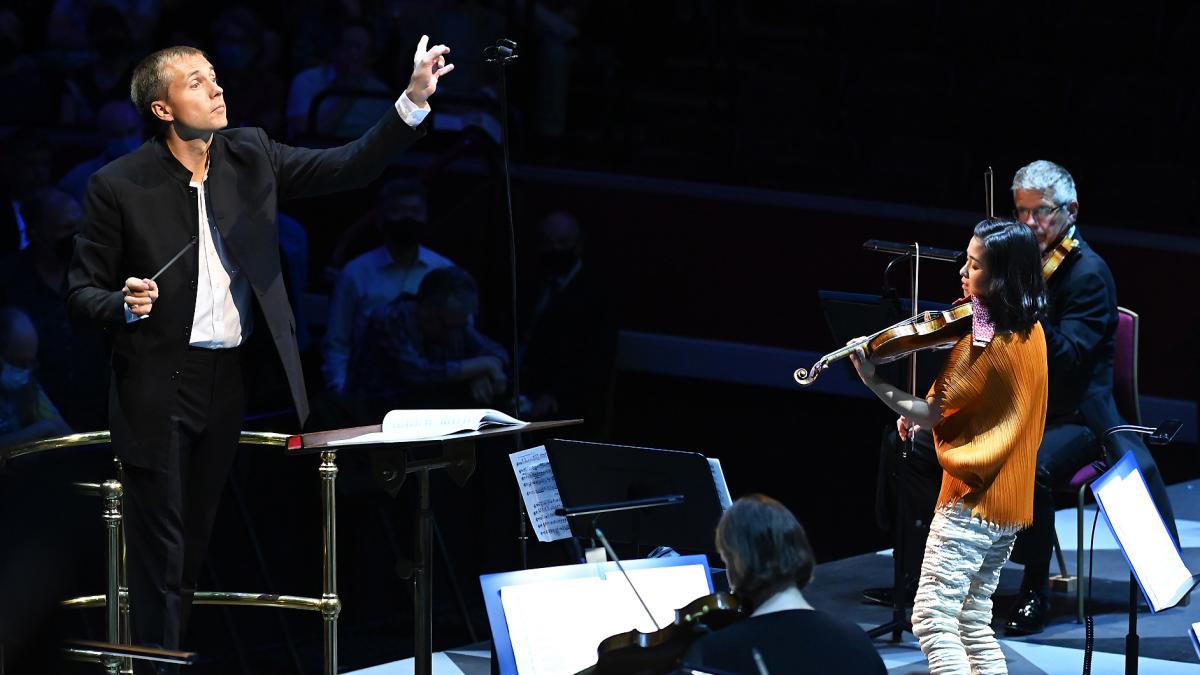
Sayaka Shoji (violin, below), Royal Philharmonic Orchestra / Vasily Petrenko (above)

Vaughan Williams Fantasia on a Theme by Thomas Tallis (1910)
Respighi
Concerto gregoriano (1921)
Mendelssohn
Symphony no.5 in D minor Op.107 (1830)

Royal Albert Hall, London
Wednesday 4 August 2021

Written by Ben Hogwood

A fascinating concert, notable on several counts. It marked the first Prom for Vasily Petrenko, recently transferred from Liverpool, in his new role as the Royal Philharmonic Orchestra’s music director. It featured three works paying tribute to a distant musical past – Vaughan Williams, Respighi and Mendelssohn expressing their admiration in very different ways. By way of an aside, it was your correspondent’s first live music in 17 months. A happy experience indeed!

In a sense my ears were in alignment with those who would have been at Gloucester Cathedral on 6 September 1910, for the world premiere of Vaughan Williams’ Fantasia on a theme by Thomas Tallis. The Royal Albert Hall, in its current reduced capacity, offered a similar acoustic, suitable for a performance where the quietest statements could be clearly heard. In the wake of a pandemic, this was wholly appropriate music to be listening to.

The Fantasia is written for two string orchestras, the second of which, nine players strong, might normally be distributed high in the gallery. Here they were positioned on stage, upper left from the conductor’s viewpoint, and projected beautifully to the back of the arena. Petrenko did not linger over the serenity of the opening, but allowed Vaughan Williams’ invention plenty of space to breathe as the Fantasia formed. A sensitive audience ensured every little nuance could be heard, and the RPO strings – in particular the solo quartet within the main orchestra – played beautifully. Petrenko has recorded a good deal of Elgar with the Royal Liverpool Philharmonic, so it will be interesting to see if he decides to look at Vaughan Williams in equivalent detail.

There followed a Proms premiere of a work written 100 years ago. As David Gutman’s excellent programme footnotes pointed out, Respighi has not enjoyed good representation at the festival over the years, and in general his music still languishes in the repertoire. This first account of the Concerto gregoriano could hardly have been more persuasive, with a passionate advocate in violin soloist Sayaka Shoji, who quarantined on her arrival in the UK prior to this performance. Respighi was a violinist, writing with skill for the instrument, but chose not to use this concerto as a display piece. Rather he paid homage to the Gregorian chants with which he had had been preoccupied in recent years, and he used these as the basis for a piece containing some particularly lush harmonies and idiosyncratic rhythms.

This was a compelling performance, Shoji soon into her groove and leading with faultless intonation in the high passages of the slow movement, carrying beautifully into the wide open spaces of the hall. She was aided by the horns and trombones of the RPO, positioned along the back of the orchestra, the punctuation of harp and celesta adding glitter to the edge of the sound.

The first movement found nicely judged contributions from oboe (John Roberts) and cor anglais (Patrick Flanaghan), with a sheen from the strings not unlike that of the Vaughan Williams. The third movement presented faster music and a greater sense of drama from its main theme, the brass again involved. This pulled back to peaceful climes, and a recap of the second movement material. Concerto gregoriano was certainly a work benefiting from a live performance, deserving of a higher profile.

Shoji was a sensitive performer, allowing Respighi’s music star billing, a sign of her maturity as a soloist. She also chose a wholly appropriate encore, the soft pizzicato beginning the Sarabande from Ysaÿe’s Sonata for solo violin no.4 (À Fritz Kreisler) the only audible noise in a rapt hall.

Mendelssohn wrote his Reformation symphony in 1830, making it the second in his output chronologically, but it was not published until long after his death. He appears not to have been wholly satisfied with it, leaving it unperformed. It carries a powerful impact, anticipating Schumann’s own D minor symphony (no.4) while including the Lutheran chorale Ein feste Burg ist unser Gott (A mighty fortress is our God). In this the composer, perhaps inevitably, was including Bach in his homage.

Petrenko had the work’s measure, leading us straight into the ‘sturm und drang’ of the first movement with its grim, D minor struggles. They were captivating, especially at the end of the introduction when rapt strings introduced the ‘Dresden Amen’, a striking alternative to the flurry of activity around them. The second movement had an attractive lilt, the third a nicely poised subject, before flautist Emer McDonough gave an impeccable solo to lead us into the finale. It fell to her to present the chorale theme, taken up with greater number and power by the rest of the orchestra. The mood turned from struggle to victory. Petrenko’s pacing was ideal, as was the phrasing, while the final reverberations of the chorale were more than sufficient in lieu of an encore.

This was a very fine if slightly understated first Prom for the RPO conductor in his new role, bringing the ideal combination of new and familiar. The orchestra appear to be in very good hands.

You can listen to a playlist of the works featured in this concert, including the violin encore, on Spotify below:

You can find more information on the BBC Proms at the festival’s homepage

In concert – Jonathan Martindale, CBSO / Michael Seal: Summer Classics

michael-seal

Jonathan Martindale (violin, below), City of Birmingham Symphony Orchestra / Michael Seal (above)

Dvořák Carnival Op.92 (1891)
Vaughan Williams
The Lark Ascending (1914/20)
Elgar
Chanson de matin Op.15/2 (1889)
Grieg
Peer Gynt Suite no.1 Op.46 (1875/88) – no.1, Morning; no.4, In the Hall of the Mountain King
Mendelssohn
A Midsummer Night’s Dream Op.21 (1826)
Vivaldi
The Four Seasons Op.8 (1718/20) – no.2 in G minor RV315 ‘Summer’
Price
Symphony no.1 in E minor (1931-2) – Juba Dance
Tchaikovsky
The Nutcracker Op.71 (1892) – Waltz of the Flowers

Symphony Hall, Birmingham
Friday 2 July 2021 (2pm)

Written by Richard Whitehouse Photo of Jonathan Martindale courtesy of Upstream Photography

The penultimate event in the City of Birmingham Symphony Orchestra’s current season, this afternoon’s Summer Classics featured a wide-ranging selection of pieces that between them spanned over two centuries, and whose ‘feel good’ factor at no time precluded stylish or committed playing.

With longstanding associate director Michael Seal at the helm, the orchestra made the most of Dvořák’s effervescent Carnival overture; the alluring pathos of its central interlude accorded due emphasis, and with some eloquent woodwind solos. Its popularity during recent years has made Vaughan Williams’s The Lark Ascending a regular inclusion in such programmes, and Jonathan Martindale (below, who also led the concert) gave a thoughtful while never flaccid reading – most perceptive in the middle section with its folk-like whimsy and fanciful evocations of birdsong. The CBSO responded with limpid dexterity, the whole performance a reminder that this work is best tackled as a concertante piece and by a player (recalling such as Hugh Bean, Iona Brown and, more recently, Richard Tognetti) who knows the orchestra from the inside.

Next came an ingratiating take on Elgar evergreen Chanson de matin, then excerpts from the First Suite of Grieg’s incidental music to Peer Gynt – a rapturous Morning and stealthy In the Hall of the Mountain King skirting headlong terror at the close. Mendelssohn’s overture to A Midsummer Night’s Dream made for an unlikely but effective centrepiece – the highlight being those fugitive imaginings towards its centre, along with the disarming eloquence of its final bars where the teenage composer conjures a fulfilment he was only rarely to recapture.

The Summer concerto from Vivaldi’s The Four Seasons again saw Martindale as soloist in an account that lacked little of that rhythmic vitality his contemporaries (notably Bach) seized on with alacrity; nor was there any absence of poise in its atmospheric second movement. One who has come in from the cold partly through the recovery of her manuscripts, Chicago-based Florence Price broke with convention by introducing the Juba Dance into her symphonies in lieu of a scherzo; the CBSO responding in full measure to its rhythmic verve. A winning harp solo from Katherine Thomas launched Waltz of the Flowers from Tchaikovsky’s ballet The Nutcracker and ended the main programme in fine style – Seal and the CBSO acknowledging the applause with the final ‘galop’ from Rossini’s William Tell overture as a dashing encore.

Throughout the concert, film expert Andrew Collins interspersed proceedings with his remarks and recollections (not least on that seminal 1970s supergroup The Wombles). The music itself was accompanied by varying shades and colours of lighting, but these rarely seemed intrusive – not least compared to the garish ‘Moulin Rouge’ effects routinely encountered nowadays at the Proms. Certainly, anyone in the process of getting the know just what classical music was all about, and those merely in search of a pleasurable afternoon’s listening, were well served.

Next Wednesday brings the last in this current series of concerts, the CBSO being conducted by Joshua Weilerstein (who is replacing an ‘unable to travel’ Edward Gardner) in an enticing programme of Judith Weir, Prokofiev (with the violinist Alina Ibragimova) and Beethoven.

You can find information on the final concert in the CBSO’s season at their website. For more information on composer Florence Price, click here