Elias String Quartet (above – Sara Bitlloch, Donald Grant (violins), Robin Ireland (viola), Marie Bitlloch (cello)); Navarra String Quartet (below – Magnus Johnston, Marije Johnston (violins), Rebecca Jones (viola), Brian O’Kane (cello)
Beamish String Quartet no.3, ‘Reed Stanzas’ (2011) (5:25-20:49) (Elias Quartet only) Mendelssohn Octet in E flat major Op.20 (1825) (27:02-58:58)
Wigmore Hall, London; Monday 25 June 2018
You can listen to the BBC Radio 3 broadcast by clicking here
Written by Ben Hogwood
You would do well to find a really quiet spot before listening to this concert. That is because Sally Beamish’s String Quartet no.3, written for a first performance at the BBC Proms in 2011, begins with a distant offstage violin solo.
In her work Beamish is tapping heavily into the folksongs of the Hebrides, and the Elias Quartet second violinist Donald Grant, well versed in that literature, is an ideal player to begin the work (from 5:25), with all the inflections the style of writing brings. As the ensemble join nearly two minutes later Beamish’s harmonic workings become clearer, but the distinctive folk melody continues to pull the ear.
A set of ‘stanzas’ provide development and variations on the theme, with the one from 8:15 changing the mood considerably from wide open to closed in. From 11:25 violin and cello join in a duet, before the music breaks into a quicker and much more assertive section. Then after some pretty frenetic dialogue, the mood cuts once again towards that of the opening, moving back towards the original folk melody, which subsides to silence once again.
The performance here was an intense one, its colours and harmonies showing a clear debt to Britten, whose quartets Beamish was listening to at the time. Yet there is no fully blown pastiche here, with a distinctive style of quartet writing that stays very open and direct in its communication. It was great to see Sally Beamish in the audience.
The Elias Quartet were then doubled in number by the Navarra Quartet to play one of Mendelssohn’s many early chamber music masterpieces. The Octet is a real one-off, mastering a form few composers since have managed to achieve. It is all the more remarkable when you consider Mendelssohn completed the work at the age of just 16!
The piece begins with typically youthful Mendelssohn qualities of enthusiasm and vigour, but with a melody that immediately sticks in the head (from 27:02-41:02). The second theme (29:07) is a nice complement, serene and thoughtful. What really stands out is the fullness of texture when compared to the string quartet before, Mendelssohn beefing up the sound with the two cellos and violas at the lower end in particular. Yet he thinks nothing of changing the mood quite considerably in the course of the first movement, with a sudden vulnerability introduced around 35:50 that checks the positive thoughts around it – until a rush back to the original theme.
The second movement (from 41:30-48:18)) is a slow Andante, and it exploits the uncertainty briefly aired in the first with a darker outlook but also a romantic sense of longing. It too thinks nothing of moving to a faster section, quite a fraught exchange of ideas.
The third movement scherzo (48:39) is the most celebrated of the four movements, containing strong pointers towards Mendelssohn’s Shakespearian music, and especially the Scherzo from A Midsummer Night’s Dream. This one too is fleet of foot, with silvery shadows darting around the texture all the way through to the end at 53:03. At this point we surged into the finale, a thrilling dialogue between the four different sections of instruments (two lots of violins, violas and cellos) before a sweep to the finish at 58:58.
This was an excellent, joyous performance from the two ensembles, even if just occasionally it had too firm a foot on the accelerator pedal, with some of the tuning in the first movement going slightly awry as the ensembles pushed further forwards.
Further listening
There are no recordings currently available of Reed Stanzas, though a natural progression for further listening is a disc containing Beamish’s first two string quartets:
If the Mendelssohn appeals, this version from the Academy of St. Martin-in-the-Fields Chamber Ensemble combines the Octet with a much later work, the wonderful and underrated String Quintet no.2:
For more early Mendelssohn, you simply have to try the amazing Piano Quartets, written when the composer was just 14, and showing an uncommon mastery of writing dramatic music for the piano:
Fatma Said (soprano, above), James Vaughan (piano, below)
Schumann 6 Gesänge Op. 89 (1850); Singet nicht in Trauertönen Op.98a/7, Liebeslied Op.51/5 (both 1849), Requiem Op.90/7 (1850) Mendelssohn Die Liebende schreibt Op.86/3 (1831), Ach, um deine feuchten Schwinge (Suleika) Op.34/4 (1837), Hexenlied Op.8/8 (1827) Poulenc Les chemins de l’amour, from Léocadia (1940), 2 poèmes de Louis Aragon (1943) Sherif Mohie El Din Three Poems by Amal Donqul (1989)
Wigmore Hall, London; Monday 15 January 2018
Written by Ben Hogwood
The broadcast can be heard on the BBC iPlayer by clicking here
As a demonstration of artistry, this was quite some Wigmore Hall debut for soprano Fatma Said, a BBC Radio 3 New Generation Artist. The Egyptian singer used four languages in the course of an hour, and showed an aptitude for contrasting musical styles in a cleverly constructed programme.
It was good to hear less familiar Schumann songs as a starting group (from 1:32 on the broadcast) The set of six, published as Op.89, were written in the composer’s second ‘year of song’, the productive 1850. They set words by Wilfriend von der Nenn (a pseudonym for Wilhelm Schöpf), and show off an economy and intensity of word setting, with none lasting more than two minutes.
Said caught the agitation running through Es stürmet am Abendhimmel (There are storms in the evening sky) (1:32), set up by a wonderfully turbulent introduction from the excellent James Vaughan. A flowing Heimliches Verschwinden (Stealthy departure) (3:07) led to the yearning harmonies of Herbstlied (Autumn song) (5:12), then the softer hearted Abschied vom Walde (Farewell to the forest) (7:38). Both performers threw wide the curtains for a bracing Ins Freie (Out in the open) (9:45), before Röselein, Röselein! (Rose, little rose) (11:54) began with a striking solo, setting its dreamy mood.
A group of three more Schumann songs followed, the bright and carefree Singet nicht in Trauertönen (Do not sing in mournful tones) (15:20) leading to Liebeslied (Love Song), where there was a nice rapport from both performers in the song’s ebb and flow (17:38). Requiem (19:46) had a restrained and respectful air.
Mendelssohn’s songs are less-often heard, but carry melodic invention along with often incredibly challenging piano parts! A thoughtful Die Liebende schreibt (The beloved writes) (24:55) and the more urgent Ach, um deine feuchten Schwingen (Ah, West Wind, how I envy you) (27:51) were nicely done, but the Hexenlied (Witches’ song) (30:34) was something else, the high notes nailed impressively by Said while Vaughan handled the flurry of notes with apparent ease.
The pair then turned to Poulenc, whose songs are the jewel in the crown of his musical output. We heard three brief but meaningful numbers, Les chemins de l’amour (The paths of love) (34:44) caught the efforts to stay cheerful despite the approach of World War II in 1940, while C (38:51) dealt with the immediate and horrific aftermath. Fêtes galantes (41:40) was a bit too breathless, but maybe that was the point as it raised a laugh!
Said then turned to ‘home away from home’, introducing three songs by Egyptian composer Sherif Mohie El Din, a welcome move that introduced a new sound world to the Wigmore Hall as well as showing the soprano’s clear passion for music and words of her first language.
The musical depiction of The Rain (from 44:22) was vivid and featured well-placed silences, the piano part enhancing the effect of raindrops. Could the river flow forever (46:50) had darker shading, while the final Against whom? (49:57) was a tortuous and anguished study of feelings felt during surgery.
The performers generously gave us two encores – a further Egyptian song, Daughter of the Sultan by Gamal Abdel-Rahim (54:41) and then, after the radio went off air, Old Sir Faulk by Sir William Walton, with accompanying gestures from the soprano.
This emphasised how at home she is on the stage, and capped an extremely impressive and enjoyable recital, where a blend of musicianship and communication of the messages behind the text was always the primary goal. Both performers succeeded comfortably.
Further listening
You can listen to recorded versions of the repertoire in this concert on this Spotify playlist, apart from the Sherif Mohie Eldin songs which are not on the streaming service:
Meanwhile here is a link to the Sherif Mohie Eldin official YouTube page, including the three poems performed in the concert:
Michael Haydn Violin Concerto in G major (c1757-64) Mendelssohn String Symphony no.10 in B minor (1823) Mendelssohn Violin Concerto in D minor (1822)
Wigmore Hall, London; Tuesday 7 November 2017
Written by Ben Hogwood
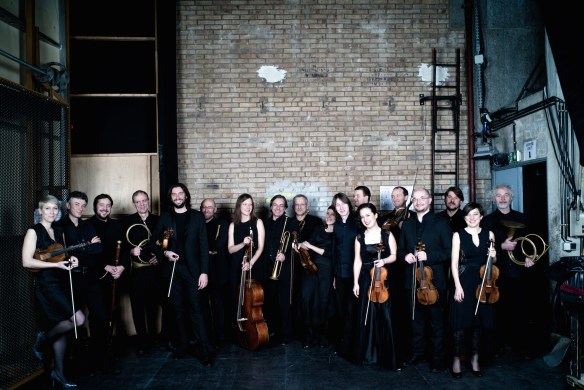
A relatively rare Tuesday lunchtime treat from the Wigmore Hall took the form of an hour of music from the late classical period from Il Pomo d’Oro, their concertmaster Federico Guglielmo and violinist Alina Ibragimova.
It would have been all too easy for them to program Mendelssohn’s much-loved Violin Concerto in E minor as the main work, but Ibragimova has a special affinity with a much earlier work in the same form. The Violin Concerto in D minor, accompanied by a smaller force of string orchestra, was written when the composer was just 13, and is a spiky, energetic piece channeling the spirit of C.P.E. Bach’s ‘Sturm und Drang’ period from the 1770s.
In this performance the notes fairly leapt from the page, with quick tempo choices demanding and receiving dextrous fingerwork from all the string players. Il Pomo d’Oro were an equal match for Ibragimova’s pyrotechnics, which were delivered with deceptive calm but communicated the passionate music within the fast movements. A sanguine slow movement offered sunnier, breezier climes before the energetic finale took a catchy tune and spun it so that Mendelssohn’s melodic invention stayed rooted in the mind long after the concert.
Providing a rather lovely contrast was the Violin Concerto in G major from Michael Haydn, Franz Joseph’s older brother. Often the poor musical relation of the family, he nonetheless wrote some fine works himself, particularly in the choral field, with memory recalling a fine Requiem performed relatively recently by the King’s Consort at the BBC Proms.
This performance at the Wigmore Hall was notable for its lively interplay and distinctive melodies, and the interactions between violinist and orchestra showed their mutual enjoyment of Haydn’s music, especially in the jaunty finale. Here Ibragimova took the lead, as she did in the aria-like slow movement, where the violin sang more graciously, ideal in the hall’s acoustic.
Between the two concertos we heard the String Symphony no.10 in B minor, another remarkable example of Mendelssohn’s promise as a teenager. This one was written a year after the Violin Concerto, and quite how a teenager could achieve such an assured standard with such substantial melodies remains a mystery! The language again is direct, as are all the minor key works from this period. Il Pomo d’Oro played with poise and guile, paying sensitive attention to their melodic phrasing through selective vibrato, led by Guglielmo. It helped define their colourful sound, a complete rebuff to those who might suggest ‘period instrument’ ensembles are lacking in subtlety and variation. Here we had those qualities in abundance, the best possible advocates for Mendelssohn’s well-spent youth!
Unfortunately this concert is not available online, but you can listen to clips of Alina Ibragimova’s recording of Mendelssohn’s Violin Concertos at the Hyperion website. Meanwhile a Spotify playlist including the works from this concert can be enjoyed below:
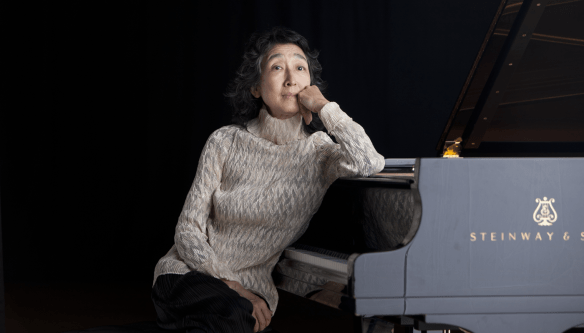
Jörg Widmann (clarinet, above – photo by Marco Borggreve) & Mitsuko Uchida (piano, below)
Wigmore Hall, Thursday 9th February, 2017
Brahms Clarinet Sonata in F minor Op.120/1 (1894)
Berg 4 Pieces for Clarinet and Piano Op. 5 (1913)
Widmann Fantasie for solo clarinet (1993)
Schubert Impromptu in C minor D899/1 (1827)
Widmann Sonatina facile (2016, UK première)
Schumann 3 Fantasiestücke Op.73 (1849)
Written by Ben Hogwood
The sound made by the clarinet is surely one of the most beautiful in classical music.
Yet, as Jörg Widmann reminded a packed Wigmore Hall when playing his Fantasie for solo clarinet, the instrument’s qualities extend far and wide. Widmann explored multiphonics – playing more than one note at once – and also used the clarinet to evoke a lilting Alpine dance, some outrageous Gershwin-style slides and baleful, shy asides as though he was the only performer in the room.
Widmann has been chosen as the Wigmore Hall’s Composer in Residence for 2017-18. It is a chance to appreciate his versatility, for clarinet pieces are one side of a substantial catalogue. He has written for solo piano, but although Mitsuko Uchida’s UK premiere performance of the Sonata facile was superbly characterised, it was not as successful musically. Widmann takes Mozart’s Piano Sonata in C major, K545, as a starting point, but he effectively screws up the pages of the work, distorting and fragmenting so that they did not quite add up to a meaningful whole.
Far more purposeful was Uchida’s performance of Schubert’s first published Impromptu, where we explored the composer’s very heart through an interpretation that had the hall on the edge of their seats. The repetitive march theme was darkly coloured, but the transition from minor key to major brought brilliant shafts of light under Uchida’s quick fingers.
When the two musicians played together the results were electric. In spite of a mobile phone that rang for more than a minute, and a hearing aid that shrilled in close proximity to the pitch of Widmann’s clarinet, their Brahms was beautifully poised. The Clarinet Sonata in F minor Op.120/1 is a late, nocturnal treasure, its tension giving way to an autumnal glow in exchanges between the instruments that behave as though they are old friends. This performance caught that intimacy, especially in the slow movement, and enjoyed the dance of the finale with a spring in its step.
Schumann’s 3 Fantasiestücke faired similarly, closing the program wreathed in smiles, despite the occasional furrowed brow in the first piece. Here the interaction was again on the most intimate of scales, Widmann’s control exquisite in the slower music and matched by Uchida’s voicing of the individual parts.
Even better was the duo’s performance of Berg’s 4 Pieces for Clarinet and Piano, a relatively early publication from 1913 that explores the outer limits of tonality. The mysterious second piece had an extraordinary inner tension, fully released in a flurry of notes, while the last piece, also slow, hung on the air for an age.
Widmann’s control here was almost superhuman, and although he admitted to being out of breath after the Schumann, he and Uchida gave a substantial encore by the 14-year old Mendelssohn. The graceful second movement from his Clarinet Sonata sounded like the work of a much older man, and was lovingly played.
Violinist Tasmin Little is a cherished English violinist, loved for her interpretations of the classics in the repertoire but also for her pioneering work in ensuring less heard British works for the instrument get their due. More recently she has championed the worth of classical music education, and ensuring classical music is promoted to those who do not often hear it.
Her strong relationship with Chandos Records has yielded a number of high quality recordings, among them a recent release of Beethoven’s complete sonatas for violin and piano with Martin Roscoe. She gave generously of her time in this recent interview, talking with characteristic enthusiasm about Beethoven, Yehudi Menuhin, the importance of musical education – and how to stop those aches and pains violinists so often get!
Can you remember your first encounters with classical music?
The answer is no…because it was probably while I was inside the womb! Neither of my parents is a classical musician, but they love classical music and my father was an actor who sang. There was always music in the house, and they had very broad taste, so I remember Blood, Sweat & Tears and The Beatles in particular. I grew up with the whole range, including the genre of musicals as I grew up. It was the same as talking, listening to music!
How did you develop a love of the violin?
As part of my parents’ record collection they had some violin concertos. I used to listen to them and as I got older, say five or six years old, I began to know what some of the instruments were. I loved the violin especially, and then the piano. My sister began to learn the violin, but it was a disaster and I thought it would be a disaster if I tried too! We begged her to give up, and as a result she is now a visual arts star!
When I was seven I fell ill with chicken pox and I hit on the idea of teaching myself the recorder while I was ill in bed. I did that, and loved it. So when I got better I had piano lessons – and then I thought I would learn the violin.
What experience of playing Beethoven did you have prior to recording the sonatas?
I’ve played Beethoven for years and year, as a student at the Yehudi Menuhin school, where I played it in string quartets and tackled some of the violin sonatas. They are difficult, so I didn’t play them until my early teens – probably the Spring Sonata first. The more complex works such as the C minor sonata I left until later, and then the big mountain, the Kreutzer Sonata, I tackled when I was 21.
Tasmin with her accomplice in the Beethoven sonatas, pianist Martin Roscoe
“Of course when you play these works you need a really good pianist, and it wasn’t until we were at least in our teens that we could cover this music. I’ve been playing some of the sonatas for 30 years, others for 20-25 years, so I’ve known them for a long time. It is really important with works of this nature and complexity, and works that are well recorded to have mature thoughts on them.”
The Violin Concerto I have known since I was 21, and it has been in my repertoire for a long time. More recently I also learned the Triple Concerto, which I recorded with Howard Shelley and Tim Hugh, but it is the Violin Concerto that I completely adore. One of the earliest recordings I had was made by Zino Francescatti, that I have listened to and played into the ground.
Was it daunting recording the sonatas?
I always wanted to record this repertoire, as it is the big mountain of violin and piano repertoire. The violin sonatas by Mozart are a bit more juvenile, whereas with the Beethoven sonatas they are all of such quality you need comparable maturity and sophistication to play them. I took a deep breath before doing the sessions! We did the first five, working fast, in three days – and we felt we were on such a role, Martin and I. Then six months later we finished off the remaining five. It was good to do it like that, otherwise we would have suffered a hit in quality. There was a feeling of momentum.
To begin with in the sonatas they are spring-like, but then that all starts to change. The A minor work, Op.23, is quite a nervy piece but still can’t resist a few jokes. The C minor sonata, Op.30 no.2, is a steely work from start to finish, there is no let up in the drama or intensity. The Kreutzer Sonata is another dimension removed from that, it is an incredibly complex piece. He thinks of it as a concerto for both players, and that’s how it has to be represented. We each represent the orchestra if you like, there are times when he has the fire, and I am in battle against him and his orchestra.
With the ten works covering each period of Beethoven, do you feel like you’re really getting to know him as you progress through each work?
It’s actually misleading, because nine of the sonatas were written in a small space of time, within two years of each other. Then there is a long pause before the last work, Op.96. They are not so representative of the different periods in his output, and that’s why, unlike Mozart, you have this tremendous consistency, within that, he was such a master of so many different styles.
With the equal billing for piano and violin in the Beethoven sonatas, does it help that you have such a good understanding with Martin Roscoe?
Definitely. Beethoven actually puts the piano before the violin in his title pages, it says Sonata Für Pianoforte und Violine – so he considers them piano sonatas with the violin. Because of that I felt strongly that Martin should have lead billing on the cover for this release.
You have got to have someone who is capable of mastering the strength of these pieces, but also the subtlety of colours and the sophistication, mastering the great tunes. You need someone who knows how to play a great tune without being fussy. That’s one of the great strengths of Martin’s playing.
Do you think the sonata recordings are a nice balance to the English music that you’ve recorded?
Absolutely, it is very important to have a balance. I know I’m well known for promoting British music – and there is so much wonderful music that comparatively few people are promoting. I love the standard repertoire too though – Beethoven, Brahms and Tchaikovsky – and I enjoy playing them in concerts.
What is lovely about the relationship I have with Chandos is their support of those aspects of my recording, they don’t try to box me in. The recordings have been varied, with British repertoire but also with the works by Schubert, Richard Strauss and Respighi that I have recorded recently – that’s quite a range. It gives me a much more interesting balance.
You were taught by Yehudi Menuhin as part of your education. What would you say he left as a legacy for violinists?
I would say he left us so much. From a practical point of view he commissioned so many works, to think of just a few those by Bartók, Walton and Panufnik. He also was very much interested in bringing to people’s attention other composers such as Delius. He was very good at communicating, and he used his abilities to bring these to the public.
I also think he was one of the first genuine crossover artists, thinking of his work with Stéphane Grappelli, Ravi Shankar and world music. He made it acceptable to work in different genres, it was fine because he was doing it. He was a great teacher – he founded the school I went to – and he also used his position politically to bring people together. In addition to what he left as a violinist he was trying to use his position to unite conflict – and he did this in the House of Lords, through his work as a conservationist and humanitarian.
You’re also judging the Yehudi Menuhin competition. Given all that you’ve done for music education and youth, is it important for you to be putting something back into this level?
I was at a state primary school in the 1970s, and music had a high position in the curriculum. There was a full time violin teacher, and if there hadn’t have been I would not have started. Because there was, and because music was so high on the governmental agenda, all these things were possible.
That is why it is so important to keep lobbying to make sure that gifted people do not fall through the net. I have given two speeches to the House of Commons and the House of Lords about this, and have written letters about it to them as well.
On another tip entirely, do you suffer from aches and pains as a violinist?
The violin is such an unnatural playing position, horrendously so! You have the full weight on one shoulder, and because of that I do work hard keeping shipshape – I have massages and treatments. I have had a few problems so far but I think generally I have been lucky. You have to take care, as it’s a great physical input as well as emotional and intellectual.
Finally, what violin concertos would you suggest to someone who hasn’t heard any before?
There are two that spring to mind. The first is the Mendelssohn, which is a sparkly, light piece. The second is the BruchViolin Concerto no.1, the one that I get asked to play the most. It is dark, mysterious and very romantic!
For those who have already heard a few violin concertos I would suggest the one by Glazunov, which I absolutely love!





 Providing a rather lovely contrast was the Violin Concerto in G major from Michael Haydn, Franz Joseph’s older brother. Often the poor musical relation of the family, he nonetheless wrote some fine works himself, particularly in the choral field, with memory recalling a fine Requiem performed relatively recently by the King’s Consort at the BBC Proms.
 Far more purposeful was Uchida’s performance of Schubert’s first published Impromptu, where we explored the composer’s very heart through an interpretation that had the hall on the edge of their seats. The repetitive march theme was darkly coloured, but the transition from minor key to major brought brilliant shafts of light under Uchida’s quick fingers.

 Arcana.fm