CBSO Soloists [Kate Suthers and Bryony Morrison (violins), Amy Thomas (viola), Miguel Fernandes and Helen Edgar (cellos)]
CBSO Centre, Birmingham Thursday 10 February 2022 2pm
Written by Richard Whitehouse
Just one work in this afternoon’s Centre Stage but, given this was Schubert’s String Quintet, no-one could complain of being short-changed. Music, moreover, that has featured regularly in recitals given by members of the City of Birmingham Symphony Orchestra over the years (not least the first live performance for this reviewer, given at the Birmingham and Midland Institute in the early 1980s as the second half of an imposing programme which opened with Brahms’s First Sextet) and that remains an emotionally involving experience like few others.
Pacing this work so its textural richness is allowed full rein without any loss of momentum is at least half the story, not least an opening movement whose contrasting themes need to find expressive accord from the outset. The present account succeeded handsomely in this respect, not least by varying the balance between these themes in the repeat of the exposition, and if the development marginally lost focus in its earlier stages, the heightened lead-back into the reprise brought an emotional frisson almost matched by the stark conclusiveness of the coda.
Whether or not the finest movement as to actual content, the Adagio is often the highlight of a performance – those outer sections shot through with a yearning regret which was tangibly in evidence. While the central episode could have been even more agitated, the spellbinding transition into the initial music was unerringly judged. Nor was anything amiss in the contrast between the Scherzo and its trio; the former bracingly impetuous, the latter inwardly fatalistic (and making the most of those rapturous two-cello sonorities) without ever becoming turgid.
If the finale often feels anti-climactic, this is not because of its relative concision but through an inherently Viennese ingratiation as was rightly played down in preference for a rhythmic forthrightness maintained through to a close that conveyed defiance as much as decisiveness. It duly set the seal on an impressive reading as drew an enthusiastic response from the near-capacity house. Hopefully an equally sizable attendance will be in evidence for next Friday evening’s recital, featuring Bach and Piazzolla, which comes courtesy of El Ultimo Tango.
You can read more about that next Centre Stage recital, and book tickets, on the CBSO website
Schubert Mignon (Kennst du das Land) D321 (1815), Gesänge aus Wilhelm Meister D877: Heiss mich nicht reden; Nur wer die Sehnsucht kennt (1826) Clara Schumann Er ist gekommen Op. 12 No. 1 (1841); Sie liebten sich beide Op. 13 No. 2 (1842); Lorelei (1843) Robert Schumann Lieder und Gesänge aus Wilhelm Meister Op. 98a: Kennst du das Land (1849) Duparc La vie antérieure (1884); L’invitation au voyage (1870) Lili Boulanger Clairières dans le ciel (1913-14): Si tout ceci n’est qu’un pauvre rêve; Je garde une médaille d’elle; Vous m’avez regardé avec toute votre âme Debussy Les soirs illuminés par l’ardeur du charbon (1917); 5 poèmes de Baudelaire (1890): Le jet d’eau; Recueillement; La mort des amants
Wigmore Hall, London, 17 January 2022
reviewed by Ben Hogwood from the online broadcast
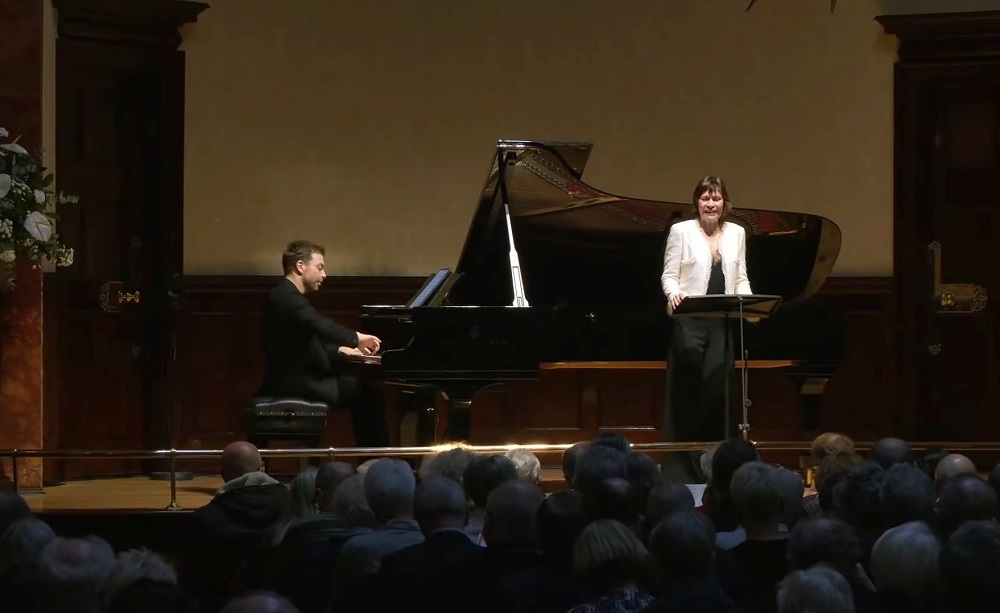
It was heartening indeed to see the Wigmore Hall at capacity for the visit of soprano Sandrine Piau and pianist David Kadouch, bringing with them a new program with the theme of Journeys: Longing and Leaving.
They delivered the songs in two ‘halves’, one of German Lieder drawn from the first half of the 19th century, the other of French song from the late 19th and early 20th centuries, giving us a smooth trajectory from Schubert to Debussy.
Refreshingly the journey took in substantial contributions from Clara Schumann and Lili Boulanger, three songs from each – as well as showing the increasing influence of Wagner on even the smallest forms of vocal music as the century turned.
Singing from a tablet, Sandrine Piau gave heartfelt performances and had the ideal foil in David Kadouch, whose brushstrokes on the piano were immediately telling. His chilly introduction to the third song in the Schubert group, Nur wer die Sehnsucht kennt, set the tone after a characterful first song and a sorrowful second, with a soaring vocal line from the soprano. Piau sang with arms outstretched, expressively capturing all the ornamentation and hitting the depths of the song’s turbulent middle section.
The Clara Schumann selection was fascinating, especially given the context of husband Robert’s well-known productivity in the years 1841-1843. The urgent Er ist gekommen was first, a heady song sitting high in the range, before a setting of Heine from just after Schumann’s celebrated year of song, a yearning and ultimately tragic number with a limpid commentary from the piano. The Loreley started in the same key, pushing restlessly forward. The only Schumann song in the program retained its intensity despite a noisy mobile phone introduction, a very different setting to the same text as tackled by Schubert at the start.
Turning to France, we heard two from the small output of Henri Duparc, whose entire output barely covers the length of a single concert. There is quality rather than quantity, however, and we heard the celebrated L’invitation au voyage, sumptuously performed with great poise. The two found the ideal pacing for La vie antérieure before it, solemn but quite open, and building to a powerful declamation.
Lili Boulanger wrote powerfully original music before her tragic death at the age of 24. Her orchestral tone poems have received greater exposure of late but the songs have remained relatively hidden. Piau and Kadouch put that to rights with three songs drawn from the wartime collection Clairières dans le ciel. They found an ominous tone in the lower vocal register from Piau, all the more so given the retrospective knowledge that Boulanger would only live for another three years from when the songs were written. The pained complexion at the end of Si tout ceci n’est qu’un pauvre rêve from Piau was profoundly affecting, then a slightly more optimistic Je garde une médaille d’elle led to the purity of Vous m’avez regardé avec toute votre âme.
Finally a selection from Debussy, prefaced by his final published piano piece Les soirs illumines par l’ardeur du charbon. This was a nice touch as an interlude, and was beautifully played. by Kadouch, We then heard three of the five Baudelaire poèmes, beginning with a babbling fountain shaded by Kadouch as Piau’s voice floated easily above. Recueillement (Meditation) found stillness initially but with the poet, distracted by darker thoughts, was mirrored by the music breaking from its reverie. Piau judged the awkward intervals perfectly, especially the final words with their harmonic transformation. The ultimate farewell was saved for last, La mort des amants quite a complex song. As with much early Debussy the harmonies travelled far but arrived at a strangely logical end point, both performers exhibiting exceptional control at journey’s end.
Piau spoke of the program giving ‘therapy after these two long years’, after which Beau Soir – one of Debussy’s celebrated songs – proved the ideal encore, though as the soprano warned, it was essentially saying, “Look at these beautiful things, because everybody goes in the same direction – death!”
Bach Prelude and Fugue no.8 in E flat minor / D sharp minor BWV853, Prelude no.14 in F sharp minor BWV883; Fugues – no.1 in C major, BWV846; no.5 in D major, BWV874; no.21 in B flat major, BWV866; no. 22 in B flat minor BWV867 Beethoven Adagio cantabile Op.13/2 Chopin Waltz no.7 in C sharp minor Op.64/2 Massenet Élégie Op.10/5 Mendelssohn Lieder ohne Worte in E major Op.30/3 Rachmaninov Prelude in C sharp minor Op.3/2 Schubert Ständchen D957/3 Schumann Träumerei Op.15/7 Villa-Lobos Bachianas Brasileiras no.9 W449
São Paulo Symphony Choir / Valentina Peleggi
Naxos 8.574286 [58’32”] English and Portuguese translations included
Recorded: 5-10 August 2019 at Sala São Paulo, Brazil
Written by Richard Whitehouse
What’s the story?
Naxos’s coverage of the music of Heitor Villa-Lobos (part of this label’s series The Music of Brazil) continues with a selection of mainly transcriptions from the piano repertoire that the composer undertook during the mid-1930s as part of his extensive educational commitments.
What’s the music like?
Almost all these arrangements emerged in the period 1932-5, when Villa-Lobos took on the challenge of overhauling music education in the public school system of Rio de Janeiro. This involved the creation, virtually from scratch, of a choral pedagogy that he drew from across the spectrum of Baroque, Classical and Romantic music. It is a measure of his prowess that such transformation from mostly piano sources was accomplished with unfailing rigour and an idiomatic quality, so the fame of the originals is almost the only clue to their provenance.
From the soulful strains of among the most mellifluous from Mendelssohn’s Songs without Words, the programme then continues with the Eighth Prelude and Fugue from the first book of Bach’s The Well-Tempered Clavier – the former piece summoning a plangently rhetorical response which finds pertinent contrast with the latter piece’s methodical and intricate build-up to a culmination of sombre eloquence. The arrangement of Dreaming from Schumann’s Scenes from Childhood fully conveys its wistful pathos, as does that of the First Fugue from Bach’s WTC the original’s cool elegance. Similarly, the last of Schubert’s Serenade settings loses little of this song’s plaintiveness, and the Twenty-First Fugue from Bach’s WTC takes on unexpected jauntiness in what proves one of Villa-Lobos’s most inspiriting re-creations.
Chopin’s Waltzes might be considered unsuited to the vocal medium, yet the C sharp minor responds ably to such elaboration, as too the ruminative calm of the Twenty-Second Prelude from Bach’s WTC. Rachmaninov might have thought better of his Prelude in C sharp minor had he encountered this uninhibitedly dramatic realization, with basses providing the baleful anchorage, in contrast to the yearning aura drawn from the Fourteenth Prelude of the second book from Bach’s WTC. Massenet’s Elegy exceeds the original song for bittersweet poise, a foil to the serenity of the Fifth Fugue from Bach’s WTC. The indelible main melody from the Adagio of Beethoven’s Pathétique segues ideally into the Ninth Bachianas Brasileiras, with Villa-Lobos’s choral incarnation rather more atmospheric and evocative than that for strings.
Does it all work?
Almost entirely and due in no small part to the excellence of the São Paulo Symphonic Choir with its Italian conductor Valentina Peleggi. Lasting just under 60 minutes, the selection feels varied yet also cohesive enough to be enjoyed as a continuous programme, while enterprising choirs from both sides of the Atlantic ought to find much here to enrich their existing rosters. Inclusion of Villa-Lobos’s own music at the close is a reminder its technical demands should never be taken for granted, but here too the SPSC rises to the challenge with unstinting verve.
Is it recommended?
It is. The acoustic is just a little reverberant at times yet without detriment to the clarity of the choral writing, with informative annotations from Manoel Corrêa do Lago. Listeners should also investigate a recent Naxos release of Villa-Lobos’s first three violin sonatas(8.574310).
Listen
Buy
You can discover more about this release at the Naxos website, and you can also purchase the recording here. You can read more about conductor Valentina Peleggi here
At 1pm on Monday June 1st, live music-making returned to the Wigmore Hall and BBC Radio 3.
While we have been incredibly fortunate to enjoy live streams of music from around the world since lockdown began, this felt like something extra special. A whole month of lunchtime concerts, served up by our finest chamber music venue in conjunction with BBC Radio 3, and streamed on the Wigmore Hall website. With a selection of top class artists, all of whom live close enough to journey in and play, all that was missing was the audience – but this added extra poignancy, offering us private moments with the musicians in our own home, a deluxe version of what BBC Radio 3 has been giving us for decades. A note should be made for presenter Andrew McGregor‘s broadcasting manner, expertly paced and perfectly weighted.
The musical riches in the first week have been many and varied. The first concert was ideally placed, Steven Hough giving us Busoni’s epic realisation of Bach’s Chaconne in D minor and Schumann’s lovelorn Fantasie in C major. In some performances of the Bach-Busoni the virtuoso elements of the piece take over at the expense of feeling, but not here. Hough shaped the phrases with great care, bringing out the gusto when it was needed but giving an incredibly well-balanced account of a familiar showpiece.
With Schumann’s Fantasie he gave a flowing performance of a notoriously difficult work, made all the more poignant because of its circumstances, written in isolation by a composer pining for his wife Clara. There was joy, too – the march theme of the second movement ringing out with bell-like clarity, while the resolution at the end, softly voiced, left a lasting smile.
Tuesday’s song recital from soprano Lucy Crowe and pianist Anna Tilbrook had the themes of Hope and Longing – appropriately in the awful context of world events, which saw the concert begin with a two-minute period of reflection on racial inequality and violence.
Crowe began on high, judging her vibrato beautifully for Thomas Arne’s aria O ravishing delight, before three Schumann songs found her vocal control matched by her communication with the audience, in spite of the empty hall. The sound world of Berg’s 7 frühe Lieder is very different, with challenges of tricky melodic intervals and words by seven different poets, but the soprano handled them effortlessly, helped by Tilbrook’s painterly application of light and shade for the corners of Berg’s nocturnal settings.
The pair moved on to a selection of poignant folk songs, none more so than the unaccompanied She moved through the fair, before English lyrics old and new from Thomas Dunhill, Ivor Gurney, Vaughan Williams and Madeline Dring. It was a touching recital with both soprano and pianist clearly on the same page.
Few guitarists would expect to receive compliments on the quality of their quiet playing…but that was what stood out immediately from Sean Shibe’s solo recital on the Wednesday. With a collection of attractive Scottish dances the listener was drawn in from the start and borne to the beauty of the Highlands, the tunes carrying on the air in performances of extraordinary intimacy.
The same could be said for Shibe’s performance of Bach’s Lute Suite in E minor, carefully studied but delighting in the expressive interplay between the parts, bringing Bach’s notes clean off the page. Steve Reich’s Electric Counterpoint was even better, Shibe moving to a Fender to play the 12th part of this multilayered composition. The waves of sound echoing around the Wigmore as the guitarist, now barefoot, completely lost himself in the music.
Oboist Nicholas Daniel and pianist Julius Drake, both Wigmore regulars and musical partners for 40+ years, crammed their Thursday lunchtime with music old and new, all of personal significance.
They included two short premieres, the wide open textures of Huw Watkins’ haunting Arietta and the uncertainties of Michael Berkeley’s A Dark Waltz, written in lockdown. There was a rarity,too, in the first broadcast performance of Liszt’s darkly coloured Élegie, originally written for cello and piano but here in a recently unearthed version with for cor anglais.
Howard Ferguson’s arrangement for oboe and piano of Finzi’s substantial Interlude was beautifully paced and deeply felt in that slightly elusive way in which the composer writes, Drake absorbing the extra parts with ease. Meanwhile Ferguson’s arrangements of three pieces for pedal piano by Schumann studies were also nicely done. Later we heard three attractive shorter pieces from Madeline Dring, and finally Nicholas Daniel showed off the oboe’s versatility in three rewarding arrangements of popular songs, including The Girl From Ipanema and capped by All The Things You Are. A note, too, for the pair’s deeply felt and beautifully observed Bach encore, Jesu, Joy of Man’s Desiring, prefaced by a sensitive introduction.
Last but not least, Pavel Kolesnikov and Samson Tsoy reminded us what an intimate form of communication the piano duet can be. As the pair live together they have experienced isolation in each other’s company, and that in itself brought an extra poignancy to their lovingly played selection of Brahms’ Liebeslieder Waltzes, a profound SchubertImpromptu in A flat from Tsoy and a bittersweet clutch of six Waltzes, Ländler & German Dances from Kolesnikov.
Together the pair enjoyed the humour and lightness of touch in Beethoven’s 8 Variations on a theme of Count Waldstein, but the best was saved for last and a wonderful performance of Schubert’s Fantasia in F minor. Recognised as one of the finest works in the piano duet repertoire, it received a performance led by Tsoy that moved from almost painful introspection to passionate outbursts five minutes later. The scherzo section had plenty of cut and thrust, while the whole piece, ideally paced, built to an almost overwhelming strength of feeling, capped by an intensely dramatic pause before the softly voiced opening theme returned.
What a musical week it has been – and looking at the roll call it looks like we are in for another three weeks of equally fine and moving insights. You can catch up with all the concerts on the links above and are strongly advised to do so, for there are some incredibly fine performances waiting to be heard. Live concerts may not be with us for a while yet, but in the meantime these intimate hours with some of our best classical music artists are an ideal substitute.
You can see the schedule for forthcoming Wigmore Hall livestreams here, the series resuming courtesy of cellist Steven Isserlis and pianist Mishka Rushdie Momen on Monday 8 June.
Ruby Hughes (soprano, above), Natalie Clein (cello), Julius Drake (piano, both below)
Wigmore Hall, Monday 9 March 2020 (lunchtime)
You can listen to this concert on the BBC Sounds app here (opens in a new window)
Review and guide by Ben Hogwood
A fascinating hour of music for three instruments not often linked – soprano, cello and piano. Its imaginative programme comprised music by six composers from three different centuries using four languages! It made for a very satisfying whole.
Kodály’s single-movement Sonatina for cello and piano (1:41 on the radio broadcast) began the program. This is a work with which Natalie Clein and Julius Drake are very familiar, having recorded it for Hyperion in 2009, and they immediately found its expressive core. The Sonatina was initially intended for a Sonata the composer finished in 1909, but it happened to work particularly well on its own, and was completed later. Its colourful music – which has parallels to Debussy’s own Cello Sonata – is rich in melodic and harmonic content. Free in form, it speaks directly of the composer’s Hungarian heartlands. Clein’s tone was sumptuous in this performance and Drake’s piano exemplary, the two plotting a convincing course for the work.
This was followed without a break by three of John Tavener’s 6 Akhmatova Songs, written for soprano Patricia Rozario and cellist Steven Isserlis in 1993. In effect the cello is singing here too, its wordless line providing an otherworldly introduction for the third song of the six, Boris Pasternak (10:45). Clein’s rich sound was the ideal foil for the clarity of Ruby Hughes’ soprano. Couplet (12:48) was immediately more agitated, the gruff cello adopting a more questioning slant as it helped describe the poet’s suspicion about praise of her own work. Hughes, too, was more penetrating in her delivery. Finally Dante (14:23) grew outwards from the start, its expressive line shared between singer and instrumentalist.
Deborah Pritchard’s short but powerful Storm Song (16:46), a setting of text by Jeanette Winterson, was the last part of this unbroken first sequence. Premiered almost exactly three years ago, it was led by Hughes’ wide ranging but beautifully shaped melodic lines, soaring above the sinuous cello and piano as they descended into a powerful maelstrom at the song’s heart.
Debussy’s Chansons de Bilitis were next, three heady settings of words by Pierre Louÿs, initially claimed to be erotic works from Ancient Greece. They were in fact the poet’s own construction, a fact Debussy presumably knew. La flûte de Pan (23:02) immediately transported the listener to a sultry outdoor setting and a lovers’ tryst, given appropriately chromatic settings by the composer. Julius Drake provided a rich tapestry in Debussy’s piano writing, and the humid setting was enhanced by the slow, tolling bells of the introduction to La chevelure (25:50) Hughes, now lower in her range, cast the spell. Le tombeau des naïades (29:16) closed this deliberately elusive trio, and we were left feeling as though we were all in on a rendezvous that was not supposed to be happening!
On the palmy beach is a commission from Kings Place for Judith Weir, completed in 2019 for these three performers and watched here by the composer herself. A cycle of four themed songs, it takes encounters with the sea and its inhabitants as inspiration, setting four very different poems by Wallace Stevens, Kathleen Jamie, Norman McCaig and Emily Dickinson. Weir has blogged on how she initially intended to keep the two instruments in step with each other, but how it became ‘much more alluring to liberate the cello’. Presumably for copyright reasons, the text for only one of the four poems (the Dickinson) could be printed, which made the text more difficult to follow in spite of Hughes’ wonderful singing. Yet there was a great deal of communication through the music, for which Clein and Drake were equally responsible.
Clein soared towards the heights in the prologue to the setting of Stevens’ Fabliau of Florida (34:30), where foam and cloud are one, and gave a full-throated epilogue too. Weir’s use of the cello to depict a jellyfish in Jamie’s The Glass-hulled boat(38:23) was uncanny, humorous and strangely touching, the agile lines dovetailing with Hughes’ own words. Norman McCaig’s Basking Shark (42:08) was next, the broad cello line a counterpoint to Hughes’s vivid storytelling and only latterly joined by the piano. Finally the setting of Dickinson’s I started Early – Took my Dog – (656)(46:13) was compelling, the sea toying with the author before ultimately opting not to catch her up.
To conclude a unique concert we heard Schubert’s Auf dem Strom (50:57), written for Beethoven’s memorial a year after his death in 1828 and containing a quotation from the Eroica Symphony. Setting the poetry of Ludwig Rellstab, it was written for soprano with horn and piano accompaniment, the composer later adding an obbligato cello was just as valid instead of the horn. This was to our advantage, for it enabled Natalie Clein to project the phrases beautifully, setting the scene for Hughes’ subtly wrought grief. With eloquent playing from Drake, this felt rather like the slow movement of a Schubert piano trio, but with words – expressive and touching.
Repertoire
This concert contained the following music (with timings on the BBC Sounds broadcast in brackets):
Kodály Sonatina for cello and piano (1922, published 1969) Tavener Akhmatova Songs (1993) (excerpts) (10:45) Pritchard Storm Song (2017) (16:46) Debussy Chansons de Bilitis (1897-8) (23:02) Weir On The Palmy Beach (2019) (34:30) Schubert Auf dem Strom D943 (1828) (50:57)
Further listening & viewing
The works by Deborah Pritchard and Judith Weir have not been recorded yet, but you can hear available recordings of the works by Kodály, Tavener, Debussy and Schubert on the following Spotify playlist:
References to Natalie Clein and Julius Drake’s Kodály recordings of 2009 were unfortunately missed from the Wigmore Hall program. You can hear preview clips of their collection, including the Sonatina on the Hyperion website
The most recent collection of music by Judith Weir comes highly recommended. Airs from Another Planet is a collection of songs and chamber music, released on the enterprising Delphian label:
Meanwhile the music of John Tavener continues to enchant in a lasting way. While awareness of the composer centres all too often around his piece for cello and orchestra, The Protecting Veil, this collection of works for cello from RCA – nominated for the Mercury Music Prize in 1997 – has aged very well. It includes all six of the Akhmatova Songs, performed by dedicatees Patricia Rozario and Steven Isserlis:







 Arcana.fm