In appreciation – Maurizio Pollini

by Ben Hogwood. Picture (c) Matthias Bothor / DG

Yesterday we heard the sad news of the death of the great Italian pianist Maurizio Pollini, at the age of 82.

You can read a number of tributes to Pollini, by Barry Millington on the Guardian website and by HarrisonParrott, his agents.

Throughout his career Pollini recorded for Deutsche Grammophon, leaving a succession of remarkable recordings ranging from a famous early collection of the Chopin Etudes through to pioneering modern collections, with a landmark LP of works by Schoenberg and a 20th century collection of Stravinsky, Webern, Boulez and Prokofiev. The playlist below is a personal selection of favourites and a memory from seeing Pollini play Schumann‘s Fantasie in C major at the Royal Festival Hall.

Published post no.2,127 – Saturday 24 March 2024

In concert – Benjamin Grosvenor, CBSO / Riccardo Minasi: Schubert, Chopin & Mozart

Benjamin Grosvenor (piano), City of Birmingham Symphony Orchestra / Riccardo Minasi

Schubert Overture in C major ‘In the Italian style’ D591 (1817)
Chopin Piano Concerto no.2 in F minor Op.21 (1830)
Mozart Symphony no.41 in C major K551 ‘Jupiter’ (1788)

Symphony Hall, Birmingham
Thursday 1 June 2023 (2.15pm)

Reviewed by Richard Whitehouse

It is not often these days to have a whole concert of music from the late Classical and early Romantic eras, but that was just what the City of Birmingham Symphony Orchestra provided this afternoon under the disciplined as well as immensely assured direction of Riccardo Minasi.

There was no mistaking the inherent classicism of Chopin’s Second (sic) Piano Concerto – not least the simmering impetus in its opening Maestoso where, after a forthright tutti, Benjamin Grosvenor rendered those main melodies with requisite poise, and the emotional eddying of its development in direct contrast to the terseness of its coda. Most memorable was a Larghetto of melting eloquence but also, in its central episode, a volatility only gradually dispelled. Here, and in the final Allegro, the almost concertante role allotted to bassoon was characterfully taken by Nikolaj Henriques – as were those brass fanfares and col legno writing for strings (was this really Chopin’s idea?) which see the latter movement on its way to a spirited close. A limpid take on Chopin’s Nocturne in C sharp minor from the same year made for an appropriate encore.

Mozart symphonies rarely conclude a programme nowadays, yet the last four are ideal for this purpose and none more than the Forty-First – by some distance the weightiest and the most physical such work prior to Beethoven’s Eroica. This was the highlight of Minasi’s recording of the final triptych (Harmonia Mundi), with the opening Allegro likewise a statement of intent in its rhythmic tensility and general bravura, though its more ambivalent asides were never downplayed. Less distinctive melodically than its two predecessors, the Andante is memorable for its expressive understatement and a subtlety – with wind and strings enfolded into a textural continuity – that accentuates its pathos. Nor was there any lack of suavity in the Menuetto, its outer sections finding ideal contrast with a trio whose pert expectancy was delectably pointed.

The final Allegro crowns this work in every respect and, here again, Minasi did not disappoint. Not that there any sense of merely ‘going through the motions’ with his inclusion of first- and second-half repeats, each of which brought added intensity to what had gone before as well as enabling the wealth of contrapuntal detail to come through as it too rarely does. For its part the CBSO more than rose to the challenge, not least in a coda whose methodical combining of this movement’s themes makes possible an apotheosis such as felt truly visceral in its affirmation.

Schubert evidently had other preoccupations when essaying his two overtures ‘in the Italian style’, both of which have fallen out of the repertoire this past half-century but which make for attractive and appealing curtain-raisers. Especially that in C major with its teasingly portentous introduction, jocular and lilting main themes, then coda which sees it through to an effervescent close. The CBSO players (woodwind in particular) audibly enjoyed making its acquaintance, and it would be a real pity were such pieces relegated to the lower reaches of today’s playlists.

Hopefully a performance such as that by Minasi will make this just a little less likely. One looks forward to his future collaboration with this orchestra, which returns next Wednesday with its chief conductor Kazuki Yamada in a programme featuring Holst, Beethoven and Rachmaninoff.

You can read all about the 2022/23 season and book tickets at the CBSO website. Click on the artist names for more information on Riccardo Minasi and Benjamin Grosvenor

Online Concert: Christian Poltéra & Kathryn Stott @ Wigmore Hall – Prokofiev & Chopin

Christian Poltéra (cello, above), Kathryn Stott (piano, below)

Prokofiev Cello Sonata in C major Op.119 (1949)
Chopin Cello Sonata in G minor Op.65 (1845-6)

Wigmore Hall, Monday 13 February 1pm

by Ben Hogwood

Christian Poltéra and Kathryn Stott are a long-established duo who have provided us with a richly rewarding discography including works by Fauré, Saint-Saëns, Barber and Schumann. Their encounters with Russian music appear to have been less frequent to date, and it was good to hear their poised account of one of the form’s most popular works. Ukrainian-born Prokofiev wrote his sonata, a late work, for Mstislav Rostropovich, who had impressed him with his larger than life playing. It is the first of a late burst of works for the instrument, including the Sinfonia Concertante, Solo Cello Sonata and Concertino.

Poltéra began the sonata with a solemn intonation on the lowest register of the cello, emphasising the ‘grave’ aspect of Prokofiev’s tempo marking rather than going for an epic sound. This thoughtful approach bore fruit in the slower sections, and with Stott an attentive partner there was plenty to enjoy in Prokofiev’s baleful writing, and impressive clarity in the more expansive passages.

The second movement danced attractively, tapping into Prokofiev’s ballet credentials, with some enjoyable exchanges between the two, if not always making the most of the composer’s frequently humourous asides. The third movement sang out more, Poltéra projecting further without losing any of his admirable control or intonation, and Stott getting to the heart of Prokofiev’s combination of percussive cut and thrust and soft-centred lyricism.

Chopin’s Cello Sonata came as something of a surprise to his fellow composers in the mid-1840s. Written for the French cellist Auguste Franchomme, it is a substantial work, which unsurprisingly asks a great deal of the pianist in a full-bodied, almost orchestral role.

Poltéra it was who led the first movement most impressively, with a consistently attractive sound singing subtly but meaningfully. Technically he is a superb cellist, with tone unflinching, but praise should be levelled at Stott’s ability to bring beautiful phrasing to even the most congested piano writing. The searching legato theme in the second movement was a case in point for the cellist, beautifully played with flowing piano figures. The lovelorn third movement was tinged with sadness, finishing lost in thought. The last movement showed determination to break from this soul searching, looking outward as it powered through to a major key finish.

This was an excellent performance, ideally balanced and capturing the right balance of regret and resolve – and was balanced by the encore, Saint-SaënsRomance in F major Op.42. A Monday lunchtime treat.

For more livestreamed concerts from the Wigmore Hall, click here

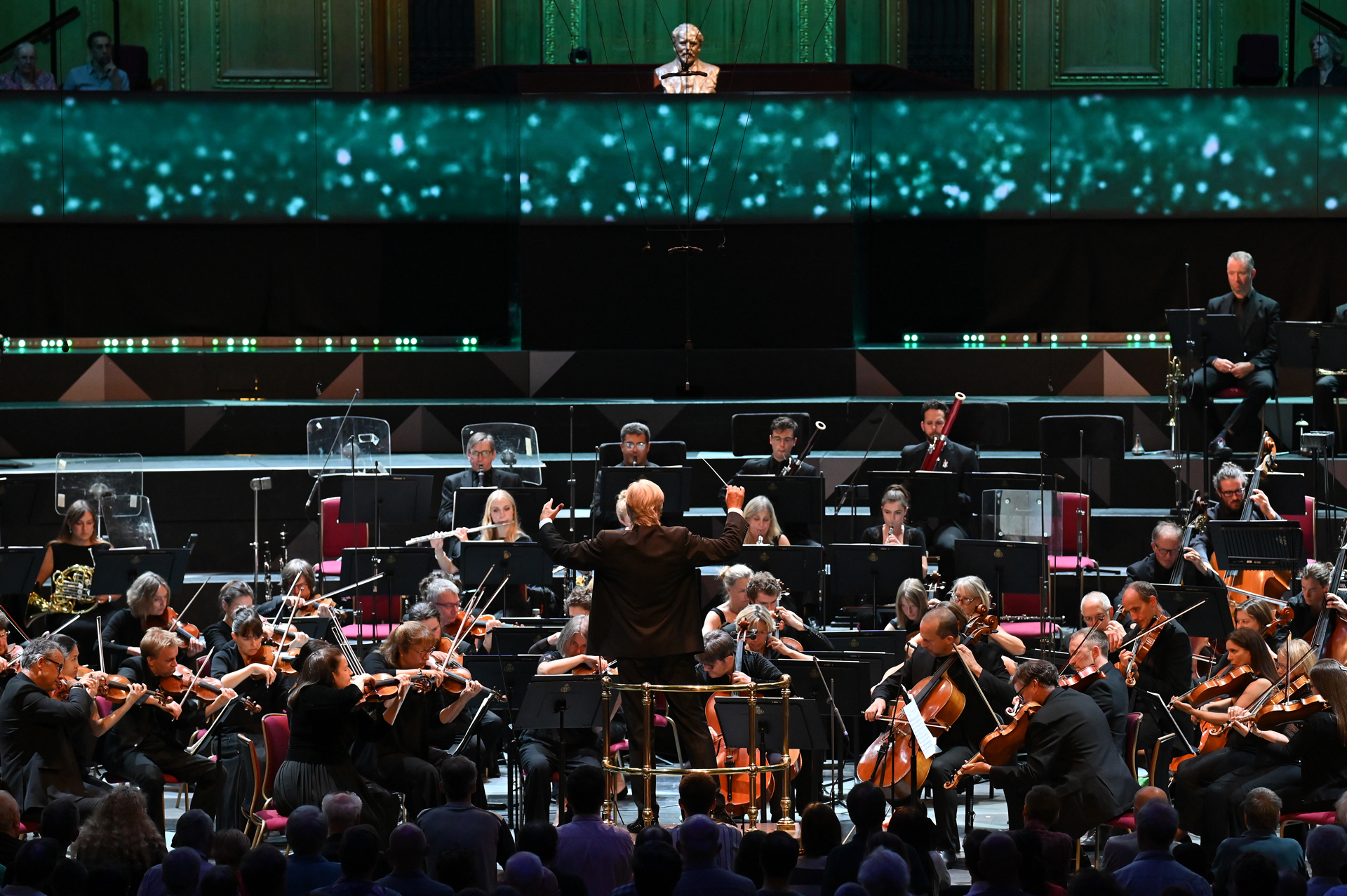
BBC Proms #42 – Jan Lisiecki, BBC Scottish Symphony Orchestra / Thomas Dausgaard: Nielsen, Beethoven & Sibelius

Prom 42 – Jan Lisiecki (piano), BBC Scottish Symphony Orchestra / Thomas Dausgaard

Sibelius Symphony no.7 in C major Op.105 (1924)
Beethoven Piano Concerto no.4 in G major Op.58 (1804-6)
Nielsen Symphony no.4 FS76 ‘The Inextinguishable’ (1914-16)

Royal Albert Hall, London
Thursday 18 August 2022

Reviewed by Richard Whitehouse Photos (c) Chris Christodoulou

Ending his tenure as Chief Conductor of the BBC Scottish Symphony Orchestra, Thomas Dausgaard directed this programme which once again played to both his and the orchestra’s strengths – in the process underlining just what they have achieved together over the past six seasons.

He might not have scheduled Sibelius quite so assiduously as his one-time predecessor Osmo Vänskä, but Dausgaard is hardly less perceptive in this composer as was proven with his take on the Seventh Symphony. If not a tale of two parts, the first half that resonated more deeply – an introduction shot through with expectancy that preceded a powerful build-up to the first emergence of the trombone theme, and an effortlessly accelerating ‘scherzo’ as made feasible a central climax of rare intensity. From here tension dropped a little over the course of a lucid yet (in this context) over-extended ‘intermezzo’, and if the approach to the final return of the trombone theme had the right inexorability, the strings’ climactic response was a little reined-in emotionally. Nor did the fraught cadence into the home-key have the desired inevitability.

Whether or not the Sibelius should open a concert, Beethoven’s Fourth Piano Concerto made for an ideal continuation. Stepping in at the eleventh hour, Jan Lisiecki is no stranger to this music such that his lightly articulated if rarely insubstantial tone complemented Dausgaard’s incisive but never headlong accompaniment. Just occasionally in the opening movement this jewel-like pianism felt a little self-defeating, though not with a lucid rendering of the (more familiar) cadenza or transition from the Andante into the finale of heart-stopping eloquence. The latter movement had the necessary vigour but also an appealing intimacy, as in the lower strings’ transition towards the final return of the rondo theme or those ruminative woodwind asides before the decisive coda. Chopin’s C minor Nocturne (1838) made for a limpid encore.

Keen to get on with proceedings, Dausgaard launched Nielsen’s Fourth Symphony after the interval before applause had subsided. Often a conductor willing to modify his approach, he might have steered the opening Allegro less forcefully given the textural detail that was lost in the Albert Hall’s ample expanse, but the twofold appearances of the ‘motto’ theme were magisterially rendered – the shocked transition into the intermezzo proving as mesmeric as this latter movement was affecting through its deft combination of winsomeness and pathos.

Equally memorable was Dausgaard’s handling of the slow movement, here exuding fervency without undue histrionics both in the searching string threnodies and the confiding passages either side – the latter of which provided a stealthy transition into the final Allegro. Here the placing of a second timpani set front-left in the arena made stretched the antiphonal contrast a little too obviously, but the music’s overall intent came across unscathed as the ‘motto’ made its climactic final appearance then those closing bars hit the ground as they should – running. Whether or not Dausgaard intended ‘Inextinguishable’ to sum up his music-making with the BBCSSO, or whether anything might be read into his wearing a Covid mask throughout, this concert was a worthy leave-taking. Hopefully he will not be absent from the UK for too long.

Click on the artist names for more information on Jan Lisiecki and Thomas Dausgaard, and for more information on the BBC Scottish Symphony Orchestra head to their website

On record – Villa-Lobos: Choral Transcriptions (São Paulo Symphony Choir / Valentina Peleggi) (Naxos)

villa-lobos

Villa-Lobos transcriptions of:

Bach Prelude and Fugue no.8 in E flat minor / D sharp minor BWV853, Prelude no.14 in F sharp minor BWV883; Fugues – no.1 in C major, BWV846; no.5 in D major, BWV874; no.21 in B flat major, BWV866; no. 22 in B flat minor BWV867
Beethoven Adagio cantabile Op.13/2
Chopin Waltz no.7 in C sharp minor Op.64/2
Massenet Élégie Op.10/5
Mendelssohn Lieder ohne Worte in E major Op.30/3
Rachmaninov Prelude in C sharp minor Op.3/2
Schubert Ständchen D957/3
Schumann Träumerei Op.15/7
Villa-Lobos Bachianas Brasileiras no.9 W449

São Paulo Symphony Choir / Valentina Peleggi

Naxos 8.574286 [58’32”] English and Portuguese translations included

Producer Ulrich Schneider
Engineers Marcio Jesus Torres, Camilla Braga Marciano, Fabio Myiahara

Recorded: 5-10 August 2019 at Sala São Paulo, Brazil

Written by Richard Whitehouse

What’s the story?

Naxos’s coverage of the music of Heitor Villa-Lobos (part of this label’s series The Music of Brazil) continues with a selection of mainly transcriptions from the piano repertoire that the composer undertook during the mid-1930s as part of his extensive educational commitments.

What’s the music like?

Almost all these arrangements emerged in the period 1932-5, when Villa-Lobos took on the challenge of overhauling music education in the public school system of Rio de Janeiro. This involved the creation, virtually from scratch, of a choral pedagogy that he drew from across the spectrum of Baroque, Classical and Romantic music. It is a measure of his prowess that such transformation from mostly piano sources was accomplished with unfailing rigour and an idiomatic quality, so the fame of the originals is almost the only clue to their provenance.

From the soulful strains of among the most mellifluous from Mendelssohn’s Songs without Words, the programme then continues with the Eighth Prelude and Fugue from the first book of Bach’s The Well-Tempered Clavier – the former piece summoning a plangently rhetorical response which finds pertinent contrast with the latter piece’s methodical and intricate build-up to a culmination of sombre eloquence. The arrangement of Dreaming from Schumann’s Scenes from Childhood fully conveys its wistful pathos, as does that of the First Fugue from Bach’s WTC the original’s cool elegance. Similarly, the last of Schubert’s Serenade settings loses little of this song’s plaintiveness, and the Twenty-First Fugue from Bach’s WTC takes on unexpected jauntiness in what proves one of Villa-Lobos’s most inspiriting re-creations.

Chopin’s Waltzes might be considered unsuited to the vocal medium, yet the C sharp minor responds ably to such elaboration, as too the ruminative calm of the Twenty-Second Prelude from Bach’s WTC. Rachmaninov might have thought better of his Prelude in C sharp minor had he encountered this uninhibitedly dramatic realization, with basses providing the baleful anchorage, in contrast to the yearning aura drawn from the Fourteenth Prelude of the second book from Bach’s WTC. Massenet’s Elegy exceeds the original song for bittersweet poise, a foil to the serenity of the Fifth Fugue from Bach’s WTC. The indelible main melody from the Adagio of Beethoven’s Pathétique segues ideally into the Ninth Bachianas Brasileiras, with Villa-Lobos’s choral incarnation rather more atmospheric and evocative than that for strings.

Does it all work?

Almost entirely and due in no small part to the excellence of the São Paulo Symphonic Choir with its Italian conductor Valentina Peleggi. Lasting just under 60 minutes, the selection feels varied yet also cohesive enough to be enjoyed as a continuous programme, while enterprising choirs from both sides of the Atlantic ought to find much here to enrich their existing rosters. Inclusion of Villa-Lobos’s own music at the close is a reminder its technical demands should never be taken for granted, but here too the SPSC rises to the challenge with unstinting verve.

Is it recommended?

It is. The acoustic is just a little reverberant at times yet without detriment to the clarity of the choral writing, with informative annotations from Manoel Corrêa do Lago. Listeners should also investigate a recent Naxos release of Villa-Lobos’s first three violin sonatas (8.574310).

Listen

Buy

You can discover more about this release at the Naxos website, and you can also purchase the recording here. You can read more about conductor Valentina Peleggi here